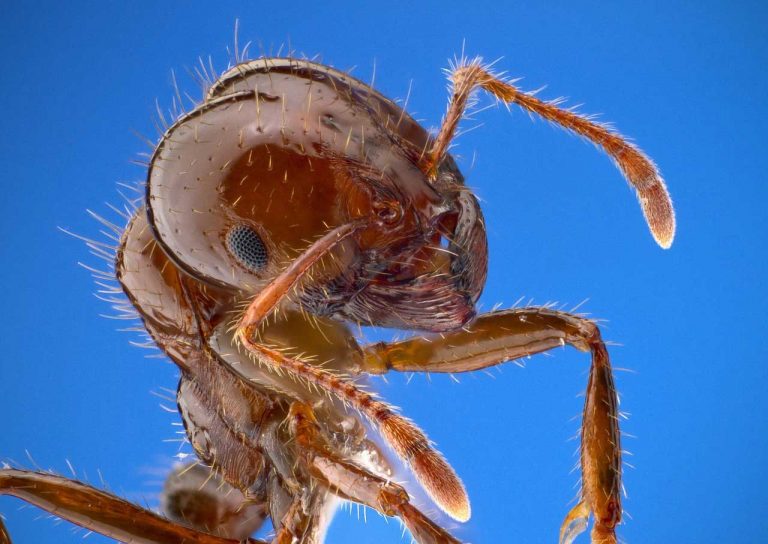
Insect Anatomy: The Body Parts of an Insect Explained
Quick answer: An insect’s body has three main parts: the head, which carries the antennae, compound eyes and mouthparts; the thorax, which carries six jointed legs and usually two pairs of wings; and the abdomen, which holds the digestive and reproductive organs and has tiny breathing holes called spiracles along its sides.
Insects are the most varied group of animals on Earth. Scientists have described about 900,000 species, and many more are still waiting to be named. Beetles, ants, butterflies, flies and crickets look very different, yet they share the same basic body plan.
Once you know that plan, you can tell an insect apart from a spider or a centipede in seconds. In this guide we use a cricket as our example, because its parts are big and easy to see.
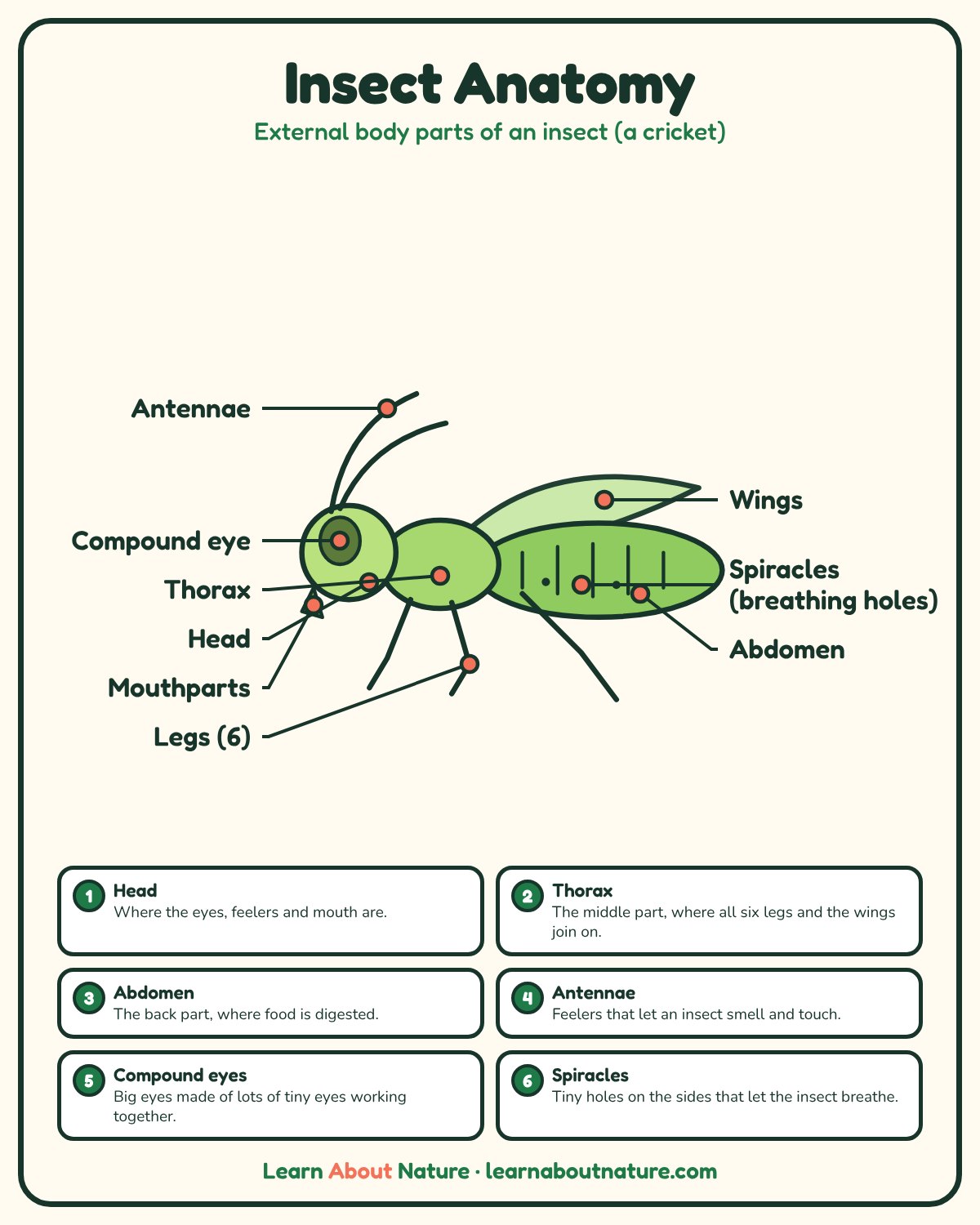
Teachers and students: you’re welcome to use this diagram in lessons and projects with credit to Learn About Nature.
Free printable: Download the Insect Anatomy labeling worksheet (PDF) – label the parts using the word bank. Answer key included.
Parts of a Insect and What They Do
| Part | What it does |
|---|---|
| Head | Holds the brain, eyes, antennae and mouthparts |
| Antennae | Smell, taste and feel the surroundings |
| Compound eyes | Many tiny lenses that detect shapes, colors and movement |
| Ocelli | Simple eyes that sense light and dark |
| Mouthparts | Chew, suck, pierce or lap up food, depending on the insect |
| Thorax | Middle section; holds the muscles for the legs and wings |
| Legs (6) | Walk, jump, dig, swim or grab |
| Wings | Let most adult insects fly; some use them to make sound |
| Abdomen | Holds the digestive and reproductive organs |
| Spiracles | Tiny holes that let air into the breathing tubes |
| Cerci | Feelers at the tail end that sense movement |
| Exoskeleton | Hard outer shell that supports and protects the body |
The Insect Body Plan: Three Parts, Six Legs
Every adult insect has a body in three sections: the head, the thorax and the abdomen. It also has six legs, all attached to the thorax, and a single pair of antennae.
Insects have no bones. Instead, a tough outer shell called an exoskeleton supports and protects the body. It is made largely of a material called chitin. Because the exoskeleton cannot stretch, a young insect has to shed it, or molt, several times as it grows.
The Head
The head is the insect’s control center, packed with sense organs and the brain.
- Antennae: a pair of jointed feelers that smell, taste and touch. A cricket’s antennae can be longer than its whole body.
- Compound eyes: two large eyes made of many tiny units, each with its own lens. Together they build up a picture that is very good at spotting movement.
- Ocelli: many insects also have up to three small simple eyes on top of the head that sense light and dark.
- Mouthparts: shaped to fit the diet. Crickets and beetles have chewing jaws called mandibles, butterflies have a sucking tube, and mosquitoes have piercing mouthparts.
The Thorax: Legs and Wings
The thorax is the insect’s engine room. It is made of three segments, and each segment carries one pair of legs. It is packed with strong muscles that move the legs and wings.
Each leg has several jointed sections, ending in a foot (the tarsus), often with tiny claws for gripping. Legs are shaped for the job: a cricket’s big back legs are built for jumping, a mantis has grabbing front legs, and a water beetle has flat, paddle-like legs for swimming.
Most adult insects have two pairs of wings attached to the second and third segments of the thorax. Beetles have hard front wings that cover the flying wings like a case. Flies have only one pair of flying wings. Some insects, like worker ants and fleas, have no wings at all.
The Abdomen
The abdomen is usually the largest section. It holds most of the digestive system and the reproductive organs. It is made of a row of segments that can stretch a little as the insect eats or fills with eggs.
Along the sides of the abdomen and thorax are tiny holes called spiracles. Many insects also have a pair of feelers called cerci at the tip of the abdomen. A female cricket also has a long, needle-like tube called an ovipositor that she uses to lay eggs in the soil.
Internal Anatomy: Inside an Insect
Insects do not breathe through their mouths. Air enters through the spiracles and travels through a network of branching tubes called tracheae, which carry oxygen straight to the cells.
An insect’s blood, called hemolymph, is usually clear, green or yellowish rather than red, because it does not carry oxygen the way our blood does. A long tube-shaped heart along the back pumps it forward, and it then flows loosely around the organs. This is called an open circulatory system.
Food passes from the mouth through a crop, where it is stored, into a midgut, where it is digested. Thin tubes called Malpighian tubules clean waste from the hemolymph. The main nerve cord runs along the belly side of the body, not the back as in our spine.
Insect Senses
Insects sense the world in ways that can seem strange to us. Many can see ultraviolet light, which is invisible to people. Tiny hairs all over the body feel touch and air movement.
Insect ears turn up in surprising places. A cricket’s ears are small drum-like patches on its front legs, just below the knee. Some moths have ears on the thorax, and grasshoppers have them on the first segment of the abdomen.
Insects vs Spiders
Spiders are often called bugs, but they are not insects. They belong to a group called arachnids. A spider has two body parts instead of three, eight legs instead of six, no antennae and no wings. Most spiders also have simple eyes rather than compound eyes.
Insects and spiders are both arthropods, however. That means they share a hard exoskeleton and jointed legs, which is why they look a little alike.
Fun Facts About Insect Bodies
- Male crickets chirp by rubbing a ridged vein on one front wing against a scraper on the other wing.
- Some dragonflies have compound eyes with tens of thousands of lenses.
- Because insects breathe through tubes rather than lungs, the oxygen supply limits how big they can grow.
- Insects were the first animals to fly. They took to the air more than 300 million years ago, long before birds, bats or flying reptiles.
Insect Anatomy for Kids
- Head: where the eyes, feelers and mouth are.
- Thorax: the middle part, where all six legs and the wings join on.
- Abdomen: the back part, where food is digested.
- Antennae: feelers that let an insect smell and touch.
- Compound eyes: big eyes made of lots of tiny eyes working together.
- Spiracles: tiny holes on the sides that let the insect breathe.
Key words: thorax – the middle section of an insect, where the legs and wings attach; abdomen – the rear section of an insect’s body; exoskeleton – a hard outer skeleton that covers and protects the body; spiracle – a small breathing hole on the side of an insect’s body; compound eye – an eye made of many small units, each with its own lens; molt – to shed the old exoskeleton so the insect can grow.
Try this: Build an insect from three balls of modeling clay for the head, thorax and abdomen, then add six pipe-cleaner legs to the thorax and two antennae to the head. Check: are all the legs on the middle section?
Related Guides
- Beetle life cycle
- Ant Anatomy
- Bee Anatomy
- Butterfly Anatomy
- Grasshopper life cycle
- Cockroach life cycle
- All animal & plant anatomy diagrams
- Animal & plant life cycles
Insect Anatomy FAQs
What are the 3 main body parts of an insect?
Every adult insect has a head, a thorax and an abdomen. The head carries the eyes, antennae and mouthparts. The thorax carries the six legs and the wings. The abdomen holds the digestive and reproductive organs and has breathing holes called spiracles.
How do insects breathe?
Insects breathe through small holes called spiracles along the sides of the thorax and abdomen. Air flows into a branching network of tubes called tracheae, which carry oxygen directly to the body’s cells. Insects do not have lungs, and their blood does not carry oxygen the way ours does.
Do all insects have wings?
No. Most adult insects have two pairs of wings, but some have only one pair, like flies, and some have none, like fleas, silverfish and worker ants. Young insects such as caterpillars and nymphs do not have working wings yet.
Why is a spider not an insect?
A spider has two body parts instead of three, eight legs instead of six, and no antennae or wings. That places it in a different group called arachnids. Spiders and insects are related, though, since both are arthropods with an exoskeleton and jointed legs.
Where are a cricket’s ears?
A cricket’s ears are on its front legs, just below the knee joint. Each ear is a thin, drum-like patch called a tympanum that vibrates when sound hits it. Crickets use them to hear the chirping songs of other crickets.
Sources: Insect Anatomy – Museum of the Earth (Paleontological Research Institution); Numbers of Insects (Species and Individuals) – Smithsonian BugInfo; Lepidopteran: Form and Function – Encyclopaedia Britannica; Spider Structure – Australian Museum

Nato is a content writer and researcher with a background in psychology who’s eager to explore the wonders of nature. As a travel enthusiast and animal lover, she hopes to inspire others to discover and cherish the beauty and importance of the natural world. She also writes about the history of candy and snacks for Snack History and about food and healthy eating for The Fitchen.