Bee Life Cycle

Honey bees have amazed us with their ability to cooperate and collaborate to live in organized colonies. For years, researchers have studied bees’ behavior as they dedicate themselves to making honey and also the bee life cycle. From filling honeycombs to biting intruders who invade their territory, these bees are highly interesting creatures. In the same way, a bee’s life cycle is a highly interesting process.
Since its birth, a honey bee starts its fascinating journey. This article will help us understand the journey better by looking closely at its life from when it’s an egg up until it becomes an adult.
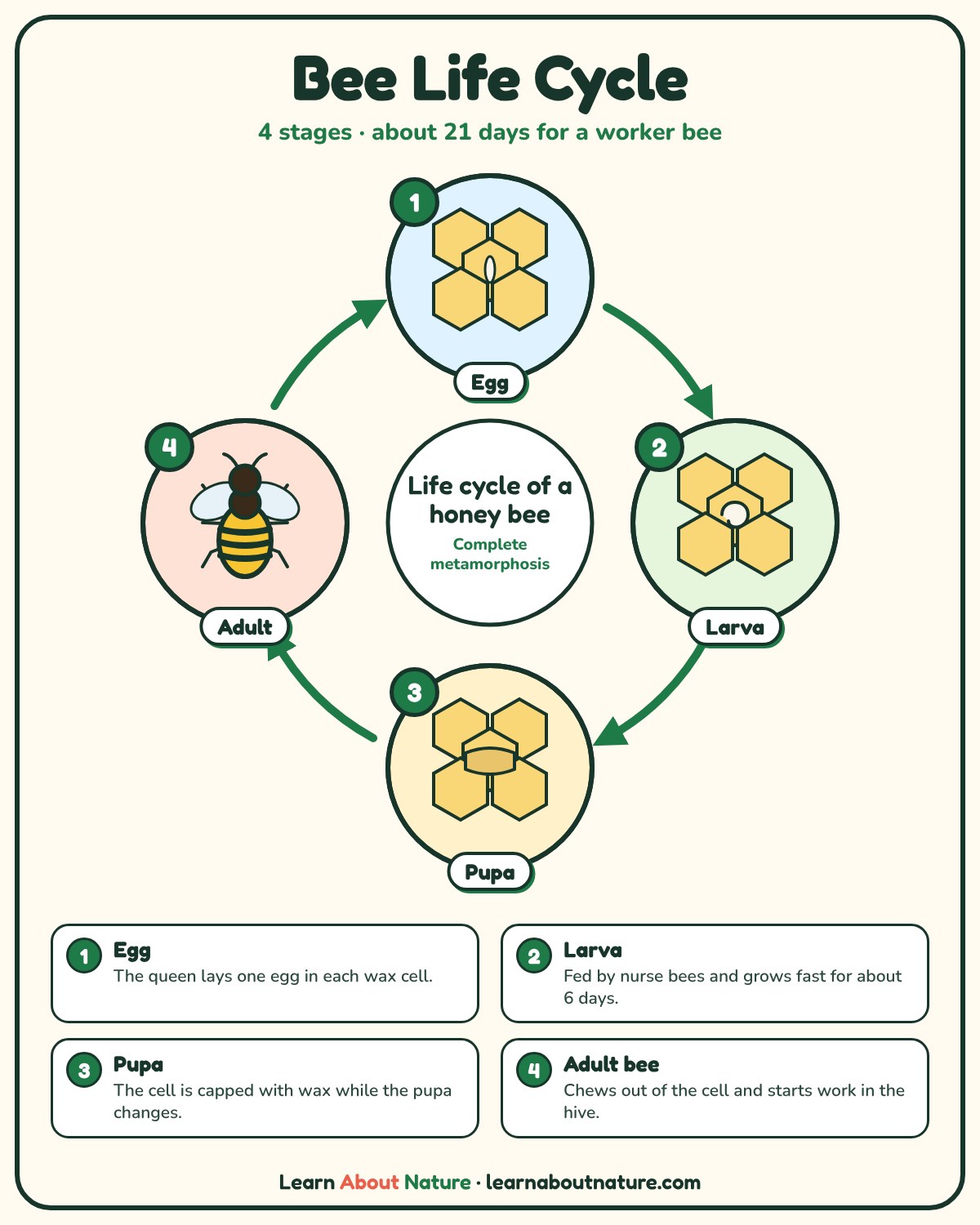
Teachers and students: you’re welcome to use this diagram in lessons and projects with credit to Learn About Nature.
Bees are thought to be social insects since they live in colonies and work closely together. These small flying insects are also responsible for producing 1/3rd of the world’s food supply through pollination. And since they produce a valuable resource such as honey, many people have started beekeeping as a hobby.

What Are the Stages of a Bee’s Life Cycle?
A bee’s life cycle has four stages: egg, larva, pupa and adult. In honey bees the egg hatches after three days, the larva is fed by workers for about six days, then its cell is capped while it pupates. Queens emerge after 16 days, workers after 21 days and drones after 24 days.
The Honey Bee Life Cycle
The bee life cycle has four stages. These are egg, larva, pupa, and then finally adult. The overall life cycle for other bees, such as drones and worker bees, is similar but may differ in terms of days and developments.
1. Honey Bee as Eggs
The first stage of a bee life cycle begins when the queen lays eggs. Ideally, a Queen bee lays up to 1,500-2,000 eggs per day. The fertilized eggs go on to hatch into female honey bees, which are also known as worker bees. Meanwhile, the unfertilized eggs hatch to become male bees, also known as drones.
The eggs are laid inside the cells that bees have been cleaned by the workers to raise the new generation of bees. The Queen bee is very selective about the cell she wants to lay eggs in. If the cell isn’t spotless, she’ll move on to another cell to lay eggs. The queen lays its eggs upright, which might be hard to see with the naked eye. Moreover, the eggs’ overall width is 0.4 millimeters, so they’re very hard to see.
Workers are responsible for regulating the female to male population ratio. They do so by making smaller cells for female workers and larger cells for male drones.
2. The Larval Stage
After three days, the egg hatches into a larva in which the bee is a worm-like creature. In this stage, a bee has no legs, wings, or antennas; it is merely in a semi-solid state. Usually, the larvae appear white at first and resemble small grubs. It is tiny at first but grows, shedding its skin five times over the course of this stage. All young larvae get royal jelly at first, but only larvae chosen as future queens keep receiving it throughout development, which makes them grow into queens. Let’s move on to the third stage of a bee life cycle.
3. The Pupa Stage
This is the stage where things begin to happen and change for the bee. In this phase, the bee begins to develop certain parts, such as eyes, wings, and legs. Moreover, coloration also begins to take place during this phase. The bee takes on familiar characteristics as an adult bee and begins developing a pink color at first, then purple, and then finally black.
After that, hair begins growing on its body as it begins to develop. After 12 days, the bee is developed enough to chew her way out of the wax and joins the rest of the crew.
4. The Adult Stage
Typically, a Queen bee takes 16 days to come out of the pupa stage. This is comparatively less than an average bee, which takes 18-22 days for completion. On the other hand, the drone takes 24 days to develop into an adult bee. This is the last stage of a bee’s life cycle.
Different Types of Honey Bees in a Colony
Each honey bee has a different role after it hatches from the eggs. As we mentioned before, there are numerous honey bees in the hives. These bees also have a significant difference in terms of roles and duties.
In a hive, the Queen Bee is the only female that gets to reproduce. The task of female worker bees is to make the hive and guard the queen, while the male bees, also referred to as drones, take off in search of other queen bees looking to mate.
The Role of a Queen Bee
All honey bee colonies have only a single Queen bee, who is also the biological mother of all the bees in the hive. Queens can be singled out by their long, slender abdomens; beekeepers often mark them with a dot of paint to find them easily. If a second Queen bee emerges in the hive, the female bees either drive her out or the two Queens fight until one emerges victorious.
The primary role of a Queen bee is to only lay eggs to maintain the population of the colony. On average, she needs to lay around 1500 eggs per day to maintain a steady population.
The Role of a Worker Bee

A worker bee is the most integral part of the beehive. All these workers are female and often change their tasks as they age. Younger female workers engage in work inside the nest, which includes taking care of the queen and the larvae. The duration of this role may depend on the overall condition and requirements of the beehive. They are also integral to maintaining the process of a bee’s life cycle.
Typically, a worker bee works inside the hive for a few weeks and later adopts outside tasks such as guarding. The last role for a worker bee is that of a forager. This involves the bees venturing outside the nest to collect pollen and other necessities for the hive.
The Role of a Male Bee (Drone)
A typical male bee has no significant role other than assisting in reproduction. They lack stingers and have larger eyes, unlike female bees. They are only around for a few months over the year and mate with different Queen Bees to spread colonies. Every day, they leave the colony in search of another Queen Bee who is looking to mate.
Final Thoughts
We hope you learned a lot of things about a typical honey bee life cycle from our guide. Honey bees live an interesting but very short life of just a few weeks. Nevertheless, their hard work and contribution to the environment is a commendable feat.
Honey Bee Development Timeline by Caste
Queens, workers and drones all pass through the same four stages, but they take different amounts of time. The table shows the typical number of days from the egg being laid.
| Stage | Queen | Worker | Drone |
|---|---|---|---|
| Egg | Days 1 to 3 | Days 1 to 3 | Days 1 to 3 |
| Larva (open cell) | Days 4 to 8 | Days 4 to 9 | Days 4 to 10 |
| Cell capped, pupa | Days 8 to 16 | Days 9 to 21 | Days 10 to 24 |
| Adult emerges | Day 16 | Day 21 | Day 24 |
| Typical adult lifespan | 2 to 5 years | 5 to 7 weeks (summer); 4 to 6 months (winter) | A few weeks to a few months |
Beekeepers use these timings every day. For example, if a colony loses its queen, they know a new one can emerge about 16 days later, and that worker brood capped today will hatch in roughly 12 days.
What Happens Inside the Cell
Each stage happens inside a single wax cell in the comb. The cells are hexagonal, which lets bees pack the most storage space into the least wax.
- Egg: the queen lays a tiny white egg standing upright at the bottom of the cell. Over three days it slowly tilts over.
- Larva: nurse bees visit each larva hundreds of times a day. It grows so fast that it increases its weight hundreds of times in under a week, moulting five times.
- Capping: when the larva is fully grown, workers seal the cell with a wax cap. Worker brood caps are flat; drone caps are domed like bullets.
- Pupa: the larva spins a thin cocoon and changes into a pupa. Eyes darken first, then the body colours and hairs develop.
- Emergence: the new adult chews through the cap and almost immediately starts its first job, cleaning cells.
Queen cells look completely different. They hang down vertically from the comb and are shaped like a peanut shell, which is why beekeepers can easily spot when a colony is raising a new queen.
Worker Bee Jobs by Age
Once a worker emerges, her life follows a second, adult cycle of jobs that changes as she gets older. The ages below are typical, but bees switch jobs early or late when the colony needs it.
- Days 1 to 3: cleaning cells so the queen can lay in them.
- Days 3 to 12: nurse bee, feeding larvae with food made in glands in her head.
- Days 12 to 18: making wax and building comb, storing nectar and pollen, and fanning to cool the hive.
- Days 18 to 21: guarding the entrance and removing dead bees.
- Day 21 onward: forager, collecting nectar, pollen, water and plant resin until she dies, usually after two to three weeks of flying.
Winter bees are different. They are raised in autumn, do little foraging and cluster together to keep the queen warm, which is why they can live for several months.
Bee Life Cycle for Kids
- Egg: The queen bee lays one egg in each wax cell.
- Larva: White larvae hatch and are fed by worker bees.
- Pupa: Workers seal the cell and the larva changes inside.
- Adult: The adult chews out and becomes a worker, drone or queen.
Key words: colony – a big group of animals living together; nectar – sweet liquid inside flowers that insects drink; pollination – moving pollen so a flower can make seeds.
Try this activity: Make a honeycomb from paper hexagons and show the stages in different cells. Plant bee-friendly flowers in a school bed. Watch bees from a distance and do not touch them.
Free printable: Download the Bee life cycle worksheet (PDF) – put the stages in order, match key words, draw and explain. Answer key included.
Honey Bee Life Cycle FAQs
What are the stages of a honey bee’s life cycle?
Honey bees go through complete metamorphosis in four stages: egg, larva, pupa and adult. Eggs hatch after about three days, larvae are fed by worker bees and grow quickly, then each larva is capped in its cell to pupate. Workers emerge as adults after about 21 days.
How long does it take each type of bee to develop?
A queen develops fastest, emerging about 16 days after the egg is laid. Worker bees take about 21 days, and drones, the males, take about 24 days. Differences in diet and cell size help determine how each type of bee develops.
How long do honey bees live?
Worker bees born in spring and summer usually live about five to seven weeks because their foraging work is so demanding. Workers that emerge in autumn can survive the winter, living several months. Queens can live for several years, while drones usually die after mating or are expelled in autumn.
How does a larva become a queen bee?
All female larvae are fed royal jelly for the first few days. Larvae chosen to become queens are raised in special larger cells and fed royal jelly throughout their development. This rich diet triggers them to develop into fertile queens instead of workers.
How many eggs does a queen bee lay?
At the peak of the season, a healthy queen can lay up to around 1,500 to 2,000 eggs a day. Fertilized eggs become female workers or queens, while unfertilized eggs develop into male drones. Egg laying slows down greatly in autumn and winter.
More life cycles
- Pink Ladybug Life CycleEgg → larva → pupa → adult
- Monarch Butterfly Life CycleEgg → caterpillar → chrysalis → butterfly
- Butterfly Life CycleEgg → caterpillar → chrysalis → butterfly
- Dragonfly Life CycleEgg → nymph → adult
- Snake Life CycleEgg or live birth → hatchling → adult

Randi Jones is the owner and founder of the Nature Gift Store, an online retailer specializing in nature-themed gifts, educational science projects, live animal nature kits and real butterfly artwork. A biology graduate who fell in love with insects, she founded the company in 2001 to make active learning about nature fun, accessible and engaging for children and adults. Her store offers real butterfly frames, home and garden decor and educational live animal kits, including ant farms, worm farms, tadpoles, ladybugs and hermit crabs, and she runs a bug museum in Washington featuring live animals like Eddie the Iguana alongside other reptiles and insects. Randi wrote most of the guides on this site. They first appeared on her long-running nature sites, including Monarch-Butterfly.com, Ladybug-Life-Cycle.com, Frog-Life-Cycle.com, Dragonfly-Site.com and Butterfly Pictures, which have now been brought together here at Learn About Nature.