Brown Tree Snake
Scientific Classification
| Kingdom: | Animalia |
| Phylum: | Chordata |
| Subphylum: | Vertebrata |
| Class: | Reptilia |
| Order: | Squamata |
| Suborder: | Serpentes |
| Family: | Colubridae |
| Genus: | Boiga |
| Species: | B. irregularis |
| Binomial name: | Boiga irregularis |
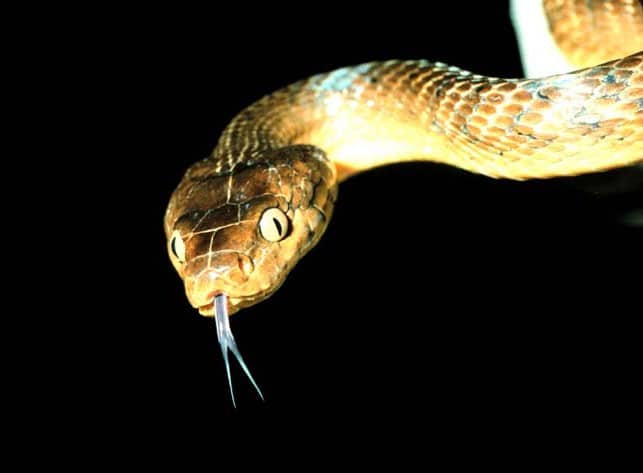
This Brown Tree Snake, a tree-dwelling snake Boiga irregularis with fangs on the rear, is the largest family of snakes. Their habitat lies on the north and east coast of Australia, Papua New Guinea, East of Indonesia, and vast islands in the North West of Melanesia. This variety of brown tree snakes is notorious for encroaching, accountable for disturbing most of the inhabitant birds in Guam.
On account of the accessibility of prey and deficiency of predators in the snake’s new habitat like Guam, they seem to have grown bigger than their normal size of length 1 to 2 m (3.3 to 6.6 ft). The Brown Tree Snake that was found in Guam has a length of 3 M (9.8 ft which is a record for the lengthiest tree snake.
Curbing The Invasive Brown Tree Snake On Guam
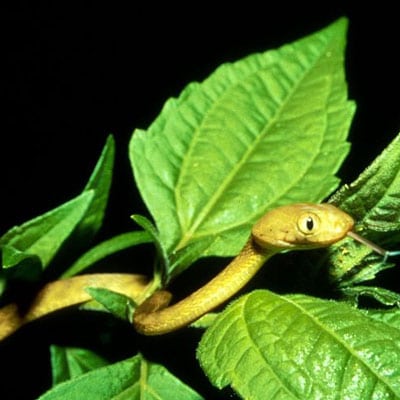
As per the report of the BBS News of fifth December in the year 2013, US let down on Guam 2,000 poisoned dead mice to control the population of snakes.
The mice were filled with paracetamol of 80 mg, a gentle medicine for pain; it is poisonous to the Brown Tree Snakes.
They tied the rodents on tiny pieces of cardboard in the shape of parachutes designed in such a way as to settle on the branches where they were easily visible to the snakes.
This year the fourth release of the mice on Guam was on a Sunday
The yearly expenditure for this program was $8m (£4.8 m) for the US.
Ever since the World War, Guam, which is a territory of US has been a significant outpost of the US Military.
Anatomy
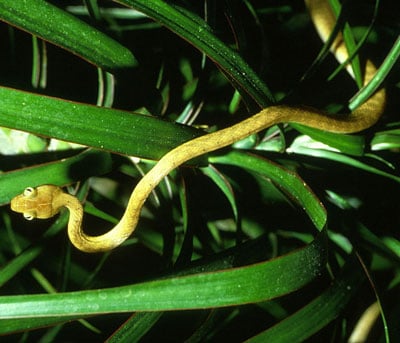
The Brown Tree Snake has a big head having protruding large eyes containing pupils in vertical position. Because of its thin neck, this head is conspicuous. The upper portion is brown in color and the edges are ragged. The cross bands on the back portion and sides of the Eastern Australian snakes is dark colored. The specimen belonging to the Northern Australia have a cream background with dark red bands. The color of the belly is orange to cream. The length of this snake is 2 m. The row of scales on the middle of the body are 19 to 23, the division of the sub-caudals are 85 – 130, one analscale and the ventral is divided into 225 – 265 parts.
Behavior
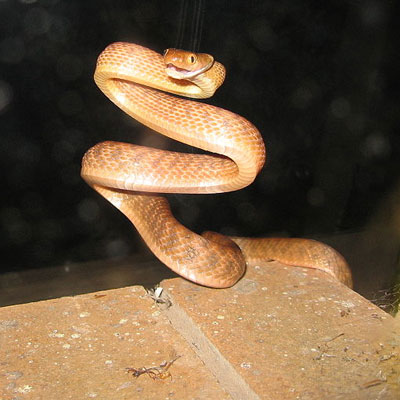
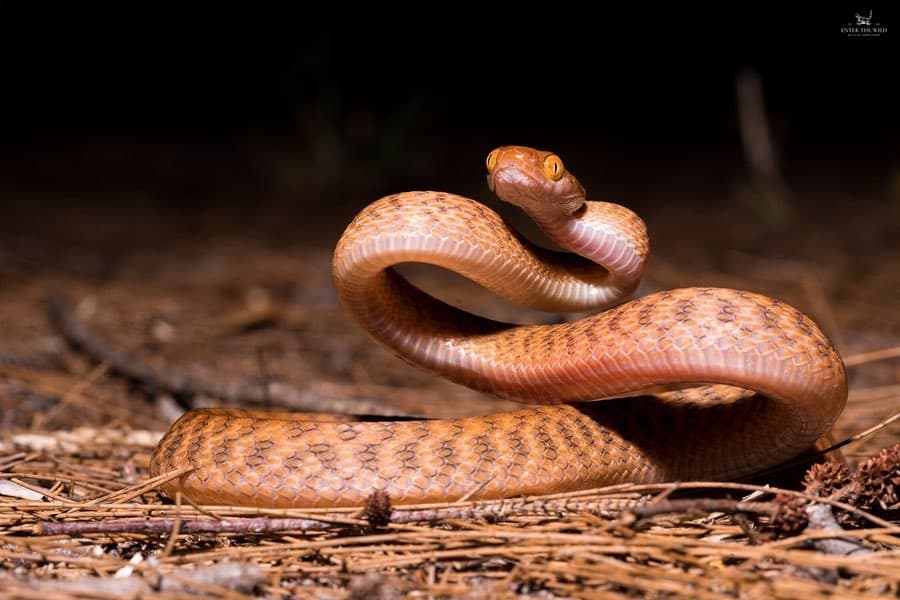
The Brown Tree Snake is a good climber and feels comfortable among the shrubs and trees, where, at night, it forages for prey using its perfect senses of smell and receptive vision at night to locate its prey. Often we find them entering commercial buildings, residential buildings and several habitats in the urban areas searching for spots to hide and to forage. A probable place of retreat at day is one that gives safety and protects the entry of dazzling light and extreme temperature. While hiding, it is possible for the snakes to get their flexible body coiled and occupy very limited space. These snakes that are active at night tend to become violent if aggravated. Their body formation is a clear form of ‘S’ shape. They tighten the prey and even poison them, even though they use the least quantity of venom to make the prey to subdue to them. These Brown Tree Snakes frequently squeeze themselves through the narrow gaps in bird cages and devour the inhabitants, after which it becomes impossible for them to get out through the bars, This astonishes the bird keeper and frightens him in the morning.
Habitat
The habitation of the Brown Tree Snake is the islands of Solomon, New Guinea, Papua and the Northern Coastal regions of Australia. The length of this snake is normally 4 to 5 feet even though at times they attain a length of 8 ft, and attain the weight of 5 lbs.
Diet
The little snake’s diet consists of dragons, skinks, frogs and geckos, whereas the adult snakes feed on eggs, birds and mammals (particularly house mice). In the year 1991 Shine discovered that the diet of the Brown Tree Snakes hailing from the New South Wales have mammals as a vital part of their diet. The snakes hailing from Queensland have birds as their main diet, and those from the Northern Territory feed principally on lizards.
Having discovered a fondness for insects while pursuing her degree in Biology, Randi Jones was quite bugged to know that people usually dismissed these little creatures as “creepy-crawlies”.