Bushmaster
Scientific Classification
| Kingdom: | Animalia |
| Phylum: | Chordata |
| Subphylum: | Vertebrata |
| Class: | Reptilia |
| Order: | Squamata |
| Suborder: | Serpentes |
| Family: | Viperidae |
| Subfamily: | Crotalinae |
| Genus: | Lachesis |
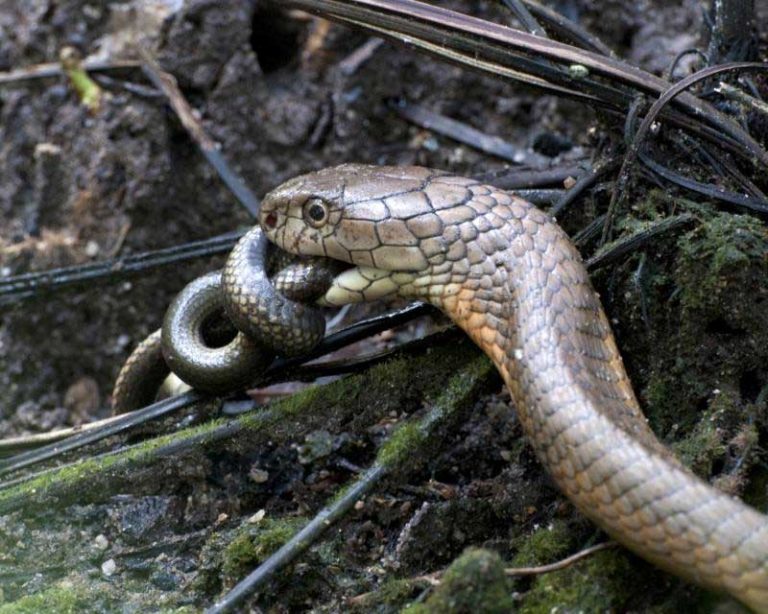
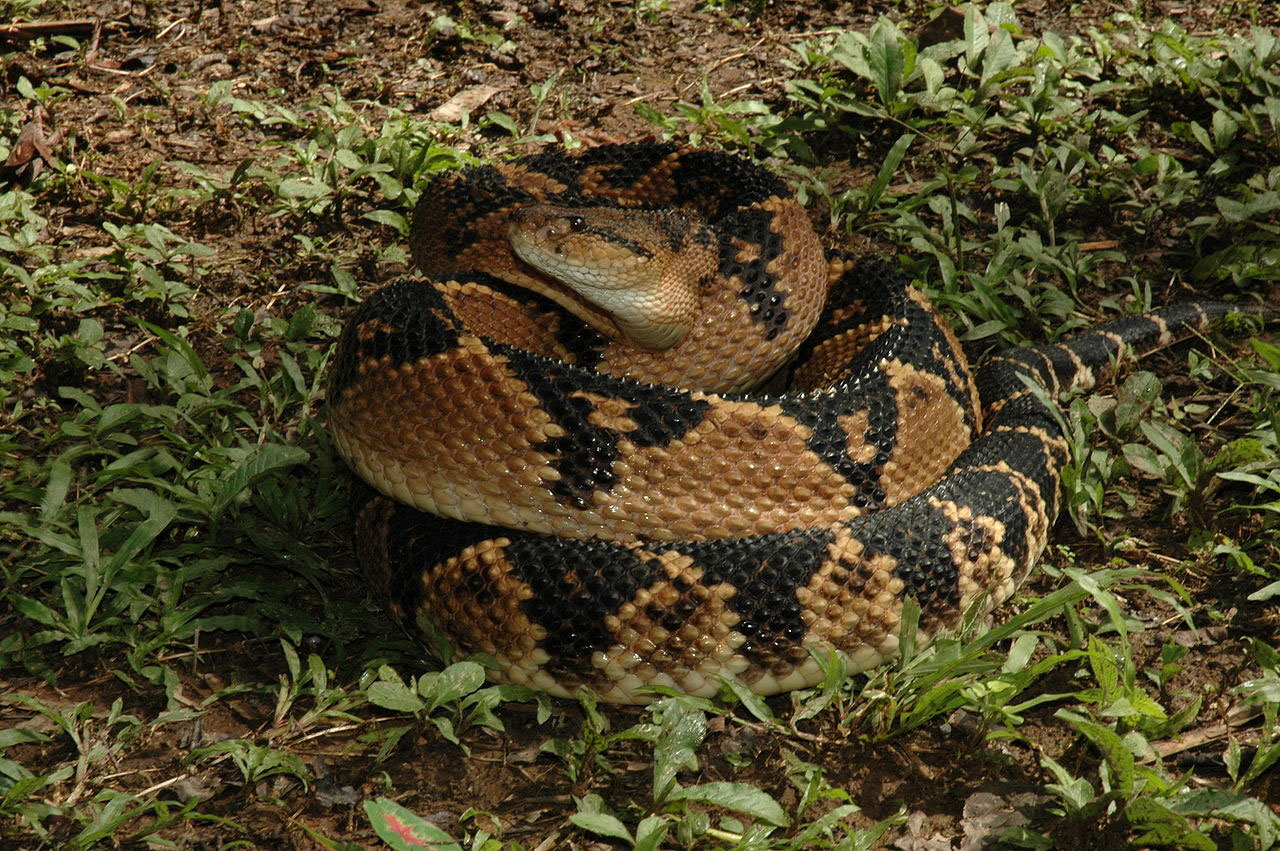
Bushmaster Snake belongs to the Bushmaster Genus Lachesis. They are the longest venomous snakes in the American continent belonging to the family of pit vipers. We can find them in forests and scrublands from the north Amazon basin onto Costa Rica. We know of three species of this snake. They are, Lachesis melanocephala, Lachesis muta, and Lachesis stenophrys. Bushmasters normally measure about 1.8 meters or Around six feet. They can very well grow as long as 3 meters or 10 feet. These snakes range from reddish brown color to a kind of pinkish gray. These colors match the forest floor of their habitats. Some of these snakes have ’X’ or diamond-shaped decorations on their back. We rarely come across bushmasters, they are dangerous since their venom is potentially lethal.
The snake can make multiple bite strikes and inject large quantities of venom. Even the bite of a juvenile bushmaster could be fatal. Fortunately, humans rarely encounter these snakes, and incidents of snake bites are not common.
The bushmaster has the practice of shaking its tail like a rattlesnake. The difference is that bushmasters lack rattles. This accounts for its scientific name of Lachesis Muta, which means ‘Silent Fate’. Due to their big size, bushmasters are capable of producing more venom than many viper species. For instance, the bushmaster has eight times more poison than American Copperheads.
Anatomy
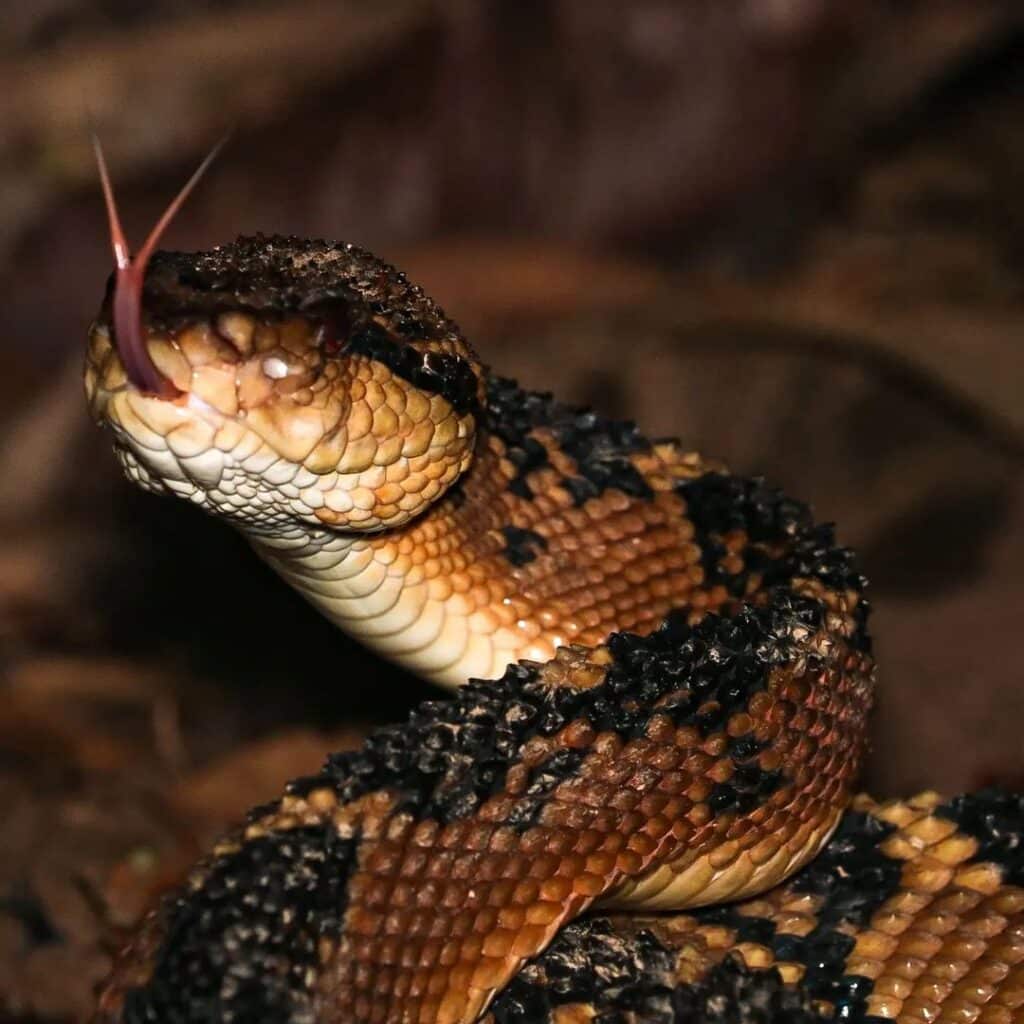
Bushmasters are certainly big snakes. Normally, individual snakes of the species are often more than two meters long. They have the potential to reach more than 3.5 meters in length. They are not only the longest poisonous snakes in the American Continent, but also the world’s second longest venomous snake species. The first place goes to the King Cobra. The body color can be reddish brown, pinkish or tan with clear diamond shaped patterns that run down the back. Their bellies are light colored. Usually you can find a dark stripe that extends from the eye to the mouth’s back corner. The scales are heavily keeled with a central vertebral ridge seen along the dorsum.
Behavior
Bushmasters are solitary, except during breeding season. Moreover, they are nocturnal. There is not much known about their behavior as they are so secretive.
Habitat
We can find the this snake in the comparatively cool, damp tropical forests ranging from mountainous terrain to lowlands in the coastal areas. They inhabit south Central America and most of the northern half of South America. The subspecies of Central America range from the southern regions of Nicaragua and southwards to northern areas of Colombia. You can find the southern bushmaster subspecies in central Colombia towards Bolivia. They extend from the eastern parts of Ecuador, northwest Peru, to the coastal areas of the northern parts of Brazil. You can also find them in the Guyanas as well as in Surinam, Trinidad Island and along the southern Brazilian Coast.
As a Pet
Breeding
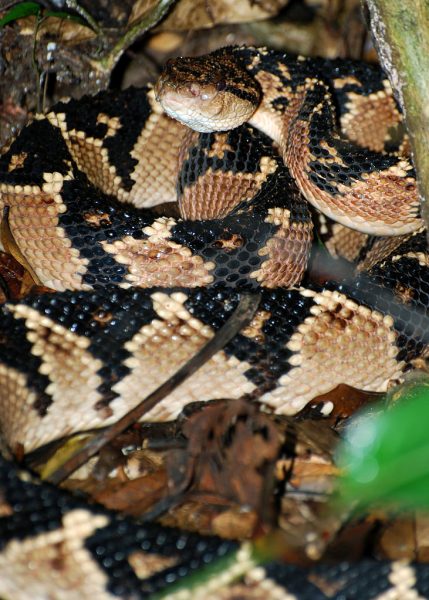
Bushmasters are oviparous (egg layers). Bushmasters have the distinction of being America’s one and the only pit-vipers that lay eggs. They are reclusive till mating time. The males follow the scent trails of the females. Once the male finds a female, he flicks his tongue and rubs his head along her body to express his intentions, and to check whether she is receptive. The female bushmaster will not stoop to making burrows. She lays her eggs in burrows made by other small animals. She is not averse to sharing the burrow with the animal who built the burrow. Once she has laid the eggs, she coils her body around them and will not leave them till they hatch nearly 80 days later. She will not leave the eggs, even to go hunting.
Housing
Prepare a 20 gallon vivarium with secure closures for these snakes.
Food
Bushmasters are nocturnal creatures that feed small mammals, rodents, small birds or reptiles in the wild. In Costa Rica, they seem to prefer spiny rats. Bushmasters are ground dwelling predators who lie in wait for their prey. As soon as the prey comes near, they strike. You can feed them in captivity, with small mice. Take care to feed them only using tongs.
Handling
Utmost care is recommended while handling this snake.
Having discovered a fondness for insects while pursuing her degree in Biology, Randi Jones was quite bugged to know that people usually dismissed these little creatures as “creepy-crawlies”.