Hairy Bush Viper
Scientific Classification
| Kingdom: | Animalia |
| Phylum: | Chordata |
| Subphylum: | Vertebrata |
| Class: | Reptilia |
| Order: | Squamata |
| Suborder: | Serpentes |
| Family: | Viperidae |
| Subfamily: | Viperinae |
| Genus: | Atheris |
| Species: | A. hispida |
| Binomial name: | Atheris hispida |
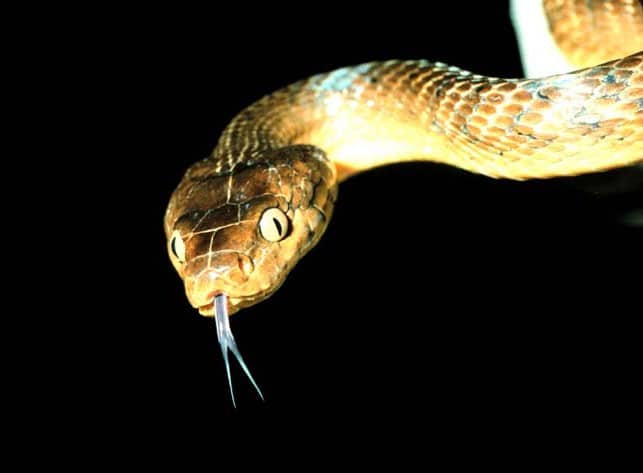
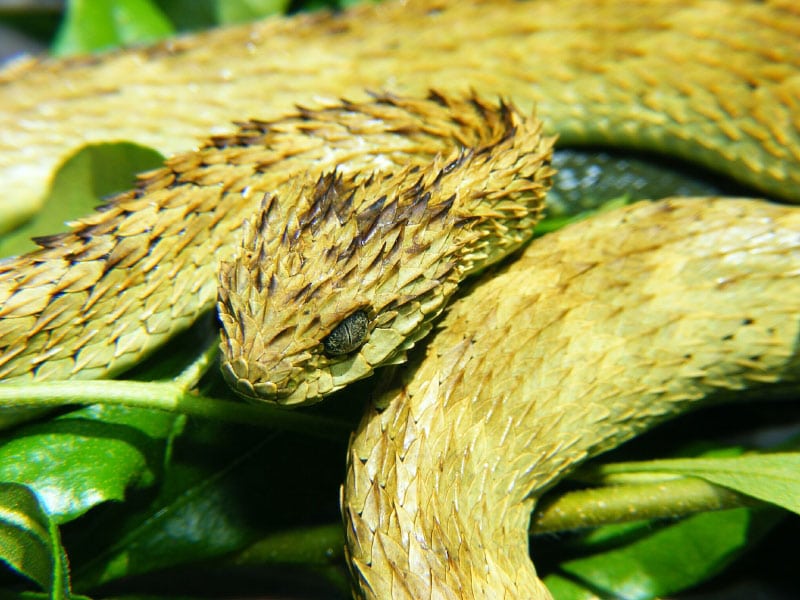
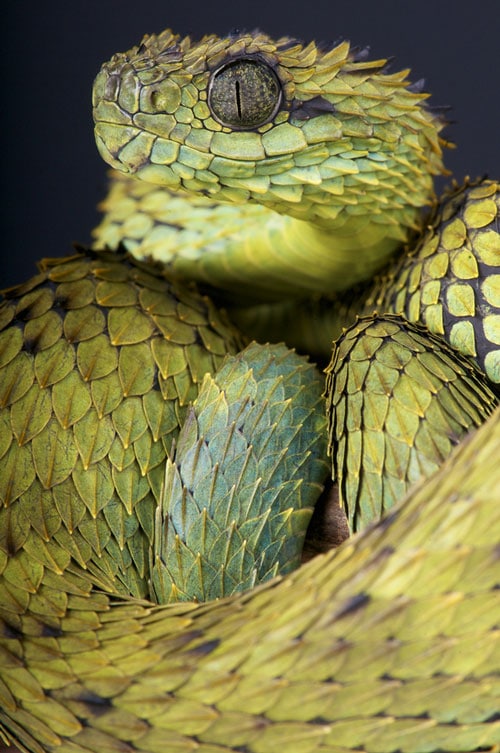
The Hairy (Bush) Viper belongs to the species of viper Atheris hispida. These snakes possess highly keeled Dorsal-scales. These scales give the snake a bristly, shaggy look. Hence the name, hairy (Bush) Viper. There are no recognized subspecies. These snakes are called by a host of names including, hairy viper, African hairy (Bush) Viper, Spiny (Bush) viper, Rough scaled (Bush) Viper, and the like. These species are confined to the Central regions of Africa.
Anatomy
Hairy Bush Viper
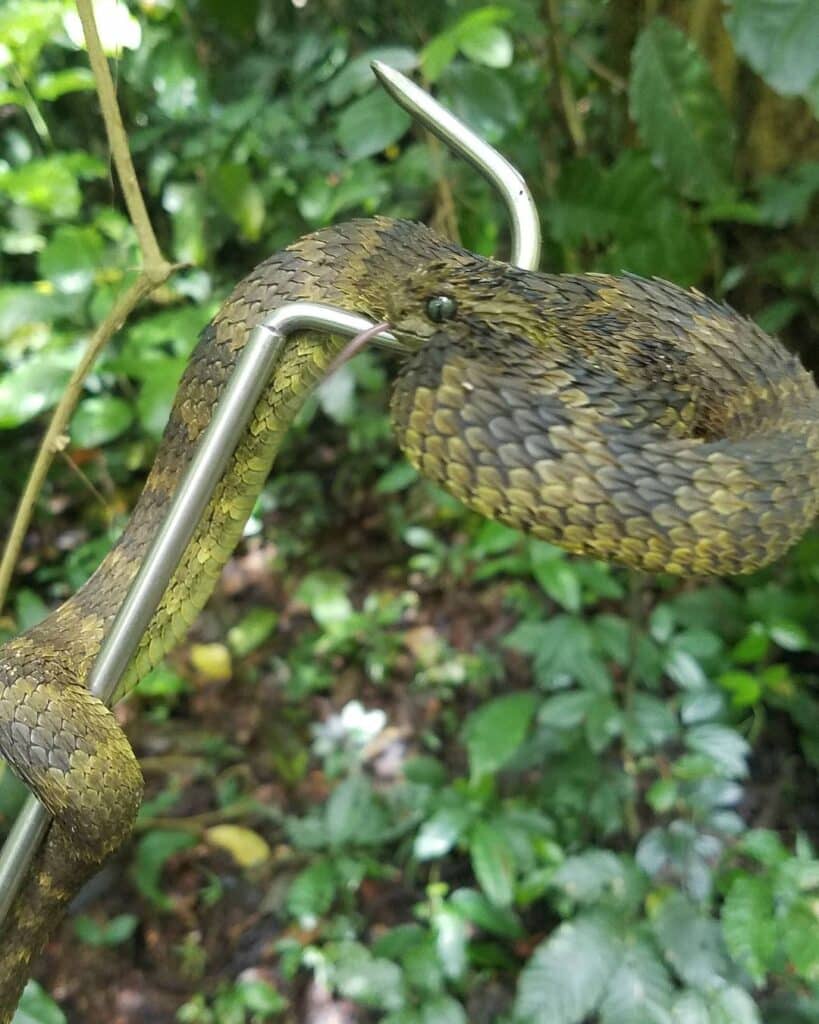
Hairy Bush Viper males grow to a maximum overall length of 73 centimeters, with the tail accounting for 15 cms. The females grow to a maximum of 58 centimeters in length. The males appear as strikingly longer and more slender compared to the females. These snakes have a short snout in the head. The snout is more pronounced in males. . 9 to 16 circumorbital scales surround their large eyes. Eight to nine scales separate the orbits (eyes). The nostril looks like a slit. Two scales separate it from the eyes. A single row of scales separates the eyes and the super labials. The superlabials are 7-10 in number, with the 4th one enlarged. The elongated, highly keeled, dorsal scales covering the body, give the snake the hairy, shaggy look. The lengthiest scales surround the head and neck. The dorsal scales in mid body are in 15 to 19 rows. The ventral scales number 149-166, while the subcaudals are 35 to 64 in number. There is a single anal scale.
The males of this species grow to maximum total length of 73 cm (29 in) – body 58 cm (23 in), and tail 15 cm (5.9 in). Females grow to a maximum total length of 58 cm (23 in). The males are surprisingly long and slender compared to the females.
Behavior
These snakes are mostly nocturnal. In daytime, they climb stalks and reeds. They bask on top of terminal leaves and flowers.
Habitat
These Hairy Bush Viper snakes are fairly spread out in Central Africa. You can find them in west Kenya, Uganda (south west) and DR Congo. You can find this genus (Altheris) of venomous snakes only in sub Saharan Africa, with the exception of southern Africa. These species are confined to the rain forests and their distribution is isolated and fragmented. Studies show that they are distributed as isolated populations in DR Congo’s Orientale provinces and Kivu, Uganda’s south east Ruwenzori and Western Kenya’s Kakamega forests.
As a Pet
These snakes are almost impossible to maintain as pets because of their dietary habits. The snakes feed only on slugs, frogs, lizards and the like, as rodent based diets given to captive pets, could kill them.
Breeding
Hairy Vipers are live bearers. On an average, they give birth to 12 young ones in one go. The newborns measure about 15 cms in overall length.
They need average temp of 70 F and a basking spot of 80Fand a reasonably large and comfortable housing.
Food
In the wild, They feed on slugs, frogs, lizards, birds and maybe small mammals. Sometimes hunts for mammalian prey on the ground.
Handling
You will have to be an experienced keeper for this very venomous viper snake and would do well to get a well bred animal, as most imports deliver stressed and irritable snakes that take a long time to acclimatize.
Having discovered a fondness for insects while pursuing her degree in Biology, Randi Jones was quite bugged to know that people usually dismissed these little creatures as “creepy-crawlies”.