Zebra Facts for Kids: Habitat, Diet, Stripes and Fun Facts
Quick answer: A zebra is a wild member of the horse family with bold black-and-white stripes. Zebras live on the grasslands and savannas of eastern and southern Africa and eat mostly grass. There are three species: the plains zebra, Grévy’s zebra and the mountain zebra. Every zebra’s stripe pattern is different.
On the African savanna, a herd of zebras grazes side by side, their stripes blending into one big jumble of black and white. Zebras are some of the most recognizable animals on Earth, yet scientists are still learning why they have stripes.
Zebras are close cousins of horses and donkeys. They live in family groups, travel long distances to find fresh grass and water, and can run fast when they need to. Here is how zebras live, what they eat, how their foals grow up and what makes each of the three zebra species special.
Teachers and students: you’re welcome to use this fact sheet in lessons and projects with credit to Learn About Nature.
Free printable: Download the Zebra fact file worksheet (PDF) – draw the animal, fill in the facts and match key words. Answer key included.
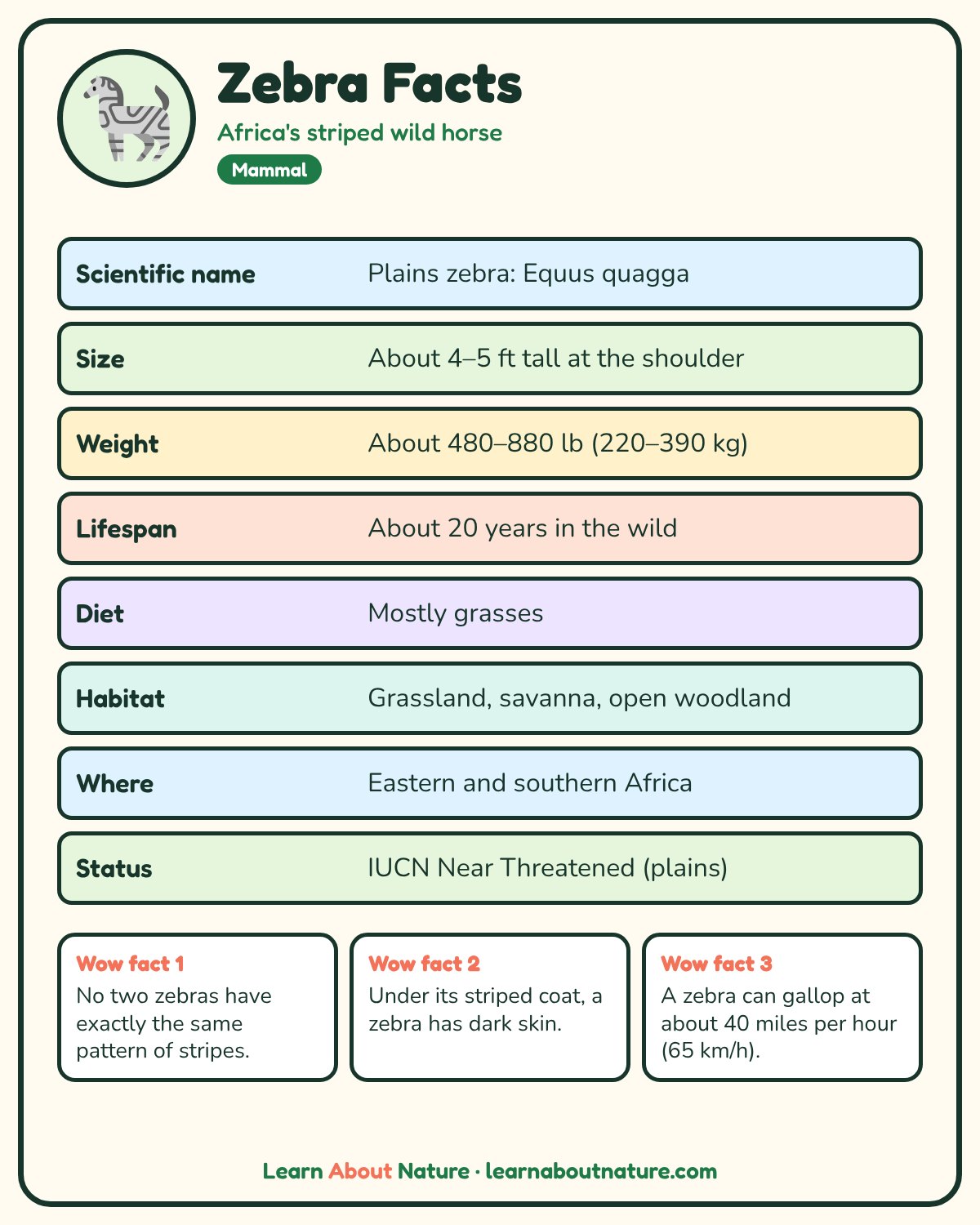
Zebra Quick Facts
| Class | Mammal |
| Family | Horse family (Equidae) |
| Species | Plains, Grévy’s and mountain zebra |
| Height | About 4–5 ft (1.2–1.5 m) at the shoulder |
| Weight | Plains zebra about 480–880 lb (220–390 kg) |
| Top speed | About 37–43 mph (60–70 km/h) |
| Pregnancy | About 12–13 months |
| Baby name | Foal |
| Group name | Herd; family group called a harem |
| Conservation status | Plains Near Threatened; Grévy’s Endangered; mountain Vulnerable |
What Is a Zebra?
A zebra is a mammal in the horse family, called Equidae, along with horses, donkeys and wild asses. Like horses, zebras have one toe on each foot, covered by a hard hoof.
There are three species of zebra. The plains zebra, Equus quagga, is the most common and the one most people picture. Grévy’s zebra, Equus grevyi, is the biggest and the rarest. The mountain zebra, Equus zebra, lives in rocky hills and mountains in the southwest of Africa.
Adult plains zebras weigh about 480 to 880 pounds (220 to 390 kg) and stand about 4 to 5 feet (1.2 to 1.5 m) tall at the shoulder.
Where Do Zebras Live?
All zebras live in Africa. Plains zebras have the widest range of any wild member of the horse family. They live in more than 15 countries in eastern and southern Africa, on grasslands, savannas and open woodlands, usually within reach of water.
Grévy’s zebras live in dry, scrubby grasslands in northern Kenya and Ethiopia. Mountain zebras live in rugged, hilly country in South Africa, Namibia and southwestern Angola. They are excellent climbers on rocky slopes.
Some plains zebras make long journeys every year to follow the rains and fresh grass. In the famous migration in Tanzania and Kenya, hundreds of thousands of zebras travel with wildebeest between the Serengeti and the Maasai Mara.
What Do Zebras Eat?
Zebras are herbivores. They eat mostly grasses, and sometimes leaves, shoots and bark when grass is scarce. They spend much of each day grazing.
Zebras can eat tough, tall grass that many other grazers avoid. By munching down the tough tops, they open up the shorter, more tender grass underneath for animals such as wildebeest and gazelles. That is why zebras are sometimes called “pioneer grazers.”
Zebras need to drink water regularly, so herds rarely wander too far from rivers, lakes and waterholes.
Why Do Zebras Have Stripes?
Every zebra has its own stripe pattern, a bit like a fingerprint. Stripes also differ between species and between regions. Under the hair, a zebra’s skin is dark.
Scientists have long wondered why zebras are striped. One strong idea is that stripes protect zebras from biting flies, which can spread disease. In a 2019 study in England, researchers watched horseflies around zebras and horses. Flies flew toward both animals, but near the zebras they had trouble slowing down and landing. When horses wore striped coats, far fewer flies landed on the striped cloth than on plain black or white coats.
Other ideas, such as stripes helping zebras stay cool or confusing predators, are still being studied. It is possible that stripes do more than one job.
Zebra Foals
A baby zebra is called a foal. In plains zebras, a mother is pregnant for about a year, usually around 375 days, and has one foal at a time. A newborn weighs about 66 to 77 pounds (30 to 35 kg).
A foal can stand almost right away and walks with its mother within a short time. That matters on the open savanna, where the herd must keep moving. For the first few days, the mother keeps other zebras away so her foal learns her stripes, smell and voice.
Foals start nibbling grass within about a week but keep drinking milk until they are about 9 months old. Grévy’s zebras have the longest pregnancy of any member of the horse family, about 390 days.
- Pregnancy: about 12–13 months
- Foals per birth: 1
- Weight at birth: about 66–77 lb (30–35 kg)
- Weaning: at about 9 months
Herds and Family Life
Plains zebras and mountain zebras live in small family groups called harems. Each harem has one adult male, called a stallion, several females, called mares, and their young. These families can stay together for years. Many harems may gather into one big herd, especially during migration.
Living in a group helps zebras stay safe. While some zebras graze, others keep watch. Their main predators are lions and spotted hyenas. When danger comes near, zebras bunch together and run. Adults can gallop at about 37 to 43 miles per hour (60 to 70 km/h) and can kick hard with their back legs.
Grévy’s zebras are different. They do not form lasting family groups. Instead, males guard territories near water and grass, and females with young move between them. Plains zebras live about 20 years in the wild.
Plains vs Grévy’s vs Mountain Zebras
The three zebra species can be told apart by their size and stripes. Plains zebras have wide stripes, and many have pale brownish “shadow stripes” between the black ones. Their stripes wrap all the way around the belly.
Grévy’s zebras are the largest, weighing about 770 to 950 pounds (350 to 430 kg). They have many narrow stripes, about 80 in all, a white belly and very large, rounded ears.
Mountain zebras are smaller and have a flap of skin under the throat called a dewlap. Their stripes cover the body but stop before the belly, and the stripes on their back end form a grid-like pattern. There are two kinds: the Cape mountain zebra and Hartmann’s mountain zebra.
Threats and Conservation Status
Conservation status depends on the species. On the IUCN Red List, the plains zebra is Near Threatened (assessed 2016). There are more than 500,000 plains zebras, but numbers fell by about a quarter during the 1990s and 2000s, and they have disappeared from Burundi and Lesotho.
Grévy’s zebra is Endangered (assessed 2016), with only about 2,000 adults left in the wild. The mountain zebra is listed as Vulnerable.
The main threats are habitat loss as farms and towns spread, competition with livestock for grass and water, and illegal hunting for meat and skins. Protected parks and community conservation programs help keep zebra herds safe.
Fun Facts About Zebras
Here are a few more zebra surprises:
- In the north of their range, plains zebras have bolder stripes because their pale shadow stripes fade.
- Zebras can swim across rivers during their migration.
- Zebras swish their tails almost all day to keep biting flies away.
- Young male Grévy’s zebras stay with their mothers for at least three years.
- The quagga, a half-striped zebra from South Africa, died out in the 1800s. Scientists now count it as a kind of plains zebra.
Fast Facts for Young Readers
- Zebras are wild members of the horse family.
- Zebras live in Africa.
- They eat mostly grass.
- Every zebra has its own stripe pattern.
- A baby zebra is called a foal.
- A foal can stand soon after it is born.
- Stripes may help keep biting flies away.
Key words: herbivore – an animal that eats only plants; foal – a baby zebra, horse or donkey; harem – a zebra family group with one stallion, several mares and their young; migration – a long journey animals make at the same time each year; dewlap – a flap of loose skin hanging under the throat; hoof – the hard covering on the foot of a horse or zebra.
Try this: Design your own zebra: draw a zebra outline, give it a stripe pattern no one else has, then compare with classmates to see that, like real zebras, no two patterns match.
Related Guides
- Zebra life cycle
- Giraffe facts for kids
- Platypus facts for kids
- Bat facts for kids
- Raccoon facts for kids
- All animal facts for kids
Zebra FAQs
Why do zebras have stripes?
Scientists are still studying this. A leading idea is that stripes protect zebras from biting flies. In a 2019 study, flies near zebras had trouble landing, and far fewer flies landed on horses wearing striped coats. Stripes may also help with keeping cool or confusing predators.
Is a zebra white with black stripes or black with white stripes?
Under its fur, a zebra has dark skin. Many scientists describe zebras as dark animals with white stripes, because the white hairs simply lack color. Either way, each zebra’s pattern of stripes is unique.
How fast can a zebra run?
Plains zebras can gallop at about 37 to 43 miles per hour (60 to 70 km/h) to escape predators such as lions and hyenas. They also zigzag while running and can deliver powerful kicks with their back legs.
What do zebras eat?
Zebras are herbivores that eat mostly grass. When grass is scarce, they also eat leaves, shoots and bark. They can eat tall, tough grass that other grazers avoid, which opens up shorter, tender grass for animals such as wildebeest and gazelles.
Are zebras endangered?
It depends on the species. On the IUCN Red List, the plains zebra is Near Threatened, Grévy’s zebra is Endangered with about 2,000 adults left, and the mountain zebra is Vulnerable. Habitat loss, competition with livestock and illegal hunting are the main threats.
Sources: San Diego Zoo Wildlife Alliance Library: Plains Zebra fact sheet; San Diego Zoo Wildlife Alliance Library: Grévy’s Zebra population and conservation; Smithsonian’s National Zoo: Grévy’s Zebra; African Wildlife Foundation: Zebra; UC Davis: How Zebra Stripes Disrupt Flies’ Flight Patterns; Wikipedia: Mountain zebra

Nato is a content writer and researcher with a background in psychology who’s eager to explore the wonders of nature. As a travel enthusiast and animal lover, she hopes to inspire others to discover and cherish the beauty and importance of the natural world. She also writes about the history of candy and snacks for Snack History and about food and healthy eating for The Fitchen.