Bat Facts for Kids: Habitat, Diet and Fun Facts
Quick answer: A bat is a mammal with wings made of skin stretched over long finger bones, and the only mammal that can truly fly. There are more than 1,400 species living on every continent except Antarctica. Most bats eat insects, which they find using echolocation, while others eat fruit, nectar or even blood.
As the sun sets, a dark cloud swirls out of a cave entrance. It is not smoke. It is millions of bats heading out for a night of insect hunting. Bats are some of the most amazing and misunderstood animals on Earth.
Bats come in all sizes, from a bat about as heavy as a paper clip to giant fruit bats with wings as wide as a grown-up is tall. They help farmers by eating pests, pollinate flowers and spread seeds. Here is how bats fly, find food in the dark, raise their pups and why many of them need our help.
Teachers and students: you’re welcome to use this fact sheet in lessons and projects with credit to Learn About Nature.
Free printable: Download the Bat fact file worksheet (PDF) – draw the animal, fill in the facts and match key words. Answer key included.
Bat Quick Facts
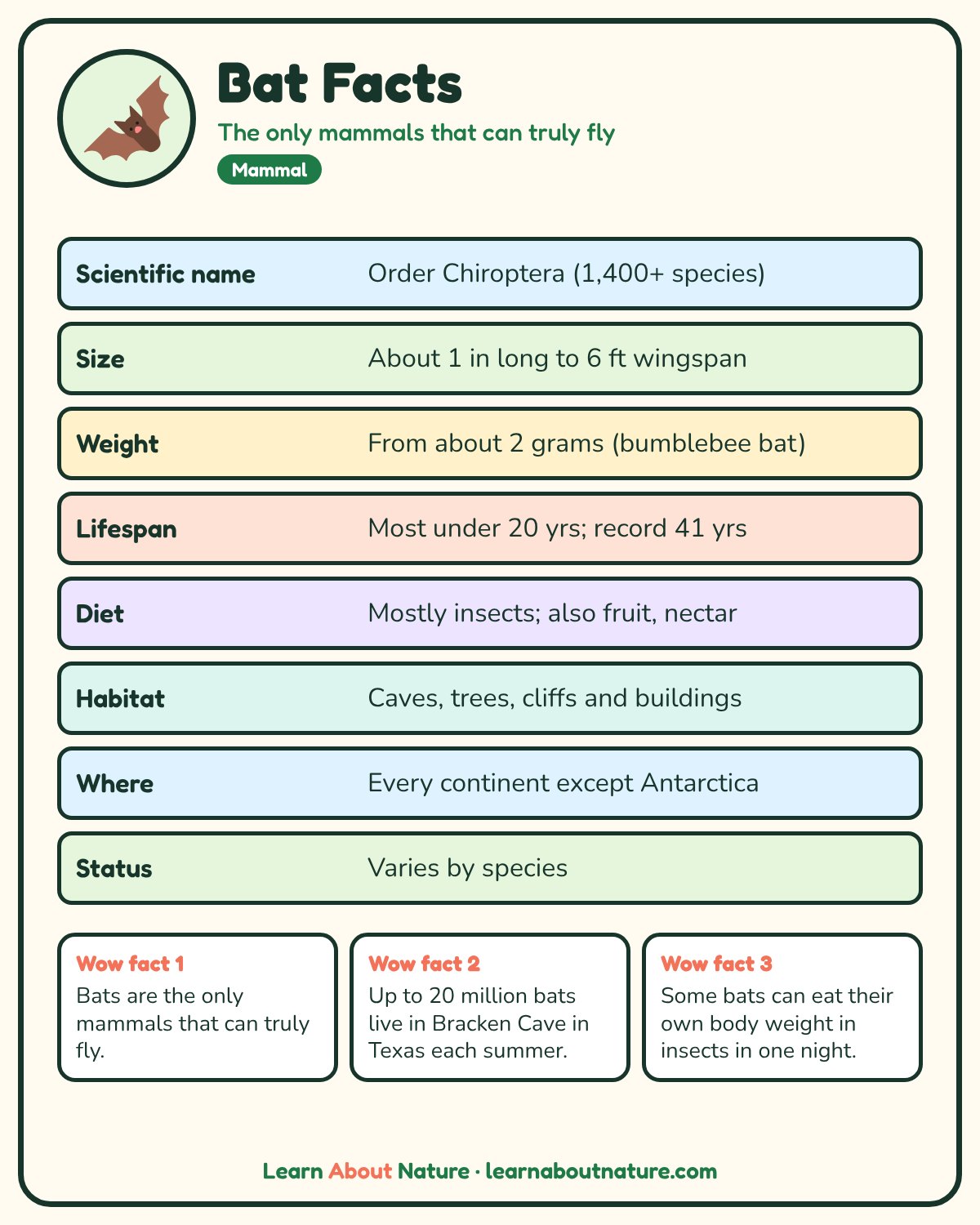
| Class | Mammal |
| Order | Chiroptera (“hand wing”) |
| Number of species | More than 1,400 |
| Smallest | Bumblebee bat, about 2 g |
| Largest wingspan | Flying foxes, up to about 6 ft (1.8 m) |
| Diet | Mostly insects; also fruit, nectar, fish, frogs; 3 species drink blood |
| Pups per year | Usually 1 |
| Baby name | Pup |
| Record lifespan | At least 41 years (Brandt’s bat) |
| Conservation status | Varies: e.g. little brown bat Endangered; Mexican free-tailed bat Least Concern (IUCN) |
What Is a Bat?
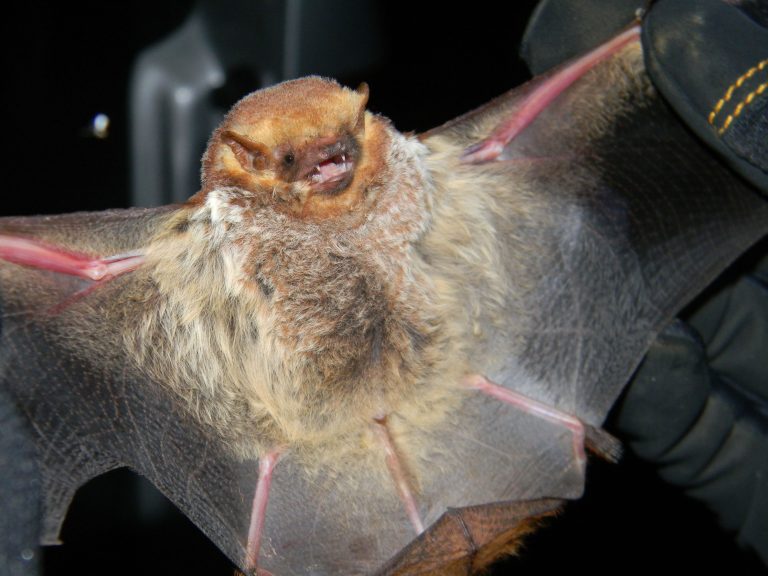
A bat is a mammal. Like other mammals, bats are warm-blooded, have fur and feed their babies milk. But bats can do something no other mammal can: they truly fly. Flying squirrels and some other animals only glide.
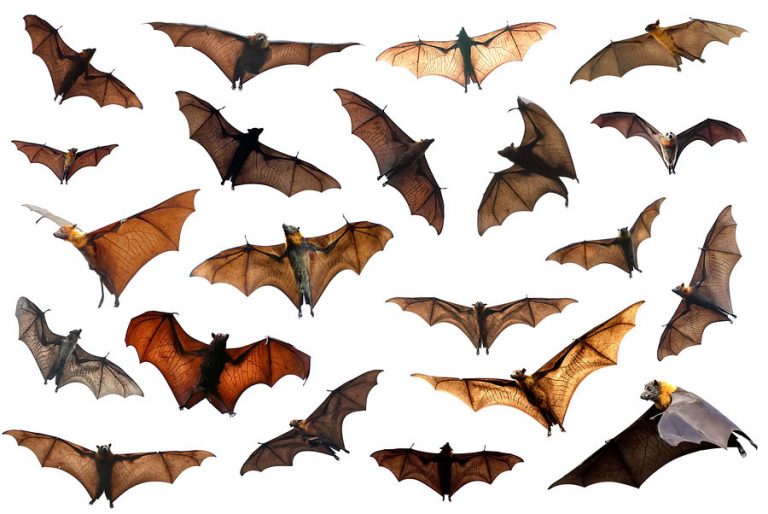
Bats belong to a group called Chiroptera, which means “hand wing.” A bat’s wing is like a human hand with very long fingers. Thin, stretchy skin connects the fingers, arms, body and legs. By moving its fingers, a bat can change the shape of its wing and twist and turn in the air.
There are more than 1,400 species of bats, which makes them the second-largest group of mammals after rodents. Bats have been around for more than 50 million years.
Where Do Bats Live?
Bats live on every continent except Antarctica. Most species live in warm, tropical places, but many live in cooler regions too. The United States and Canada have 47 bat species.
During the day, bats rest in places called roosts. Roosts can be caves, hollow trees, cracks in rocks, under bark, in leaves, under bridges or in buildings. Some bats roost alone, while others live in huge colonies.
The largest known bat colony is in Bracken Cave near San Antonio, Texas. Each summer, up to about 20 million Mexican free-tailed bats live there.
What Do Bats Eat?
More than 70 percent of bat species eat insects. Bats catch moths, beetles, mosquitoes and many other flying insects. Many can eat up to half their body weight in insects in a single night, and nursing mothers can eat even more. Scientists estimate that insect-eating bats save US farmers billions of dollars a year by eating crop pests.
Other bats eat fruit or drink nectar from flowers. As they feed, they carry pollen from flower to flower and spread seeds in their droppings. Plants such as agave, some giant cacti and balsa trees depend on bats, and more than 300 kinds of fruit rely on bats for pollination.
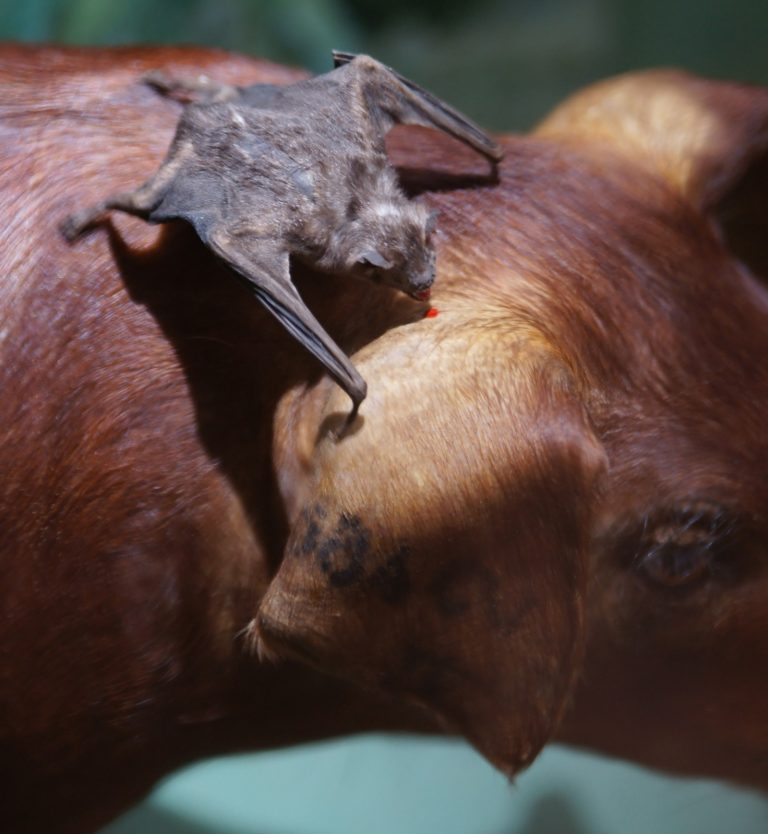
A few bats have unusual diets. Some catch fish with their feet, and some eat frogs or small animals. Only three species, the vampire bats of Central and South America, feed on blood.
Body and Senses
Bats range hugely in size. The smallest is the bumblebee bat, or Kitti’s hog-nosed bat, which is just over an inch (about 3 cm) long and weighs about 2 grams. The biggest bats are flying foxes, such as the giant golden-crowned flying fox, with wings up to about 6 feet (1.8 m) across.
Many bats find their way and catch food using echolocation. They make high-pitched calls, usually too high for people to hear, and listen for the echoes that bounce back. From the echoes, a bat can tell the size, shape and distance of an insect, even in total darkness.
Bats are not blind. All bats can see, and many fruit bats have large eyes and excellent night vision. When a bat hangs upside down, its weight pulls its toes closed around a perch, so it can grip without using energy, even while asleep.
Baby Bats
A baby bat is called a pup. Most bats give birth to just one pup a year, though a few species, such as the eastern red bat, often have twins.
In many species, mothers gather in warm roosts called maternity colonies to give birth and raise their young. The pups drink their mother’s milk and cling to the roost while their mothers go out to feed. A mother bat can find her own pup among thousands of others by its voice and smell.
Pups grow fast and usually learn to fly within a few weeks. For such small animals, bats live a long time. Most live less than 20 years in the wild, but a Brandt’s bat in Siberia lived at least 41 years.
- Baby name: pup
- Pups per year: usually 1
- Nursery roost: maternity colony
- Record lifespan: at least 41 years
Bat Behavior
Most bats are nocturnal, which means they are active at night and rest during the day. Bats spend a lot of time grooming, cleaning their fur and wings with their tongues and claws, and some even groom each other.
When winter comes and insects disappear, bats in cold places have two choices. Many hibernate, sleeping deeply in caves or mines with their body temperature dropping low to save energy. Others, such as some Mexican free-tailed bats, migrate to warmer places where food is still available.
Bats can be fast fliers. Mexican free-tailed bats have been tracked flying at up to about 100 miles per hour (160 km/h) in short bursts, although wind may have helped.
Fruit Bats vs Insect-Eating Bats
Bats are often split into two broad types. Fruit bats, including flying foxes, live in tropical parts of Africa, Asia and Australia. Many are large, with fox-like faces, big eyes and a keen sense of smell for finding ripe fruit and flowers. Most fruit bats do not use echolocation the way insect-eating bats do.
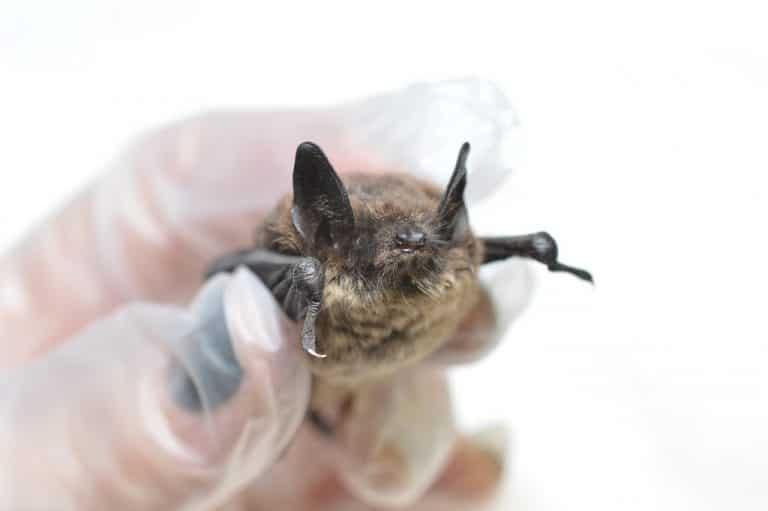
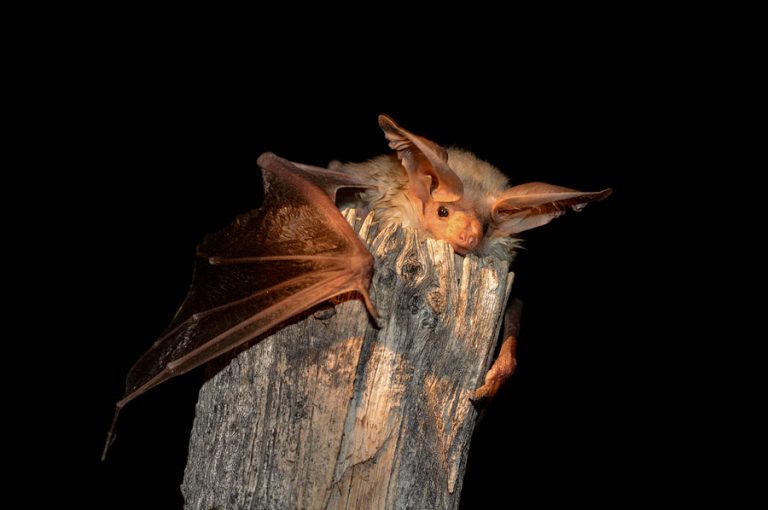
Insect-eating bats are usually much smaller. They often have large ears and odd-shaped noses that help them send and receive echolocation calls. They chase flying insects in the dark and live all over the world, including in North America and Europe.
Both kinds are important. Fruit bats help forests regrow by spreading seeds, while insect-eating bats keep pest numbers down.
Threats and Conservation Status
With so many species, bat conservation status varies by species. On the IUCN Red List, the Mexican free-tailed bat is Least Concern (assessed 2015). The little brown bat of North America, once very common, is now Endangered (2021 update of a 2018 assessment). Worldwide, more than 200 bat species are listed as Vulnerable, Endangered or Critically Endangered, and more than 200 others lack enough data to judge.
A disease called white-nose syndrome, caused by a fungus, has spread through bat caves in North America since 2006. It has killed more than 90 percent of little brown bats, northern long-eared bats and tricolored bats in many areas. Habitat loss, disturbance of caves and wind turbines are other threats.
There are success stories, too. The lesser long-nosed bat grew from fewer than 1,000 bats in 1988 to about 200,000 by 2018 thanks to protection.
Fun Facts About Bats
Here are a few more bat surprises. If you ever find a bat on the ground, do not touch it; tell an adult, who can call a wildlife expert.
- Bats have belly buttons, just like people.
- Some fishing bats can detect a minnow’s fin poking just 2 millimeters above the water.
- About 80 medicines come from plants that depend on bats.
- Seeds dropped by bats can make up most of the new plants that sprout in cleared forest.
- A bat spends at least half its life hanging upside down.
Fast Facts for Young Readers
- Bats are the only mammals that can really fly.
- A bat’s wing is like a hand with long fingers.
- Most bats eat insects.
- Some bats eat fruit and help flowers grow.
- Bats use echoes to find food in the dark.
- Bats are not blind.
- A baby bat is called a pup.
- Never touch a bat. Tell an adult instead.
Key words: echolocation – finding things by making sounds and listening for the echoes; roost – a place where bats rest during the day; nocturnal – active at night and resting during the day; hibernate – to sleep deeply through the winter to save energy; pollinate – to carry pollen from one flower to another so plants can make seeds and fruit; maternity colony – a group of mother bats that live together to raise their pups.
Try this: Play “Bat and Moth,” a tag game: one blindfolded player is the bat and calls “Bat!”, while the moths must answer “Moth!” each time. The bat uses the answering voices, like echoes, to find and tag a moth.
Related Guides
- Fun bat facts
- Orangutan facts for kids
- Gorilla facts for kids
- Wolf facts for kids
- Giant Panda facts for kids
- All animal facts for kids
Bat FAQs
Are bats blind?
No. All bats can see. Many fruit bats have large eyes and excellent night vision. Insect-eating bats can see too, but they rely mainly on echolocation, making high-pitched calls and listening for the echoes, to find insects in the dark.
What do bats eat?
More than 70 percent of bat species eat insects such as moths, beetles and mosquitoes. Other bats eat fruit or drink nectar from flowers. A few catch fish or frogs, and only three species, the vampire bats of Central and South America, feed on blood.
Why do bats hang upside down?
Hanging upside down lets bats rest high up, safe from many predators, and take off quickly by simply dropping into flight. A bat’s weight pulls its toes closed around a perch, so it can grip without using energy and even sleep while hanging.
How many kinds of bats are there?
There are more than 1,400 species of bats, which makes them the second-largest group of mammals after rodents. They range from the bumblebee bat, which weighs about 2 grams, to flying foxes with wings up to about 6 feet across.
Are bats endangered?
It depends on the species. Many bats, such as the Mexican free-tailed bat, are listed as Least Concern by the IUCN, but more than 200 species are threatened. The little brown bat is now Endangered because of white-nose syndrome, a fungal disease that has killed millions of bats in North America.
Sources: Bat Conservation International: Bats 101; US Department of the Interior: 13 Awesome Facts About Bats; BBC Wildlife (Discover Wildlife): Bat facts; Wikipedia: Little brown bat; Wikipedia: Mexican free-tailed bat

Nato is a content writer and researcher with a background in psychology who’s eager to explore the wonders of nature. As a travel enthusiast and animal lover, she hopes to inspire others to discover and cherish the beauty and importance of the natural world. She also writes about the history of candy and snacks for Snack History and about food and healthy eating for The Fitchen.