Zebra Life Cycle: Stages From Foal to Adult
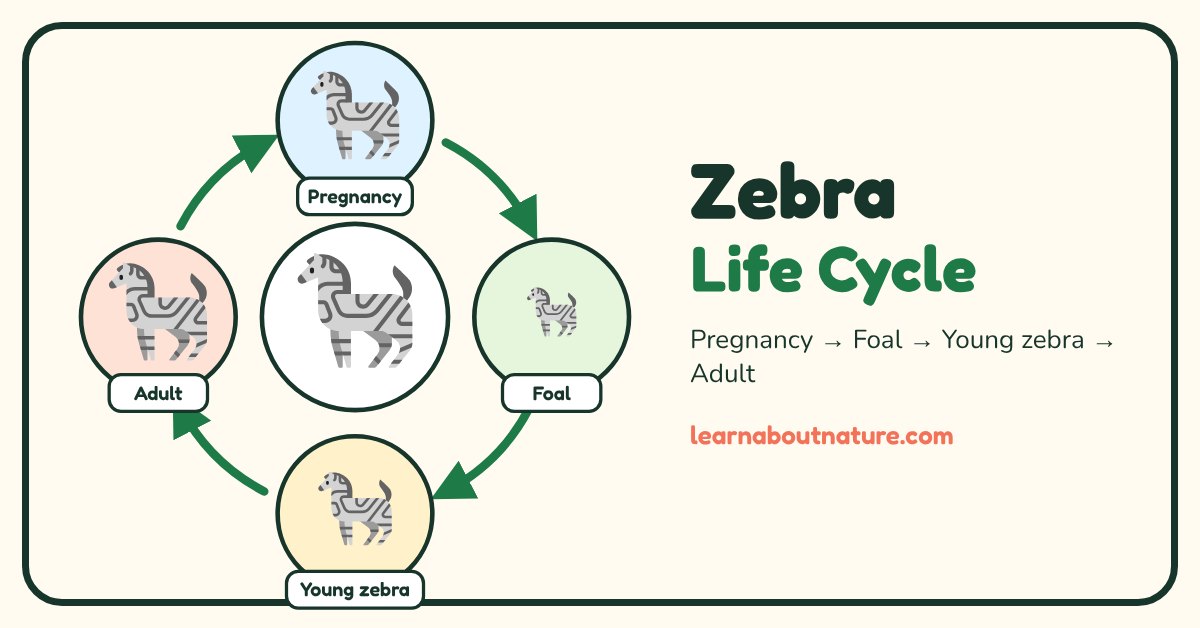
Quick answer: The zebra life cycle has four stages: pregnancy, foal, young zebra and adult. A plains zebra mother is pregnant for about a year and has one foal, which stands within minutes. Foals nurse for 7 to 11 months, leave their family at one to three years old, and become breeding adults a few years later.
A zebra foal is born into a world full of danger, so it has to get moving fast. Within about a quarter of an hour of birth, a plains zebra foal is usually standing, and within an hour it can walk after its mother.
There are three species of zebra: the plains zebra, the mountain zebra and Grévy’s zebra. This guide to the zebra life cycle uses the plains zebra, the most common and best-studied species, as its main example. Plains zebras live in family groups on the grasslands and savannas of eastern and southern Africa. The other two species follow a similar life cycle, but some timings and social habits differ.
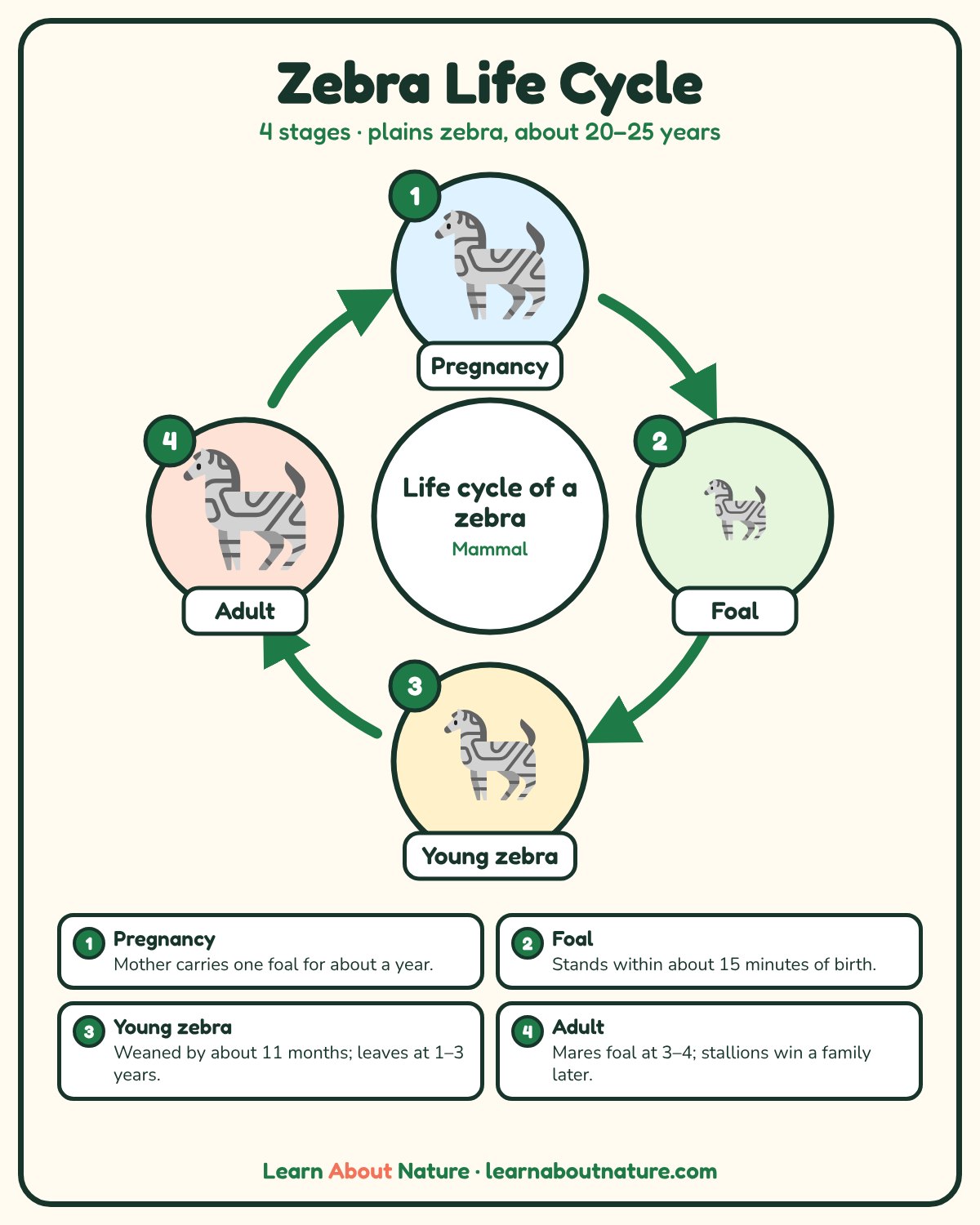
Teachers and students: you’re welcome to use this diagram in lessons and projects with credit to Learn About Nature.
Free printable: Download the Zebra life cycle worksheet (PDF) – label the diagram, cut and sequence the stages, and match key words. Answer key included.
Zebra Life Cycle Quick Facts
| Pregnancy | about 12–13 months (360–396 days) |
| Babies per birth | 1; twins are extremely rare |
| Weight at birth | about 66–77 lb (30–35 kg) |
| Stands up | about 10–15 minutes after birth |
| Weaned | about 7–11 months |
| Leaves family | about 1–3 years |
| First foal (mares) | about 3–4 years |
| Lifespan in the wild | up to about 20–25 years |
| IUCN status (plains zebra) | Near Threatened |
Zebra Families and Mating
Plains zebras live in small family groups called harems. Each harem has one adult male, called a stallion, plus one to six adult females, called mares, and their young. Many harems can gather together to form a big herd, especially during migrations.
Only stallions that have their own family get to mate. Young males without a family live in bachelor groups until they are strong enough to win mares of their own. Plains zebras can breed at any time of year, but in East Africa many foals are born during the rainy season, when there is plenty of fresh grass.
A harem stays together for years, even when it mixes with other families in a large herd. The mares in a family have a pecking order, and the stallion stays close to keep his family together.
Stage 1: Pregnancy
A plains zebra pregnancy lasts a little over a year, about 360 to 396 days. The mother almost always carries a single foal. Twins are extremely rare.
A mare can become pregnant again soon after giving birth, but most mares do not have a foal every single year. A gap of about two years between foals is common in the wild.
A mare comes back into season only about a week after giving birth, and about half of mares become pregnant again at that time. Even so, many mares in the wild skip a year, because carrying a foal while nursing another takes a lot of energy. Scientists think male foals may take a few days longer to develop than female foals.
Stage 2: Foal
A newborn plains zebra foal weighs about 66 to 77 pounds (30 to 35 kg). It stands within about 10 to 15 minutes and can walk within an hour. Being able to move so soon helps the foal keep up with the herd and run from predators.
For the first days, the mother keeps other zebras away from her foal. This gives the foal time to learn her stripes, smell and voice so it can find her in a crowded herd. Every zebra has its own stripe pattern, a bit like a fingerprint.
A newborn foal’s stripes are brown and white rather than black and white. The brown stripes slowly darken as the foal grows. Foals start nibbling grass when they are about a week old, but milk is still their main food for months.
A newborn foal takes a place in the family’s pecking order just below its mother. Other mares and older foals soon learn to recognize it, and the whole family helps keep watch for danger.
- Weight at birth: about 66–77 lb (30–35 kg)
- Stands up: about 10–15 minutes after birth
- Walks: within about an hour
- First grass: at about 1 week old
Stage 3: Young Zebra
Foals are weaned, meaning they stop drinking milk, at about 7 to 11 months old, although some mothers nurse for longer. During this time the young zebra learns to graze, drink at waterholes and run with the herd.
Young zebras leave their family group when they are about one to three years old. Young males usually leave on their own and join bachelor groups of other males. Young females are usually taken into another family by a stallion from outside their own harem. Leaving the family this way means zebras rarely mate with close relatives.
Some mothers keep nursing for as long as 16 months, but by their first birthday most young zebras get nearly all their food from grazing. Bachelor groups of young males can have up to about 15 members, though most are smaller. Inside these groups, young males play-fight and practice the skills they will need to win and protect mares one day.
Stage 4: Adult
Plains zebras can be sexually mature before they are two years old, but they do not breed right away. Most mares have their first foal when they are about three or four years old.
Stallions take longer. A male usually needs to be about four or five years old before he is strong enough to start his own family. Once he has a harem, he guards his mares and foals, chasing off rival males and placing himself between the family and danger.
Mares can keep having foals well into their teens, and pregnant mares 17 or 18 years old have been recorded in the wild.
Predators and Survival
Lions are the main predators of adult zebras. Spotted hyenas also hunt zebras, and young foals are taken by cheetahs, African wild dogs and other hunters. Crocodiles catch zebras that cross rivers during migrations.
Zebras defend themselves by staying in groups, keeping watch and running at speeds of up to about 40 miles per hour (64 km/h). A cornered zebra can also deliver a powerful kick. Studies show that adult stallions are killed by predators more often than other zebras, perhaps because they put themselves in danger to protect their families.
How Long Do Zebras Live?
Wild zebras can live about 20 to 25 years, though many die younger because of predators, disease and drought. In zoos, where food is steady and there are no predators, plains zebras have lived well into their thirties.
In North American zoos, the typical (median) lifespan of a plains zebra is about 17 years. The oldest zebras in human care have lived to nearly 40.
Threats and Conservation
There are still more than half a million plains zebras in Africa, but their numbers fell by about a quarter over the 1990s and 2000s. The IUCN Red List lists the plains zebra as Near Threatened. In many countries, plains zebras now live mainly inside protected areas.
The main threats are illegal hunting for meat and skins, and the loss of grassland to farms and fences, which can block migration routes. Grévy’s zebra is much rarer and is listed as Endangered, and the mountain zebra is listed as Vulnerable.
There are several kinds, or subspecies, of plains zebra. About three-quarters of all plains zebras are Grant’s zebras, which live in East Africa, including the famous herds of the Serengeti and Maasai Mara.
Interesting Zebra Life Cycle Facts
Here are a few surprising facts about how zebras grow up.
- A zebra foal’s stripes start out brown and darken as it grows.
- Foals learn their mother’s stripe pattern in the first few days of life.
- A plains zebra foal can stand up faster than most people can make breakfast.
- Young female zebras usually join a new family instead of staying with their own.
- Zebra families often join together into large herds of thousands during migrations.
Zebra Life Cycle for Kids
Here is the zebra life cycle in simple steps:
- Pregnancy: A mother zebra carries her baby for about a year.
- Foal: The baby zebra can stand up only minutes after it is born.
- Young zebra: The foal drinks milk, learns to eat grass and stays close to its family.
- Adult: Grown-up zebras start families of their own.
Key words: foal – a baby zebra; mare – an adult female zebra; stallion – an adult male zebra; harem – a zebra family of one stallion, several mares and their young; bachelor group – a group of young or single male zebras without mares; graze – to eat grass and other low plants.
Try this: Give each student a paper zebra outline to fill with their own stripe pattern, then mix up the drawings and see if each person can find their own, just like a foal finding its mother.
Related Life Cycles and Guides
- Otter life cycle
- Polar Bear life cycle
- Rhino life cycle
- Rabbit life cycle
- Wolf life cycle
- Fox life cycle
- All animal & plant life cycles
See also: Zebra Facts for Kids
Zebra Life Cycle FAQs
How long is a zebra pregnant?
A plains zebra is pregnant for a little over a year, about 360 to 396 days. The mother usually has one foal. Twins are extremely rare. Many foals in East Africa are born during the rainy season, when there is the most fresh grass to eat.
How soon can a baby zebra walk?
A plains zebra foal usually stands within about 10 to 15 minutes of being born and can walk within an hour. Getting up quickly helps it keep up with its mother and the herd, which protects it from lions, hyenas and other predators.
Are baby zebras born with stripes?
Yes. Zebra foals are born with stripes, but the dark stripes are brown rather than black at first. They darken as the foal grows. Each zebra has its own unique stripe pattern, which helps zebras recognize one another.
When do young zebras leave their family?
Young plains zebras leave their family at about one to three years old. Young males join bachelor groups of other males. Young females are usually taken into a new family by an outside stallion, which helps them avoid mating with close relatives.
How long do zebras live?
Wild zebras can live about 20 to 25 years, but many die younger from predators, disease or drought. In zoos, plains zebras have lived well into their thirties because they have steady food, care from vets and no predators.
Sources: San Diego Zoo Wildlife Alliance Library: Plains Zebra Reproduction & Development; San Diego Zoo Wildlife Alliance Library: Plains Zebra Population & Conservation Status; Animal Diversity Web: Equus burchellii (plains zebra); IFAW: Zebras

Nato is a content writer and researcher with a background in psychology who’s eager to explore the wonders of nature. As a travel enthusiast and animal lover, she hopes to inspire others to discover and cherish the beauty and importance of the natural world. She also writes about the history of candy and snacks for Snack History and about food and healthy eating for The Fitchen.