Seahorse Facts for Kids: Habitat, Diet and Fun Facts
Quick answer: A seahorse is a small bony fish with a horse-shaped head, a curled tail and bony plates instead of scales. Seahorses live in shallow, warm and cool coastal seas around the world and suck up tiny crustaceans through their snouts. Most amazing of all, the male carries the eggs and gives birth.
With a head like a tiny horse, a belly like a kangaroo and a tail like a monkey, a seahorse looks like it was put together from spare parts. Yet it is a real fish, and a very clever one. It can change color, hold on to plants with its tail and hunt without ever chasing its food.
Seahorses are also famous for a very unusual kind of parenting: the father gets pregnant, not the mother. Read on to learn where seahorses live, what they eat, how babies are born, and why many seahorse species need our help.
Teachers and students: you’re welcome to use this fact sheet in lessons and projects with credit to Learn About Nature.
Free printable: Download the Seahorse fact file worksheet (PDF) – draw the animal, fill in the facts and match key words. Answer key included.
Seahorse Quick Facts
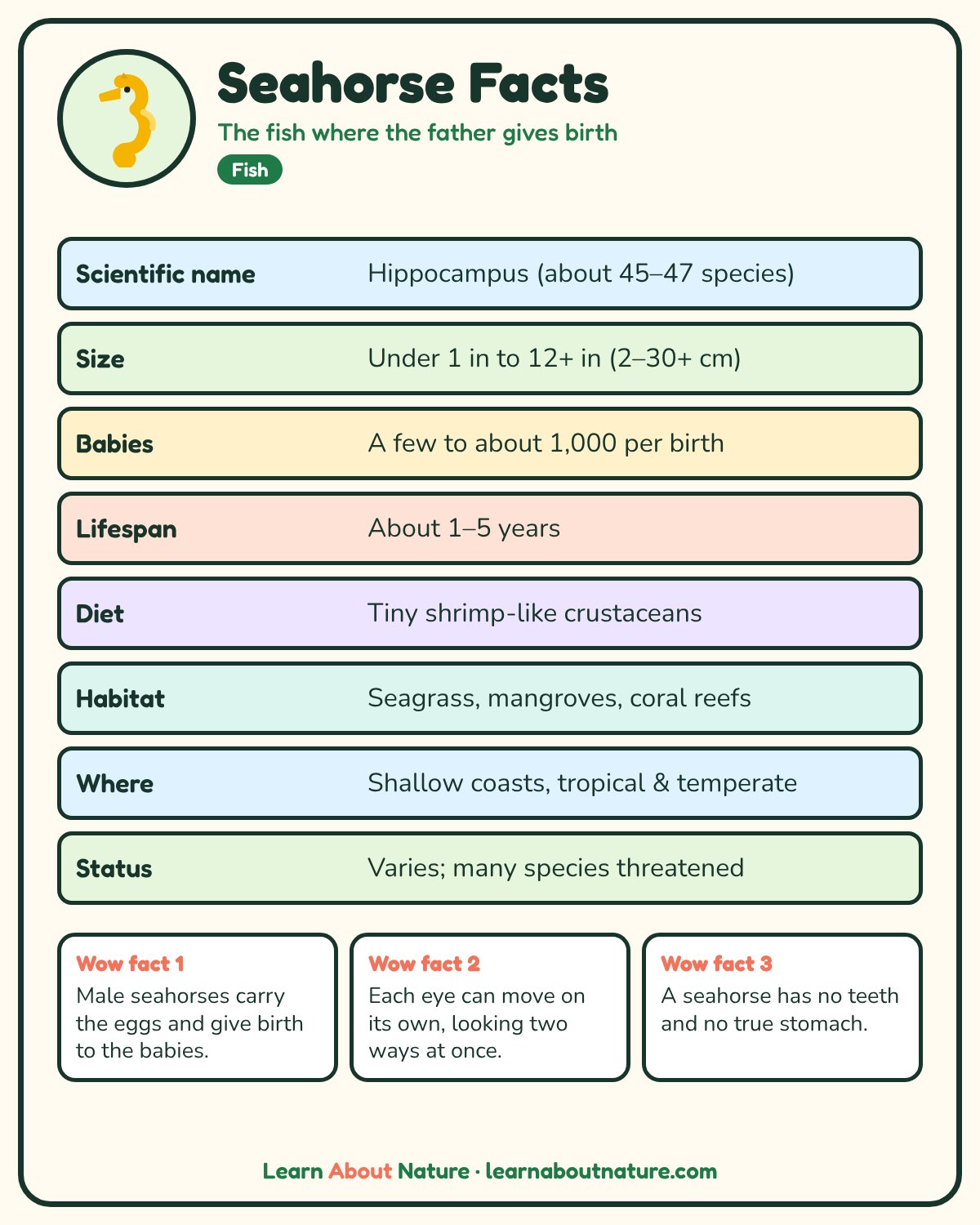
| Class | Bony fish (Actinopterygii) |
| Family | Syngnathidae (with pipefish and seadragons) |
| Number of species | About 45–47 |
| Size | Under 1 in to about 12 in (2–30 cm) or more |
| Lifespan | About 1 year (small species) to 3–5 years (larger species) |
| Diet | Small crustaceans, fish fry, other tiny animals |
| Baby name | Fry |
| Pregnancy | About 2–4 weeks, carried by the male |
| Babies per birth | A few to about 1,000 (record over 1,500) |
| Conservation | Varies by species; many threatened (IUCN Red List) |
What Is a Seahorse?
A seahorse is a fish. It has gills to breathe underwater, a backbone, and fins, just like a goldfish or a tuna. All seahorses belong to one genus, Hippocampus, a name that comes from Greek words for “horse” and “sea monster.”
Scientists recognize about 45 to 47 species, and new ones are still being found. More than a dozen have been described only since the year 2000. Seahorses belong to the same family as pipefish and seadragons, which are long, thin fish with similar tube-shaped snouts.
Unlike most fish, a seahorse swims upright, with its head held up and its tail hanging below. Its skin covers a suit of bony plates, so it feels stiff rather than slippery.
Where Do Seahorses Live?
Seahorses live in shallow coastal waters in tropical and temperate (mild) seas around the world, from roughly 50 degrees north to 50 degrees south of the equator. Most species are found in the western Atlantic Ocean and the Indo-Pacific region.
They like places with lots of things to hold on to. Seagrass meadows, mangrove roots, coral reefs, seaweed and even estuaries, where rivers meet the sea, all make good seahorse homes. Many seahorses stay in a very small area for weeks or months.
What Do Seahorses Eat?
Seahorses are carnivores, which means they eat other animals. Their main food is tiny crustaceans such as amphipods and mysid shrimp. They also eat baby fish and other small invertebrates that drift past.
A seahorse has no teeth and no true stomach. It waits quietly, then snaps its head forward and sucks prey into its long snout like a vacuum cleaner. Because food passes through its body quickly, a seahorse needs to eat often. Seahorses only eat living, moving food.
Body, Senses and How Seahorses Swim
A seahorse swims by fluttering the small fin on its back, called the dorsal fin, many times a second. Two little fins near its head, the pectoral fins, help it steer. This makes seahorses good at turning and hovering but very slow. The dwarf seahorse is listed by Guinness World Records as the slowest fish, moving only about 5 feet (1.5 meters) in an hour.
Instead of racing around, a seahorse wraps its prehensile tail around seagrass or coral to hold still. Its eyes can move separately, so it can watch for food with one eye and for danger with the other.
Seahorses are masters of disguise. Special color cells in their skin let them change color to match their surroundings, and some species grow little skin flaps that look like seaweed. Pygmy seahorses, some smaller than a fingernail, look almost exactly like the sea fans they live on.
Seahorse Babies: When Dads Give Birth
In most seahorse species, a male and female pair up and greet each other each morning with a little dance. They change color, swim side by side and twirl together. Courtship before mating can last for hours or even days.
When they mate, the female places her eggs into a pouch on the male’s belly called the brood pouch. The eggs are fertilized there, and the male carries them while they grow. Pregnancy usually lasts about two to four weeks, and it is shorter in warmer water.
Then the father gives birth, pushing out tiny babies called fry. Depending on the species, he may release just a few, a few dozen or about 1,000 young at once. One male in a study gave birth to more than 1,500. The babies are fully formed and on their own right away. Only a very small number, roughly 1 in 200, survive to become adults.
Seahorse Behavior
Most seahorses studied in the wild seem to stay with one partner for at least a breeding season. Their daily greeting dance may help the pair stay in step, so the female is ready with new eggs soon after the male gives birth.
Seahorses are calm, shy animals. They spend much of the day holding on with their tails, waiting for food to drift close. Some species stay inside a home range only a few square yards in size.
Predators, Threats and Conservation Status
Adult seahorses have few natural predators because they are bony, spiky and well hidden. Crabs, large fish, rays, sea turtles, penguins and water birds sometimes eat them. Babies are in much more danger, since many small animals feed on them.
The biggest threat to seahorses comes from people. Many are caught by accident in shrimp trawl nets. Others are taken for traditional medicine, sold dried as souvenirs or caught for aquariums. Pollution and the loss of seagrass beds, mangroves and coral reefs also harm them.
Each species has its own status on the IUCN Red List. More than a third of the assessed seahorse species are listed as threatened (Vulnerable, Endangered or Critically Endangered), and for several others there is not yet enough data to tell. Since 2004, international trade in all seahorses has been controlled under CITES, a global wildlife-trade treaty.
Fun Facts About Seahorses
Here are a few more surprising seahorse facts to share with friends.
- Seahorses and their relatives in the pipefish family are the only animals in which males become pregnant.
- Seahorses swim upright, not flat like most fish.
- A seahorse’s snout works like a drinking straw for catching food.
- The smallest pygmy seahorses are less than 1 inch (2 cm) tall.
- The big-bellied seahorse of Australia and New Zealand is one of the largest, growing to about 12 inches (30 cm) or more.
- Many seahorses have a bony bump on top of the head called a coronet, shaped a bit like a crown.
Seahorse vs. Seadragon
Seadragons live only along the southern coast of Australia. They are close cousins of seahorses, but they have long, leafy skin flaps and their tails cannot grab onto things.
Male seadragons also carry the eggs, but they glue them to the underside of the tail instead of keeping them inside a closed pouch. Pipefish, another cousin, look like seahorses that have been stretched out straight.
Fast Facts for Young Readers
- A seahorse is a fish, even though it looks like a horse.
- Seahorse dads carry the eggs in a pouch on their tummy.
- Baby seahorses are called fry.
- Seahorses hold on to seagrass with their curly tails.
- They suck up tiny shrimp through their long snouts.
- Seahorses can change color to hide.
- They are some of the slowest swimmers in the sea.
Key words: brood pouch – a pocket on a male seahorse’s belly where eggs grow into babies; fry – baby fish, including baby seahorses; prehensile tail – a tail that can wrap around and hold on to things; camouflage – colors or shapes that help an animal blend in with its surroundings; crustacean – an animal with a hard outer shell and jointed legs, such as a shrimp or crab; bycatch – animals caught by accident in fishing nets meant for other kinds of sea life.
Try this: Fill a clear jar with water, add a few strips of green paper as seagrass, and move a paper seahorse through it. Talk about how holding on with a curled tail helps a slow swimmer stay safe and hidden.
Related Guides
- Octopus facts for kids
- Shark facts for kids
- Starfish facts for kids
- Manatee facts for kids
- All animal facts for kids
Seahorse FAQs
Is a seahorse a fish?
Yes. A seahorse is a bony fish. It breathes with gills, has a backbone and uses fins to swim. Its unusual shape, upright posture and bony armor make it look very different from other fish, but it belongs to the same family as pipefish and seadragons.
Do male seahorses really give birth?
Yes. The female places her eggs in the male’s brood pouch, where they are fertilized and grow. After about two to four weeks, the male pushes the babies out of his pouch. Depending on the species, he may release a few young or around a thousand at once.
How long do seahorses live?
Lifespans in the wild are not well known. Scientists think the smallest species live about one year, while larger species live about three to five years on average. Many babies never reach adulthood because so many are eaten in their first days.
What do seahorses eat?
Seahorses eat tiny live animals, mainly small crustaceans such as amphipods and mysid shrimp, plus baby fish. They have no teeth, so they suck prey into their tube-shaped snouts in a quick snap. Because they have no true stomach, they need to eat often throughout the day.
Are seahorses endangered?
Some are. Each seahorse species has its own IUCN Red List status. More than a third of assessed species are listed as threatened, and several others lack enough data. Bycatch in shrimp trawls, trade for medicine and souvenirs, and loss of seagrass, mangroves and reefs are the main problems.
Sources: Seahorse FAQs – Project Seahorse; Do seahorses really give birth? – NOAA Ocean Service; Seahorse – National Geographic; Slowest fish – Guinness World Records; Hippocampus – IUCN Red List

Nato is a content writer and researcher with a background in psychology who’s eager to explore the wonders of nature. As a travel enthusiast and animal lover, she hopes to inspire others to discover and cherish the beauty and importance of the natural world. She also writes about the history of candy and snacks for Snack History and about food and healthy eating for The Fitchen.