Moose Facts for Kids: Habitat, Diet and Fun Facts
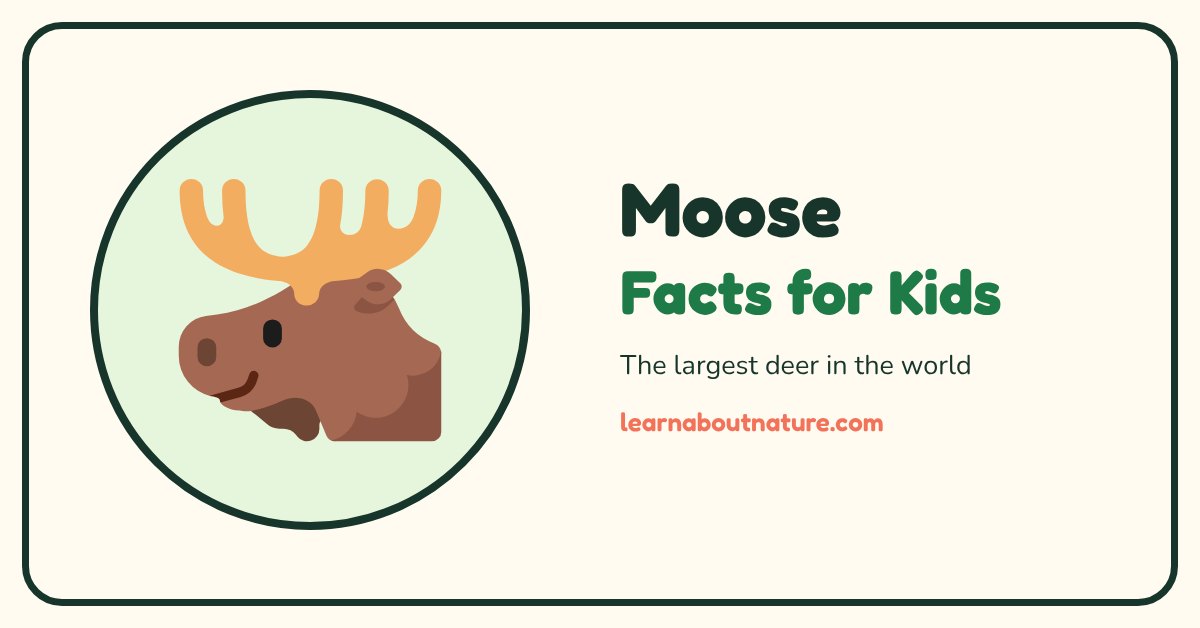
Quick answer: A moose is the largest member of the deer family. It lives in cold northern forests near lakes and wetlands in North America, Europe and Asia. Moose are herbivores that browse on twigs, leaves, bark and water plants. Males grow enormous, flat antlers every year and shed them each winter.
Imagine a deer taller than a grown-up, with long legs, a big droopy nose and antlers as wide as a car is long. That is a bull moose. It is the tallest land animal in North America.
Moose look a bit clumsy, but they are strong swimmers, fast runners and expert survivors of deep snow and freezing winters. Here is what life is like for the world’s biggest deer.
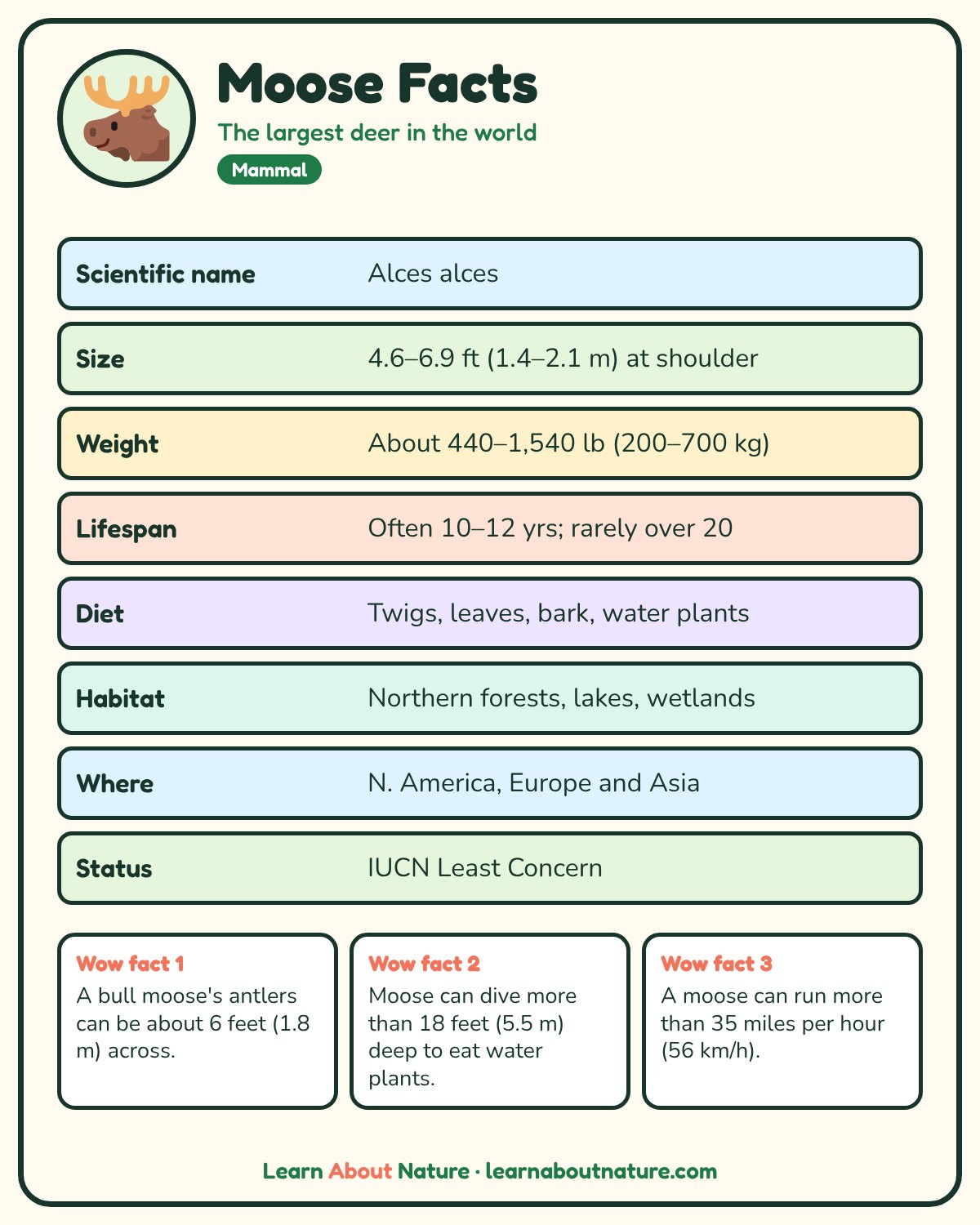
Teachers and students: you’re welcome to use this fact sheet in lessons and projects with credit to Learn About Nature.
Free printable: Download the Moose fact file worksheet (PDF) – draw the animal, fill in the facts and match key words. Answer key included.
Moose Quick Facts
| Class | Mammal |
| Family | Deer family (Cervidae) |
| Scientific name | Alces alces |
| Height | About 4.6–6.9 ft (1.4–2.1 m) at the shoulder |
| Weight | Cows 440–1,080 lb; bulls 840–1,540 lb |
| Top speed | More than 35 mph (56 km/h) |
| Lifespan | Often 10–12 years; rarely more than 20 |
| Baby name | Calf |
| Calves per birth | 1, sometimes twins |
| Conservation status | Least Concern (IUCN) |
What Is a Moose?
The moose is the largest living member of the deer family, Cervidae. Its scientific name is Alces alces. The word “moose” comes from an Algonquian word often translated as “twig eater.”
In Europe, people call this animal an elk. That can be confusing, because in North America “elk” means a different, smaller deer also called the wapiti. The plural of moose is just moose.
Where Do Moose Live?
Moose live in the cold northern parts of the world. In North America they live across most of Canada and Alaska and in northern US states from Maine to Washington, with some in the Rocky Mountains. In Europe and Asia they live in Scandinavia, the Baltic countries, Poland and across Russia to Mongolia and northern China.
Their favorite habitat is the boreal forest, also called the taiga, with lots of willow, birch, aspen and fir, plus lakes, ponds, bogs and rivers. Moose are built for cold. They can overheat in hot weather and often cool off by standing in water or resting in shade.
What Do Moose Eat?
Moose are herbivores. They are browsers, which means they eat leaves, twigs, buds and bark from trees and shrubs rather than mostly grass. Willow, birch, aspen and balsam fir are favorites.
In summer, moose wade into ponds and lakes to eat water plants such as pondweed and water lilies. These plants give them sodium, a salt their bodies need. Moose can put their whole head underwater and even dive more than 18 feet (5.5 m) to reach plants on the bottom.
In winter, when leaves are gone, moose chew twigs, bark and evergreen needles. A large moose can eat about 70 pounds (32 kg) of food in a day.
Body, Antlers and Senses
Moose are huge. An adult stands about 4.6 to 6.9 feet (1.4 to 2.1 m) tall at the shoulder. Bulls (males) usually weigh about 840 to 1,540 pounds (380 to 700 kg), and cows (females) about 440 to 1,080 pounds (200 to 490 kg). The largest moose live in Alaska and far eastern Russia.
Only bulls grow antlers. Unlike horns, antlers are made of bone, fall off every year and grow back. A bull drops his antlers in late fall or winter after the mating season, then grows a new set starting in spring. While growing, the antlers are covered in soft, furry skin called velvet. Big bulls’ antlers can be about 6 feet (1.8 m) across.
A moose has long legs for stepping through deep snow and fallen logs, a hump of muscle over its shoulders and a flap of skin under its throat called a bell or dewlap. Its eyesight is fairly poor, but its hearing and sense of smell are excellent. Its big, flexible upper lip helps it strip leaves from branches.
Moose Calves
Moose mate in the fall, mainly in September and October. This season is called the rut. Bulls grunt, thrash bushes and sometimes fight by pushing their antlers together. Cows make loud, moaning calls.
A cow is pregnant for about eight months. In late spring she gives birth to one calf, or twins when food has been plentiful. A newborn calf usually weighs about 25 to 35 pounds (11 to 16 kg) and has reddish-brown fur. Calves can walk within a day and grow fast. Within about five months they can weigh ten times their birth weight.
The calf stays close to its mother for about a year. She protects it fiercely from wolves and bears. Just before she gives birth again, she chases the yearling away so it can live on its own.
- Pregnancy: about 8 months
- Calves per birth: 1, sometimes twins
- Birth weight: about 25–35 lb
- Time with mother: about 1 year
How Moose Behave
Adult moose usually live alone, apart from mothers with calves. In winter, a few moose may gather in places with good food and shelter. Moose are most active around dawn and dusk.
Moose are excellent swimmers and can cross wide lakes and rivers. On land, they can trot through deep snow and run more than 35 miles per hour (56 km/h) in short bursts.
Moose are not usually aggressive, but they are very large and can be dangerous, especially a mother with a calf or a bull during the rut. People should always watch moose from a safe distance.
Predators, Threats and Conservation
Wolves and brown bears (including grizzlies) are the main predators of moose, and black bears often catch young calves. In parts of Asia, tigers also hunt moose. Many calves do not survive their first year.
Warmer winters linked to climate change are a growing problem in some areas. Winter ticks can attach to a single moose by the tens of thousands, and parasites like brainworm, spread by white-tailed deer, can make moose sick. Collisions with cars and trains also kill many moose. In some northeastern US states, moose numbers have dropped sharply.
Worldwide, however, moose are still common, with well over a million in North America and Eurasia. The IUCN Red List lists the moose as Least Concern.
Moose vs Elk (Wapiti)
In North America, moose and elk often share the same mountains, so it helps to know the difference. A moose is bigger and darker, with a long, droopy nose, a shoulder hump and a bell of skin hanging under its throat. Bull moose have wide, flat antlers shaped a bit like open hands.
An elk, or wapiti, is smaller and lighter brown, with a pale rump patch and a darker neck. Bull elk have long, pointed antlers that sweep backward, with no flat part. Elk usually live in herds and graze on grass, while moose mostly live alone and browse on twigs and water plants.
Their calls are different, too. In the fall, bull elk make a high, whistling call called a bugle, while bull moose give deep grunts.
Fun Facts About Moose
A few more things to know about moose:
- The moose is the tallest land animal in North America.
- A bull grows a whole new set of antlers in just a few months each year.
- Moose can close their nostrils when they put their heads underwater.
- Their long legs help them step through deep snow that slows down wolves.
- Moose often wade into water to escape biting insects in summer.
Fast Facts for Young Readers
- The moose is the biggest kind of deer.
- Moose live in cold northern forests.
- They eat twigs, leaves, bark and water plants.
- Only male moose grow antlers.
- Moose lose their antlers every winter and grow new ones.
- A baby moose is called a calf.
- Moose are great swimmers.
Key words: antlers – bony branches that grow on a male deer’s head and fall off each year; browser – an animal that eats leaves, twigs and shoots from trees and shrubs; rut – the fall mating season of moose and other deer; velvet – the soft, furry skin that covers growing antlers; boreal forest – the cold, northern forest of evergreen and birch trees, also called taiga.
Try this: Use a measuring tape and chalk to mark 6 feet (1.8 m) on a wall or sidewalk to show how tall a moose stands at the shoulder and how wide big antlers can be.
Related Guides
- Gorilla facts for kids
- Meerkat facts for kids
- Polar Bear facts for kids
- Tiger facts for kids
- All animal facts for kids
Moose FAQs
How big is a moose?
A moose stands about 4.6 to 6.9 feet (1.4 to 2.1 m) tall at the shoulder, often taller than an adult person. Bulls usually weigh about 840 to 1,540 pounds, and cows about 440 to 1,080 pounds. The biggest moose live in Alaska and far eastern Russia.
Do female moose have antlers?
No. Normally only bull moose grow antlers. Bulls shed their antlers after the fall mating season and grow a new set each spring and summer. While they grow, the antlers are covered in soft, furry skin called velvet.
Can moose swim?
Yes. Moose are excellent swimmers. They often cross lakes and rivers, wade in to escape biting insects, and feed on water plants. They can put their whole heads underwater and have even been seen diving more than 18 feet deep to reach plants on the bottom.
What is the difference between a moose and an elk?
In North America, a moose and an elk are two different deer. The moose is bigger, with a droopy nose, a throat bell and flat, wide antlers. The elk, or wapiti, is smaller with pointed antlers. In Europe, though, people call the moose an elk.
Are moose dangerous?
Moose usually avoid people, but they are very large and can kick or charge if they feel threatened. Mothers with calves and bulls during the fall rut are most likely to be aggressive. Always watch moose from a safe distance and never approach or feed one.
Sources: Alaska Department of Fish and Game: Moose; National Wildlife Federation: Moose; Wikipedia: Moose (size, diet, diving and IUCN 2016 assessment)

Nato is a content writer and researcher with a background in psychology who’s eager to explore the wonders of nature. As a travel enthusiast and animal lover, she hopes to inspire others to discover and cherish the beauty and importance of the natural world. She also writes about the history of candy and snacks for Snack History and about food and healthy eating for The Fitchen.