Cat Anatomy: Parts of a Cat and What They Do
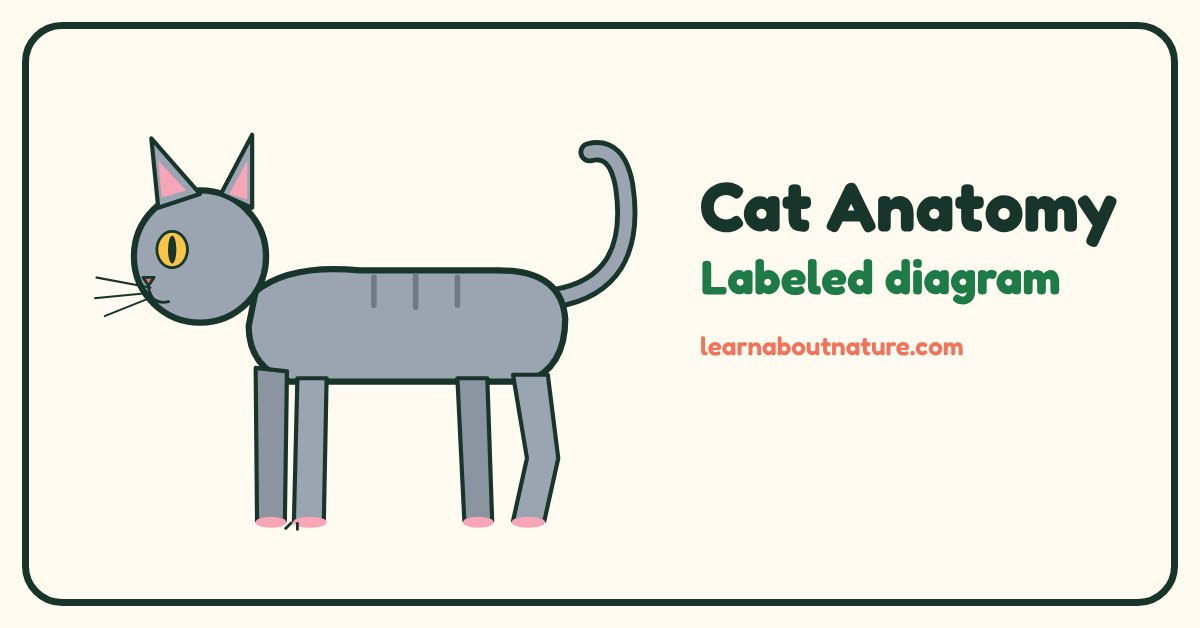
Quick answer: A cat’s main external parts are its triangular ears (pinnae), large eyes, nose, whiskers, flexible neck and spine, shoulders, four legs ending in padded paws with retractable claws, muscular haunches and a long tail. Cats walk on their toes, and their whiskers, ears and eyes give them very sharp senses for hunting.
Pet cats are close relatives of wild cats such as the African wildcat, and they still have the body of a hunter. They can leap several times their own height, squeeze through tiny gaps and land on their feet after a fall.
This guide explains cat anatomy: the parts you can see on the outside, from whiskers to tail, and the skeleton, teeth and senses that make cats such skillful, agile animals.
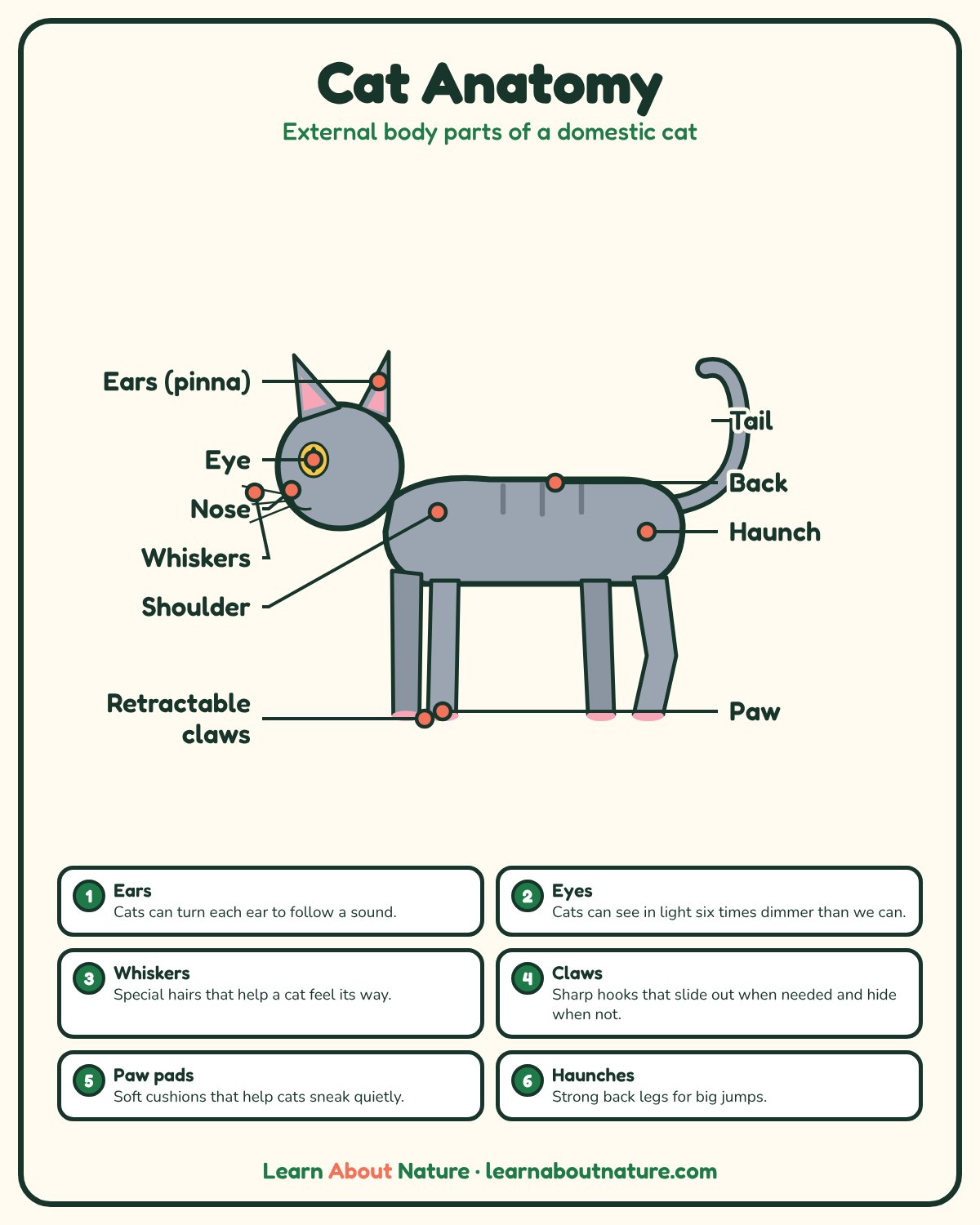
Teachers and students: you’re welcome to use this diagram in lessons and projects with credit to Learn About Nature.
Free printable: Download the Cat Anatomy labeling worksheet (PDF) – label the parts using the word bank. Answer key included.
Parts of a Cat and What They Do
| Part | What it does |
|---|---|
| Ears (pinnae) | Collect sound; swivel toward noises |
| Eyes | See well in dim light; judge distance for pouncing |
| Tapetum lucidum | Reflects light inside the eye; makes eyes glow |
| Nose | Smells food, other cats and danger |
| Whiskers (vibrissae) | Sense touch, air movement and gap width |
| Teeth (30 in adults) | Grip and slice meat |
| Tongue | Rough spines groom fur |
| Shoulders | Loose joints allow long strides and squeezing through gaps |
| Paw pads | Cushion landings and allow silent walking |
| Retractable claws | Climb, grip and defend; stay hidden when not needed |
| Haunches | Powerful hips and back legs for jumping |
| Tail | Balances the body and shows feelings |
The Cat Body Plan
Cats are mammals in the cat family, Felidae, which also includes lions, tigers and lynxes. A house cat has a rounded head, a flexible neck and spine, four legs and a long tail. Most domestic cats are similar in size; the smallest and largest breeds differ by only about 5 to 10 pounds.
Like dogs, cats are digitigrade: they walk on their toes. A cat usually has five toes on each front foot and four on each back foot, making 18 in all.
The Head: Ears, Eyes, Nose and Whiskers
- Ears: the outer ear flap is called the pinna. It is shaped like a funnel to collect sound. A cat has many muscles in each ear and can swivel each one separately toward a noise.
- Eyes: very large for the size of the head and placed at the front, which helps a cat judge distance when it pounces. In bright light the pupils shrink to narrow vertical slits; in the dark they open wide.
- Nose: the leather on the nose has a pattern of tiny bumps. Inside, the nose has many smell-sensing cells.
- Whiskers: stiff, deeply rooted hairs called vibrissae. Most cats have about 12 on each side of the muzzle, roughly 24 in all, plus more above the eyes, on the chin and on the back of the front legs.
- Mouth: holds sharp teeth and a rough tongue.
Paws and Retractable Claws
Under each paw are soft paw pads: one under each toe and a larger pad behind them, plus a small extra pad on the back of each front wrist. Pads cushion landings and let a cat creep silently.
A cat’s claws are curved and sharp. When the cat is relaxed, stretchy ligaments hold each claw pulled back into a sheath of skin and fur, so it stays sharp and does not click on the ground. When the cat needs them, muscles pull on tendons in the toes and the claws slide out. This is why cats’ claws are called retractable.
Cats use their claws to climb, grip prey, defend themselves and stretch. Scratching also removes the worn outer layers of the claws, leaving sharp new ones underneath.
Shoulders, Haunches and Tail
A cat’s shoulders are very loose. Its collarbones are tiny and not firmly joined to the rest of the skeleton, so the shoulder blades can slide freely. This lets a cat take long strides and squeeze through surprisingly narrow gaps.
The haunches are the hips and the big muscles of the back legs. When a cat crouches before a jump, it is loading these muscles like a spring. The back legs are longer than the front legs, which gives cats their powerful leap.
The tail helps with balance when a cat walks along a narrow fence or turns quickly. It is also used to communicate: a tail held straight up usually means a friendly greeting, while a puffed or swishing tail can mean fear or annoyance.
Skeleton, Organs, Teeth and Tongue
A cat’s skeleton has about 230 to 250 bones, depending partly on tail length. The spine is extremely flexible, with loosely linked bones that let a cat arch its back, twist in the air and stretch out to full length when running.
Inside the chest, protected by the ribs, are the heart and lungs. The belly holds the liver, stomach, intestines and kidneys. Cats are obligate carnivores, which means their bodies are built to live on meat. Their intestines are short compared with those of plant-eating animals, and they need certain nutrients that are found naturally in animal foods. In the wild, a cat eats many small meals a day, such as mice and birds, rather than one big meal.
Kittens have 26 baby teeth. Between about 5 and 7 months old, these are replaced by 30 adult teeth, including 12 small incisors and 4 long canines. Cats have sharp, blade-like cheek teeth for slicing meat and do not have flat molars for grinding plants.
A cat’s tongue is covered in tiny, stiff, backward-pointing spines called papillae. They work like a comb when a cat grooms its fur.
A Cat’s Senses
- Sight: cats see in dim light about six times better than people. A mirror-like layer behind the retina, the tapetum lucidum, bounces light back through the eye, which is why cats’ eyes glow at night. Cats do see some color, but probably not as richly as people do.
- Hearing: cats hear sounds from about 45 to 64,000 Hz, much higher than people can hear. This lets them detect the squeaks and rustles of mice.
- Touch: whiskers sense air currents and nearby objects, helping a cat move in the dark and judge whether a gap is wide enough.
- Smell: cats also have a vomeronasal (Jacobson’s) organ in the roof of the mouth. A cat sometimes opens its mouth slightly and curls its lip to draw scents toward it.
- Taste: cats cannot taste sweetness. Scientists found that the gene for the sweet taste receptor does not work in cats.
Landing on Their Feet
Cats have a famous righting reflex. If a cat falls, its balance organs in the inner ear sense which way is up. The cat twists its head and front half around first, then its back half, so it can turn over in the air and land feet first. Its flexible spine and loose shoulders make this possible. Even so, falls can still hurt cats, so it is important to keep windows and balconies safe.
House Cats Compared With Big Cats
A house cat’s body is a small version of a big cat’s. Lions and tigers also have retractable claws, whiskers, a tapetum lucidum and rough tongues. One difference is the voice: house cats purr but cannot roar, while lions, tigers, leopards and jaguars can roar. The pupils differ too. House cats have slit-shaped pupils, which suit small hunters active in dim light, while lions and tigers have round pupils.
Fun Facts About Cat Anatomy
- Most cats have 18 toes, but some cats, called polydactyl cats, are born with extra toes.
- Cats have a clear third eyelid that sweeps across the eye to protect it.
- Whiskers on the back of the front legs help a cat feel prey it is holding.
- Cats sweat only a little, mainly through their paw pads.
- A cat’s whiskers are shed and regrow, just like its fur.
- Kittens are born with their eyes closed. Their eyes usually open when they are one to two weeks old, and kitten eyes are blue at first.
Cat Anatomy for Kids
- Ears: cats can turn each ear to follow a sound.
- Eyes: cats can see in light six times dimmer than we can.
- Whiskers: special hairs that help a cat feel its way.
- Claws: sharp hooks that slide out when needed and hide when not.
- Paw pads: soft cushions that help cats sneak quietly.
- Haunches: strong back legs for big jumps.
- Tail: helps a cat balance and tells how it feels.
Key words: pinna – the outer flap of the ear (plural: pinnae); retractable – able to be pulled back in, like a cat’s claws; vibrissae – the scientific name for whiskers; tapetum lucidum – a mirror-like layer in the eye that helps animals see in dim light; digitigrade – walking on the toes instead of the whole foot; righting reflex – the way a falling cat twists to land on its feet.
Try this: Watch a cat (or a video of one) for five minutes and note every time its ears turn, its tail changes position or its whiskers move forward. Talk about what the cat might have been sensing or feeling each time.
Related Guides
- Cat life cycle
- Cow Stomach
- Dog Anatomy
- Rabbit life cycle
- Wolf life cycle
- Fox life cycle
- All labeled anatomy diagrams
Cat Anatomy FAQs
What are the main parts of a cat?
A cat’s main external parts are its ears (pinnae), eyes, nose, whiskers, mouth, neck, shoulders, chest, back, haunches, four legs with padded paws and retractable claws, and a long tail. Inside, a flexible spine and loose shoulders let cats twist, stretch and squeeze through small spaces.
How many whiskers does a cat have?
Most cats have about 24 whiskers on the muzzle, around 12 on each side, usually in rows. They also have shorter whiskers above the eyes, on the chin and on the back of the front legs. The exact number varies from cat to cat.
Why do cats have retractable claws?
Keeping the claws pulled back while walking stops them from wearing down or clicking on the ground, so they stay sharp and the cat can move quietly. When a cat climbs, catches prey or defends itself, muscles and tendons push the claws out in an instant.
How many teeth does a cat have?
Adult cats have 30 teeth: 12 incisors, 4 canines, and premolars and molars for slicing meat. Kittens have 26 baby teeth, which are replaced by adult teeth between about 5 and 7 months of age.
Can cats see in the dark?
Cats cannot see in total darkness, but they see in dim light about six times better than people. Their large pupils open wide, and a reflective layer called the tapetum lucidum bounces light back through the eye, giving the light-sensing cells a second chance to detect it.
Sources: Description and Physical Characteristics of Cats – Merck Veterinary Manual; Did You Know? (Cat whiskers) – The Cat Fanciers’ Association; How Well Do Dogs and Other Animals Hear? – Louisiana State University; Pseudogenization of a Sweet-Receptor Gene Accounts for Cats’ Indifference toward Sugar – PLoS Genetics (2005); Are Cats and Dogs Colourblind? – McGill Office for Science and Society

Nato is a content writer and researcher with a background in psychology who’s eager to explore the wonders of nature. As a travel enthusiast and animal lover, she hopes to inspire others to discover and cherish the beauty and importance of the natural world. She also writes about the history of candy and snacks for Snack History and about food and healthy eating for The Fitchen.