Kangaroo Life Cycle: Stages From Joey to Adult

Quick answer: The kangaroo life cycle has five stages: pregnancy, newborn joey, pouch joey, young-at-foot and adult. A red kangaroo is pregnant for about 33 days. The tiny newborn crawls into the pouch, grows there for about eight months, then hops beside its mother and drinks milk until about one year old before becoming an adult.
A newborn kangaroo is about the size of a jellybean. It has no fur, its eyes are closed, and its back legs are tiny stubs. Yet within minutes of being born, it pulls itself through its mother’s fur and into her pouch, where it will spend the next several months growing.
This page follows the kangaroo life cycle using the red kangaroo, the largest kangaroo, as the main example. We also point out where the eastern grey kangaroo does things differently, and explain the clever trick called embryonic diapause that lets a mother kangaroo pause a pregnancy until the time is right.
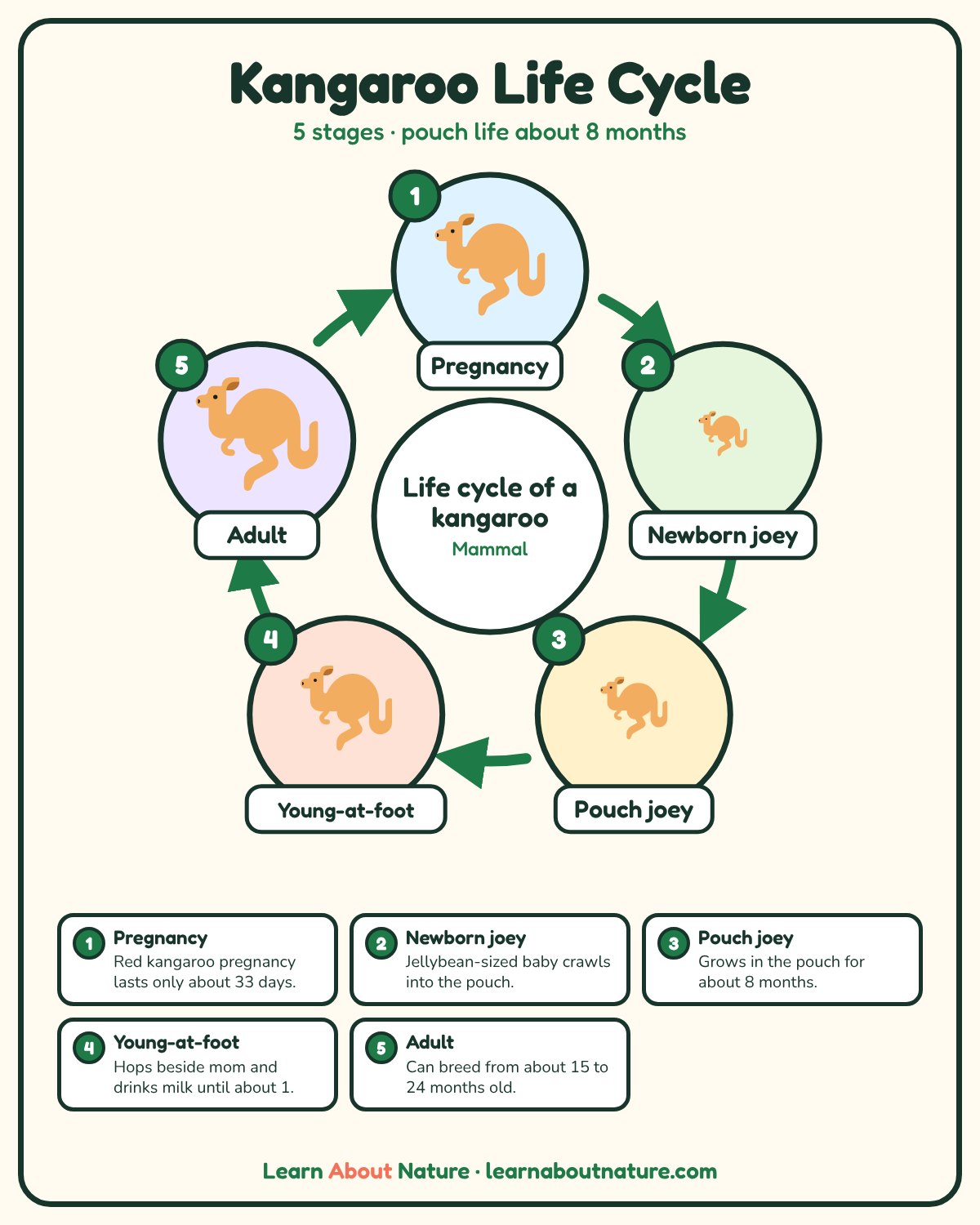
Teachers and students: you’re welcome to use this diagram in lessons and projects with credit to Learn About Nature.
Free printable: Download the Kangaroo life cycle worksheet (PDF) – label the diagram, cut and sequence the stages, and match key words. Answer key included.
Kangaroo Life Cycle Quick Facts
| Main example | Red kangaroo (Osphranter rufus) |
| Pregnancy | about 33 days (eastern grey: about 36 days) |
| Babies per birth | 1 |
| Size at birth | about 1 in (2.5 cm), 0.75 g |
| Time in pouch | about 235 days (eastern grey: about 11 months) |
| Weaned | about 12 months |
| Breeding age | females 15–20 months; males 20–24 months |
| Adult male weight | up to about 200 lb (90 kg) |
| Lifespan | up to about 22 years recorded in the wild |
Stage 1: Mating and Pregnancy
Red kangaroos live in the dry inland parts of Australia, and they do not have a fixed breeding season. Females can breed at any time of year when there is enough food and water. In a long drought, breeding slows down or stops.
Kangaroos are marsupials, which means the baby is born very early and finishes growing in a pouch. Because of this, the pregnancy is very short. A red kangaroo is pregnant for about 33 days. An eastern grey kangaroo is pregnant a little longer, about 36 days.
Just before birth, the mother licks her pouch clean and sits with her tail pulled forward between her legs, ready for the joey to arrive.
Female kangaroos spend almost their whole adult lives either pregnant, carrying a joey or both. When food is plentiful, a healthy female can produce a new joey roughly every year.
Stage 2: The Newborn Joey
A baby kangaroo of any age is called a joey. At birth, a red kangaroo joey is only about 1 inch (2.5 cm) long and weighs about 0.75 grams, less than a paper clip. It is pink, hairless and blind.
Its front legs are much stronger than its back legs. The newborn uses them to climb up through its mother’s belly fur and into the pouch, with no help from her. The trip takes only a few minutes. Its sense of smell may help guide it toward the pouch.
Inside the pouch, the joey latches onto one of four teats. The teat swells inside its mouth so it stays firmly attached. A red kangaroo joey stays fixed to the teat for roughly the first 70 days of its life.
Stage 3: The Pouch Joey
Over the next months, the joey grows fur, its eyes open, and its back legs grow long and strong. After several months it starts poking its head out of the pouch to look around and nibble on grass.
Soon it begins hopping out for short trips, then diving back in headfirst whenever it is scared, cold or tired. A red kangaroo joey leaves the pouch for good at about 235 days old, or close to eight months.
Eastern grey kangaroo joeys stay in the pouch longer, typically about 11 months. Big joeys can look funny when their long legs and tail hang out of the pouch.
The pouch does more than carry the baby. It keeps the joey warm, protects it from the sun and from predators such as dingoes and wedge-tailed eagles, and holds the teats that give it milk. Mother kangaroos clean the pouch by licking it.
Stage 4: Young-at-Foot
Once a joey no longer lives in the pouch, it is called a young-at-foot. It hops beside its mother and eats grass, but it still drinks her milk by putting its head into the pouch. Red kangaroo young keep suckling until about 12 months of age.
Here is a surprising fact: a mother can feed a young-at-foot and a tiny new pouch joey at the same time. Each teat works partly on its own, so she can make different milk for each joey, suited to its age.
Young females often stay near their mothers in the same area. Young males tend to wander farther away as they grow.
Embryonic Diapause: Pausing a Pregnancy
A female red kangaroo usually mates again within a day or two of giving birth. The new embryo grows into a tiny ball of cells called a blastocyst and then stops growing. This pause is called embryonic diapause.
The embryo waits while the older joey uses the pouch. In red kangaroos, it starts growing again when the pouch joey is about 204 days old, or right away if the pouch joey dies. Then the new baby is born just as the pouch becomes free.
This means a mother kangaroo can look after three young at once:
- an embryo waiting inside her body,
- a small joey in her pouch, and
- a young-at-foot hopping beside her.
Stage 5: Adult Kangaroo
Female red kangaroos can start breeding at about 15 to 20 months old. Males become able to breed at about 20 to 24 months, but the biggest, strongest males usually do most of the mating. Males box and kick each other to decide who is in charge.
Adult males are much larger than females. A big male red kangaroo can stand about 6 feet (1.8 m) tall and weigh up to about 200 pounds (90 kg). Females are smaller and often have a bluish-grey coat, while males are usually reddish.
Kangaroos live in groups called mobs. Adults spend the hottest part of the day resting in the shade and feed mostly in the cooler evening, night and early morning.
How Long Do Kangaroos Live?
Red kangaroos have been recorded living to about 22 years in the wild, but most live much shorter lives. Many joeys and young-at-foot die during droughts, when there is not enough food for their mothers to make milk.
In zoos, red kangaroos live an average of about 16 years. Dangers in the wild include drought, dingoes, cars on roads at night, and hunting. The red kangaroo is still common and is not considered threatened.
Fun Facts About Kangaroo Babies
Kangaroos have some of the most unusual baby-raising habits of any mammal.
- A newborn red kangaroo is tiny compared with its mother: about 0.75 grams for a baby and up to about 90 kg for a big adult male.
- The pouch opens toward the head, so the joey can climb in from below.
- A joey that is old enough to hop still dives into the pouch headfirst, then turns around inside.
- A newborn joey stays fixed to the same teat for about 70 days before it can let go.
- The mother can stop a pregnancy in its tracks and restart it later, thanks to embryonic diapause.
How the Kangaroo Life Cycle Differs From Other Mammals
Most mammals you know, such as dogs, deer and people, are placental mammals. Their babies grow inside the mother’s body for a long time, fed through an organ called the placenta, and are born fairly well developed.
Kangaroos do it the other way around. The time inside the mother’s body is short, only about a month, and the long part of growing up happens outside, in the pouch. The milk does the job that the placenta does in other mammals.
This system has a big advantage in a dry, unpredictable land like inland Australia. A mother invests very little in the short pregnancy. If a drought arrives, she can lose a small joey without having spent months carrying it, and she often has a paused embryo ready to start again when the rains return.
Other marsupials, such as koalas, wombats and wallabies, also raise their young in pouches, but the details of each life cycle are different.
Kangaroo Life Cycle for Kids
Here is the kangaroo life cycle in simple steps:
- Pregnancy: The baby grows inside its mom for only about one month.
- Newborn joey: The tiny baby is as small as a jellybean and climbs into the pouch.
- Pouch joey: The joey drinks milk and grows big in the warm pouch.
- Young-at-foot: The joey hops next to mom but still pops its head in the pouch for milk.
- Adult: The kangaroo is grown up and can have babies of its own.
Key words: joey – a baby kangaroo; marsupial – a mammal whose babies finish growing in a pouch; pouch – a pocket of skin on a mother kangaroo’s belly; young-at-foot – a joey that lives outside the pouch but still drinks milk; embryonic diapause – when a tiny unborn baby stops growing for a while and starts again later; mob – a group of kangaroos.
Try this: Cut out a jellybean-sized paper joey and a life-size paper outline of an adult kangaroo, then compare them side by side. Ask students to measure both and talk about how much the joey must grow.
Related Life Cycles and Guides
- Cow life cycle
- Pig life cycle
- Dog life cycle
- Rabbit life cycle
- Wolf life cycle
- Fox life cycle
- All animal & plant life cycles
See also: Kangaroo Facts for Kids
Kangaroo Life Cycle FAQs
How long is a joey in the pouch?
A red kangaroo joey leaves the pouch for good at about 235 days old, which is close to eight months. Eastern grey kangaroo joeys stay longer, about 11 months. After leaving, a young kangaroo still drinks milk by putting its head into the pouch until it is about a year old.
How big is a baby kangaroo when it is born?
A newborn red kangaroo is about 1 inch (2.5 cm) long and weighs about 0.75 grams, which is roughly the size of a jellybean. It is born pink, hairless and blind, with strong front legs that it uses to climb into its mother’s pouch.
How long is a kangaroo pregnant?
Kangaroo pregnancies are very short. A red kangaroo is pregnant for about 33 days, and an eastern grey kangaroo for about 36 days. Most of the baby’s growth happens later, in the pouch, over many months.
Can a kangaroo pause its pregnancy?
Yes. After mating, a kangaroo embryo can stop growing at a very early stage and wait. This is called embryonic diapause. The embryo starts growing again when the older joey is nearly ready to leave the pouch, or if that joey dies.
How long do kangaroos live?
Red kangaroos have been recorded living to about 22 years in the wild, though most live much shorter lives because drought, predators and road accidents take many young animals. In zoos, red kangaroos live an average of about 16 years.
Sources: Red Kangaroo (Macropus rufus) – Animal Diversity Web; Red Kangaroo – Australian Museum; Eastern Grey Kangaroo (Macropus giganteus) – Animal Diversity Web; Lactation in marsupials – The Open University

Nato is a content writer and researcher with a background in psychology who’s eager to explore the wonders of nature. As a travel enthusiast and animal lover, she hopes to inspire others to discover and cherish the beauty and importance of the natural world. She also writes about the history of candy and snacks for Snack History and about food and healthy eating for The Fitchen.