Dolphin Life Cycle: Stages From Calf to Adult
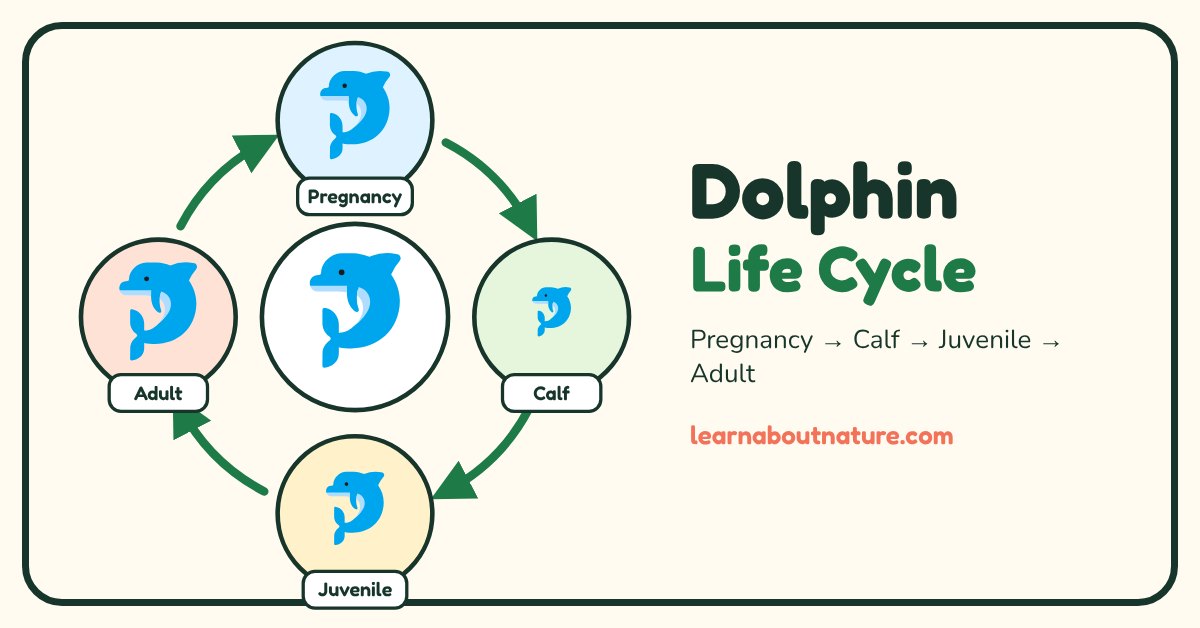
Quick answer: A dolphin’s life cycle has four stages: pregnancy, calf, juvenile and adult. A common bottlenose dolphin mother is pregnant for about 12 months and gives birth to one calf, usually tail-first. The calf nurses for about two years, stays with its mother for 3 to 6 years, and starts breeding at about 5 to 15 years old.
Dolphins are small toothed whales. Like all whales, they are mammals that breathe air, give birth to live babies and feed them milk. A dolphin spends its entire life in the water, yet it must come to the surface to breathe every few minutes.
This page follows the common bottlenose dolphin, the dolphin most people picture when they hear the word. Bottlenose dolphins have been studied for decades, so scientists know a lot about how they grow up, learn and raise their young.
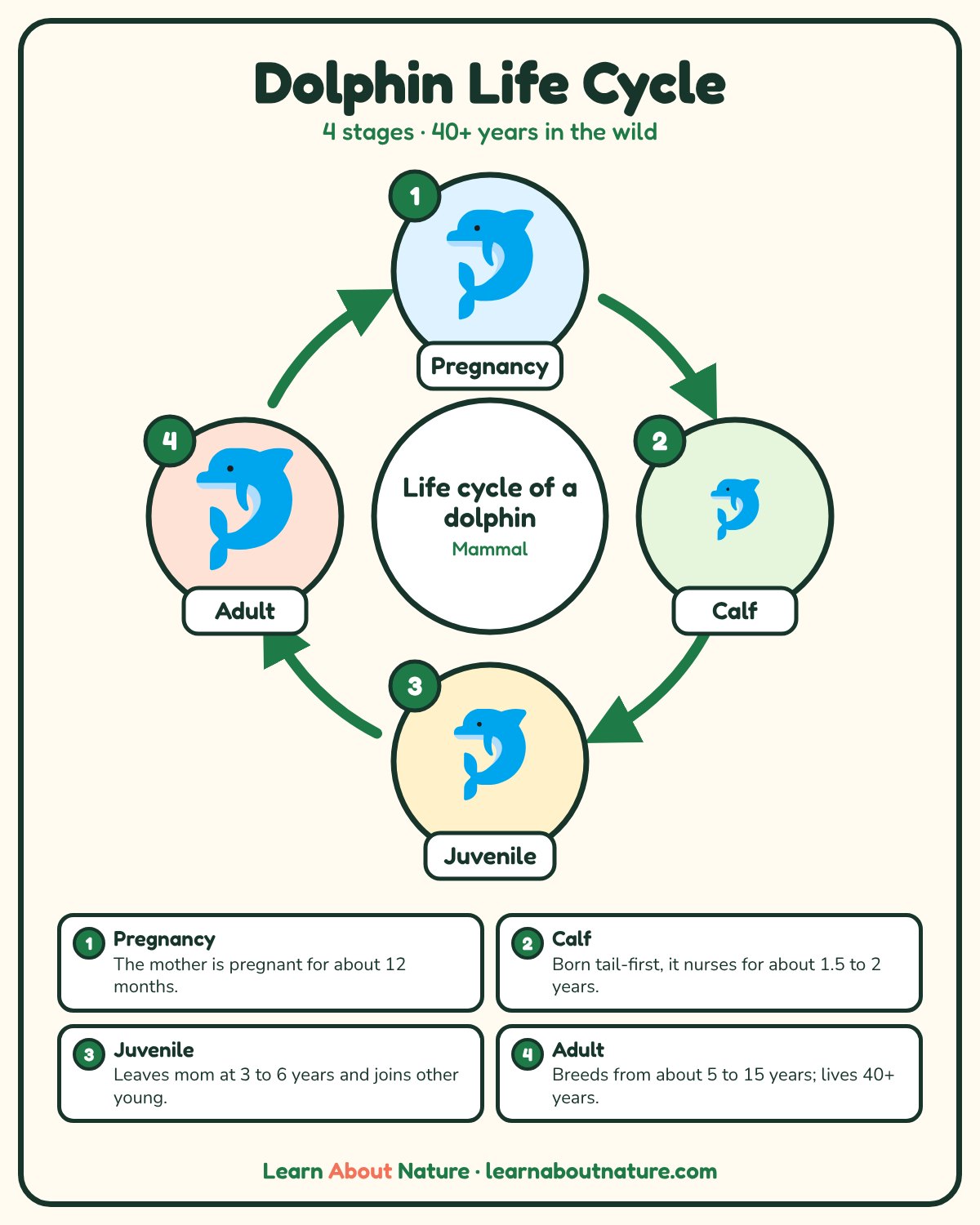
Teachers and students: you’re welcome to use this diagram in lessons and projects with credit to Learn About Nature.
Free printable: Download the Dolphin life cycle worksheet (PDF) – label the diagram, cut and sequence the stages, and match key words. Answer key included.
Dolphin Life Cycle Quick Facts
| Example species | Common bottlenose dolphin (Tursiops truncatus) |
| Pregnancy | about 12 months |
| Babies per birth | usually 1 calf |
| Length at birth | about 3.5–4 ft (about 1.1 m) |
| Weight at birth | about 22–44 lb (10–20 kg) |
| Nursing | about 18–24 months |
| Time with mother | about 3–6 years |
| Breeding age | about 5–15 years |
| Lifespan | 40+ years; some females 60+ |
Stage 1: Pregnancy
A dolphin’s life starts when a male and female mate. Bottlenose dolphins do not pair up for life. Both males and females may have several partners over the years, and fathers do not help raise the calves.
The mother is pregnant for about 12 months. She usually has a single calf. Twins are extremely rare in dolphins, because a mother can only feed and protect one baby at a time.
A female often waits 3 to 6 years between calves. That long gap gives each calf plenty of time to learn from its mother before a new baby arrives.
While she is pregnant, the mother keeps swimming, hunting and traveling with other dolphins as usual. Close to the birth, other females sometimes stay near her. Bottlenose calves can be born at any time of year, but births usually peak in the warmer months.
Stage 2: Calf
Dolphin calves are born underwater, usually tail-first. Being born tail-first keeps the calf’s blowhole covered until the very end, so it does not try to breathe too early. Right after birth, the calf swims up to the surface to take its first breath.
A newborn bottlenose dolphin is about 3.5 to 4 feet (about 1.1 m) long and weighs roughly 22 to 44 pounds (10 to 20 kg). It is darker than an adult and has pale vertical stripes on its sides. These lines come from being folded up inside its mother and fade within about six months.
The calf starts nursing within a few hours of birth. It drinks milk underwater from two slits on its mother’s belly, in short sips of just a few seconds. Dolphin milk is rich in fat, which helps the calf build a warm layer of blubber.
At first a newborn nurses very often, several times an hour, day and night. The mother rarely lets her calf stray far. If it wanders, she whistles to call it back, and the calf answers so the two can find each other again.
- The calf swims in “baby position,” close to its mother’s side and slightly behind her.
- This position helps the calf keep up, because it gets pulled along by the water flowing around its mother.
- The mother surfaces to breathe first, and the calf follows right after.
Learning to Catch Fish
A dolphin calf’s teeth start to come through at about 3 to 4 months old. Around this time it begins catching a few small fish, but milk is still its main food.
Bottlenose calves keep nursing for about 18 to 24 months. During that time they watch their mothers hunt and copy what they do. Different groups of dolphins use different hunting tricks. Some herd fish into tight balls, some chase fish onto mudbanks, and some take turns feeding while others keep the fish trapped.
Because many of these skills are learned rather than built in, the long time a calf spends with its mother is very important. Calves raised by experienced mothers often pick up the local hunting style of their community.
Stage 3: Juvenile
Most bottlenose calves stay with their mothers for about 3 to 6 years. When a new sibling is born, the older calf usually leaves and joins groups of other young dolphins.
Juvenile dolphins spend a lot of time playing, chasing each other and practicing social skills. Their groups often split up and come back together, so a young dolphin may swim with many different companions over a few weeks.
Young males often form strong friendships with one or two other males. In some places, such as Sarasota Bay in Florida and Shark Bay in Australia, these male partnerships can last for many years.
This juvenile stage is a risky time. Young dolphins are smaller and less experienced than adults, so they are more likely to be caught by large sharks. Staying in groups helps them spot danger early and escape together.
Stage 4: Adult
Bottlenose dolphins become old enough to breed at about 5 to 15 years, depending on the population. Females usually mature earlier than males. Adults are about 6 to 13 feet (2 to 4 m) long and weigh between about 300 and 1,400 pounds (135 to 635 kg). Dolphins living in cooler, deeper waters tend to be bigger than those near warm coasts.
Adult females may keep having calves for decades. Scientists have seen females as old as 45 give birth. When an adult female has a new calf, the life cycle begins again.
Adults keep learning throughout their lives. Older females often know the best feeding places and the safest spots to rest, and younger dolphins benefit from traveling with them. A healthy dolphin community needs dolphins of all ages, from newborn calves to wise old grandmothers.
Talking With Whistles and Clicks
Dolphins are very vocal. They make clicking sounds for echolocation, sending out clicks and listening for the echoes that bounce back from fish, rocks and other objects. This helps them hunt even in murky water.
Each bottlenose dolphin also develops its own signature whistle while it is young. Scientists think this whistle works a bit like a name, helping dolphins recognize and keep track of each other. Mothers and calves whistle to find each other when they get separated.
Life in a Pod
Bottlenose dolphins live in groups often called pods. A pod is not a fixed family the way an orca pod can be. Instead, dolphins join and leave groups often, a pattern scientists call fission-fusion. A dolphin may rest with one group in the morning and hunt with another in the afternoon.
Even so, some bonds are very strong. Mothers and calves stay close for years, adult females with calves of similar ages often travel together, and many adult males pair up with a favorite partner. When dolphins rest, they swim slowly side by side in tight formation and breathe in a calm, steady rhythm.
How Long Do Dolphins Live?
Common bottlenose dolphins can live for at least 40 years in the wild. Females usually outlive males, and some females have lived 60 years or more.
Scientists learn a dolphin’s age by counting growth layers in its teeth, a little like counting tree rings. Long-term studies that photograph the fins of the same dolphins every year also show how long individuals survive. Each dolphin’s dorsal fin has unique nicks and notches that work like an ID tag.
Threats to Dolphins
Bottlenose dolphins are not endangered as a species, but some local populations face serious problems. Dolphins can get tangled in fishing gear or swallow fishing line and hooks. Boat strikes, pollution, oil spills and toxic algae blooms such as red tide can also harm them.
Feeding wild dolphins is illegal in the United States. It teaches dolphins to beg near boats, which puts them at greater risk of being hit or hooked. The best way to enjoy wild dolphins is to watch quietly from a distance.
Dolphin Life Cycle for Kids
Here is the dolphin life cycle in simple steps:
- Pregnancy: The mother dolphin carries her baby inside her for about a year.
- Calf: The baby is born tail-first and drinks its mother’s milk underwater.
- Juvenile: The young dolphin leaves its mom and plays with other young dolphins.
- Adult: The grown-up dolphin finds a mate and has a calf of its own.
Key words: calf – a baby dolphin; mammal – a warm-blooded animal that breathes air and feeds its babies milk; blowhole – the nostril on top of a dolphin’s head that it breathes through; echolocation – finding things by making clicks and listening for echoes; signature whistle – a special whistle each dolphin uses a bit like a name; pod – a group of dolphins that swim together.
Try this: Hold your breath while a partner times you, then compare it with how often a dolphin must surface, and talk about why a newborn calf needs to reach the surface quickly.
Related Life Cycles and Guides
- Whale life cycle
- Octopus life cycle
- Coral life cycle
- Shark life cycle
- Fish life cycle
- Jellyfish life cycle
- All animal & plant life cycles
See also: Dolphin Facts for Kids
Dolphin Life Cycle FAQs
How long is a dolphin pregnant?
A common bottlenose dolphin is pregnant for about 12 months. Other dolphin species have similar pregnancies of around 10 to 12 months. The mother usually gives birth to just one calf, and twins are very rare.
How are baby dolphins born?
Dolphin calves are born in the water, usually tail-first. This keeps the blowhole covered until the end of the birth. Once the calf is out, it swims to the surface for its first breath, often with its mother close beside it.
How long do baby dolphins stay with their mothers?
Bottlenose dolphin calves nurse for about 18 to 24 months and usually stay with their mothers for 3 to 6 years. During this time they learn how to hunt, avoid danger and get along with other dolphins in their community.
How long do dolphins live?
Common bottlenose dolphins live at least 40 years in the wild. Females tend to live longer than males, and some have reached 60 years or more. Scientists estimate age by counting growth layers in a dolphin’s teeth.
Is a dolphin a fish or a mammal?
A dolphin is a mammal, not a fish. Dolphins breathe air through a blowhole, are warm-blooded, give birth to live young and feed their calves milk. Fish breathe with gills and most lay eggs. Dolphins belong to the same group as whales.
Sources: Common Bottlenose Dolphin – NOAA Fisheries; Bottlenose Dolphin: Care of Young – SeaWorld Parks & Entertainment; Bottlenose Dolphin – Channel Islands National Park (NPS); How dolphins communicate: new discoveries from a long-term study in Sarasota – WLRN / The Conversation

Nato is a content writer and researcher with a background in psychology who’s eager to explore the wonders of nature. As a travel enthusiast and animal lover, she hopes to inspire others to discover and cherish the beauty and importance of the natural world. She also writes about the history of candy and snacks for Snack History and about food and healthy eating for The Fitchen.