Octopus Anatomy: Parts of an Octopus and What They Do
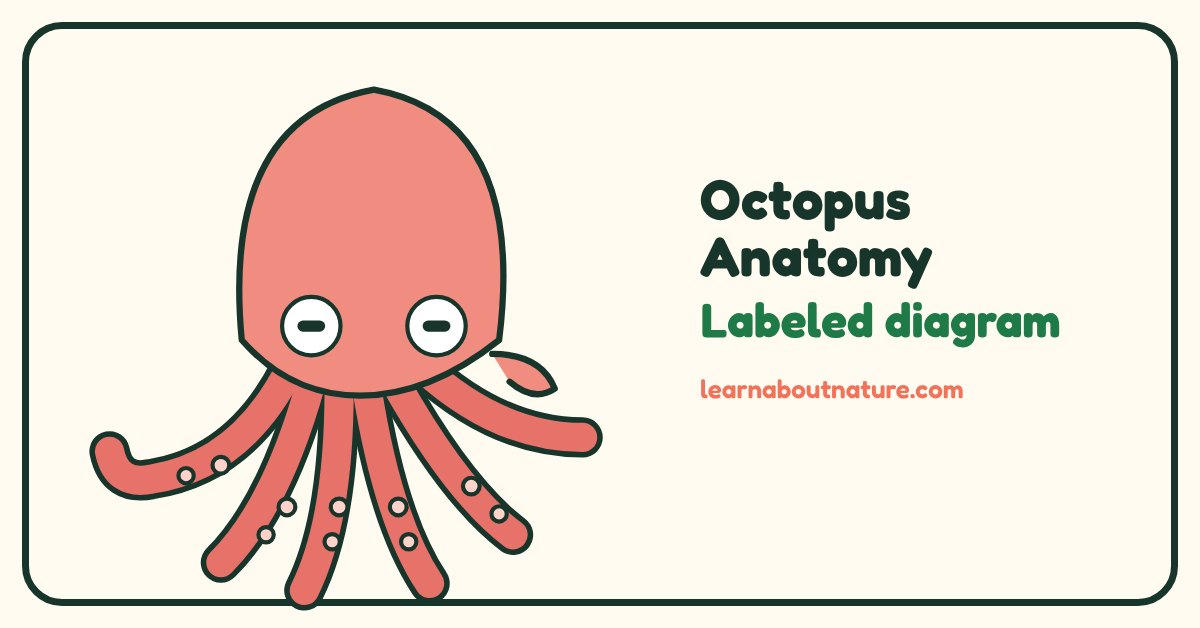
Quick answer: The main parts of an octopus are the mantle, a soft sac holding the organs; a head with two large eyes; a siphon for breathing and jet swimming; and eight arms lined with suckers. Hidden where the arms meet is a mouth with a hard beak. Inside are three hearts, gills and a large brain.
An octopus has no bones, no shell and no skeleton at all, yet it can open jars, squeeze through gaps the size of its beak and change color in a blink. Its body is arranged so differently from ours that even its head and arms seem back to front.
This guide labels the outside parts of an octopus, explains what each part does and then looks inside at its three hearts, blue blood and unusual brain. Most examples use the common octopus and the giant Pacific octopus, two of the best-studied species.
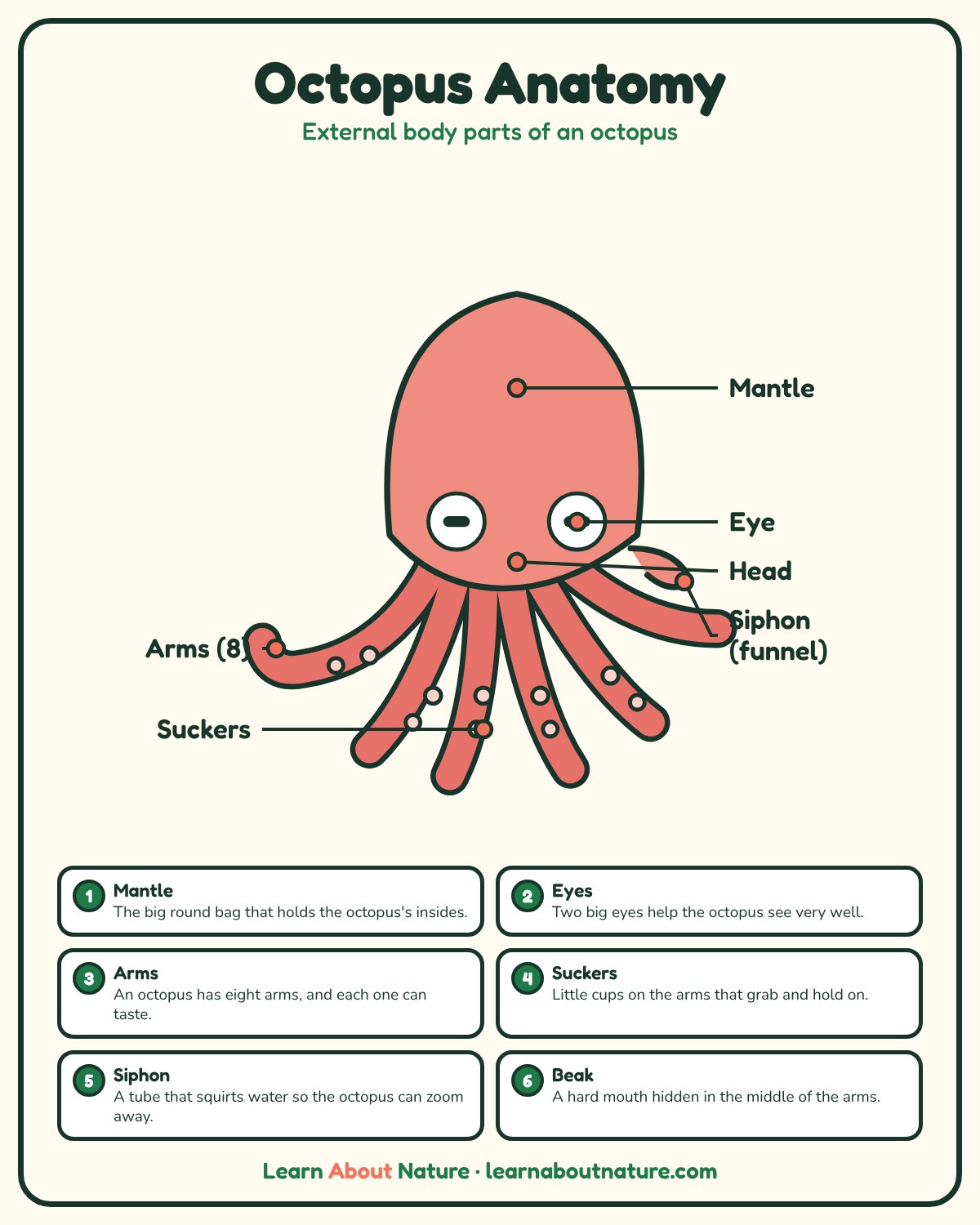
Teachers and students: you’re welcome to use this diagram in lessons and projects with credit to Learn About Nature.
Free printable: Download the Octopus Anatomy labeling worksheet (PDF) – label the parts using the word bank. Answer key included.
Parts of a Octopus and What They Do
| Part | What it does |
|---|---|
| Mantle | Muscular sac that holds the organs and pumps water |
| Head | Holds the brain and eyes; the arms grow from it |
| Eyes | See clear images to find prey and spot danger |
| Siphon (funnel) | Pushes water out for breathing and jet swimming |
| Arms (8) | Crawl, grab, explore and handle food |
| Suckers | Grip surfaces and taste what they touch |
| Web | Skin between the arms that can trap prey |
| Beak | Hard mouthpart that bites and tears food |
| Radula | Toothed, tongue-like strip that scrapes food |
| Gills | Take oxygen from the water |
| Three hearts | Two pump blood to the gills, one pumps it around the body |
| Ink sac | Stores ink squirted out to escape predators |
| Chromatophores | Color cells in the skin used for camouflage and signals |
The Octopus Body Plan
Octopuses are mollusks, related to snails and clams. Together with squid, cuttlefish and nautiluses they form the group called cephalopods, which means head-foot. That name fits: the arms grow straight out of the head.
An octopus has three main regions. The mantle is the baggy sac that holds most organs. The head carries the eyes and brain. The arms spread out around the mouth. The shell that ancient relatives carried has been lost, which is why octopuses are so squishy.
External Anatomy: Mantle, Head, Eyes and Siphon
- Mantle: A muscular sac that looks like a big head but is really the body. Inside is the mantle cavity, a space that holds the gills.
- Eyes: Two large eyes on the sides of the head. Like our eyes, they have a lens, an iris and a retina and can form clear images.
- Siphon (funnel): A flexible tube that pushes water out of the mantle cavity. The octopus can point it in different directions to steer.
- Skin: Packed with color cells called chromatophores and small bumps called papillae, so the octopus can change both color and texture.
External Anatomy: Arms, Suckers and Beak
Octopuses have eight arms, not tentacles. In zoology, tentacles are the two longer feeding limbs of squid and cuttlefish, which have suckers mostly near the tips. An octopus arm has suckers along its whole length.
The suckers grip, pull and hold, and they can also taste. A giant Pacific octopus has two rows of suckers on each arm, up to about 250 per arm, according to Georgia Aquarium. A thin web of skin links the arms near their base and can spread out like an umbrella to trap prey.
The mouth sits in the middle of the underside, where all eight arms meet. Inside is a hard beak, shaped a little like a parrot’s, used to bite and tear food. Behind the beak is the radula, a tongue-like strip covered with tiny teeth. In males, one arm is specially shaped for passing sperm to a female.
Internal Anatomy: Three Hearts and Blue Blood
An octopus has three hearts. Two smaller ones, called branchial hearts, pump blood through the two gills. The third, the systemic heart, sends oxygen-rich blood around the rest of the body. Smithsonian Magazine notes that this main heart stops beating while the octopus swims, one reason octopuses prefer crawling.
Octopus blood is blue. It carries oxygen with hemocyanin, a protein built around copper, rather than the iron-based hemoglobin in our blood.
Other organs include the gills inside the mantle cavity, a digestive gland, a stomach, kidneys and an ink sac. When threatened, an octopus squirts dark ink through the siphon to hide or confuse a predator.
The Octopus Brain and Senses
The Natural History Museum in London reports that the common octopus has around 500 million neurons. About two-thirds of them are in the arms, not the head. The central brain is doughnut-shaped and wraps around the esophagus, the food tube. Each arm can taste, touch and move partly on its own.
Octopuses have sharp eyesight, and chemical sensors in their suckers let them taste whatever they touch. They also have balance organs called statocysts near the brain.
How an Octopus Moves, Feeds and Breathes
To breathe, an octopus draws water into its mantle cavity, where the gills take out oxygen, and then pushes the water out through the siphon. A hard squeeze turns this into jet propulsion, shooting the animal backward to escape. Most of the time, though, octopuses crawl along the seafloor on their arms.
Octopuses hunt crabs, clams, fish and other animals. They grab prey with their suckers and bite it with the beak. Many species also inject saliva that helps weaken prey and start digestion.
Octopus Compared With Squid
Squid have eight arms plus two long tentacles, a stiff internal support called a pen, and fins on the mantle for steady swimming. Octopuses have eight arms only, no internal shell and, in most species, no fins.
Many squid live in open water and swim in groups. Most octopuses live alone on the seafloor and hide in dens.
Fun Facts About Octopus Anatomy
- Since the beak is the only hard part, an octopus can squeeze through any gap the beak fits through.
- Georgia Aquarium reports that a giant Pacific octopus usually measures about 2 to 4 meters (7 to 14 feet) from arm tip to arm tip.
- Octopus blood turns from blue to clear when it loses its oxygen.
- An octopus can regrow a lost arm.
Octopus Anatomy for Kids
- Mantle: the big round bag that holds the octopus’s insides.
- Eyes: two big eyes help the octopus see very well.
- Arms: an octopus has eight arms, and each one can taste.
- Suckers: little cups on the arms that grab and hold on.
- Siphon: a tube that squirts water so the octopus can zoom away.
- Beak: a hard mouth hidden in the middle of the arms.
- Hearts: an octopus has three hearts and blue blood.
Key words: cephalopod – a group of mollusks with arms attached to the head, such as octopuses and squid; mantle – the soft, muscular sac that holds an octopus’s organs; siphon – a tube an octopus uses to push water out for breathing and swimming; sucker – a round cup on an octopus arm that grips and tastes; hemocyanin – a copper-based protein that makes octopus blood blue; chromatophore – a color cell in the skin that helps an octopus change color.
Try this: Blow up a balloon and let it go to see how pushing water or air out of one end moves something the opposite way, just like an octopus using its siphon to jet backward.
Related Guides
- Octopus life cycle
- Jellyfish Anatomy
- Crab Anatomy
- Fish Anatomy
- Shark life cycle
- Fish life cycle
- All animal & plant anatomy diagrams
- Animal & plant life cycles
See also: Octopus Facts for Kids
Octopus Anatomy FAQs
Does an octopus have eight arms or eight tentacles?
An octopus has eight arms. Scientists use the word tentacles for the two longer feeding limbs that squid and cuttlefish have, which carry suckers mainly near the tip. Octopus arms have suckers along their whole length.
Why does an octopus have three hearts?
Two small hearts pump blood through the gills, where it picks up oxygen. The third heart then pumps that oxygen-rich blood around the body. Octopus blood carries oxygen less efficiently than ours, so the extra pumping power helps keep the body supplied.
Why is octopus blood blue?
Octopus blood uses hemocyanin to carry oxygen. This protein contains copper, which gives the blood a blue color when it is carrying oxygen. Human blood uses hemoglobin, which contains iron and makes blood red.
Where is an octopus’s mouth?
The mouth is on the underside of the body, in the center where all eight arms meet. Inside is a hard beak, a bit like a parrot’s, and a toothed strip called a radula. You usually cannot see the mouth unless the octopus is upside down.
Does an octopus have bones?
No. Octopuses have no bones and no internal or external shell. The beak is the only hard part of the body. This is why a large octopus can squeeze through surprisingly small holes and cracks.
Sources: Ten Curious Facts About Octopuses | Smithsonian Magazine; Octopuses keep surprising us | Natural History Museum; Giant Pacific Octopus | Georgia Aquarium; Cephalopoda | Animal Diversity Web

Nato is a content writer and researcher with a background in psychology who’s eager to explore the wonders of nature. As a travel enthusiast and animal lover, she hopes to inspire others to discover and cherish the beauty and importance of the natural world. She also writes about the history of candy and snacks for Snack History and about food and healthy eating for The Fitchen.