Green Terror
Scientific classification
| Kingdom: | Animalia |
| Phylum: | Chordata |
| Class: | Actinopterygii |
| Order: | Perciformes |
| Family: | Cichlidae |
| Subfamily: | Cichlasomatinae |
| Genus: | Andinoacara |
| Species: | A. Rivulets |
| Binomial name: | Andinoacara Rivulatus |
For several years hobbyists in the aquarium field were uncertain about the identity of the Andinoacara Rivulatus. The morphs of both the colors, white and gold the “White Saum” or the “Gold Saum” is known as the “GREEN TERROR”. In fact, these fishes are not the “Green Terror”. The correct identification of the original variety is Andinoacara Stalsbergi, aka “Green Terror”, aka “Silver Saum. These are distinguished as fully developed and bigger in size, the tally of the fins, and the variance in its color. This dilemma took place when the introduction of Andinoacara Stalsergi was stalled in the commercial field, and the Andioacara Rivulatus which is brighter in appearance, drew attention towards itself in the field of recreation, but its species was not identified in the market and was incorporated under those species that included the Green Terror sp, (“Gold Saum”) Aequidens sp. (the “Gold Saum”) for several years in the past. However, no clear demarcation has been received until today.
The gold Saum, scientifically called Andinoaacara Rivulets, synonym, Aequidens Rivulatus belongs to the cichlid group. This fish is colorful and dwells in the fresh waters. This fish is indigenous to the Pacific regions of the continent of South America’s coastal regions beginning from the River Tumbes in Peru to Ecuador’s River Esmeraldas.
Habitat and range
The Green terror cichlid hails from the wild in Peru and Ecuador in the continent of South America. The people here who speak Spanish call it Vieja fish. This distinctive Green terror cichlid habitation is the stream of the coastal regions around the region of Pacific in Peru and Ecuador. The habitation of the Green terror starts from the Esmeraldas River in Ecuador and runs through the Tumbes River in the country of Peru. Nowadays, the breeding of the Green terror cichlid is done on fish farms for the purpose of trading in the aquarium field. This variety is not well known for consumption and it does not appear in the IUCN Red List of Endangered Species. In nature the Green terror cichlids double their number in not more than 15 months.
Description
The Green terror cichlid has sharp dorsal as well as anal fins, they are deep bodied fish. These cichlids are of fine size and in nature, attaining just above 12 inches (31 cm), although in captivity, they grow up to 6 to 8 inches (15 to 20 cm) and survive around 7 to 10 years, even though they are capable of surviving for above 10 years when they are properly taken care of.
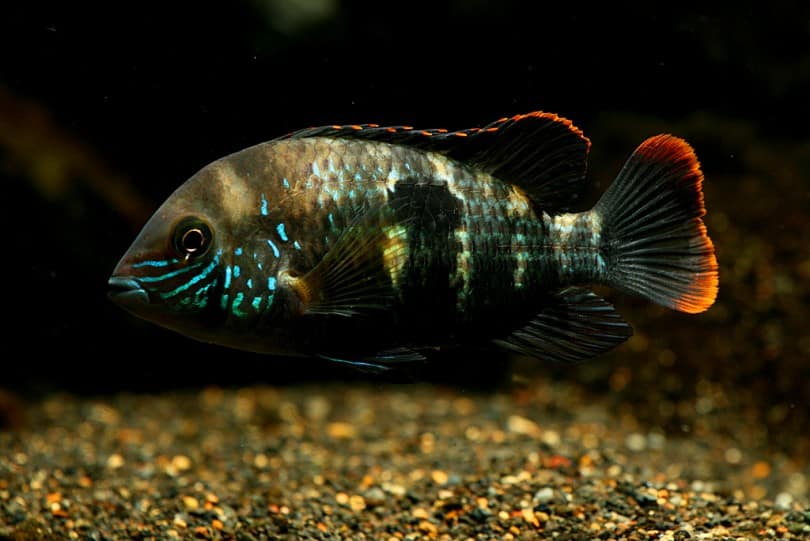
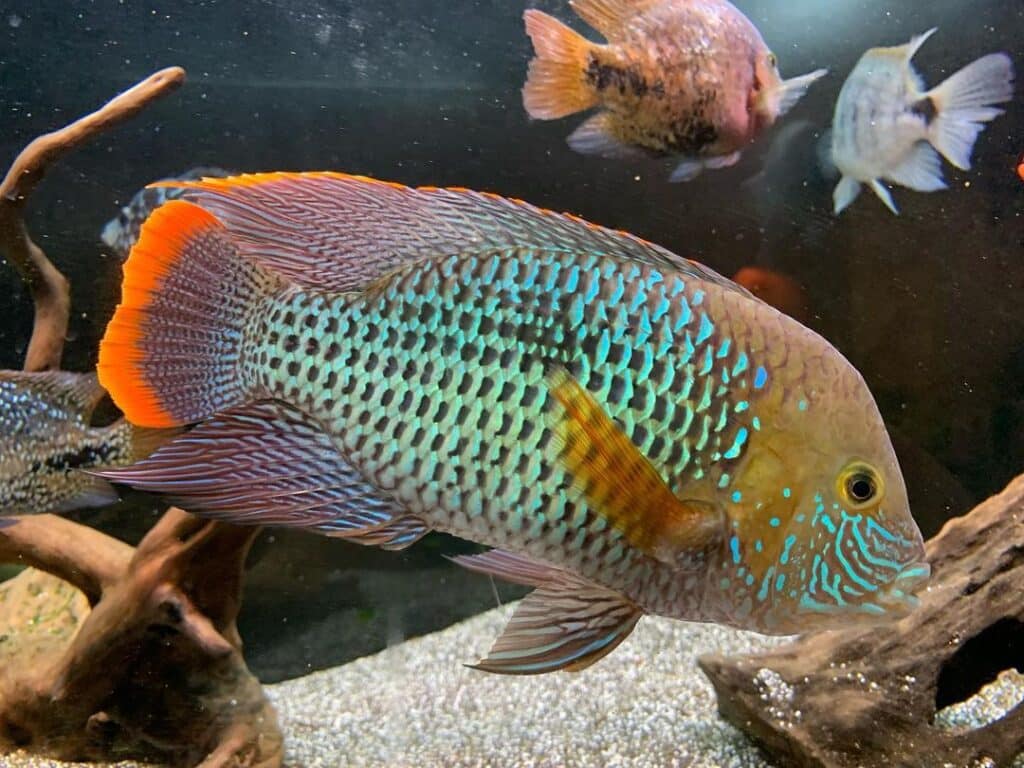
Their face and body, they are marked with different stripes.
Male
The color of the male Green terror is blue as well as green, with the luster of metals; the anal fin is blue, and a red colored stripe runs on the border of the fin of the tail. Further the grown up male fish has on its head a round shaped hump.
Female
The female fish is darker in color and her anal fin is green, the red stripe on the edge of the fin of the tail is absent, in addition they are a bit small in size when compared to the male.
Growing at home
Breeding
The ideal method to plan spawning of your Green terror is to bring up a set of young fish which are not related till they mature and grow around 3” and then, permit them to join as pairs. Choose a very sturdy couple to breed, and separate the other couples. This species breeds in classical Aequidens style. They search out an open location in the water and normally spawn on a leveled stone. Other types of cichlids have a tendency of hiding their nests in fissures, whereas the Green terror does not do so. There is no grave restriction of water. They spawn without difficulty in soft or hard water as well as low or high pH. They demonstrate excellent parenting and spawn normally up to 400. The female Green terror cichlid plays a leading role to raise the fry. Raise your fry on fine flake food or baby brine shrimp.
Tank
Place your Green terror cichlid in a separate aquarium meant only for it, or else divide the aquarium with the help of a net or glass. In time, the elder Green terror cichlids turn aggressive; hence it is advisable to keep them apart, either dividing the aquarium or by separating one. The right size of the aquarium depends on the type of species you desire to accommodate with your Green terror cichlid, or provide it with its individual aquarium. For a juvenile Green terror cichlid that has attained a length of 5 inches (13 cm) the aquarium should have as appropriate size is a 132 liter or 35 gallons measuring a minimum of 36 inches (91 cm). A grown up a Green terror cichlid needs 209 liter or 55 gallon aquarium or bigger and a dimension of minimum 48 inches (122 cm) in length. For a community aquarium provide a tank no smaller than 379 liter or 100 gallon.
Water Condition
The Green terror cichlid hails from tropical regions of Peru and Ecuador, where the waters are warm; therefore, the temperature of the water in the aquarium needs to be 20 – 24° C (69-75° F). The preference of pH is around 7 (neutral), whereas the Green terror cichlids adjust themselves to bit acidic and alkaline conditions. Set the pH more than 6.5 and less than 8.0. Avoid intensities and sudden alterations between these levels. The Green terror cichlid’s dH range is 25.
Nutrition
Provide your Green terror cichlids with an array of food as they are omnivores. Feed them with live, freeze-dried or frozen ghost shrimp, crickets, blood worms, black worms, minnows, earthworms, cichlid pellets and flake food.
Green Terror Setup
Like very big cichlids hailing from the continent of South America, Green terror fish also require a lot of area for a single fish. Provide at least 75 gallons as recommended for a couple. In case you are housing them with other larger fish, a bigger aquarium is required. The Green terrors perform their best in water that is a bit acidic to neutral and also soft. Supply competent biological filtration and ensure the movement of the water is low to reasonable. The Green Terrors need a lot of hiding places such as caves of rocks; they perform well in the normal lighting system in the aquarium. In order to reduce the pH in case your water is hard, introduce driftwood in the aquarium. Ensure there is open space in the middle for them to swim. In case you decide to have a big aquarium and house the Green terrors with other varieties. Then, organize the aquarium and block them from seeing each other, so that the aquarium has divisions of areas in order to suppress their affinity of becoming violent.
Having discovered a fondness for insects while pursuing her degree in Biology, Randi Jones was quite bugged to know that people usually dismissed these little creatures as “creepy-crawlies”.