American Bullfrog

The American bullfrog (Lithobates catesbeianus) is the largest frog in North America. It gets its name from the male’s deep, booming call, which sounds a bit like a bellowing bull. Bullfrogs are native to eastern North America, but people have spread them to many other parts of the world.
Scientific Classification & Quick Facts
| Common name | American bullfrog |
| Scientific name | Lithobates catesbeianus |
| Kingdom | Animalia |
| Phylum | Chordata |
| Class | Amphibia |
| Order | Anura |
| Family | Ranidae |
| Genus | Lithobates |
| Conservation status | Least Concern |
| Type | Amphibian |
| Diet | Insects, fish, snakes, small birds, mammals and other frogs |
| Habitat | Edges of big, slow ponds, swamps and lakes |
| Native range | Eastern United States and Canada |
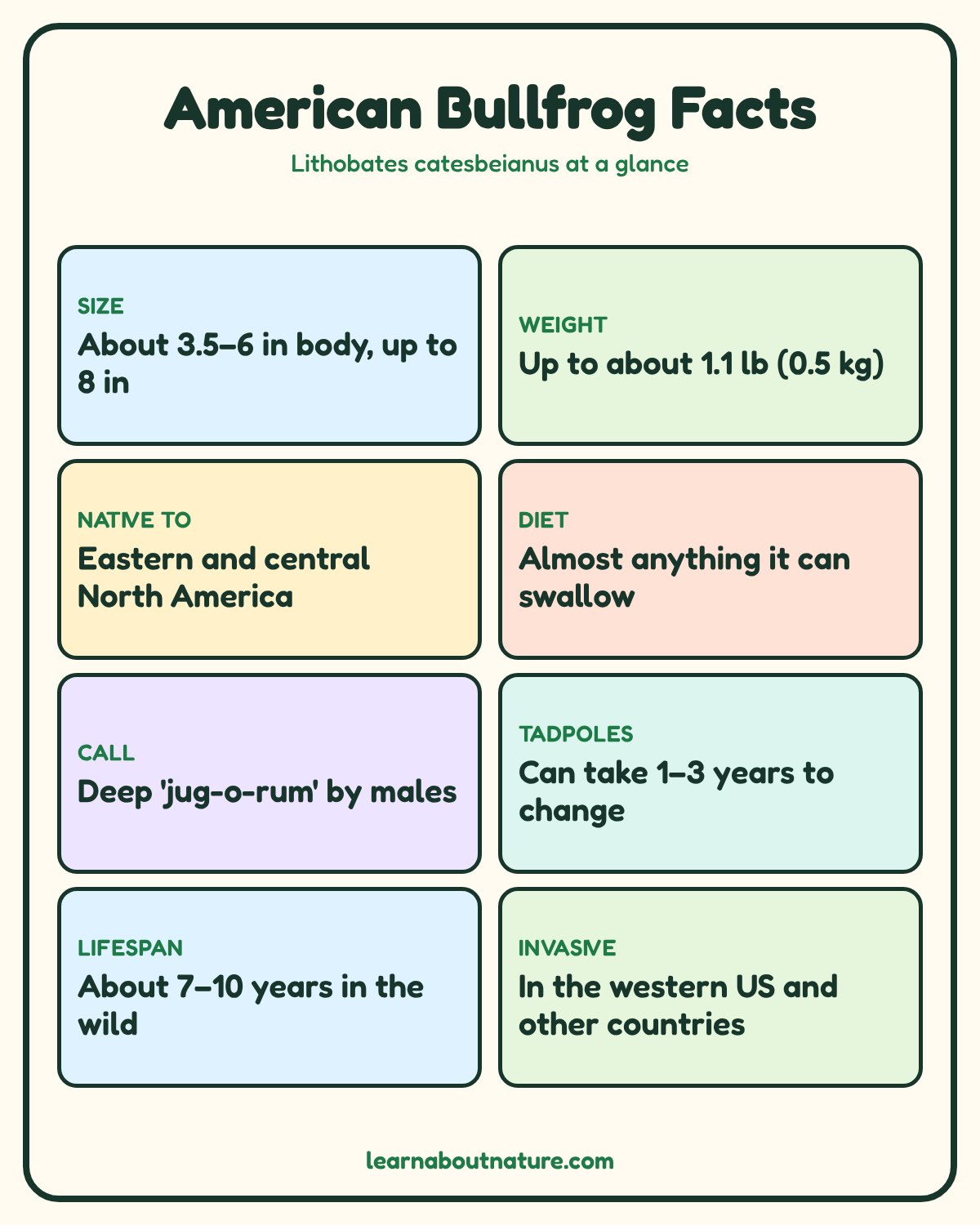
| Size | Body 3.5–6 in (9–15 cm) long |
| Lifespan | Up to 10 years wild, 16 in captivity |
| Colours | Olive green to brown back, white belly |

What Is an American Bullfrog?
The American bullfrog (Lithobates catesbeianus) is the largest frog in North America, with a body up to about 8 inches long. Native to eastern North America, it lives in large ponds and lakes, eats almost any animal it can swallow, and is named for the male’s deep, bull-like call.
Meet the Bullfrog
The bullfrog belongs to the Ranidae family, often called the “true frogs.” It used to be named Rana catesbeiana, and you’ll still see that name in many books. As scientists learned more about how these frogs are related, many North American species, including the bullfrog, were moved into the genus Lithobates.
Bullfrogs live in fresh water, not the sea. They prefer large, permanent bodies of water such as ponds, lakes, swamps and slow-moving rivers, where they sit at the water’s edge among the plants.
What Bullfrogs Look Like

Bullfrogs have broad, flat heads and bodies. Most adults measure about 3.5 to 6 inches (9 to 15 cm) from snout to rump, and the biggest reach about 8 inches (20 cm). With their long back legs stretched out, they can be well over a foot long. Females usually grow larger than males.
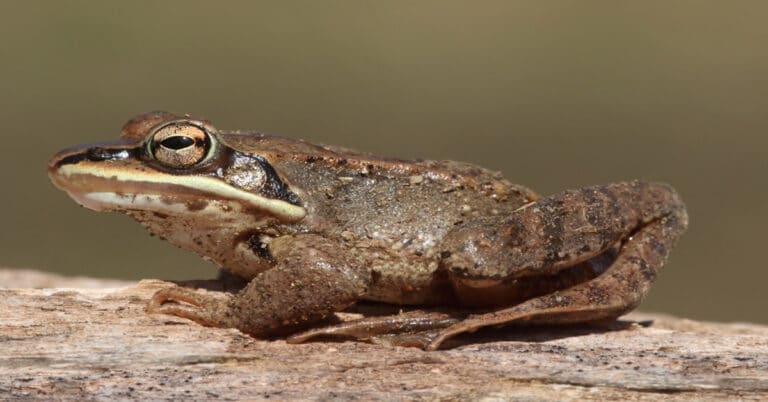
Their backs are olive green, green, brown or grayish, often with darker spots or blotches that help them hide. Their bellies are cream or white, sometimes with gray mottling, and their hind legs have dark bands. The eyes are gold or brown.
Behind each eye is a large, round eardrum called a tympanum. This is the easiest way to tell males from females: in males the eardrum is bigger than the eye, while in females it is about the same size or smaller. During breeding season, males also have a yellow throat.
Bullfrogs can be confused with other frogs, especially the smaller green frog. Look along the back: the green frog has two raised ridges running down its sides, called dorsolateral ridges, but the bullfrog doesn’t. Its ridge simply curves around the eardrum.
Behavior
Adult bullfrogs mostly live alone and stay close to water. They are most active at night. If something startles them, they leap into the water with a loud squeak or hide among cattails and lily pads.
They are strong swimmers, pushing themselves along with powerful, webbed hind feet. On land they are excellent jumpers and can leap about 6 feet (2 meters).
In spring and early summer, males gather in the shallows and defend their own patch of water. They call to warn rivals away and to attract females. If calling doesn’t work, they push, kick and wrestle. Their deep “jug-o-rum” call can carry a long way across a pond on a still night.
In cold places, bullfrogs spend the winter resting at the bottom of ponds, partly buried in the mud, until the water warms up again.
What Bullfrogs Eat

Bullfrogs are sit-and-wait hunters with huge appetites. They eat almost anything that moves and fits in their mouth, including insects, worms, crayfish, snails, fish, tadpoles, other frogs (even smaller bullfrogs), small turtles, young birds, bats, mice and snakes.
They even eat garter snakes, which normally hunt frogs. A bullfrog grabs prey with its sticky tongue and large mouth, then uses its front legs to push it in. It has tiny teeth on the roof of its mouth to help hold slippery prey.
Where Bullfrogs Live

The bullfrog’s natural home is eastern North America, from Nova Scotia and southern Canada south to central Florida and west to the Great Plains. People have released bullfrogs far outside this range, including the western United States, British Columbia, Hawaii, parts of Mexico, South America, Europe and Asia.
Where they belong, bullfrogs are a normal part of the food web: they eat lots of insects, and herons, raccoons, snakes, turtles and large fish eat them and their tadpoles. Where they’ve been introduced, though, they can be a big problem. They eat and outcompete native frogs, turtles and snakes, and they can spread diseases to other amphibians. They are listed as an invasive species in many places.
Life Cycle
Bullfrogs breed in late spring and summer. A female can lay a floating mat of up to 20,000 tiny eggs on the water’s surface. The eggs hatch in just a few days.
Bullfrog tadpoles grow slowly. They usually stay tadpoles for one to three years before turning into froglets, taking longer in colder places. They can grow to about 6 inches (15 cm) long. Bullfrogs can live around 8 to 10 years in the wild, and longer in captivity.
How People Use Bullfrogs

In North America and other countries, bullfrogs are caught and sometimes farmed for their legs, which are eaten as food. Frog farming is tricky and often fails. Bullfrogs are also used in some school biology classes for dissection.
Bullfrogs as Pets
Some people keep bullfrogs as pets, but they aren’t a good choice for most families. They grow big, need a large tank with plenty of clean water and a land area, and eat lots of live food. Like other frogs, they have delicate skin and can hurt themselves by jumping into walls, so a large glass aquarium from a pet store with a secure lid works better than a homemade tank.
Most importantly, never release a pet bullfrog or bullfrog tadpoles into the wild. Tadpoles sold for garden ponds are sometimes bullfrogs, and released frogs can wipe out native wildlife. If you have a pond, the best plan is to let local frogs find it on their own, and avoid using pesticides nearby.
Fun Facts
- The name “bullfrog” comes from the male’s call, which sounds like the lowing of cattle.
- Bullfrogs are one of the few frogs that people raise on farms for food.
- Bullfrog skin makes bad-tasting secretions that discourage some predators.
- A bullfrog sits so still while hunting that it is called an ambush predator.
Bullfrog Size and Facts at a Glance
| Feature | American bullfrog |
|---|---|
| Body length | Usually 3.5–6 in (9–15 cm); up to about 8 in (20 cm) |
| Weight | Typically around 1 lb (0.5 kg); the biggest can be heavier |
| Length with legs stretched | Can exceed 12 in (30 cm) |
| Larger sex | Females |
| How to tell males | Eardrum larger than the eye; yellow throat in breeding season |
| Breeding season | Late spring to summer |
| Eggs per clutch | Up to about 20,000 |
| Time as a tadpole | 1–3 years |
| Tadpole length | Up to about 6 in (15 cm) |
| Lifespan | About 8–10 years wild; up to 16 in captivity |
| Active | Mostly at night |
These figures make the bullfrog one of the heaviest frogs in the world, though it is far smaller than the African goliath frog, the largest of all. Its huge tadpoles are often the first sign that bullfrogs live in a pond, since they can be seen in the water all year round in milder areas.
Bullfrog vs. Green Frog and Other Look-Alikes
Young bullfrogs are easy to confuse with several other North American frogs. These are the most useful differences.
| Frog | Ridges on back | Typical size | Call |
|---|---|---|---|
| American bullfrog | No ridges down the back; a fold curves around the eardrum | 3.5–6 in, up to 8 in | Deep “jug-o-rum” drone |
| Green frog | Two ridges running partway down the back | 2–3.5 in | Single twang, like a loose banjo string |
| Pig frog | No ridges; very similar to bullfrog | 3–5.5 in | Low grunts like a pig |
| Leopard frog | Pale ridges full length of back | 2–3.5 in | Snore-like rattle and chuckles |
| Mink frog | Ridges weak or absent | 2–3 in | Fast tapping “cut-cut-cut” |
Pig frogs live in the far southeastern US and have more pointed snouts and webbing that reaches almost to the toe tips on the hind feet. Mink frogs, found in the north, give off a musky smell like a mink when handled. For most people, the quickest test is the ridge: if the fold stops at the eardrum, it is likely a bullfrog.
Predators and Defences
Bullfrogs are big hunters, but they are also food for many animals, especially when young. Eggs and tadpoles are eaten by fish, aquatic insects such as dragonfly larvae and diving beetles, turtles and birds. Adults are hunted by herons, egrets, raccoons, otters, snakes such as water snakes, snapping turtles, large fish like bass, and people.
To stay alive, bullfrogs rely on several defences:
- Camouflage: green and brown colours with dark blotches blend with mud, weeds and lily pads.
- Escape: powerful legs launch them into the water, where they hide in mud or plants.
- Alarm call: a sharp squeak as they jump can startle a predator and warn other frogs.
- Distress scream: if grabbed, some bullfrogs give a loud scream that may cause a predator to let go.
- Bad taste: skin secretions and the unpleasant taste of tadpoles put off some fish and other hunters.
- Night activity: being active after dark helps them avoid many daytime birds.
Large numbers of eggs also help: even if most are eaten, a few survive to adulthood.
How Bullfrogs Survive Winter
In the northern part of their range, ponds can freeze over for months, yet bullfrogs survive without leaving the water. As the water cools in autumn, they become less active and stop eating. They then settle on or near the bottom of the pond, often partly buried in soft mud or sheltered under leaves, where the water stays just above freezing.
During this winter rest, called brumation in amphibians, the frog’s body slows down a great deal. Its heart beats slowly and it uses very little energy. Bullfrogs can take in oxygen from the water through their skin, so they do not need to come up to breathe, as long as the water holds enough oxygen. Unlike wood frogs, bullfrogs cannot survive being frozen, so they must stay below the ice.
Tadpoles also spend winter in the pond. This is why bullfrog tadpoles take one to three years to change into frogs in cold areas: growth stops each winter and starts again in spring.
In warm southern areas, bullfrogs may stay active all year, only slowing down during the coolest spells. As soon as the water warms in spring, they return to the edges of the pond to feed and, later, to call.
American bullfrog FAQs
Why is it called a bullfrog?
It is named after the male’s deep call, which sounds like the mooing or roar of a bull. The loud call can be heard from far away and helps him guard his territory.
What do bullfrogs eat?
Bullfrogs eat almost anything they can swallow. That includes insects, worms, crayfish, fish, small snakes, young birds and even other frogs.
How big do bullfrogs get?
Bullfrogs are the biggest frogs in North America. Their bodies grow to about 3.5 to 6 inches, and a few reach 8 inches. Females are bigger than males.
How long do bullfrogs live?
Bullfrogs live up to about 10 years in the wild. In captivity they can live as long as 16 years.
Are bullfrogs an invasive species?
In some places, yes. Bullfrogs spread outside their home range, and where they are new they eat native frogs and other small animals, which can wipe them out.

Randi Jones is the owner and founder of the Nature Gift Store, an online retailer specializing in nature-themed gifts, educational science projects, live animal nature kits and real butterfly artwork. A biology graduate who fell in love with insects, she founded the company in 2001 to make active learning about nature fun, accessible and engaging for children and adults. Her store offers real butterfly frames, home and garden decor and educational live animal kits, including ant farms, worm farms, tadpoles, ladybugs and hermit crabs, and she runs a bug museum in Washington featuring live animals like Eddie the Iguana alongside other reptiles and insects. Randi wrote most of the guides on this site. They first appeared on her long-running nature sites, including Monarch-Butterfly.com, Ladybug-Life-Cycle.com, Frog-Life-Cycle.com, Dragonfly-Site.com and Butterfly Pictures, which have now been brought together here at Learn About Nature.