Cyclamen – Remembered by Antiquity for its Purgative Powers

Scientific Classification & Quick Facts
| Common name | Cyclamen |
| Scientific name | Cyclamen |
| Kingdom | Plantae |
| Phylum | Tracheophyta |
| Class | Magnoliopsida |
| Order | Ericales |
| Family | Primulaceae |
| Type | Perennial that grows from a tuber |
| Habitat | Bright, indirect light and cool temperatures indoors |
| Native range | Europe and Mediterranean east to Iran; one in Somalia |
| Flowering season | Varies by species: autumn, winter or spring |
| Special feature | Goes dormant in the dry Mediterranean summer |

Cyclamen belongs to the variety having 23 types of perennials that grow from tubers, considered great for their upswept petals and foliage of different patterns. Europe and the Mediterranean basin east to Iran are home to Varieties of Cyclamen, with just one variety relegated to Somalia. Though originally they had categorized it as belonging to the family Primulaceae, presently they have recategorized it under the family myrsinaceae. However, from 2009, they reclassified it under the Primulaceae family under the sub-family Myrsinoidea.
Antiquity remembers Cyclamen for its bitter cyclamen content that gave it purgative powers. In homeopathy it has traditionally been used for grief and depression.
Anatomy
Cyclamens are tuberous. Flowers and roots spring up from this tuber. In most of the varieties, you see the leaves in the autumn, maturing through winter and withering in spring. Further, the plant becomes inactive during the dry Mediterranean summer.
How to Cultivate Domestically
Preparation for Planting
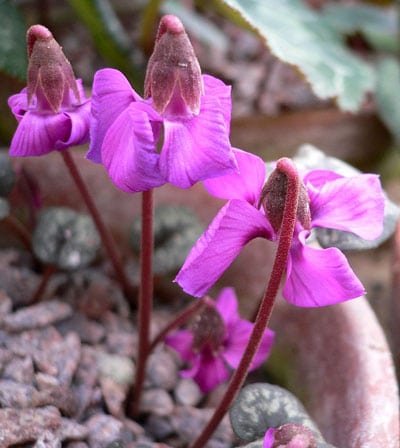
Photo by: Mark Griffiths
Cyclamen comprises 23 species, all belonging to the primrose family. You must give individual care for these perennials. You should normally consider these plants as indoor plants; however, they grow well in certain areas outside as well. These beautiful big flowering plants prosper as indoor plants in areas where you can get bright indirect light of less temperature intensity. These cyclamen plants need dedication. As a matter of fact, even a little negligence to meet their care requirements can lead to the sudden death of this plant.
Planting
- In order to grow your Cyclamen plants, select pots of ten inches height, having drainage holes at their bottom. Take a tray, fill it with a thick layer of pebbles and water and place the pots on top. The tray gathers the water and gives the plant humidity. When the tray overflows, empty it.
- Put soil based potting soil into the pot to its brim. Use organic and airy potting soil to ensure proper drainage; give the roots of the cyclamen plants enough space for breathing.
- Water the plant sufficiently, but never permit stagnation of water.
- Give the Cyclamen plants a very good diet of a nitrogen based fertilizer and add it to the soil as per the instructions of the manufacturer. Most of the cyclamen plants need frequent fertilizing.
Placement and Watering
As a part of proper Cyclamen plant care, place them in a place where you can get access to enough light; you can get very good flowering if you make sunlight available throughout or three-quarter part of the day. For retaining the moisture in the plants, water your cyclamen plants daily. Each time you water the plant, make sure to pour sufficient water so that the water reaches the bottom of the pot and drains out through the holes.
Flowering Period
Your Cyclamen plant blooms in any part of the year based on the variety. Cyclamen purpurascens and Cyclamen hederifolium blossom during autumn and summer, Cyclamen repandum flowers in the spring, coum and Cyclamen persicum blossom in the winter.
After Bloom Care
Once flowering is complete in that season, never shear off the leaves, let them stay in their place, they collect sunlight and by photosynthesis they prepare food and energize the bulb for the next season. Water sufficiently while the plant is growing (one inch of moisture a week is sufficient).
As Cut Flowers

Photo by: Francine Riez
Cyclamens flower stalks are robust, firm and celery green; when mature we see the beautiful flowers with clear light green lips at every floret’s mouth. The restricted opening restricts the entry of insects for pollination, as a result of which the flowers have a long life and are superb as cut flowers.
Cyclamen FAQs
Where do cyclamen come from?
Cyclamen are native to Europe and the Mediterranean region, east to Iran. Just one species comes from Somalia.
When do cyclamen flower?
It depends on the species. Cyclamen repandum flowers in spring, while Cyclamen coum and Cyclamen persicum flower in winter. Others flower in autumn.
Do cyclamen grow from bulbs?
Cyclamen grow from tubers. The flowers and roots spring up from the tuber.
Why do cyclamen leaves die back in summer?
Most cyclamen grow leaves in autumn, keep them through winter and lose them in spring. The plant then rests through the dry Mediterranean summer.
Should you cut off cyclamen leaves after flowering?
No, leave them. The leaves collect sunlight and make food that gives the plant energy for the next season.

Randi Jones is the owner and founder of the Nature Gift Store, an online retailer specializing in nature-themed gifts, educational science projects, live animal nature kits and real butterfly artwork. A biology graduate who fell in love with insects, she founded the company in 2001 to make active learning about nature fun, accessible and engaging for children and adults. Her store offers real butterfly frames, home and garden decor and educational live animal kits, including ant farms, worm farms, tadpoles, ladybugs and hermit crabs, and she runs a bug museum in Washington featuring live animals like Eddie the Iguana alongside other reptiles and insects.