Chlorella

Chlorella is a genus of tiny, single-celled green algae that live mainly in fresh water. Each cell is a perfect little green ball, far too small to see without a microscope, and today chlorella is grown in large amounts and sold as a dried green powder and tablets.
Quick Facts
| Common name | Chlorella |
| Scientific name | Chlorella |
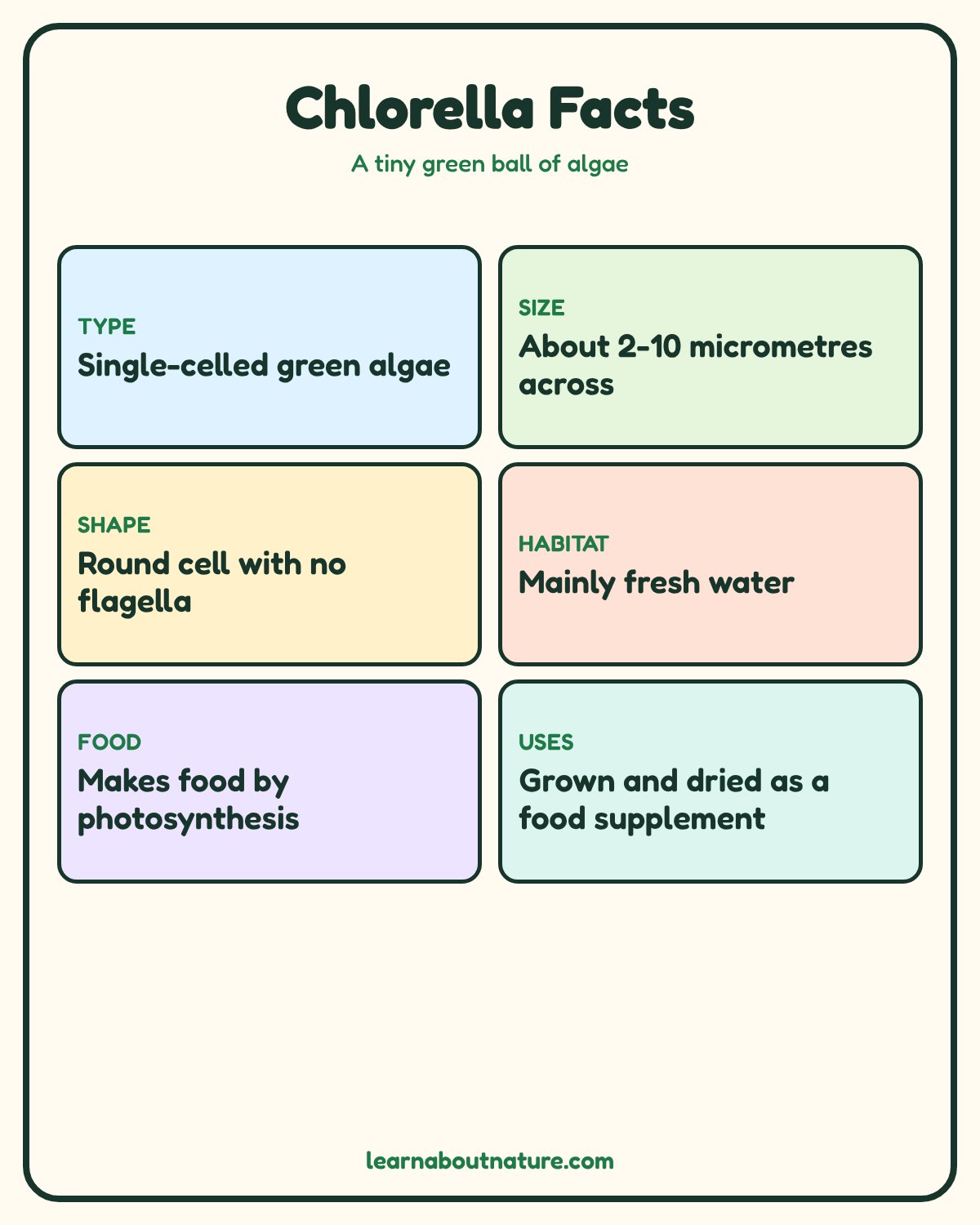
| Type | Single-celled green alga |
| Diet | Makes food by photosynthesis |
| Habitat | Fresh water such as rivers and lakes |
| Size | 2-10 micrometres across |
| Colours | Green |
| Special feature | Dried and sold as an emerald-green supplement |
What Is Chlorella?
Chlorella belongs to the green algae (division Chlorophyta). Each cell is round and only about 2 to 10 micrometers wide. That is so small that several hundred of them lined up in a row would only stretch about a millimeter.
Unlike some algae, chlorella has no flagella, the whip-like tails that some tiny organisms use to swim. Instead, it floats in the water. Inside each cell is a cup-shaped chloroplast filled with the green pigments chlorophyll a and chlorophyll b, the same pigments found in land plants.
Where the Name Comes From
The name chlorella comes from the Greek word chloros, meaning green, and the Latin ending -ella, meaning small. So chlorella simply means “little green one.”
How Chlorella Lives and Grows
Like plants, chlorella makes its own food by photosynthesis. All it needs is water, carbon dioxide, sunlight, and a few minerals. With these, it can grow very quickly.
Chlorella reproduces without mating. One cell divides inside its own wall to form several smaller daughter cells, usually four or eight. The parent cell wall then splits open and the new cells float away to grow and divide again. In good conditions, a population can double in less than a day.
Chlorella lives in ponds, lakes, rivers, and damp soil all over the world. When there is plenty of light and nutrients, chlorella and other algae can multiply so much that the water turns green. Some chlorella even live inside other animals, such as the green hydra, sharing the food they make in return for shelter.
A Food of the Future?
In the 1940s and 1950s, scientists became very excited about chlorella. Because it grows so fast, uses sunlight so efficiently, and is rich in protein, many people thought it could help feed the world’s growing population. Researchers also studied it as a way to make food and oxygen for astronauts on long space journeys.
Large-scale farming of chlorella turned out to be harder and more expensive than expected. Its tough cell walls also make it hard for people to digest unless the cells are broken open. So chlorella never became a cheap everyday food like soybeans or whole grains.
Chlorella as a Supplement
Today, chlorella is mainly grown in large outdoor ponds and tanks, especially in East Asian countries such as Japan and Taiwan. After harvesting, it is dried and crushed into a fine, emerald-green powder, which is often pressed into small tablets that smell faintly of the sea.
Dried chlorella contains a lot of protein, often around half its weight, along with chlorophyll, vitamins, and minerals such as iron. It is sold in health food shops, sometimes alongside spirulina. Spirulina is often called an alga too, but it is actually a type of blue-green bacterium called a cyanobacterium.
Many claims are made about chlorella, for example that it can “detox” the body, change the body’s pH, or prevent serious diseases. Scientists have not found strong evidence for most of these claims, and more research is needed. Chlorella can also cause side effects in some people and may interact with some medicines. Anyone thinking about taking it, especially children, should ask a doctor first.
Other Uses for Chlorella
Besides health foods, chlorella is used in several other ways:
- Animal feed: it is added to feed for fish, poultry, and other farm animals.
- Cosmetics: extracts are used in some skin creams and beauty products.
- Science: chlorella is easy to grow, so it has been used for decades to study photosynthesis. In fact, scientists used it to work out how plants turn carbon dioxide into sugar.
- Clean water and energy: researchers are testing chlorella for cleaning wastewater and for producing biofuels.
For such a tiny, simple living thing, chlorella has played a surprisingly big role in science, food, and our ideas about the future.
Chlorella FAQs
What is Chlorella?
Chlorella is a tiny, single-celled green alga. It is round, has no flagella, and is only 2 to 10 micrometres across, far too small to see without a microscope.
What does Chlorella need to grow?
Chlorella makes its own food by photosynthesis. It needs water, carbon dioxide, sunlight and a few minerals.
Where does Chlorella live?
Chlorella lives in fresh water. When huge amounts grow, it can turn rivers and lakes green.
Why is it called Chlorella?
The name comes from the Greek word chloros, meaning green, and the Latin ending -ella, meaning small. So it means ‘little green thing’.
How do people use Chlorella?
People harvest it, dry it and crush it into a green powder. The powder is pressed into tablets sold as a supplement, and it is also used in animal feed and cosmetics.

Randi Jones is the owner and founder of the Nature Gift Store, an online retailer specializing in nature-themed gifts, educational science projects, live animal nature kits and real butterfly artwork. A biology graduate who fell in love with insects, she founded the company in 2001 to make active learning about nature fun, accessible and engaging for children and adults. Her store offers real butterfly frames, home and garden decor and educational live animal kits, including ant farms, worm farms, tadpoles, ladybugs and hermit crabs, and she runs a bug museum in Washington featuring live animals like Eddie the Iguana alongside other reptiles and insects. Randi wrote most of the guides on this site. They first appeared on her long-running nature sites, including Monarch-Butterfly.com, Ladybug-Life-Cycle.com, Frog-Life-Cycle.com, Dragonfly-Site.com and Butterfly Pictures, which have now been brought together here at Learn About Nature.