Sweet Corn

Scientific Classification & Quick Facts
| Name | Sweet corn |
| Variety of | Zea mays |
| Kingdom | Plantae |
| Phylum | Tracheophyta |
| Class | Liliopsida |
| Order | Poales |
| Family | Poaceae |
| Type | Grass-family plant; a sugary maize variety |
| Habitat | Full sun; loamy, well-drained, neutral soil |
| Colours | Yellow and white varieties |
| Edible parts | Kernels, picked at the milky stage |
| Special feature | Natural mutation keeps kernels sweet instead of starchy |
Sweet corn (Zea mays conva. Saccharata var. rugosa), otherwise known as pole corn or sugar corn) is a variety of the Maize family having a raised content of sugar. Sweet corn is a variety which occurred naturally by recessive mutation in the species that stabilizes the changing of sugar into starch within the endosperm of the corn kernel. Most people pick up Sweet corns prematurely (milky stage) and cook and eat them as a vegetable, not as a grain. This is quite different from that of the field-corn types that one reaps when the kernels grow fully, and then dry before use.
Habitat
Sweet corn appears as a natural impulse of changes in the field corn that many tribes of Native America cultivated.
Anatomy

Photo by: Forest & Kim Starr
The corn kernel is the fruit obtained from the sweet corn plant. This variety of fruit is known as caryopsis. The corn ear includes accumulated kernels on the heads of the axis; the kernels grow in paired rows, so the number of rows is usually even. The ear is firmly covered with leaves known as husk. The pistillate flowers, that emerges from the husk, they call “silk.”
Preparation of Soil for Planting
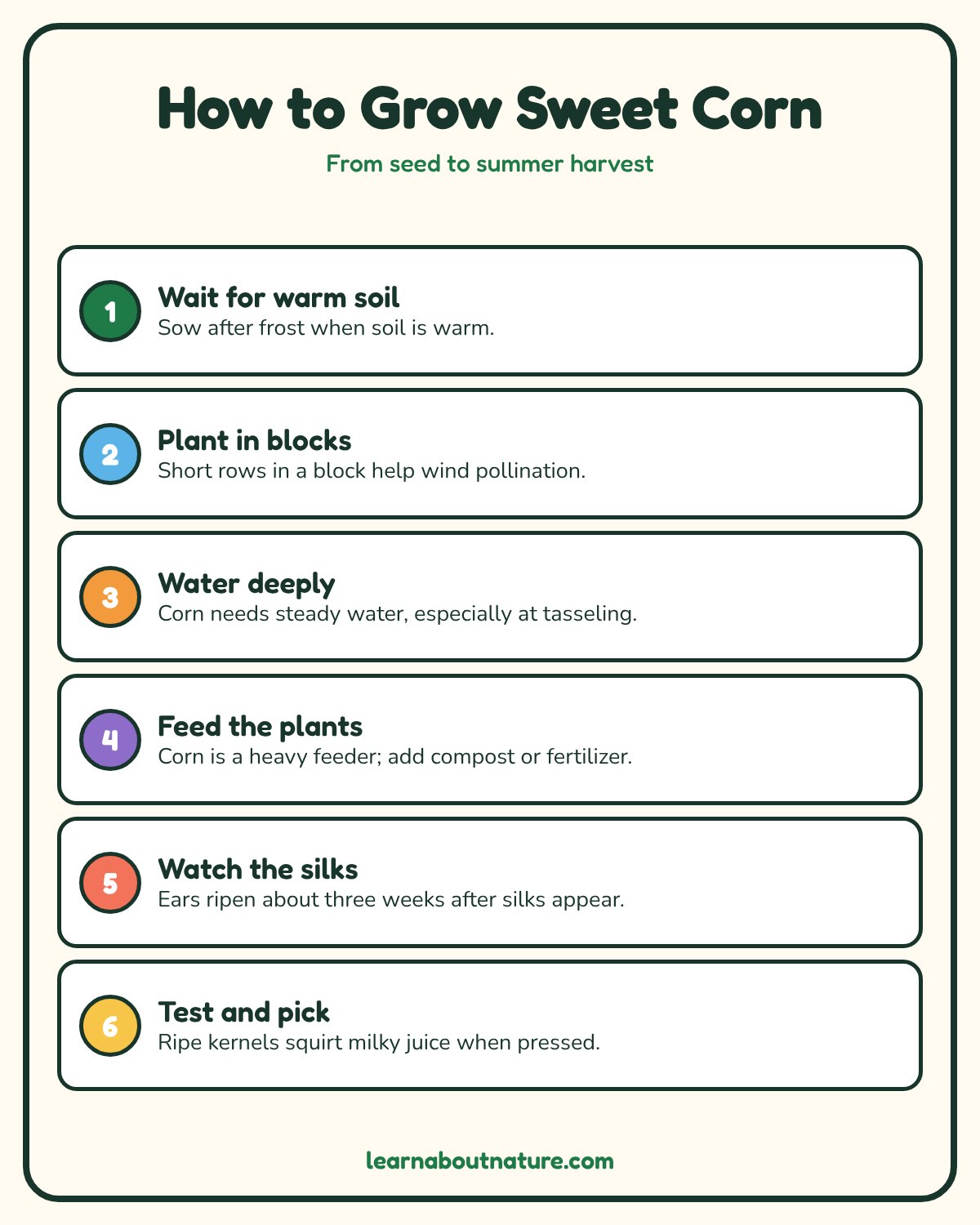
Following planting you require a long period of frost-free season for growing Sweet Corn. The wind pollinate the Sweet corn and hence, it would seem better to follow a block pattern instead of rows. Drain the soil in to maintain the moisture consistency. Loosen the soil with a neutral pH (6.0 – 7.0). Heavy soil, prevents the tap roots from growing long. The short roots that you see over the soil holds the tall plants.
Sun exposure: Complete Sunlight
Soil Type: Loamy
Soil pH: Neutral
Watering
During dry weather on account of the short roots make sure to water them properly at the rate of 5 gallons per sq. Yard. Mulching assists in reducing the evaporation. While planting the sweet corn, water them properly.
Temperature and Humidity
If germination is to succeed, the soil temperature must exceed 60° (go up to 65 F for extra sweet types). In case of necessity use a plastic cover (black) to warm up the soil in the colder regions. Plant your seeds through the holes.
Care
- Take care not to damage the root while weeding.
- Maintain the soil dampness by properly draining the soil.
- The roots of the corn are short, hence in dry situations ensure you water them properly by watering 5 gallons for every square yard.
- Mulch assists in decreasing evaporation.
- While the plants grow to a height of four to five inches plant them at a clear distance of 16 to 23 in.
Pest
Mice: After you planted the sweet corn seeds the rodents eat them.
Remedy: At the place where you so your sweet corn seeds keep traps.
Birds: Pigeons and Jays spoil the ripening crops.
Remedy: Enclose each cob with plastic bags or place a net on the whole crop.
Slugs and snails: The snails and slugs have their meals on these tender seedlings; you can see the slime trail on the soil around your crop, and on the leaves too.
Remedy: You can control the snails and slugs in different ways; this includes eggshell barriers and copper tape, saw dust or beer traps.
Harvest Month and Storage

- The right time for harvesting is when the cobs begin to bloat and silks start turning brown in color. Kernels must look milky and full
- To remove the stalk, pull the ears down and twist it.
- The sweetness of the different type of sweet corns is lost following harvest.
- Once you finish the picking, get ready for preserving or eating them.
- In case you remove the ears prior to freezing, they freeze well.
Varieties
You have three varieties of Sweet corns: the Super Sweet Corn, Sugar improved and Normal. The Sucrose content in each corn varies, so the taste and consistency of each corn is different. The sweeter types keep their sweetness for a lengthier time following harvest.
Some of the varieties are:
Lochief’ –sugar type (Midseason normal) – yellow.
Silver Queen’ -Sugar variety (normal sugar) – white. Resist certain bacterial diseases.
Challenger Crisp n Sweet’ super sweet variety, high yielding yellow, resist certain disease.
Pristine’ sugar increased variety- white tastes good.
Sweet corn FAQs
What is sweet corn?
Sweet corn is a type of maize with extra sugar in its kernels. It came from a natural mutation that stops sugar turning into starch, so people eat it as a vegetable.
What is the difference between sweet corn and field corn?
Sweet corn is picked early, at the milky stage, and eaten as a vegetable. Field corn is left until the kernels are fully grown and dry.
When is sweet corn ready to harvest?
It is ready when the cobs start to swell and the tassels turn brown. The kernels should look milky and full.
What is corn silk?
Corn silk is the thread-like part of the female flowers that sticks out from the husk, the leafy covering that wraps the ear.
Why is sweet corn planted in blocks instead of rows?
Sweet corn is pollinated by the wind. Planting it in a block helps pollen reach every plant, which gives better ears.

Randi Jones is the owner and founder of the Nature Gift Store, an online retailer specializing in nature-themed gifts, educational science projects, live animal nature kits and real butterfly artwork. A biology graduate who fell in love with insects, she founded the company in 2001 to make active learning about nature fun, accessible and engaging for children and adults. Her store offers real butterfly frames, home and garden decor and educational live animal kits, including ant farms, worm farms, tadpoles, ladybugs and hermit crabs, and she runs a bug museum in Washington featuring live animals like Eddie the Iguana alongside other reptiles and insects. Randi wrote most of the guides on this site. They first appeared on her long-running nature sites, including Monarch-Butterfly.com, Ladybug-Life-Cycle.com, Frog-Life-Cycle.com, Dragonfly-Site.com and Butterfly Pictures, which have now been brought together here at Learn About Nature.