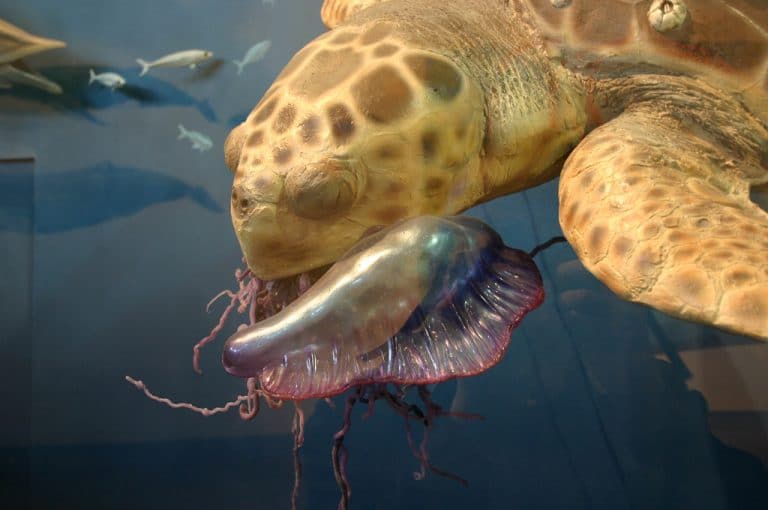
Snapping Turtle – The Two Genus

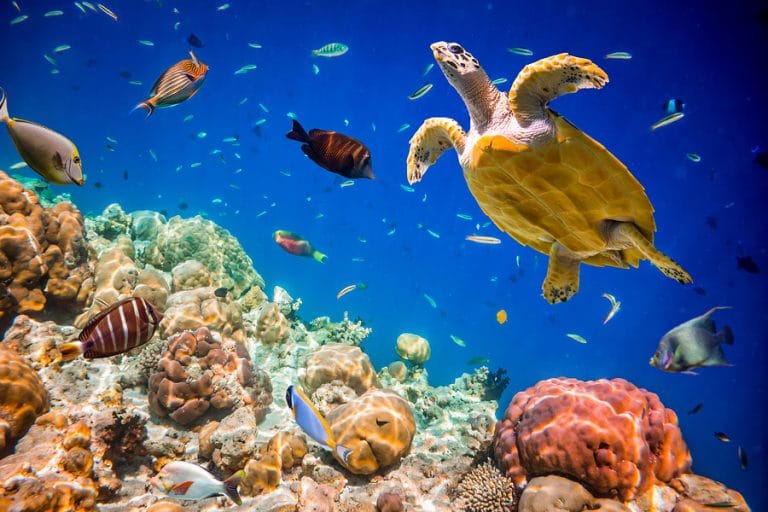
Turtles have been part of our world for around 230 million years, though their exact origin is unknown with scientists being unsure of exactly what they evolved from. These have evolved into some of the coolest reptiles in the world today; from map turtles, to painted turtles, to snapping turtles, to sea turtles which have remained unchanged for roughly 110 million years.
Turtles account for just three-percent of living reptiles today, and there are 356 different species that we currently know of including tortoises. 34 of them belong to the United States, seven of them are sea turtles, four painted turtles, 13 map turtles, and several species of snapping turtles.
Snapping turtles have been around for 90 million years, which means they, like some crocodilians, snakes, scorpions, and birds survived the extinction that wiped out the non-avian dinosaurs.
As mentioned above, to our surprise, there are traditionally two kinds of snapping turtles, the common and the alligator snapper, though recent studies recognise more than two living species.
Scientific Classification & Quick Facts
| Common name | Snapping turtle |
| Scientific name | Chelydridae |
| Kingdom | Animalia |
| Phylum | Chordata |
| Class | Testudines |
| Type | Reptile (large freshwater turtles) |
| Diet | Fish, frogs, insects, small animals, carrion and plants |
| Habitat | Lakes, swamps, ponds and rivers with muddy bottoms |
| Native range | North America |
| Size | Common snapper shell 8–14.5 in; alligator up to 29 in |
| Weight | Common snapper 10–35 lb; alligator males 155–175 lb |
| Special feature | Cannot pull its head and legs fully into its shell |
The ordinary snapping turtle belongs to the family Chelydridae and is a large fresh water turtle. In nature their range extends southwest of the boundary of Rocky Mountains to the Southwest of Canada and faraway east of Nova Scotia and Florida. Their binomial name is “turtle, Chelydra serpentina.”
Common Snapping Turtle
Common snapping turtles inhabit much of North America, from the entire east coast of the United States including Florida to Maine, all the way out to Montana, Wyoming, and Idaho, to parts of Canada.
They also inhabit southwestern states like Utah where they’re an invasive species that people brought to the area.
Common snapping turtles occupy many shallow waters of the United States, from lakes to swamps, ponds, and river streams.
They grow anywhere from 8-to-14.5 inches in length, with males growing larger than females. Common snapping turtles reach maturity at around 10 years of age, where they’ll be about 10 inches in length.
After a few more years, around ages 15-to-20, they’ll reach their full size at 14-plus inches, and they can live for over 40 years.
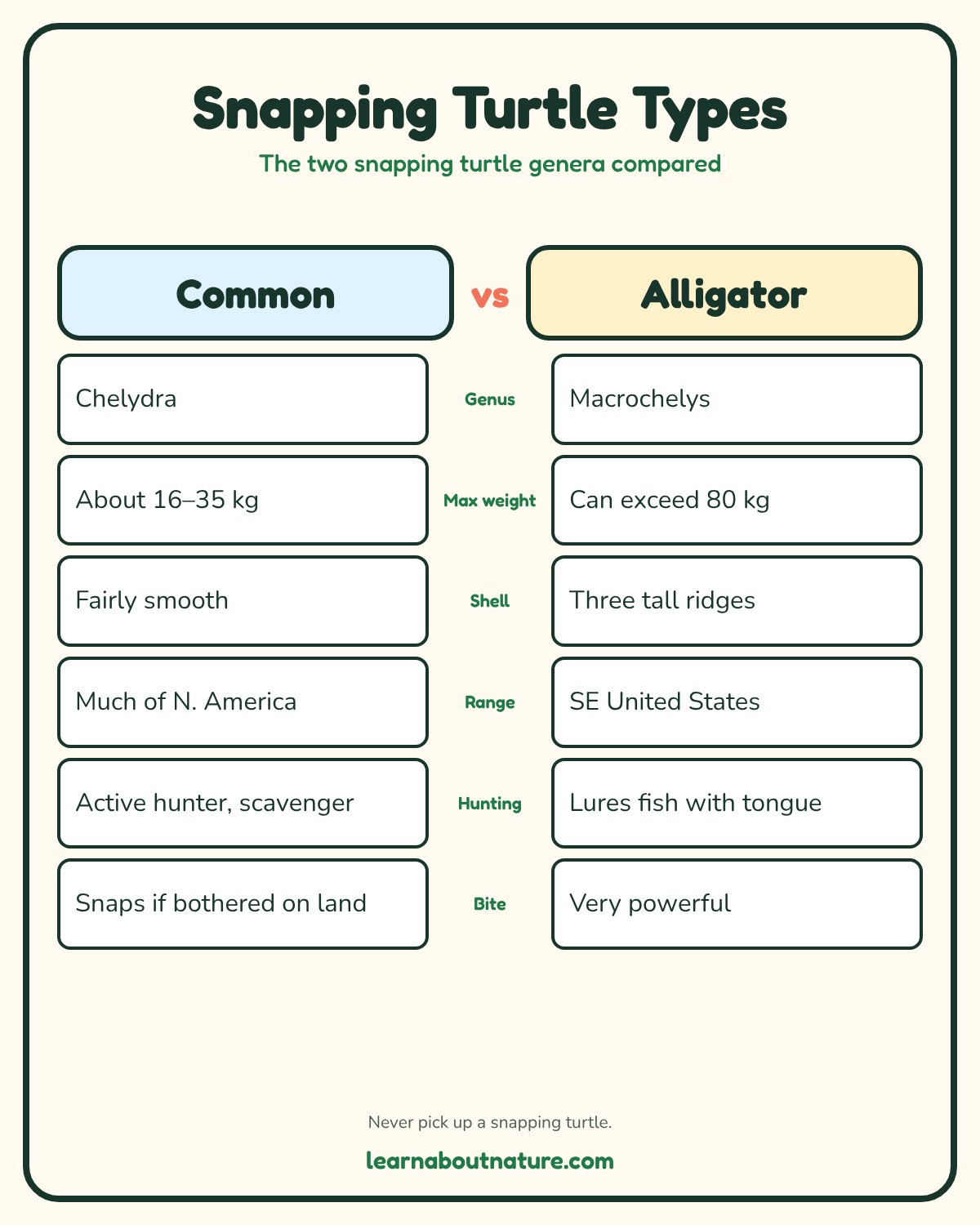
Along with their impressive size, they generally weigh between 10-and-35 lbs, though the largest ever recorded weighed a whopping 75 lbs.
An interesting fact about common snapping turtles, much like crocodilians, they must eat whilst in the water as their tongues are not designed to push food to the back of their throat to aid them in swallowing.
Common snapping turtles are omnivorous scavengers that feed on a wide variety of meat, vegetables, and fruits, including but not limited to a number of invertebrates, fish, frogs, crayfish, insects, reptiles native to their area including snakes and smaller turtles, birds, and small mammals.
The mating season of these incredible creatures is between April and November, with the mothers laying around 25-to-80 eggs in a single clutch. These turtles are independent from birth, and they’re only 1-to-1.5 inches as hatchlings weighing just a few ounces.

Alligator Snapping Turtle
The alligator snapping turtle, like the common snapping turtle, ranges similar areas of the United States from Florida to Texas, to as far north as Iowa and Illinois, and they too live in rivers, lakes, swamps, and sometimes in brackish water systems, which is a mixture of fresh water and salt water.
The alligator snapping turtle does not however live as far out west, or as far north as the common snapping turtle. It rather prefers more wetland areas such as Louisiana, Alabama, Florida, Missouri, and Mississippi to name a few.
Alligator snappers grow much bigger than their cousins, being the largest freshwater turtle in North America. Males can grow upwards of 29 inches in length, while females reach about 22 inches at their biggest.
The largest alligator snapping turtle ever recorded weighed 249 lbs, though males typically weigh between 155-and-175 lbs. In contrast, females only reach about 62 lbs at full maturity.
They reach maturity around the same age as common snappers, at about 11-to-13 years old, and they continue growing throughout their lives. The average lifespan of an alligator snapping turtle is about 70 years, though they’ve been known to surpass 100 years.
Alligator snapping turtles are primarily carnivorous, feeding mainly on a variety of fish and other aquatic animals, as well as small mammals. They are however known to feed on some vegetation at times.
They have a similar mating season to common snapping turtles, from April to October. They lay between 20-and-40 eggs in dry, sandy areas, though they’ve been known to lay upwards of 100 in a single nest.
Both common snapping turtles and alligator snapping turtles reproduce once yearly.
Males never leave the water, while females will go onto land simply to lay their eggs and cover them up before going back to their homes.
Anatomy
The snapping turtle also possesses a shell or carapace that encloses their back just like other turtles. The snapping turtle has a shell length of around 8 to 8 ½ inches. Their shell color varies from deep brown to tan, or even black. In the course of its growth, mud and algae coat the snapping turtle’s shell.
The tail length of the snapping turtle is equal to the length of its shell and a sharp ridge runs right through its length. Its head is dark in color, while its tail, legs and necks have a yellow hue. Its mouth has a beak shape, bony, strong and toothless. The snapping turtle’s skin is rough, having distinctive bumps on their legs and necks called “tubercles”. They have webbed feet with sturdy claws.
A plastron which is a hard plate, covers the stomach of turtles. The plastron of the snappers being small, you can see much of its body. This signifies that unlike other turtles, snapping turtles cannot draw their head and legs into their shell to shield themselves from attack. Snapping turtles compensate for this deficiency of body shields by their violent behavior.
- Weight: 8.81 to 35.24 lb; 4.0 to 16.0kg
- Length: 7.87 to 17.72 in; 20.0 to 45.0 cm
- Status: Wild
Habitat
The native habitat of the snapping turtles is the Nearctic region. This area extends from the central part of Texas and the south of the Gulf of Mexico, Southern Alberta eastwards to Nova Scotia in Canada. They dwell only in the brackish or fresh water. They favor muddy basins with plenty of plants to hide with ease. Snapping turtles dwell throughout in the water, but leave the waters only to lay eggs on the sandy beaches. We find these turtles in the marshes, swampy wetlands, temperate fresh water, Aquatic Biomes streams, ponds, rivers and lakes.
Lifespan
In nature, the snapping turtle lives for approximately for 30 years. Snapping turtles are most in danger when they are hatching. When they attain a particular age, they have only few predators, but vehicles often hit them close to their nesting region or ponds while foraging for food. In captivity their lifespan extends to 47 years.
Behavior
Snappers are loners, meaning they live all alone. Although a number of turtles are at times seen is a smaller region, their aggression leads to restricted communal contacts among themselves, especially the males. The food availability is a determining factor in the turtle population in a particular location. Once out of the water, the snapping turtles turn ferocious, but they become passive when they return to the water.
They enjoy burying themselves in the mud and exposing only their nostrils and eyes. This act of burying surprises the prey. At the end of the tongue of the snapping turtle there is a tiny growth which resembles a squirming worm. To catch a fish the snapping turtle opens its mouth in such a way that only the ‘worm’ is seen, as soon as the fish come to the worm the snapping turtle captures the fish with its sturdy jaws.

Communication
Snapping turtles face their mates and communicate with the movements of their legs. Snapping turtles detect their prey by their sense of vision, touch and smell and react to vibrations in the water. The Channels of Communication are chemically tactile and visual. Channels of Perception are chemically tactile and visual sensations.
Food
The snappers consume whatever comes to the reach of their jaws. These animals are omnivores and eat amphibians, insects, dead animals, fish, birds, little mammals and astonishingly plenty of aquatic vegetation. Snappers bite off the heads of other turtles and kill them.
This action, possibly prevents other turtles from encroaching into their territory. They also feed on animal foods such as mollusks, reptile eggs, carrion, insects, mammals, amphibians as well as vegetation like algae and leaves.
Their Predators and Defense Mechanisms
Other species of large turtles, foxes, bullfrogs, water snakes, great blue herons, raccoons, skunks, crows and the big predatory fish like the largemouth bass are likely to consume the hatchlings and eggs of the snapping turtles. But once the snapping turtles grow big enough, only some animals continue as their predators. Snapping turtles are very violent and they fight viciously.
Do They Cause Problems?
Human’s favorite fish are at times consumed by the snapping turtles, but the impact is not grave since they do not eat a lot. Snapping turtles also prey on grown up geese and ducks, but still the effect is very little.
Their Interaction with Human Beings
Snapping turtle meat is a favorite ingredient in turtle soups and stews and many rituals performed by the Native Americans use the shells of snapping turtles. They even make rattles out of the dried shells with corn kernels inside.
Are They Endangered?
Snapping turtles are not endangered in population or in fear of extinction. But the continuous ruination of ponds is likely to bring down their number later on. Some people use the snapping turtles for food and this leads to an impact on their population, however small the numbers.
As a Pet
Many people have reported rearing snapping turtles as pets and even breeding them to hatch them from eggs. You can hardly tame these animals. However, they are clever and hold a strong appeal to hobbyists. When they are adults the best place to keep them is in a cattle watering tank. They require shallow waters. Filter the water, but do not use sponge filters, because they tear them down. De-chlorinate tap water and then use it.
Basking rock is not essential for them; they usually bask on the surface of the water by floating.
They are carnivores; they consume insects, crawdads, fish, mice, worms and at times pellets,
Important Clarifications:
The common snapper bites badly, however, they cannot bite off a finger of an adult. They are toothless.
The snapping turtle grows up to 10” in diameter. Many people suggest that they are not good to keep as pets. They snap (so their name) and it pains. They are animals of the wild – hence leave them back in the pond where you found them.
Summary
All in all, snappers have very few predators, though they have of course fallen victim to other animals, especially as youngsters.
That’s why only one in 100 sea turtles for instance make it to adulthood because once they’re born, they have a long walk from their nest to the water. Seagulls and other birds pick them off on the beach, in the water, and there are a number of other predators in the water that will kill and eat them as well because they’re too small to defend themselves.
Snapping turtles aren’t much different; they too will fall victim to some birds, fish, as well as otters, bears, rats, fire ants, opossums, badgers, raccoons, and coyotes to name a few. Alligator snapping turtles have a little bit more luck when it comes to this, of course, growing twice as big as common snappers, with the only predator to grown adults being humans.
Alligator snapping turtles will at times prey on common snapping turtles as well, and both fall victim to American alligators.
They are nocturnal creatures that mainly hunt at night, and they’re also solitary animals that don’t make many friends in their lifetime.
Should you find a snapping turtle in the wild, once identifying what kind of snapper it is, there’s something you’d need to know should you want to handle it.
Alligator snapping turtles have much shorter necks than that of common snapping turtles, therefore making them much safer to handle. They’re also more docile than common snappers.
Never pick up either kind of snapping turtle by the head. Both can bite very hard, and a careless handler may lose a couple of fingers.
Common snapping turtles however surprisingly only have a bite force of about 150 PSI, right around the same as us humans, but their beaks are of course much sharper than our teeth.
On the contrary, alligator snapping turtles have a bite force of 1,000 PSI, which gives them the no. 14 strongest bite force in the animal kingdom today.
So, considering their impressive agility, it’s safest to handle the common snapping turtle by grabbing its tail followed by putting one hand underneath them and then picking them up that way.
But, for the turtles safety, you must not strain their tail too much; just grab it enough to get a grip, then proceed by lifting them with the hand on the underside of them.
A snappers tail is part of its vertebrae, and its vertebrae is intertwined and connected to its shell. This means you can quite easy to dislocate it by lifting them from its tail, and it can lead to paralysis and death in these turtles if you do it wrong and injure them.
If you want a better description of how to properly pick up a snapping turtle, be sure to check out this video uploaded to Clint’s Reptiles YouTube channel.
On the contrary, if you’re holding one in the correct manner, that doesn’t mean you won’t get scratched up; they have very sharp claws, and even stronger legs.
Part of the reason these turtles, both common and alligator snappers, live in a wide range of the United States is that they’re incredibly adaptable creatures.
They can live in a variety of waters of many different temperatures from about 40-to-90 degrees, though if you’re keeping one as a pet it’s best to keep them around 75-to-80 degrees. They can also live in waters of differing PH balances.
The turtles can go without air for up to three hours at a time, and they don’t really hibernate either. Their metabolism will slow down in the cooler months, but they’ve been seen active under sheets of ice during the winter.
Identifying these turtles from one another is relatively easy, as alligator snapping turtles have three ridges on the base of its shell, while common snappers shells are much smoother.
The face of an alligator snapper is also a little rougher looking than a common snappers, who’s face is smoother in appearance much like their shell, and alligator snappers have a slightly more pointed nose.
If you enjoyed this piece, feel free to share it on social media!
Snapping turtle FAQs
What are the two kinds of snapping turtles?
The article describes two kinds: the common snapping turtle (Chelydra serpentina) and the alligator snapping turtle (Macrochelys temminckii). The alligator snapper is the biggest freshwater turtle in North America.
What do snapping turtles eat?
Snapping turtles eat almost anything they can catch. They eat fish, frogs, crayfish, insects, snakes, small birds and mammals, plus carrion and water plants.
How big do snapping turtles get?
A common snapping turtle has a shell 8 to 14.5 inches long and weighs 10 to 35 pounds. The alligator snapping turtle is much bigger, with males often weighing 155 to 175 pounds.
Can snapping turtles pull into their shells?
No. Their belly shell is small, so they cannot pull their head and legs inside, and they protect themselves by snapping instead.
How does an alligator snapping turtle catch fish?
It lies still with its mouth open, wiggling a bit of its tongue that looks like a worm. When a fish comes to take the bait, the turtle snaps its strong jaws shut.

I started writing in the fourth quarter of 2018. I wrote solely about MMA and boxing up until October of 2022, where I began writing about animals; primarily dangerous, venomous species. They’ve always fascinated me. Considering, my goal is to make a living by teaching people about these wonderful creatures. You can check out my Facebook page, where every article I’ve ever written currently sits, or you can check out my Twitter page, where I’ve shared all of my animal pieces to date.