Boulenger’s Cape Tortoise
Scientific Classification
| Kingdom: | Animalia |
| Phylum: | Chordata |
| Class: | Reptilia |
| Order: | Testudines |
| Family: | Testudinidae |
| Genus: | Homopus |
| Species: | H. boulengeri |
| Binomial name: | Homopus boulengeri |
Boulenger’s cape tortoise Homopus Boulengeri, now renamed as Karoo Padloper, is also called Doonner-wee tortoise or Boulenger’s Padloper. This tortoise belongs to the genus of Homopus and is widespread in the province of the Nama Karoo in South Africa.
Anatomy
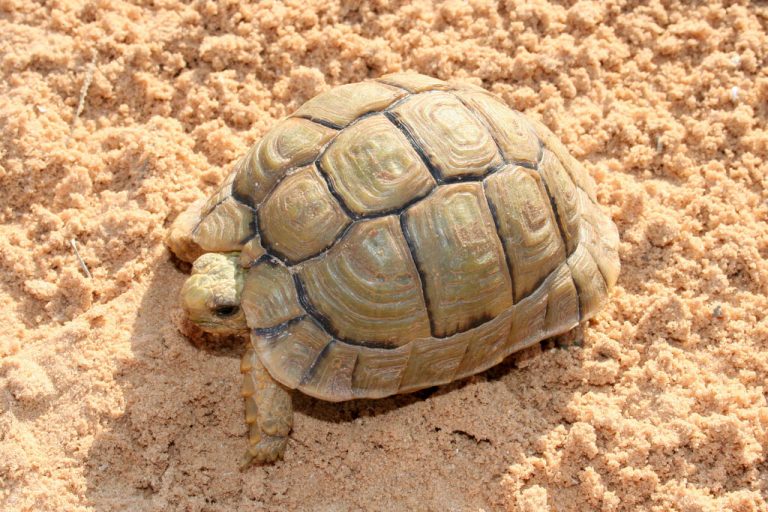
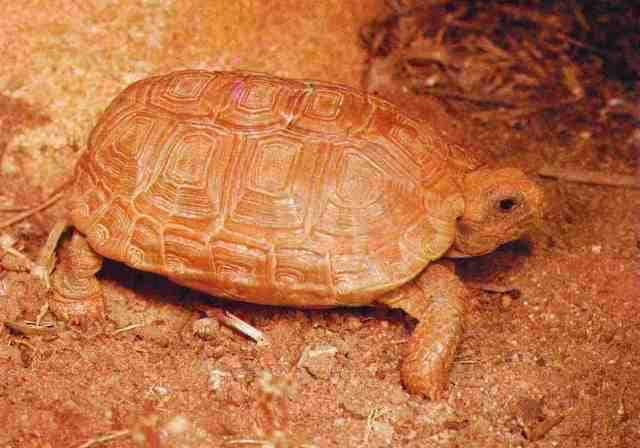
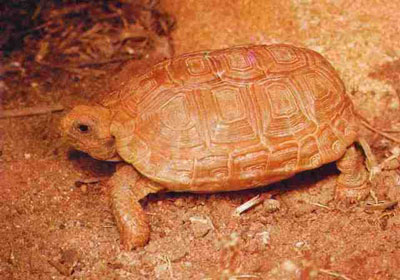
The Karoo Padloper is comparatively a small variety of tortoise having brownish colored (red to olive or orange brown) flattened carapace. Even though its color is homogeneous, the shell’s vertebral shields are dark in color at at the edges to a certain extent, particularly in the juveniles. Its color in the dry, rocky Karoo habitation merges with the surroundings.
The carapace of the Homopus Boulengeri very closely resembles that of the Homopus Signatus, yet it can grow a little bigger (around 13 cm). The design of the carapace is completely dissimilar. The carapace of the Homopus boulengeri is uniform in color, which is perhaps red, brown or yellowish. The males have a concave shaped plastron; both the males and females have buttock tubercles. The clutch laid by the females of this variety is a one egg at a time.
Similar to the close relatives the Nama Padloper and Speckled Padloper of the west, the Karoo Padloper also has four clawed toes on its hind feet and five on its front feet. They normally weigh from 100 to 150g. Their standard length is100mm, The grown up males are smaller than the females, but still they display a concave shape of their belly (plastron) and somewhat lengthier tails.
Habitat
In the Wild
You can find this species in the province of the Karoo (South Africa), around the eastern provinces of Wolwefontein and Pearston, to the Carnarvon and Sutherland in the west. Mostly this area gets rain during the summer. Homopus boulengeri dwell strictly in the rocky habitations, it possibly inhabits the sandstone and the ironstone regions. There is little knowledge of the biological study of this Boulenger’s Cape Tortoise.
In the wild, in the regions of the Great Karoo, we have the Boulenger’s Cape tortoise dwelling in the edges and protrusions of the ironstone and shale. In this region, it takes shelter beneath the ledges and the crevices of rocks (not like the other species of tortoises that take shelter under plants). Its diet is exceptional (thus when in captivity, its survival rate is very weak). This tortoise appears just prior to thunderstorms, for which reason, it derived its local name from the Afrikaans “Donnerweerskilpad, ” (“Thunder Tortoise”).
In Captivity
It is difficult for this variety to thrive properly when in captivity, unless you take care to provide food similar to their natural diet, like the original vegetation from the region of Nama Karoo. They need very precise moisture, temperature and climatic conditions.
A second version states that The Homopus Research Foundation does not possess the know-how with husbandry of this variety, and it appears there is no documents published of husbandry anywhere else. As all the other varieties of Padlopers flourish well as captives, and because of the morphological and ecological similarity of this with that of the H. Signatus, there is no reason to wonder why you cannot rates these too as good pets in captivity.
Threats
It is an endangered species because of the poaching for the pet trade, overgrazing as well as the road traffic. The collection of Homopus species for trade is unlawful and thus any incidence of captivity recorded in the non-commercial studbook of Namibia and South Africa or any type of commercial trading of Homopus tortoises is with no exception, firmly prohibited.
Having discovered a fondness for insects while pursuing her degree in Biology, Randi Jones was quite bugged to know that people usually dismissed these little creatures as “creepy-crawlies”.