Diamond Python

Scientific Classification & Quick Facts
| Common name | Diamond python |
| Scientific name | Morelia spilota spilota |
| Kingdom | Animalia |
| Phylum | Chordata |
| Class | Squamata |
| Family | Pythonidae |
| Genus | Morelia |
| Type | Reptile (non-venomous python) |
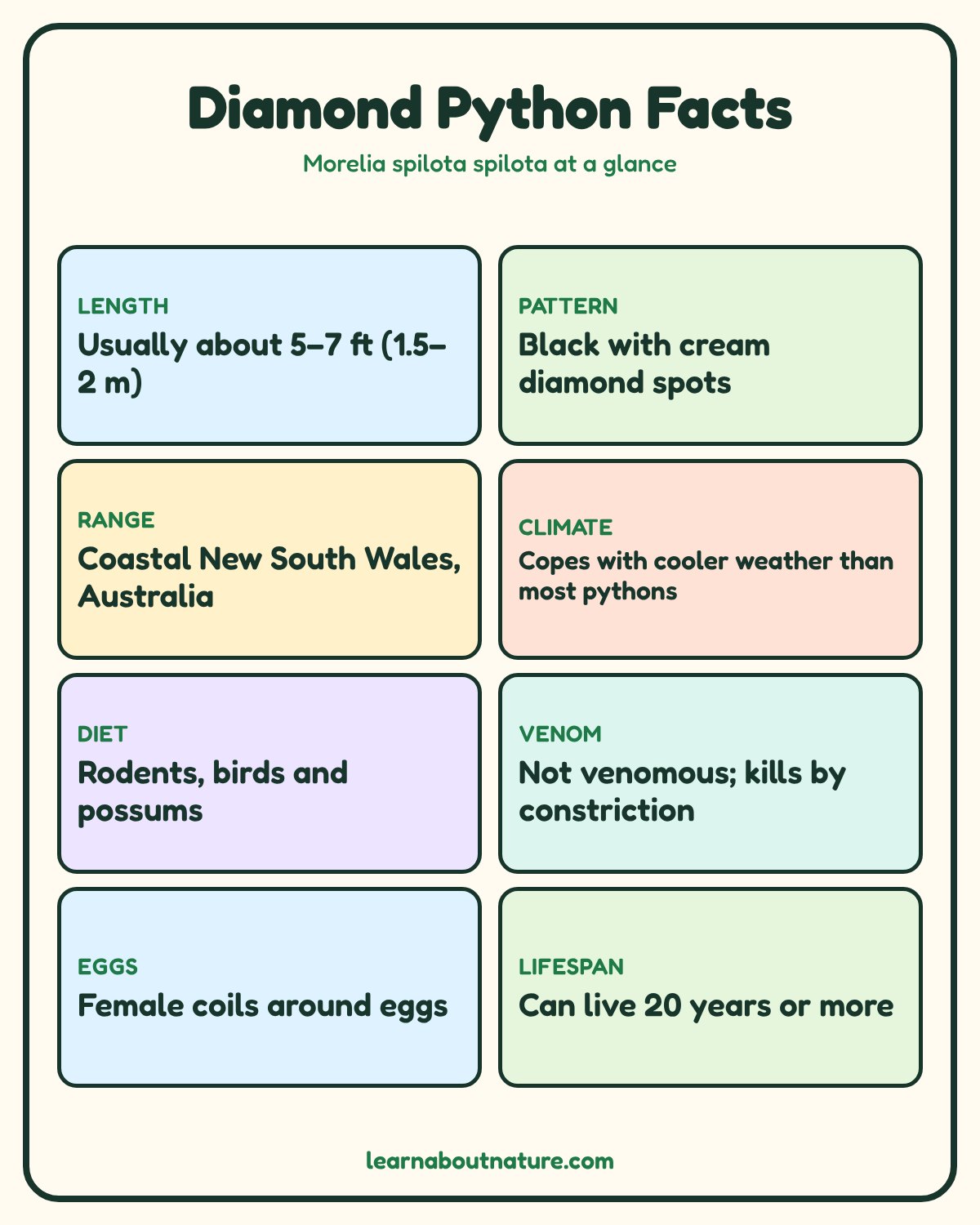
| Diet | Lizards and mammals up to the size of a possum |
| Habitat | Woodland, heath, forest and suburbs |
| Native range | Coastal southeastern Australia |
| Size | About 2 m (6 ft); some reach 3 m |
| Colours | Dark olive and black with cream-yellow scale spots |
| Special feature | Mother shivers to keep her eggs warm |
The Diamond Python, Morelia Spilota Spilota, is a close relative of Morelia Spilota or the Carpet python. Endemic to the coastal regions and the nearby ranges of the South East of Australia, this is a snake of reasonable size and inhabits the highest altitudes among Australian python species.

Anatomy

The Diamond Python grows normally to about two meters or a little over six feet, but specimens of up to about 3 meters (10 feet) have been reported. They display a variety in color and patterns, though dark olive and black are their principal colors. The name Spilota (spotted) comes from the yellow or cream spot in the middle of their dorsal scales. Many of the scales on its tail and body, form clusters of rosettes that give the impression of diamonds, giving this snake its name. Their belly is of cream, yellow or white color, but have been often known to be spotted black.
Breeding
These snakes hatch a clutch of about about 25 eggs, going up to 54 at times. The female protects her eggs vociferously, coiling herself around them and going through a process of shivering for regulating the temperature. During the period of incubation, she is zealous about her eggs and will leave them only to raise her body temperature by basking in the sun. Once the young emerge from their eggs, they are on their own. The juveniles look like miniature versions of the adults and their colors gain significance only when they reach adulthood.
Habitat

We can find Diamond snakes in New South Wales’ coastal regions and Victoria. These snakes inhabit varied habitats which include woodlands, heaths, forest as well as urban areas. They even occupy roof spaces of houses in the suburbs, where they can prey on rats and mice. Their distribution range in Victoria is limited, These snakes are now considered rare and threatened because of the reduction in habitats.
The sole related python species in the state are the Morelia Spilota Metcalfei. They are said to hybridize with Diamond Pythons in the northern range of these subspecies, Diamond Pythons inhabit higher altitudes than other members of family Pythonidae. (The eastern regions of Gippsland, for instance.) We can generally find them on The Great Dividing Range’s east side. Sometime, we can also find them on the ranges, and occasionally, at a distance from the coast. Of all pythons, diamonds appear to have the most southern distribution. Only a few populations have been recorded in Victoria. Changes in the use of land and the resultant destruction of the habitats have led to the species as threatened with Extinction’ in the state. During winter months, they inhabit rocky habitats.
Behavior

Diamond Pythons are typical inoffensive snakes. They certainly are not eager to bite. These pythons, being ambush predators, have large, overlapping territories. The range of females is around 120 Acres and the range of males cover double the area. These snakes are active during the day and on warmer nights. They spend most of the time in ambush, patiently waiting for prey to pass by. They do not seem to mind remaining in the same position for a couple of weeks, before moving to a new location barely one hundred meters away. They kill their prey by constriction and suffocation. They usually prey on lizards and on mammals as big as a big possum. They do not pose any danger to humans. They bite if harassed. When they bite, they bite hard, and sometimes you can see traces of their teeth in the wound.
As a Pet

While the capture of Diamond snakes in the wild is banned, they are bred in captivity quite successfully and kept as popular pets by collectors in Australia and the rest of the world. They are usually kept in vivariums or other controlled environments. A steady diet of rodents suits them ideally. A captive bred Diamond python tends to become quite tame. They tolerate handling and generally make very good pets.
Diamond python FAQs
Why is it called a diamond python?
Many of its scales form clusters of rosettes, which look like diamonds. The scales also have a yellow or cream spot in the middle.
Are diamond pythons dangerous?
Not really. They are quiet, gentle snakes that do not like to bite. They only bite hard if they are harassed, and they pose no danger to people.
What do diamond pythons eat?
They eat lizards and mammals, up to the size of a big possum, and in suburbs they raid roof spaces for rats and mice. They ambush prey and squeeze it.
Where do diamond pythons live?
They live in the coastal areas and nearby ranges of southeastern Australia, in New South Wales and Victoria. They live in woodlands, heaths, forests and even suburbs.
Do diamond pythons look after their eggs?
Yes. The mother lays around 25 eggs, sometimes up to 54, and coils around them. She shivers to keep them warm and only leaves to bask in the sun.

Randi Jones is the owner and founder of the Nature Gift Store, an online retailer specializing in nature-themed gifts, educational science projects, live animal nature kits and real butterfly artwork. A biology graduate who fell in love with insects, she founded the company in 2001 to make active learning about nature fun, accessible and engaging for children and adults. Her store offers real butterfly frames, home and garden decor and educational live animal kits, including ant farms, worm farms, tadpoles, ladybugs and hermit crabs, and she runs a bug museum in Washington featuring live animals like Eddie the Iguana alongside other reptiles and insects. Randi wrote most of the guides on this site. They first appeared on her long-running nature sites, including Monarch-Butterfly.com, Ladybug-Life-Cycle.com, Frog-Life-Cycle.com, Dragonfly-Site.com and Butterfly Pictures, which have now been brought together here at Learn About Nature.