Segmented Worms

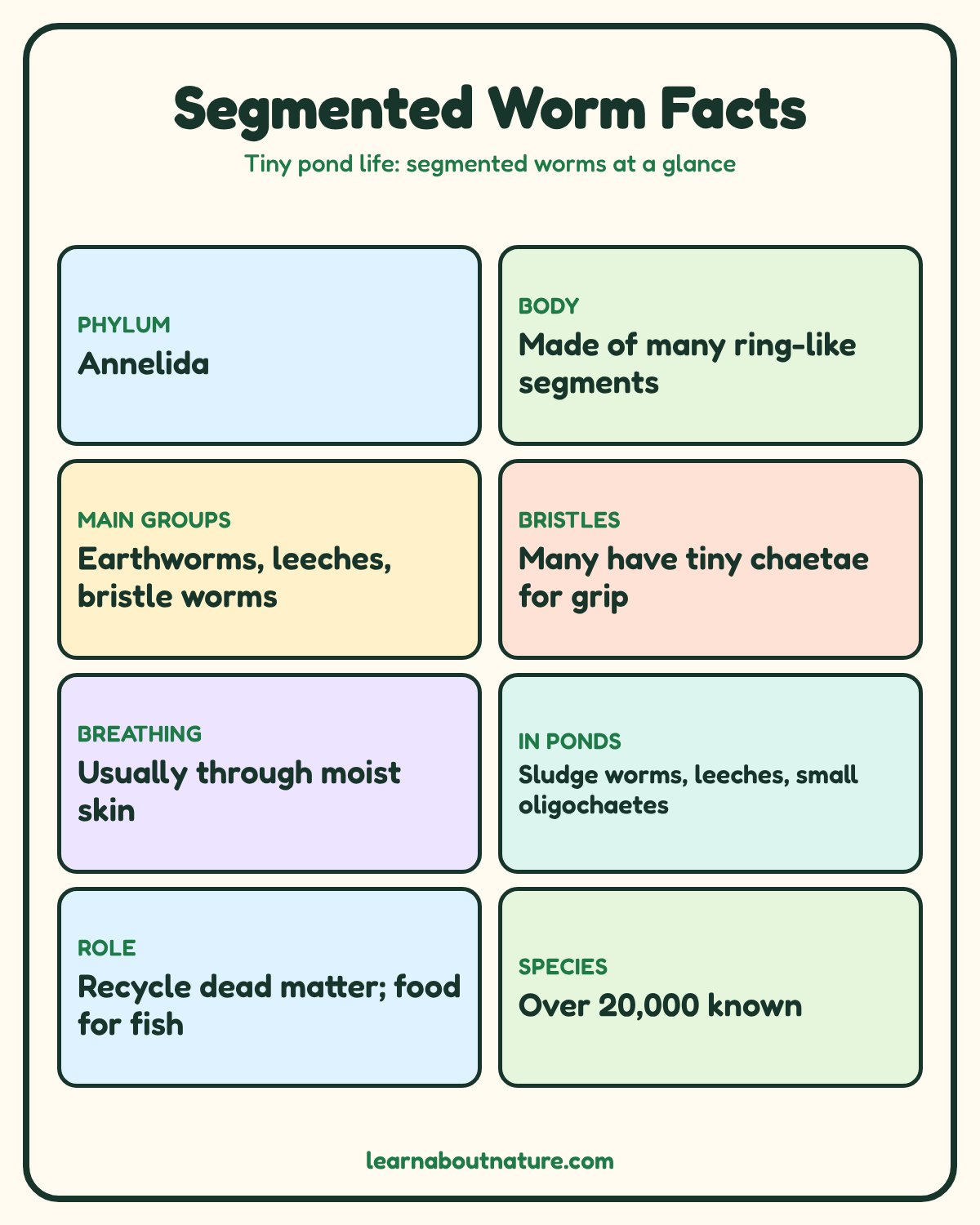
Segmented worms, also called annelids or ringed worms, are worms whose long bodies are divided into many ring-like sections. The group includes earthworms, leeches, ragworms, lugworms and colorful fanworms, and scientists have described more than 20,000 species.
Scientific Classification & Quick Facts
| Common name | Segmented worm |
| Scientific name | Annelida |
| Kingdom | Animalia |
| Type | Segmented worm (annelid) |
| Diet | Varies: rotting matter, plankton, prey or blood |
| Habitat | Sea, fresh water, soil and hydrothermal vents |
| Size | Up to about 3 m (9.8 ft) long |
| Special feature | Body is made of ring-like segments |
What Are Annelids?
The scientific name for the group, Annelida, comes from the Latin word anellus, meaning little ring. Look closely at an earthworm and you will see why: its body is made of dozens of rings, or segments, lined up one after another.
Annelids live almost everywhere. Many live in the sea, from rocky shores and muddy tidal flats to the deep ocean floor, including around hot hydrothermal vents. Others live in fresh water, and many, like earthworms, live in damp soil on land.
Annelids are invertebrates, animals without backbones. Studies of their DNA show that their closest relatives include molluscs (snails, clams and octopuses), brachiopods and ribbon worms. They are more distantly related to flatworms, which have flat bodies with no segments.
Annelids range from tiny worms smaller than a grain of rice to real giants. The giant Gippsland earthworm of Australia can stretch to well over a meter (more than 3 feet) long, making it one of the longest earthworms in the world.
Main Groups of Segmented Worms
Scientists are still working out the annelid family tree, but most textbooks describe these main groups:
- Polychaetes (bristle worms): around 10,000 or more species, most of them living in the sea. Their name means ‘many bristles’. Most have paddle-like flaps called parapodia on each segment, which they use for crawling and swimming. Ragworms, lugworms and feather-duster worms are polychaetes.
- Clitellates: earthworms and their relatives, plus leeches. They have few or no bristles and no parapodia. Instead, adults have a thick band called the clitellum, which makes a cocoon to protect their eggs.
- Oligochaetes: the earthworm side of the clitellates. Their name means ‘few bristles’. Most burrow in soil or mud and feed on rotting plant material.
- Leeches: clitellates with a sucker at each end of the body. They move by looping along like inchworms, or by swimming. Many leeches are predators that swallow small invertebrates, while some feed on the blood of fish, frogs or other animals.
Some worms that were once placed in separate groups are now known to be annelids. These include the spoon worms (echiurans) and the giant tube worms of deep-sea vents. Adult tube worms have no mouth or gut at all. Instead, bacteria living inside their bodies make food for them.
Anatomy

Photo by: Alex Popovkin
Annelids have bodies that are the same on the left and right sides (bilateral symmetry). Inside, they have a fluid-filled body cavity called a coelom, which surrounds the gut.
On the outside, the body is marked by grooves into rings. Inside, thin walls called septa usually divide the body into matching compartments. Many segments contain the same set of parts, such as nerves, muscles and organs for removing waste. A long gut, a main nerve cord and major blood vessels run through the whole body from head to tail.
Most annelids have a closed circulatory system, which means their blood flows through vessels, like ours does. Instead of one heart, an earthworm has several muscular blood vessels near its front end, often called its five pairs of hearts, that pump blood around the body.
Annelids are covered by a thin, flexible outer layer called a cuticle, made of collagen. Unlike insects and other arthropods, which have hard shells and must molt as they grow, annelids do not molt. They simply grow by adding new segments.
How Annelids Move
Many annelids, including earthworms, move by peristalsis. Each segment has two sets of muscles: rings of muscle running around the body and long muscles running from end to end. Because each segment is a sealed bag of fluid, squeezing one set of muscles makes the segment long and thin, and squeezing the other makes it short and fat.
Waves of these squeezes travel along the body, pushing the worm forward. Tiny bristles called chaetae (or setae) poke out from the skin and grip the soil, stopping the worm from slipping backward. If you gently run a finger along an earthworm, you may feel them.
Polychaetes often swim or crawl by wiggling their bodies from side to side and paddling with their parapodia. Leeches loop along using their two suckers, and some very small marine worms glide along using cilia, tiny beating hairs on their skin.
Feeding
Annelids have many different ways of eating:
- Predators: some polychaetes shoot out their throat, armed with jaws, to grab small animals.
- Deposit feeders: earthworms and lugworms swallow soil or mud and digest the bits of rotting material in it.
- Filter feeders: fanworms and feather-duster worms spread out a crown of feathery tentacles covered in cilia to catch tiny food particles from the water.
- Selective feeders: some tube-dwelling worms use long tentacles to pick food particles from the sea floor.
- Blood feeders: some leeches attach to animals and suck their blood.
Reproduction
Most annelids reproduce sexually. Many polychaetes release eggs and sperm into the water. The fertilized eggs hatch into tiny swimming larvae called trochophores, which drift with the plankton before settling down and changing into small adult worms.
Earthworms are hermaphrodites, meaning each worm has both male and female parts. Two earthworms line up and swap sperm. Later, each worm’s clitellum produces a slimy ring that slides off over its head, collecting eggs and sperm along the way. The ring seals into a small cocoon, where the eggs are fertilized and the young worms develop until they hatch.
Many annelids can also reproduce asexually by splitting into pieces, and many can regrow lost segments after an injury. Despite the popular myth, though, cutting an earthworm in half does not usually make two whole worms.
Earthworms and Healthy Soil

Earthworms are some of the most helpful animals in the garden. Some kinds burrow deep, while others live near the surface in damp leaf litter. Their tunnels loosen the soil and let air and water reach plant roots.
Earthworms also pull dead leaves into the ground and eat them. As the leaves pass through their gut, they are mixed with soil and broken down, and the worms leave behind rich droppings called castings. This speeds up decay and releases nutrients in forms that plants can easily use. The naturalist Charles Darwin was so impressed by earthworms that he wrote a whole book about them in 1881.
Segmented worm FAQs
What are segmented worms?
Segmented worms, or annelids, are worms with bodies made of many ring-like segments. The group includes earthworms, ragworms and leeches.
How many kinds of segmented worm are there?
There are more than 17,000 kinds, and some counts say over 22,000.
How big can segmented worms get?
Some are tiny, but the Australian giant Gippsland earthworm and a giant Mekong earthworm can grow up to 3 metres (9.8 feet) long.
Where do segmented worms live?
They live in many places: in the sea, in fresh water, in soil, around hydrothermal vents and in warm wet land habitats.
Why are earthworms good for soil?
Burrowing earthworms loosen the soil so air and water can get in. They also mix minerals and organic matter and speed up decay, which helps plants.

Randi Jones is the owner and founder of the Nature Gift Store, an online retailer specializing in nature-themed gifts, educational science projects, live animal nature kits and real butterfly artwork. A biology graduate who fell in love with insects, she founded the company in 2001 to make active learning about nature fun, accessible and engaging for children and adults. Her store offers real butterfly frames, home and garden decor and educational live animal kits, including ant farms, worm farms, tadpoles, ladybugs and hermit crabs, and she runs a bug museum in Washington featuring live animals like Eddie the Iguana alongside other reptiles and insects. Randi wrote most of the guides on this site. They first appeared on her long-running nature sites, including Monarch-Butterfly.com, Ladybug-Life-Cycle.com, Frog-Life-Cycle.com, Dragonfly-Site.com and Butterfly Pictures, which have now been brought together here at Learn About Nature.