Ciliates

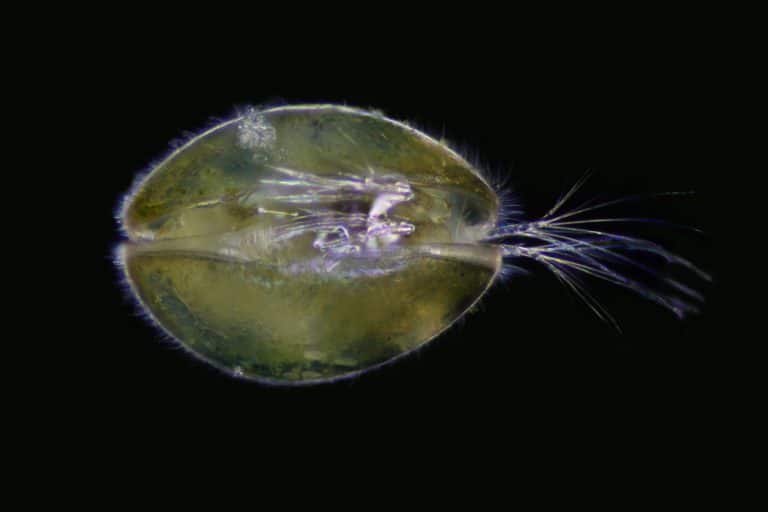
Ciliates are tiny, single-celled living things covered in hundreds or thousands of short, hair-like structures called cilia. They use these beating hairs to swim, crawl and sweep food into their bodies. Ciliates make up a group called Ciliophora, and you can find them in almost any drop of pond water.
Quick Facts
| Common name | Ciliate |
| Scientific name | Ciliophora |
| Type | Single-celled protist (protozoan) |
| Diet | Algae, bacteria and bits of dead matter |
| Habitat | Ponds, rivers, lakes, oceans and soil |
| Size | 10 micrometres to 4 mm long |
| Special feature | Covered in tiny hairs called cilia |
What Are Ciliates?
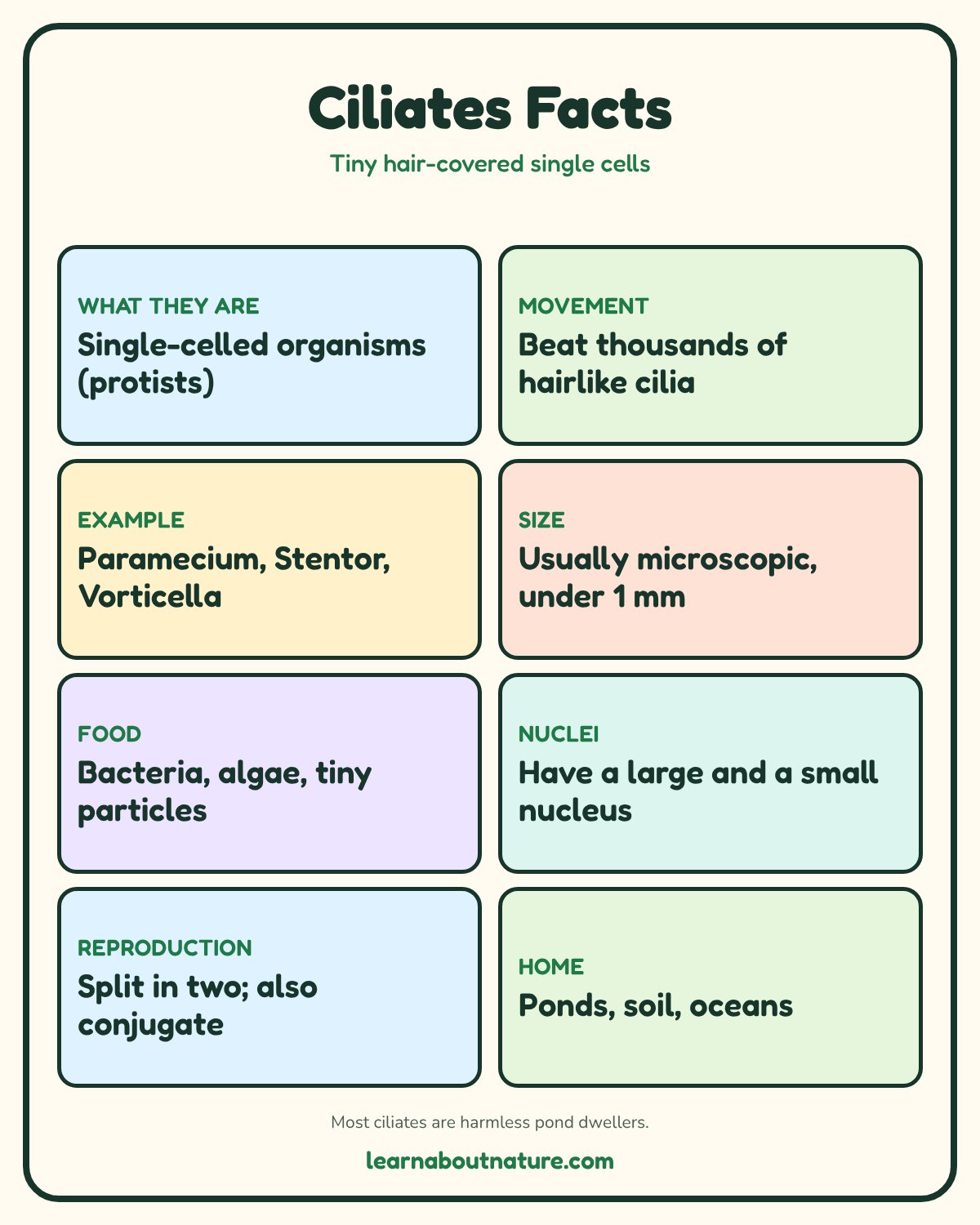
Ciliates are single-celled protists covered in short, hair-like cilia that they beat to swim, crawl and sweep food into a mouth-like groove. They belong to the phylum Ciliophora, have two kinds of nucleus, and live in almost any water. Well-known examples include Paramecium, Stentor and Vorticella.
What Are Ciliates?
Ciliates are protists, a mixed group of living things that have a proper cell nucleus but are not plants, animals or fungi. Each ciliate is just one cell, yet many are surprisingly complex, with special parts for eating, swimming, getting rid of waste and pumping out extra water.
Famous examples include the slipper-shaped Paramecium, the trumpet-shaped Stentor, and Vorticella, which looks like a tiny upside-down bell on a spring-like stalk. Scientists also study a ciliate called Tetrahymena to learn how cells work.
Cilia: Tiny Oars
Cilia are very similar in structure to the longer whips called flagella that some other cells use. The difference is mostly in number and length: a ciliate has many short cilia, while a flagellate usually has just one or a few long flagella.
Cilia beat in coordinated waves, a bit like a field of wheat rippling in the wind or a team of rowers pulling their oars together. Ciliates use them in different ways:
- Swimming: rows of cilia push the cell forward and make it spin as it moves.
- Feeding: cilia around the mouth area create currents that pull food in.
- Crawling and sensing: some ciliates have cilia fused into tiny ‘legs’ (cirri) that let them walk over surfaces.
- Attaching: some, like Vorticella, anchor themselves to plants or rocks.
A few ciliates, called suctorians, only have cilia when they are young. As adults they stay fixed in place and catch food using sticky tentacles.
Size and Habitat

Illustration by: Ali Zifan.
Most ciliates are far too small to see without a microscope. They range from about 10 micrometers (a hundredth of a millimeter) to around 4 millimeters long. The biggest, such as Spirostomum and some kinds of Stentor, can just be seen as tiny specks with the naked eye.
Ciliates live almost everywhere there is water: ponds, lakes, rivers, oceans, wet soil and even puddles. Several thousand species have been described, and scientists think there may be many thousands more still waiting to be discovered.
Some ciliates live inside other animals. Huge numbers live in the stomachs of cows and sheep, where they help break down tough plant food. A few are parasites. One, nicknamed ‘ich’, causes white spot disease in aquarium and farmed fish.
A Cell With Two Nuclei
One of the strangest things about ciliates is that each cell has two different kinds of nucleus:
- The macronucleus is large and holds many copies of the cell’s working genes. It runs the cell’s everyday jobs, such as growing and making proteins.
- The micronucleus is small and holds a ‘master copy’ of the genes. It is mostly kept in reserve and is used when ciliates swap genetic material.
This two-nucleus system is one of the key features that sets ciliates apart from other protists.
The Cell’s Outer Layer
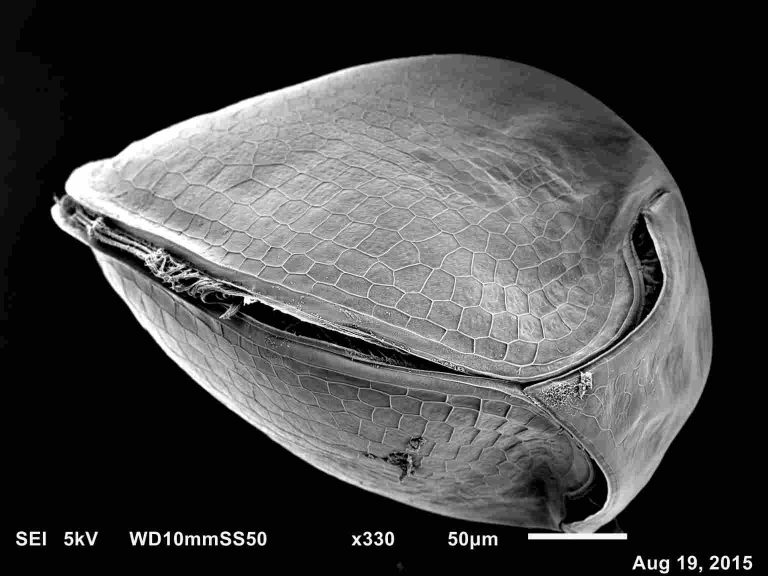
Just under a ciliate’s outer cell membrane are many tiny flattened sacs called alveoli. Together with the membrane, they form a supporting layer called the pellicle, which helps the cell keep its shape. Depending on the species, the pellicle may be stiff, flexible or able to contract.
Below the surface, the bases of the cilia are linked by a network of fibers, called the infraciliature. Its pattern is different in different groups, so scientists use it to tell ciliates apart. The alveoli also show that ciliates are related to dinoflagellates and to the parasite that causes malaria, which all belong to a larger group called the Alveolata.
How Ciliates Feed
Most ciliates eat other living things. They feed on bacteria, tiny algae, other protists and bits of dead material (detritus). Special cilia around a groove, called the oral groove, sweep food toward the cell’s ‘mouth’ opening.
Once inside, the food is wrapped in a little bubble called a food vacuole. The vacuole travels through the cell while digestive chemicals break the food down, and the nutrients pass out into the rest of the cell. Leftover waste is pushed out through a special spot on the cell surface that works a bit like an anus.
Freshwater ciliates also have contractile vacuoles. These little pumps collect extra water that seeps into the cell and squirt it back out, so the cell does not swell up and burst.
Reproduction
Ciliates usually reproduce by simply splitting in two, a process called binary fission. Most divide across the middle of the body. The micronucleus divides carefully, the macronucleus stretches and pinches in half, and the cell splits. The front half (called the proter) and the back half (the opisthe) each become a complete new ciliate.
Ciliates also have a special way of mixing their genes called conjugation. Two ciliates join together for a while and swap copies of their micronuclei. Afterward, each one builds a brand-new macronucleus. This does not make new cells right away, but it shuffles the genes, which helps ciliate populations stay healthy and adaptable.
Common Types of Ciliates
Thousands of ciliate species exist, but a few are especially common in pond water and well known from school microscope lessons.
| Ciliate | Shape | How it lives | Notable feature |
|---|---|---|---|
| Paramecium | Slipper-shaped | Swims freely, eats bacteria | Classic school specimen; has two contractile vacuoles |
| Stentor | Trumpet-shaped | Attaches by its narrow end or swims | One of the largest single cells, up to about 2 mm |
| Vorticella | Bell on a long stalk | Fixed to plants or debris | Stalk coils like a spring when disturbed |
| Didinium | Barrel-shaped | Swims and hunts | Predator that swallows Paramecium whole |
| Euplotes | Flat and oval | Walks on surfaces | Uses tufts of cilia (cirri) as legs |
| Spirostomum | Long and worm-like | Lives in pond mud | Can shorten its body extremely fast |
| Tetrahymena | Pear-shaped | Swims freely | Used by scientists to study how cells work |
Many ciliates are named after their shape, and their outline under a microscope is often the first clue to what you are looking at.
Ciliates vs Other Protozoa
Single-celled protists are often grouped by how they move. Comparing ciliates with flagellates and amoebas shows what makes them special.
| Group | How it moves | Example | Nuclei |
|---|---|---|---|
| Ciliates | Many short cilia | Paramecium | Two kinds: macronucleus and micronucleus |
| Flagellates | One or a few long whip-like flagella | Euglena | One kind |
| Amoebas | False feet (pseudopodia) of flowing cytoplasm | Amoeba proteus | One kind |
| Apicomplexans | Mostly by gliding; many have no cilia or flagella as adults | Plasmodium (malaria) | One kind |
Ciliates are usually the fastest swimmers among these groups. A Paramecium can swim many times its own body length each second.
These old groupings are based on how cells move rather than how closely related they are. Modern studies of DNA show that ciliates are most closely related to dinoflagellates and apicomplexans, which share the tiny sacs called alveoli under their cell membrane.
Why Ciliates Matter
Ciliates may be tiny, but they play a big role in nature and in people’s lives.
- Food webs: ciliates eat bacteria and tiny algae, and in turn are eaten by small animals such as rotifers, water fleas and the larvae of fish and insects. They help pass energy up the food chain.
- Cleaning water: in sewage treatment works, ciliates graze on bacteria and help make the water clearer. Workers check which ciliates are present to see how well the treatment is working.
- Digestion in animals: ciliates in the stomachs of cows, sheep and other grazers help break down tough plant material.
- Science: research on ciliates has helped scientists discover how the ends of chromosomes (telomeres) are protected, and the enzyme that maintains them, telomerase. It was first found in Tetrahymena.
- Disease: a few ciliates cause illness, such as ‘ich’ in fish and Balantidium, which can infect pigs and, rarely, people.
Because some ciliates are sensitive to pollution, the types found in a stream or pond can also be used as a sign of water quality.
How to See Ciliates Yourself
Ciliates are easy to find, and watching them is one of the best first experiments with a microscope.
- Collect a jar of pond water with some plant material or mud from the bottom. Puddles and old flower-vase water work too.
- To grow more ciliates, add a few pieces of dry grass, hay or lettuce to the water and leave the jar in a bright spot, out of direct sun, for several days. Bacteria feed on the plants and ciliates feed on the bacteria.
- Place a drop from near the plant material on a glass slide and add a cover slip.
- Start with low magnification (around 40x to 100x) to spot moving cells, then switch to higher power for detail.
- If ciliates move too fast, add a single cotton fiber to the drop to slow them down.
Look for spinning slipper shapes (Paramecium), bells on stalks that suddenly snap back (Vorticella) and tiny walking cells (Euplotes). Always wash your hands after handling pond water, and ask an adult to help if you are using a microscope for the first time.
Ciliate FAQs
What are ciliates?
Ciliates are single-celled organisms covered in tiny hair-like cilia. They use the cilia to swim, crawl, feed and sense things.
Where do ciliates live?
Ciliates live anywhere there is water, such as ponds, rivers, lakes, oceans and soil.
What do ciliates eat?
Most ciliates eat tiny living things like algae and bacteria, plus bits of dead matter. Their cilia sweep food into a mouth-like groove.
How big are ciliates?
They range from about 10 micrometres up to 4 millimetres, so some can just be seen without a microscope.
How do ciliates reproduce?
Ciliates mostly reproduce by splitting in two, which is called fission. Each new cell gets its own copy of the two nuclei.

Randi Jones is the owner and founder of the Nature Gift Store, an online retailer specializing in nature-themed gifts, educational science projects, live animal nature kits and real butterfly artwork. A biology graduate who fell in love with insects, she founded the company in 2001 to make active learning about nature fun, accessible and engaging for children and adults. Her store offers real butterfly frames, home and garden decor and educational live animal kits, including ant farms, worm farms, tadpoles, ladybugs and hermit crabs, and she runs a bug museum in Washington featuring live animals like Eddie the Iguana alongside other reptiles and insects. Randi wrote most of the guides on this site. They first appeared on her long-running nature sites, including Monarch-Butterfly.com, Ladybug-Life-Cycle.com, Frog-Life-Cycle.com, Dragonfly-Site.com and Butterfly Pictures, which have now been brought together here at Learn About Nature.