Cholla Cactus

Scientific Classification & Quick Facts
| Common name | Cholla cactus |
| Scientific name | Cylindropuntia |
| Kingdom | Plantae |
| Phylum | Tracheophyta |
| Class | Magnoliopsida |
| Order | Caryophyllales |
| Family | Cactaceae |
| Type | Cactus with jointed, cylindrical stems |
| Habitat | Hot deserts, rocky slopes, mountain foothills |
| Native range | Southwestern USA, Mexico and Central America |
| Colours | Orange or greenish-yellow flowers |
| Flowering season | April to June |
| Height | From 2 ft to 15 ft, by species |
| Special feature | Spines covered by papery sheaths |
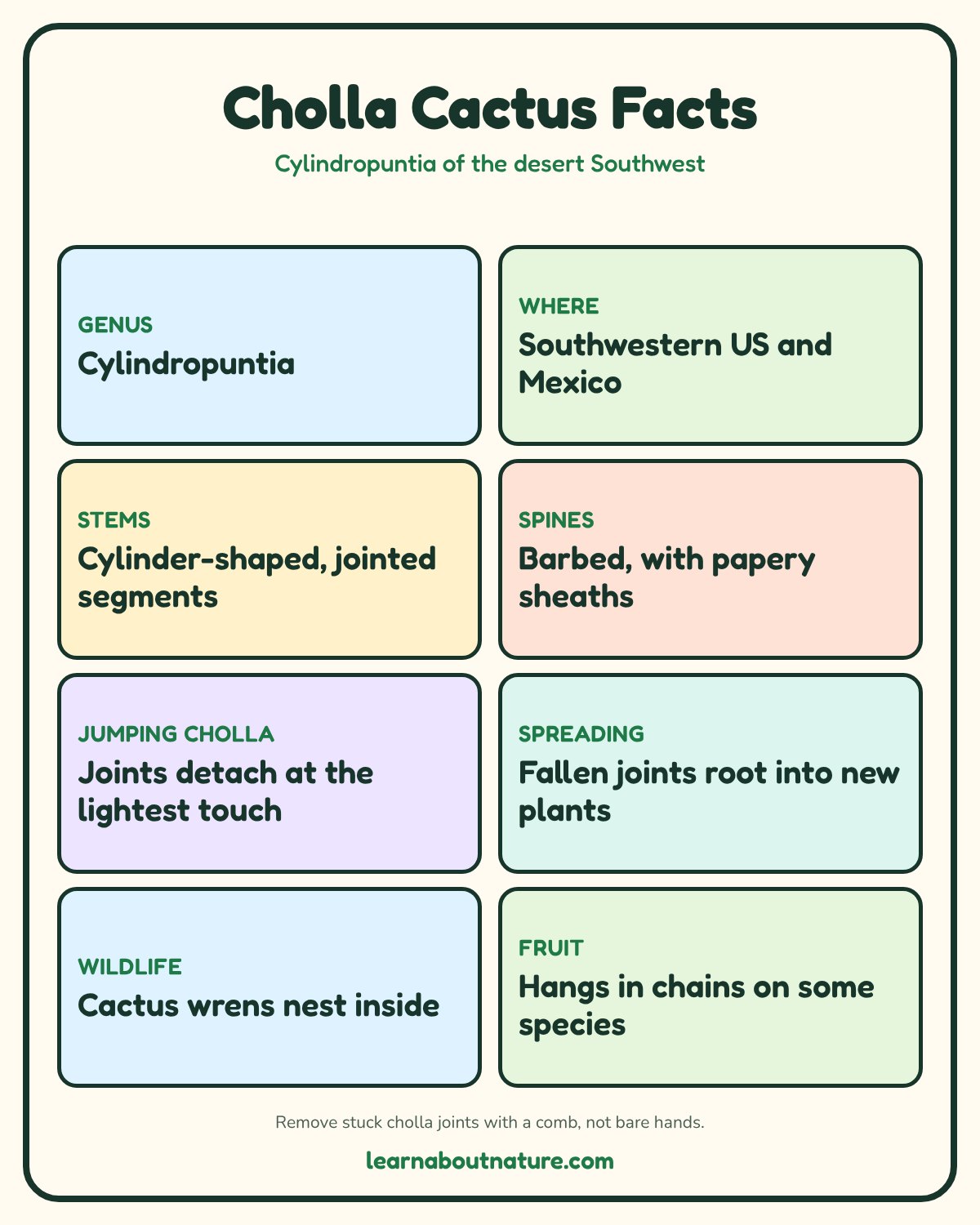
The Cholla cactus plant represents the 20 species of the Genus Cylindropuntia.
Anatomy
The Cholla cactus has cylindrical stem segments which are joined from end to end in the manner of a branching tree. Actually, these stems are modified branches that serve many functions such as photosynthesis, production of flower and storage of water. Like other cactus, on the stems, it has small and wart like projections from which spines can grow. The spines of the Cholla are covered by papery sheaths. These sheaths are habitually colorful and bright. And also provide the cactus with its unique appearance. This plant has orange or greenish yellow flowers. And these are pollinated by bees. The Fruits of this plant are fleshy and they can be seen in an extended period of the year. Depending on the local conditions, most of its species bloom in April through June. This plant appears as ground creeper, tree or shrub.
Habitat
The Cholla cactus is found in the hot deserts of Southwest America. Its varied species adapt different conditions and elevation ranges. There are many species of Cholla cactus in the warm deserts of Central and North America. Its some species are adapted to Mountain forests and others require steep rocky slopes in Mountain foothills.
Species of Cholla Cactus
There are many species of Cholla cactus and they are frost tolerant. These species are difficult to notify separately, because leading to intermediate forms, they can hybridize. There are few distinct species of Cholla cactus including Teddy Bear Cholla, tree Cholla, Chain Fruit Cholla, diamond Cholla, chain link Cholla, Devil Cholla and Buck Thorn Cholla. All species of this plant are different in their temperature tolerance, soil preference, water requirements and in geographical ranges.
Teddy Bears Cholla (Cylindropuntia Bigelovii)

Teddy Bears Cholla – Photo by: Frank Vincentz
It is believed to look like the hairy arms and legs of a teddy bear. It can be identified by its dense, straw colored spines and yellow green colored flowers. It is found in the Sonoran Deserts of Southern Nevada, Southeast, California and Western Arizona. It grows up to 5 to 9 feet in height and the fruit of this plant is egg shaped with yellow color and 1 inch long. With lavender streaks its flowers are greenish to yellow in color.
Tree Cholla (Cylindropuntia Imbricata)

Tree Cholla – Photo by: Phil Marin
It is green and fairly spineless; it looks a lot like the Cane Cholla. In colder weather, it turns purplish. It is common in Juniper and Pinyon stands and Desert Flats. It is found in the Chihuahua desert of Texas and New Mexico and in the North in semi desert areas of Western Oklahoma and Eastern Colorado. It grows up to a height of 7 feet. Its flowers are deep lavender to red in color and its fruits are oval shaped with yellow color and 2 inches long.
Christmas Cholla (Cylindropuntia Leptocaulis)

Christmas Cholla – Photo by: Diego Delso
Among all the Chollas, this is the most slender, and mostly it is widely distributed in the Chihuahuan desert. Red berries give this plant a seasonal appearance. It is also found in Texas and New Mexico. It grows up to a height of 4 to 6 feet. Its flowers are yellow to Bronze in color and its fruits are bright red in color and they are red berries which last throughout the winter.
Chain Fruit Cholla (Cylindropuntia Fulgida)

Chain Fruit Cholla – Photo by: Dave Pape
It is the largest species of this plant. It is also known as Jumping Cholla. It grows up to 15 feet tall, sometimes like a tree, but usually a shrub. Its fruits are 1 ½ inch in size and green in color. The fruits are spineless and pear shaped berries that grow in clusters and hang in long and branched chains. So it is called Chain Fruit. Its flowers are pink and white petals streaked with lavender. From the previous season, its new fruits are added and form a chain up to 2 feet long. It is native to the Sonoran desert of Northwest Mexico and South and Central Arizona. This plant can also tolerate extreme heat.
Diamond Cholla (Cylindropuntia Ramosissima)

Diamond Cholla – Photo by: Stan Shebs
It is usually a low growing shrub in the driest deserts; It has well-known yellow or tan needle barbed tips that attach firmly to clothing, fur or the skin. It grows up to a height of 5 feet. Its flowers are dark pink to apricot in color and the fruits are spiny and dry burrs. It is found in the Sonoran deserts of Southern Nevada, southwestern California and Southeast California.
Devil Cholla (Cylindropuntia Stanlyi)

Devil Cholla – Photo by: Stan Shebs
It has various species like club collar and it has no sheaths on spines. All its species are low growing and often form thick mats that can be tightly packed. It grows up to a height of 2 feet. Its flowers are lemon and yellow in color and its fruits are spiny, fleshy and smooth.
Buck Horn Cholla (Cylindropuntia Acanthocarpa)

Buck Horn Cholla – Photo by: Stan Shebs
This plant is light green in color and widespread and appears in different locales. Its spine sheaths are light colored and inconspicuous. It grows up to a height of 3 to 10 feet. Its flowers are orange, bright yellow and pink or red in color and its fruits are dry and spiny.
Silver Cholla (Cylindropuntia Echinocarpa)

Silver Cholla – Photo by: Stan Shebs
Sheaths of yellow or White color provide this Cholla both the common names Gold and silver. At the end of the longer ones, his short-Trunked and bushy species has many short terminal joints. It grows up to a height of 5 feet. It is found in the Sonoran deserts of Arizona. Its flowers are greenish and yellow in color and outer portion of these flowers are red streaked. Its fruits are spiny and they dry up when ripe.
Soil
The Cholla cactus prefers well drained and coarse soil in rocky and dry slopes.
Uses
With a reticulate pattern, all Cholla cactus plants have woody skeleton. This woody skeleton is used to make canes or other souvenirs. The dense branches of Cholla cactus are used by desert birds as sites for nest building. Fallen segments and dead remains are frequently used by desert wood rats for protection and covering for their entrance to the burrows. The Flower buds of Cholla cactus are a desert food treasure. Fresh cooked buds are very tasty and also very nutritious. It is rich in calcium. Traditionally, it was considered as an essential food for nursing mothers.
Cholla cactus FAQs
What is a cholla cactus?
Cholla is a group of about 20 desert cacti in the genus Cylindropuntia. They have branching, cylindrical stems and spines wrapped in papery sheaths.
Where does cholla cactus grow?
Cholla grows in the hot deserts of the southwestern United States and warm parts of Central and North America. Some kinds grow on rocky slopes and in mountain forests.
How tall does cholla cactus grow?
It depends on the kind. Devil cholla stays about 2 feet tall, while chain fruit cholla can reach 15 feet and is the biggest.
Why is it called teddy bear cholla?
Teddy bear cholla looks like the fuzzy arms and legs of a teddy bear because of its dense, straw-coloured spines. It is still very prickly, so do not touch it.
How do animals use cholla cactus?
Desert birds build nests in the dense branches, and wood rats use fallen pieces to cover their burrow entrances. People have also cooked the flower buds as food.

Randi Jones is the owner and founder of the Nature Gift Store, an online retailer specializing in nature-themed gifts, educational science projects, live animal nature kits and real butterfly artwork. A biology graduate who fell in love with insects, she founded the company in 2001 to make active learning about nature fun, accessible and engaging for children and adults. Her store offers real butterfly frames, home and garden decor and educational live animal kits, including ant farms, worm farms, tadpoles, ladybugs and hermit crabs, and she runs a bug museum in Washington featuring live animals like Eddie the Iguana alongside other reptiles and insects. Randi wrote most of the guides on this site. They first appeared on her long-running nature sites, including Monarch-Butterfly.com, Ladybug-Life-Cycle.com, Frog-Life-Cycle.com, Dragonfly-Site.com and Butterfly Pictures, which have now been brought together here at Learn About Nature.