Trap-Jaw Ants

Trap-jaw ants are hunting ants in the genus Odontomachus, famous for having some of the fastest jaws in the animal kingdom. They live in warm tropical and subtropical regions around the world, where they use their spring-loaded jaws to catch prey, fight off enemies and even fling themselves through the air.
Scientific Classification & Quick Facts
| Common name | Trap-jaw ants |
| Scientific name | Odontomachus |
| Kingdom | Animalia |
| Phylum | Arthropoda |
| Class | Insecta |
| Order | Hymenoptera |
| Family | Formicidae |
| Type | Carnivorous ants with snapping jaws |
| Diet | Insects such as grasshoppers |
| Habitat | Humid soil under logs, rocks and plant debris |
| Native range | Tropical Americas, Asia, Africa and Australia |
| Special feature | Jaws snap shut in a fraction of a millisecond |
What Makes a Trap-Jaw Ant Special?
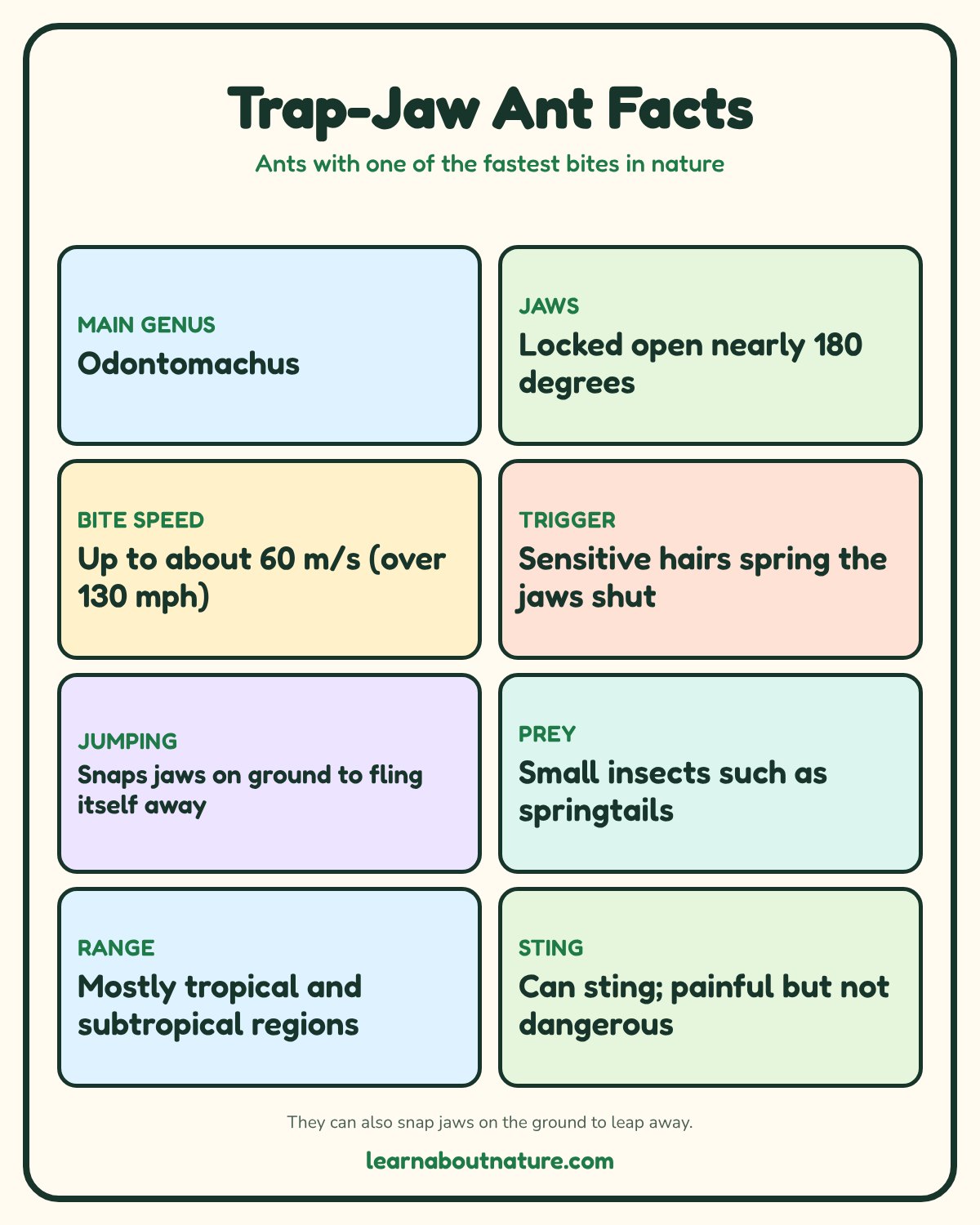
A trap-jaw ant has a pair of long, straight jaws, called mandibles, that it can open to an amazing 180 degrees, so they form a straight line across the front of its head. A built-in catch, or latch, holds the open jaws in place, a bit like a cocked mousetrap.
On the inside of each jaw are tiny trigger hairs. When an insect brushes against these hairs, the latch releases and the jaws slam shut on the victim in a fraction of a millisecond. The strike can stun, injure or kill the prey so the ant can carry it back to the nest. If one snap is not enough, the ant can reset its jaws and strike again, and it can also use them to cut larger prey into pieces.
Trap-jaw ants are not clumsy with their powerful jaws, though. They can also move their mandibles slowly and gently, which lets them dig, build their nests and carry their delicate young larvae without hurting them.
These ants are fierce hunters, and they also have a sting. Their jaws are so strong that they can even launch the ant into the air, which you can read about below.
Where Do Trap-Jaw Ants Live?
Trap-jaw ants are found in Central and South America, tropical Asia, Africa and Australia, along with many islands. Most species prefer warm, humid places such as rainforests and tropical woodlands.
Some species have spread into new areas. A trap-jaw ant called Odontomachus haematodus, which is native to South America, was first recorded in Alabama in 1956, and researchers have since found it farther along the Gulf Coast, as far as Pensacola in Florida. Another introduced species, Odontomachus ruginodis, was first noticed around Orlando and has since been found more than a hundred miles to the north, near Gainesville.
Florida also has a rare native trap-jaw ant, Odontomachus relictus, that lives only in the ancient sandy ridges of central Florida. These scrub habitats are shrinking fast, which puts this little ant at risk.
Meet Odontomachus bauri

Odontomachus Bauri Trap-Jaw Ant – Photo by: April Nobile, AntWeb.org
One of the best-studied trap-jaw ants is Odontomachus bauri. It lives from southern Costa Rica through tropical South America, as well as on the Galapagos Islands and many islands of the West Indies.
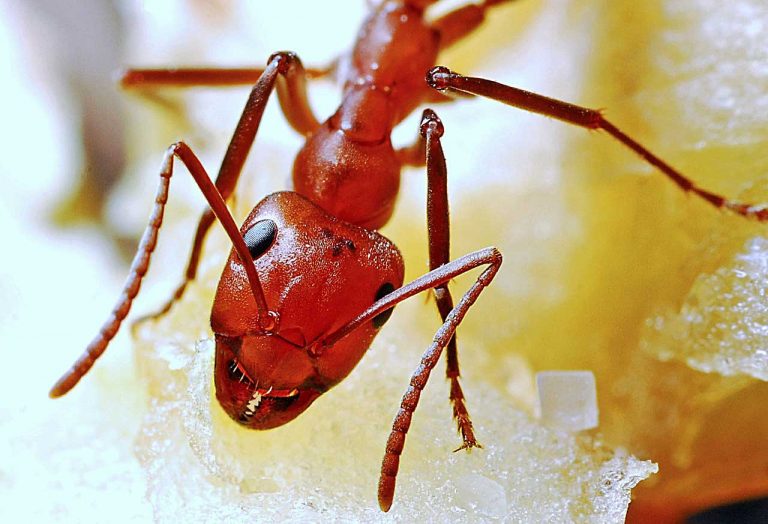
This ant is a deep reddish-brown to dark brown color, with fine grooves, or striations, on its head. Workers are roughly a third of an inch (about 1 centimeter) long, and their heads are long and narrow to make room for the big muscles that power the jaws.
Nests and Colonies
O. bauri likes to nest in soft, damp soil that is sheltered from direct sun, wind and rain. Look for its nests under fallen logs, branches and rocks, in piles of leaf litter, and even in flowerpots.
Colonies are fairly small, often around a couple of hundred ants. A single colony may spread across several nests that sit close together, which scientists call a polydomous colony. Ants from neighboring nests in the same colony get along and even share food, but they act aggressively toward ants from nests that are farther away. Each nest group tends to forage in its own area and stay out of its neighbors’ hunting grounds.
The Science of Super-Fast Jaws

Trap Jaw Ants: Diagram by: William Creighton
Trap-jaw ants have one of the fastest moving body parts ever measured in an animal. When a trigger hair is touched, the jaws snap shut at speeds of roughly 78 to 145 miles per hour (126 to 230 km/h). The whole strike takes only about 0.13 milliseconds, which is more than 2,000 times faster than the blink of an eye.
The force of the strike can be more than 300 times the ant’s own body weight. That is why the jaws are such deadly weapons against small insects.
How does the ant do it? Instead of using its muscles to close the jaws directly, the ant uses large, slow muscles to pull against the locked jaws and store up energy, like pulling back a bow or a crossbow. When a smaller trigger muscle releases the latch, all of that stored energy is let go at once, and the jaws fly shut.
The ant’s nervous system is built for speed, too. The trigger hairs are connected by a short, direct pathway of extra-large nerve cells to the muscles that release the latch. Because the signal does not have to pass through many nerve cells along the way, the ant can react in just a few thousandths of a second, making this one of the fastest reflexes known in insects.
Jumping With Their Jaws
Trap-jaw ants have discovered a surprising second use for their jaws: jumping. By snapping their jaws against the ground or another object, they can launch themselves through the air. Scientists have described two main kinds of jaw-powered jumps:
- Escape jump: The ant points its head straight down and snaps its jaws against the ground. This sends it flying up into the air, as high as about 3 inches (8 cm), which helps it get away from danger.
- Bouncer-defense jump: When the ant strikes its jaws against an intruder or a hard object in front of it, it bounces backward. These jumps can carry the ant about 16 inches (40 cm) sideways, many dozens of times its own body length.
The ant positions its head differently for each type of jump. These leaps are not very well aimed, and the ant cannot steer once it is in the air, but they are very good at getting it out of trouble fast.
What Do Trap-Jaw Ants Eat?
Trap-jaw ants are mainly predators. They hunt small, soft-bodied insects and other invertebrates, such as termites and other ants, and they also drink sweet liquids such as nectar and the sugary honeydew made by some insects.
When an ant strikes a prey animal, the force of the snap can push the ant and its victim apart. The ant often has to turn around and go back to finish the job, holding the prey and stinging it before carrying it home.
Defense and Nestmate Recognition
O. bauri is a bold and aggressive ant. When an intruder disturbs the nest, many workers spring into action. Some use their jaws to jump about, and if they land on the intruder, they bite and sting it. Unlike fire ants, where large numbers of workers rush to sting, only some trap-jaw workers usually join in the attack.
Their sting is painful but is not dangerous to most people. As with any insect sting, someone who has an allergic reaction should get medical help.
Like many ants, trap-jaw ants recognize their nestmates by smell. When two ants meet, they tap each other with their antennae, a behavior called antennation. Depending on what they sense, they may simply stay alert, raise the alarm, threaten with their open jaws, or attack by biting and stinging.
Trap-jaw ants FAQs
Why are they called trap-jaw ants?
Their long jaws open as wide as 180 degrees and lock in place. When hairs on the jaw touch prey, the jaws snap shut like a trap.
How fast can trap-jaw ants snap their jaws?
Extremely fast. The jaws can reach about 126 to 230 km/h, and they close faster than an eye blink.
Can trap-jaw ants jump?
Yes. By striking their jaws on the ground, they can fling themselves about 16 inches (around 20 body lengths) through the air to escape danger.
Do trap-jaw ants sting?
Yes. They have a venomous sting and are aggressive, but the article says it is not very harmful to people, though it can cause an allergic reaction.
Where do trap-jaw ants live?
They live in warm parts of the world, from South and Central America to tropical Asia, Africa and Australia. Some are moving north into the southeastern United States.

Randi Jones is the owner and founder of the Nature Gift Store, an online retailer specializing in nature-themed gifts, educational science projects, live animal nature kits and real butterfly artwork. A biology graduate who fell in love with insects, she founded the company in 2001 to make active learning about nature fun, accessible and engaging for children and adults. Her store offers real butterfly frames, home and garden decor and educational live animal kits, including ant farms, worm farms, tadpoles, ladybugs and hermit crabs, and she runs a bug museum in Washington featuring live animals like Eddie the Iguana alongside other reptiles and insects. Randi wrote most of the guides on this site. They first appeared on her long-running nature sites, including Monarch-Butterfly.com, Ladybug-Life-Cycle.com, Frog-Life-Cycle.com, Dragonfly-Site.com and Butterfly Pictures, which have now been brought together here at Learn About Nature.