Gorilla Facts for Kids: Habitat, Diet and Fun Facts

Quick answer: A gorilla is the largest primate in the world, a great ape that lives in the forests of central Africa. Gorillas eat mostly plants, such as leaves, stems and fruit, plus some insects. They live in family groups led by a big adult male called a silverback. Both gorilla species are Critically Endangered.
Deep in an African rainforest, a family of gorillas rests in a clearing. Youngsters wrestle and tumble while their mothers feed on leaves, and a huge male with silver hair on his back keeps watch. Gorillas may look fierce, but they are mostly gentle plant-eaters.
Gorillas are among our closest living relatives. They are clever, they show feelings, and they care for their babies for years. Here is how gorillas live, what they eat, how big they get and why both kinds of gorilla need protection.
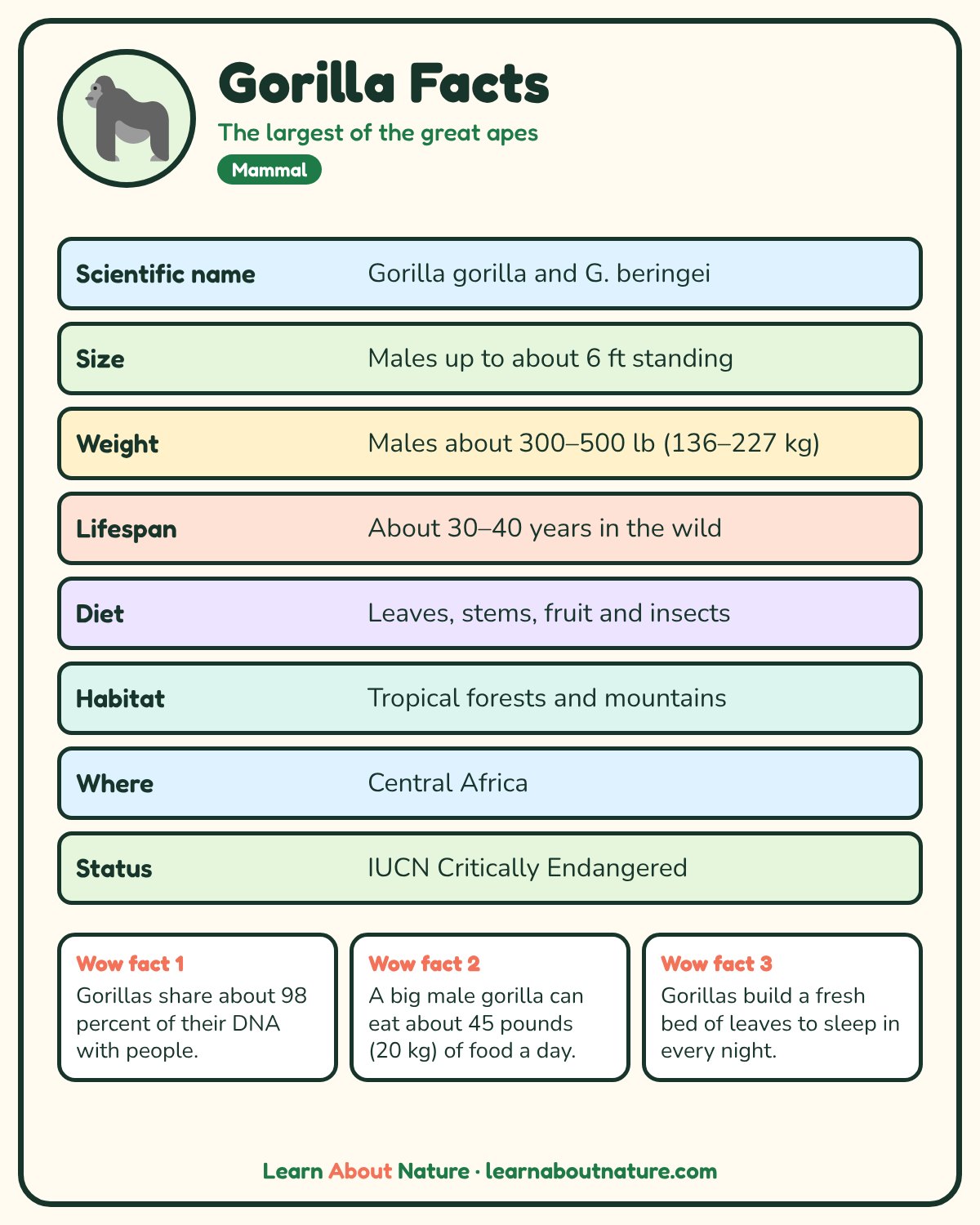
Teachers and students: you’re welcome to use this fact sheet in lessons and projects with credit to Learn About Nature.
Free printable: Download the Gorilla fact file worksheet (PDF) – draw the animal, fill in the facts and match key words. Answer key included.
Gorilla Quick Facts
| Class | Mammal |
| Order | Primates (great apes) |
| Species | Western gorilla and eastern gorilla |
| Height | Males up to about 6 ft (1.8 m); females up to 4.5 ft (1.4 m) |
| Weight | Males about 300–500 lb; females about 150–200 lb |
| Pregnancy | About 8.5 months |
| Baby name | Infant |
| Group name | Troop |
| Lifespan | About 30–40 years in the wild |
| Conservation status | Critically Endangered (IUCN, assessed 2016) |
What Is a Gorilla?
A gorilla is a mammal and a great ape, the group that also includes chimpanzees, bonobos, orangutans and humans. Gorillas are the largest living primates. Apes are different from monkeys because they have no tail.
There are two species of gorilla. The western gorilla, Gorilla gorilla, includes the western lowland gorilla and the very rare Cross River gorilla. The eastern gorilla, Gorilla beringei, includes the mountain gorilla and Grauer’s gorilla, also called the eastern lowland gorilla.
Gorillas share about 98 percent of their DNA with humans. Only chimpanzees and bonobos are more closely related to us.
Where Do Gorillas Live?
Gorillas live only in the tropical forests of central Africa, near the equator. The two species live about 560 miles (900 km) apart, separated by the forests of the Congo Basin.
Western gorillas live in lowland rainforests and swamps in countries such as Gabon, Cameroon, the Republic of Congo, the Central African Republic, Equatorial Guinea and Angola. Cross River gorillas live in hilly forests on the border of Nigeria and Cameroon.
Eastern gorillas live farther east. Grauer’s gorillas live in the Democratic Republic of the Congo. Mountain gorillas live in cool, misty forests high on the Virunga volcanoes, where Rwanda, Uganda and the Democratic Republic of the Congo meet, and in Bwindi Impenetrable National Park in Uganda.
What Do Gorillas Eat?
Gorillas are mostly herbivores. They eat leaves, stems, shoots, herbs, vines, bark and roots. Western lowland gorillas also eat a lot of fruit, from nearly 100 kinds of trees. Gorillas get a little extra protein by eating ants, termites and other small creatures they find on plants.
Because leaves are not very nutritious, gorillas need to eat a lot. An adult male can eat about 45 pounds (20 kg) of food a day, and a female eats about two-thirds of that. Gorillas spend much of the day feeding, then rest while their food digests. They get most of the water they need from juicy plants.
Body and Senses
Adult male gorillas are much bigger than females. A male can stand about 6 feet (1.8 m) tall on two legs and usually weighs about 300 pounds (136 kg), with some reaching 500 pounds (227 kg). Females stand up to about 4.5 feet (1.4 m) and weigh about 150 to 200 pounds (68 to 91 kg). A male’s arms can stretch about 8 feet (2.4 m) from fingertip to fingertip.
When adult males are about 13 years old or older, the hair on their backs turns silvery gray. These males are called silverbacks.
Gorillas usually walk on all fours. They lean on the knuckles of their hands, a way of moving called knuckle-walking. Their hands have thumbs that can grip, and each gorilla has its own fingerprints. Their senses of sight, hearing and smell are similar to ours.
Baby Gorillas
A baby gorilla is called an infant. A mother is pregnant for about 8.5 months, nearly as long as a human mother, and usually has one baby. A newborn weighs about 4 pounds (2 kg) and is tiny and helpless.
At first the baby clings to its mother’s chest. By about 3 months old it can ride on her back, and it may keep riding on her back or being carried until it is 3 or 4 years old. Young gorillas learn which plants to eat by watching their mothers.
Females usually have their first baby at about 10 or 11 years old. They give birth only about once every four to six years, so a mother may have just three to six babies in her whole life.
- Pregnancy: about 8.5 months
- Babies per birth: usually 1
- Weight at birth: about 4 lb (2 kg)
- Time between babies: about 4–6 years
Gorilla Families
Gorillas live in family groups called troops. A troop can have from 2 to more than 30 members, but western lowland gorilla groups average about five. Usually there is one silverback, several adult females and their young.
The silverback is the leader. He decides where the group travels, settles arguments and protects the family. If he feels threatened, he may stand up, hoot, tear at plants and beat his chest to warn others away. Most of the time, though, gorilla families are calm and quiet.
Every evening, each gorilla over about three years old builds a nest by bending branches and leaves around itself. Big males usually sleep on the ground, while lighter gorillas may nest in trees. Babies sleep in their mothers’ nests. Wild gorillas live about 30 to 40 years, and some in zoos reach their 50s.
Western vs Eastern Gorillas
The two gorilla species look similar, but there are differences. Western gorillas are the most numerous. Western lowland gorillas tend to have shorter, brownish-gray hair and eat more fruit. They live in low, warm rainforests and swamps.
Eastern gorillas are the largest gorillas, and Grauer’s gorilla is the biggest of all. Mountain gorillas, which are also eastern gorillas, have longer, thicker black fur that helps them stay warm in their chilly mountain forests. They eat mostly leaves and stems because there is less fruit high in the mountains.
Both species are in serious danger, but eastern gorillas are far fewer. There are only a few thousand eastern gorillas, compared with hundreds of thousands of western gorillas.
Threats and Conservation Status
Both gorilla species are listed as Critically Endangered on the IUCN Red List, the highest risk level before extinction in the wild. Both were assessed in 2016.
Western gorillas have declined by more than 60 percent in about 20 to 25 years. A 2018 study estimated more than 360,000 still live in western central Africa, but most live outside protected areas. The main threats are illegal hunting for bushmeat, the deadly Ebola virus and logging. Only fewer than 300 Cross River gorillas are thought to remain.
Eastern gorillas fell by more than 70 percent over 20 years. Grauer’s gorillas dropped from about 16,900 in 1994 to about 3,800 in 2015. There is good news, too. Thanks to strong protection, mountain gorillas grew from about 680 in 2008 to more than 1,000 by 2018, and in 2018 the IUCN moved them from Critically Endangered to Endangered.
Fun Facts About Gorillas
Here are a few more gorilla surprises:
- Every gorilla has a unique nose print, and scientists use nose shapes to recognize individuals.
- Gorillas usually travel less than 1 mile (1.6 km) a day.
- A silverback beats his chest with cupped hands, not fists.
- Gorillas can catch some human illnesses, so visitors must keep their distance.
- Mountain gorillas live higher up than any other gorillas, in forests that can be cold and wet.
Fast Facts for Young Readers
- Gorillas are the biggest apes in the world.
- Gorillas live in forests in Africa.
- They eat mostly leaves, stems and fruit.
- A big male gorilla is called a silverback.
- Baby gorillas ride on their mothers’ backs.
- Gorillas make a new leafy bed every night.
- Gorillas need our help to survive.
Key words: great ape – a large primate with no tail, such as a gorilla, chimpanzee or orangutan; primate – a group of mammals with gripping hands and big brains, including apes, monkeys and humans; silverback – an adult male gorilla with silver-gray hair on his back; troop – a family group of gorillas; knuckle-walking – walking on all fours while leaning on the knuckles of the hands; bushmeat – meat from wild animals hunted in forests, often illegally.
Try this: Build a gorilla nest: gather a pile of fallen leaves and sticks outside (or use pillows and blankets indoors) and try to make a comfy bed by bending and tucking the materials around you, just as gorillas do each night.
Related Guides
- Gorilla life cycle
- Moose facts for kids
- Hyena facts for kids
- Bat facts for kids
- Sloth facts for kids
- All animal facts for kids
Gorilla FAQs
How big is a gorilla?
An adult male gorilla can stand about 6 feet tall and usually weighs about 300 pounds, with some reaching 500 pounds. Females are smaller, up to about 4.5 feet tall and 150 to 200 pounds. Gorillas are the largest primates alive today.
What do gorillas eat?
Gorillas eat mostly plants, including leaves, stems, shoots, bark, roots and fruit. Western lowland gorillas eat a lot of fruit, while mountain gorillas eat mainly leaves and stems. Gorillas also eat ants and termites for extra protein. A big male can eat about 45 pounds of food a day.
What is a silverback gorilla?
A silverback is an adult male gorilla, usually 13 years or older, with a saddle of silver-gray hair on his back. The silverback leads his family group. He chooses where the group goes, settles arguments and protects the females and young.
Why do gorillas beat their chests?
Gorillas beat their chests to communicate. A silverback may stand up and drum on his chest with cupped hands to show his size and strength, warn rivals or signal his group. Young gorillas also beat their chests while playing.
Are gorillas endangered?
Yes. Both the western gorilla and the eastern gorilla are listed as Critically Endangered on the IUCN Red List. Hunting, disease such as Ebola and habitat loss are the main threats. Mountain gorillas are a success story: their numbers rose to more than 1,000, and they are now listed as Endangered.
Sources: Smithsonian’s National Zoo: Western Lowland Gorilla; World Wildlife Fund: Gorilla; IUCN: Four out of six great apes one step away from extinction (2016); IUCN: Fin whale and mountain gorilla recovering thanks to conservation action (2018); World Economic Forum: Camera traps help protect the rarest gorillas

Nato is a content writer and researcher with a background in psychology who’s eager to explore the wonders of nature. As a travel enthusiast and animal lover, she hopes to inspire others to discover and cherish the beauty and importance of the natural world. She also writes about the history of candy and snacks for Snack History and about food and healthy eating for The Fitchen.