Polar Bear Life Cycle: Stages From Cub to Adult
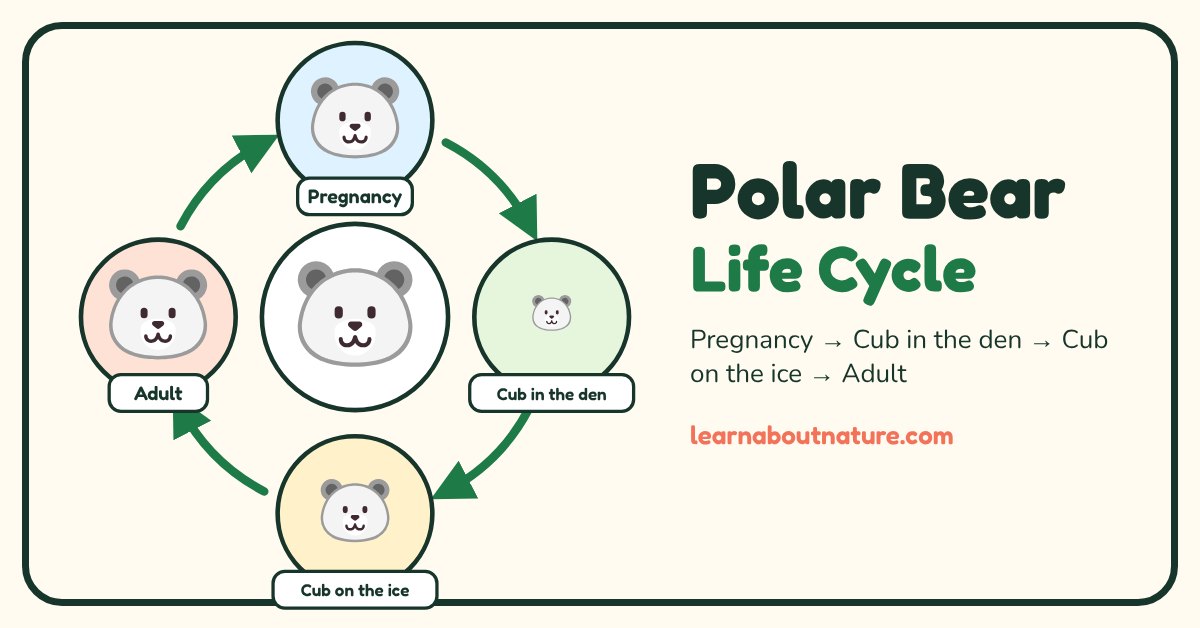
Quick answer: The polar bear life cycle has four stages: pregnancy, cub in the den, cub on the ice and adult. Polar bears mate in spring, but the embryo waits until fall to grow. Tiny cubs are born in a snow den in winter, leave it in spring, stay with their mother for about two and a half years, then live alone.
Polar bears are the largest land carnivores on Earth, yet a newborn cub weighs only about as much as a loaf of bread. It is born blind, with very thin fur, in a snow cave in the middle of the Arctic winter.
This guide follows the polar bear life cycle from spring courtship on the sea ice to the snowy maternity den, the long years cubs spend with their mother, and adult life. Polar bears live around the Arctic Ocean in Canada, Alaska (USA), Russia, Greenland and Norway, and their whole life cycle is tied to the sea ice.
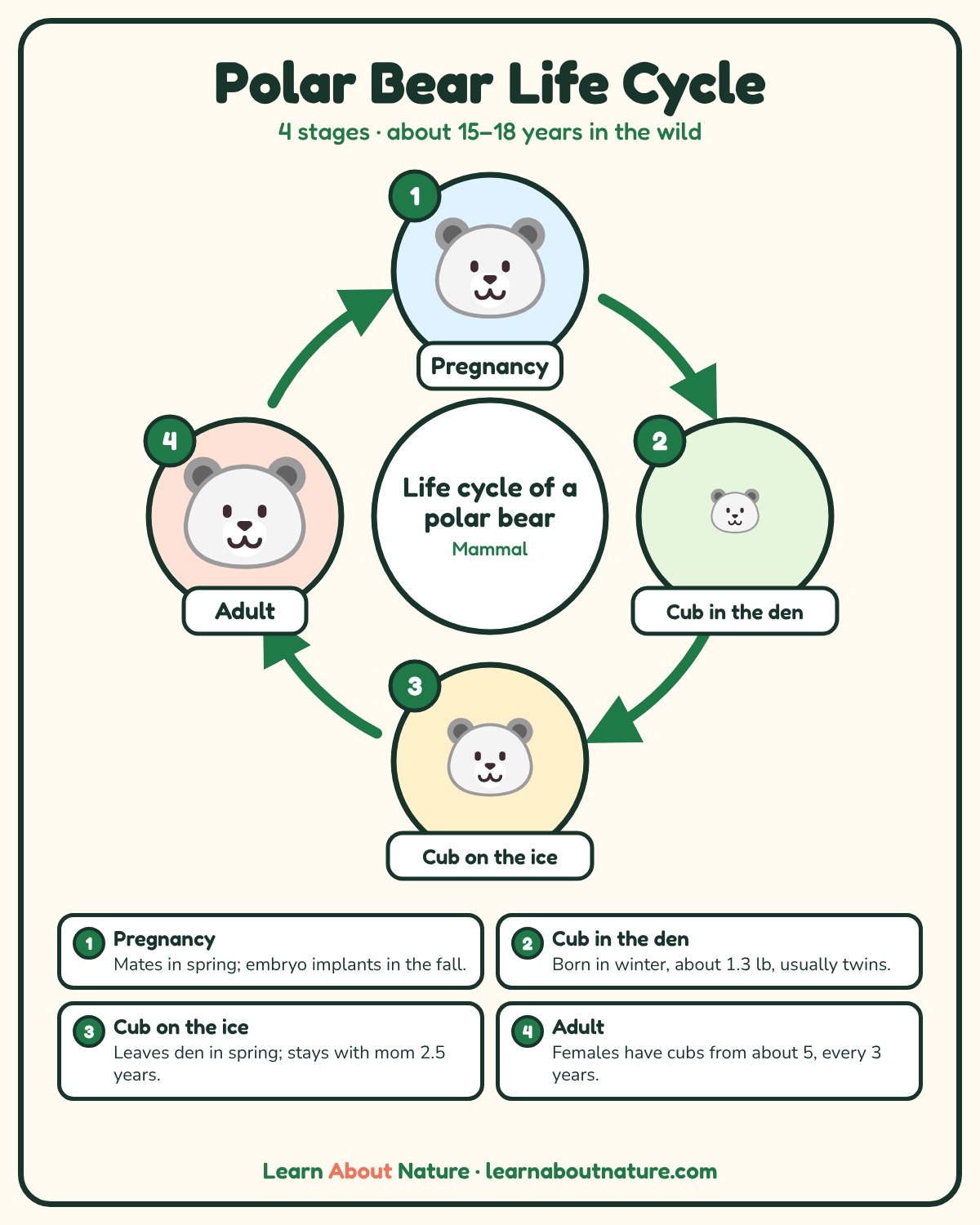
Teachers and students: you’re welcome to use this diagram in lessons and projects with credit to Learn About Nature.
Free printable: Download the Polar Bear life cycle worksheet (PDF) – label the diagram, cut and sequence the stages, and match key words. Answer key included.
Polar Bear Life Cycle Quick Facts
| Mating season | spring, about April–June |
| Pregnancy | about 195–265 days, including delayed implantation |
| Birth | about late November–January, in a den |
| Cubs per litter | usually 2 (range 1–3, rarely 4) |
| Weight at birth | about 1.3 lb (600 g) |
| Leaves the den | March or April |
| Time with mother | about 2.5 years |
| First cubs (females) | about 5 years |
| Lifespan in the wild | about 15–18 years |
Mating on the Sea Ice
Adult polar bears mostly live alone. In spring, from about April to June, males travel across the sea ice following the scent trails of females. Males sometimes fight one another for the chance to mate, and many adult males carry scars from these battles.
A female can mate only when she is not caring for cubs. Because cubs stay with their mother for more than two years, most females breed only about once every three years.
Unlike many other bears, most polar bears do not spend the whole winter in a den. Males, and females without cubs on the way, keep hunting on the sea ice through the dark months. Only pregnant females settle into dens for the winter.
Stage 1: Pregnancy and Delayed Implantation
Like other bears, polar bears have a pregnancy with a built-in pause. After mating, the fertilized egg divides a few times and then stops growing. It floats in the mother’s womb for months without attaching. This is called delayed implantation.
The embryo attaches and starts growing again in the fall, but only if the mother has stored enough fat to survive the winter and feed her cubs. Summer and fall feeding are therefore very important. Counting the pause, the whole pregnancy lasts about 195 to 265 days.
The Maternity Den
In the fall, a pregnant female digs a maternity den, usually in a snowdrift on the sheltered side of a hill near the coast. The den has a small opening and a narrow tunnel that slopes down, which helps keep warm air inside. Falling snow soon covers the entrance. With the mother’s body heat, the inside can be about 45°F (25°C) warmer than the air outside. In some places, such as western Hudson Bay in Canada, females dig dens into earth or peat instead.
Once the mother settles in, she does not eat or drink. Counting the time before she enters the den, a mother may go about eight months without food, living entirely on her stored fat.
Most dens are on land near the coast, but some are dug as far as about 60 miles (100 km) inland. In a few places where sea ice lasts all year, some mothers even dig their dens in snow on top of the ice. In western Hudson Bay, some earth dens are used again by different females in later years.
Stage 2: Cub in the Den
Cubs are born between about late November and January, most often in December. A newborn weighs about 1.3 pounds (600 g) and is about 12 to 14 inches (30 to 35 cm) long. It is blind, toothless and covered in fur so fine that it looks almost bare.
Twins are most common. Single cubs and triplets happen too, and litters of four are very rare. The cubs snuggle against their mother for warmth and drink her rich milk, which is about 31 percent fat when they are born. On this diet, cubs grow fast. By the time they are about three months old, they can weigh around 22 to 26 pounds (10 to 12 kg).
For the first weeks, the cubs mostly sleep and nurse. Inside the den, out of the wind, the family stays far warmer than it would be outside, which is why a mother can raise such tiny, nearly hairless babies in the coldest part of the Arctic year.
- Born: about late November to January
- Weight at birth: about 1.3 lb (600 g)
- Litter size: usually 2 (range 1–3, rarely 4)
- Leaves the den: March or April
Stage 3: Cub on the Ice
The family breaks out of the den in March or April. For about a week they stay in and around the den while the cubs play, explore and build strength. Then the mother leads them out to the sea ice, where she can finally hunt seals again.
Over the next two years, cubs follow their mother everywhere. They watch her wait beside breathing holes in the ice and stalk seals resting on the surface, and they learn how to travel across the ice and where to find food in each season. Cubs nurse for a long time, often into their second year.
Life is hard for young cubs. On average, only about half of cubs survive their first year. Going hungry is a major danger, especially when the mother cannot catch enough seals.
Cubs keep growing quickly once they reach the ice. They usually more than double their weight between leaving the den and their first birthday, then double it again by their second birthday. Their mother’s milk becomes less rich as they grow, dropping from about 31 percent fat at birth to about 18 percent by the time they are one year old. Most cubs are weaned at around two years and three or four months.
Stage 4: Adult
Cubs usually leave their mother at about two and a half years old, when she is ready to mate again. Young bears then live on their own as subadults until they are about five.
Females usually have their first cubs at about five years old and then have a litter about every three years. Males mature later, between about six and ten years old, and they keep growing much bigger than females. Adult males weigh about 775 to 1,300 pounds (350 to 600 kg), while adult females weigh about 330 to 650 pounds (150 to 295 kg).
Because a mother spends about two and a half years raising each litter, the average gap between litters is about three years, though it can range from one to four. A female that loses her cubs early may mate again sooner.
How Long Do Polar Bears Live?
Wild polar bears usually live about 15 to 18 years. Few live past 25, though a handful of tagged bears have reached their early thirties.
Threats and Conservation
The IUCN Red List lists the polar bear as Vulnerable. The biggest threat is the loss of Arctic sea ice as the climate warms. Polar bears need sea ice to hunt seals, so when the ice melts earlier in spring and forms later in fall, bears have less time to feed and build up fat.
This is especially hard on mothers. A female that cannot store enough fat may not have cubs at all, because the embryo will not implant. Thin mothers also produce less milk, so fewer cubs survive. Other threats include pollution and conflict with people in Arctic towns.
Interesting Polar Bear Life Cycle Facts
Here are a few surprising facts about how polar bears grow up.
- A newborn polar bear weighs less than 1 percent of its mother’s weight.
- Polar bear milk is about 31 percent fat at first, many times richer than cow’s milk.
- A mother polar bear can go about eight months without eating.
- Cubs grow about 20 times heavier between birth and leaving the den.
- A young male can be as big as his mother by the time he is two years old.
Polar Bear Life Cycle for Kids
Here is the polar bear life cycle in simple steps:
- Pregnancy: Polar bears mate in spring, but the baby only starts growing in the fall.
- Cub in the den: Tiny cubs are born in a snow cave and drink their mother’s rich milk.
- Cub on the ice: Cubs follow their mom on the sea ice and learn to hunt seals.
- Adult: Grown-up polar bears live alone and have cubs of their own.
Key words: cub – a baby polar bear; maternity den – a snow cave where a mother polar bear gives birth; delayed implantation – when an embryo waits months before it attaches and grows; sea ice – frozen ocean water that polar bears walk and hunt on; carnivore – an animal that eats mostly meat; subadult – a young animal that lives on its own but is not fully grown.
Try this: Fill two jars with warm water, wrap one in a thick layer of snow, cotton balls or a blanket, and check which stays warmer to see how a snow den protects polar bear cubs.
Related Life Cycles and Guides
- Gorilla life cycle
- Rhino life cycle
- Zebra life cycle
- Rabbit life cycle
- Wolf life cycle
- Fox life cycle
- All animal & plant life cycles
See also: Polar Bear Facts for Kids
Polar Bear Life Cycle FAQs
How long is a polar bear pregnant?
Counting delayed implantation, a polar bear pregnancy lasts about 195 to 265 days. Bears mate in spring, but the embryo pauses and does not attach to the womb until the fall. Cubs are then born in the den in early winter, most often in December.
How big is a baby polar bear?
A newborn polar bear weighs about 1.3 pounds (600 g) and is about 12 to 14 inches long. It is blind and has very thin fur. Thanks to its mother’s fatty milk, it weighs around 22 to 26 pounds by about three months old.
How many cubs does a polar bear have?
Polar bears usually have twins. A mother can have one to three cubs, and litters of four are very rare. Because cubs stay with her for about two and a half years, she usually has a new litter only about once every three years.
How long do polar bear cubs stay with their mother?
Polar bear cubs usually stay with their mother for about two and a half years. During this time they nurse, follow her across the sea ice and learn to hunt seals. They leave when she is ready to mate again.
Why are polar bears vulnerable?
The IUCN lists polar bears as Vulnerable mainly because Arctic sea ice is shrinking as the climate warms. Polar bears hunt seals from the ice. With less ice, they have less time to feed and store fat, so fewer mothers have cubs and fewer cubs survive.
Sources: Polar Bears International: Life Cycle; Polar Bears International: Top Mom and Cub Facts; San Diego Zoo Wildlife Alliance Library: Polar Bear Reproduction & Development; Polar Bears International: Polar Bear Denning

Nato is a content writer and researcher with a background in psychology who’s eager to explore the wonders of nature. As a travel enthusiast and animal lover, she hopes to inspire others to discover and cherish the beauty and importance of the natural world. She also writes about the history of candy and snacks for Snack History and about food and healthy eating for The Fitchen.