Seal Life Cycle: Stages From Pup to Adult
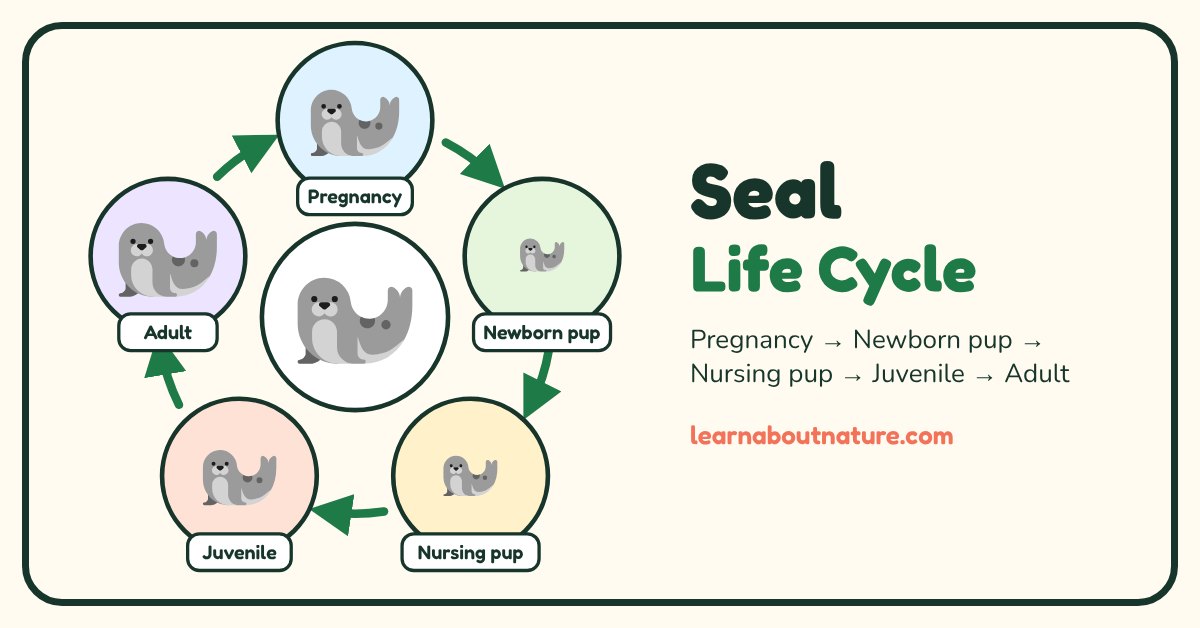
Quick answer: A seal’s life cycle has five stages: pregnancy, newborn pup, nursing pup, juvenile and adult. In harbor seals, pregnancy lasts about 10 months. The pup is born on land or ice, drinks very rich milk for about 4 to 6 weeks, then lives on its own until it can breed at about 3 to 7 years.
Seals are marine mammals. They spend much of their lives in the ocean, but they breathe air, have fur, and feed their babies milk. Every seal must come out of the water, onto a beach, a rock or a sheet of ice, to give birth.
This page follows the harbor seal, one of the most widespread seals in the Northern Hemisphere, from before birth to adulthood. Along the way, we compare it with two well-known relatives, the gray seal and the harp seal, whose pups grow up in very different ways.
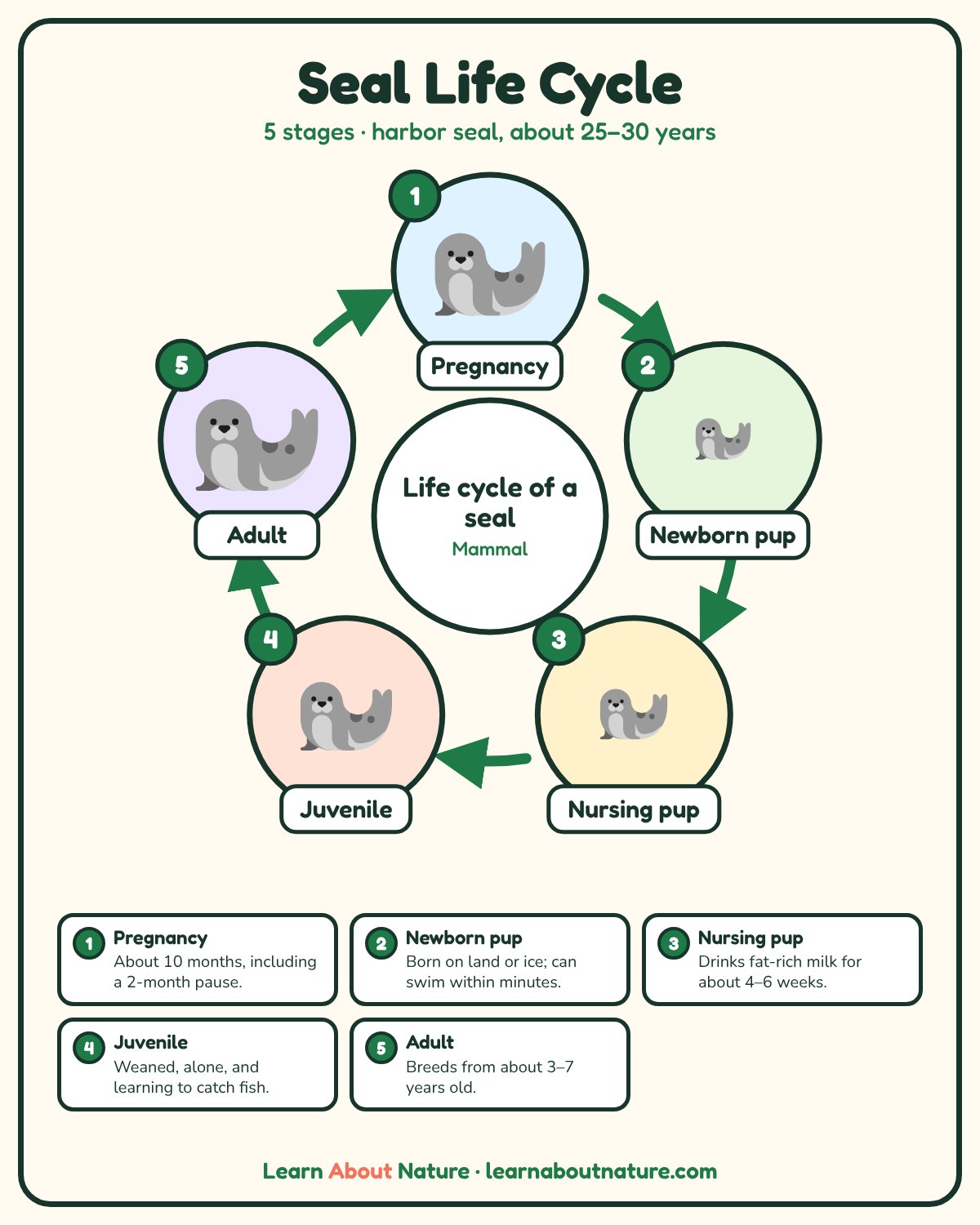
Teachers and students: you’re welcome to use this diagram in lessons and projects with credit to Learn About Nature.
Free printable: Download the Seal life cycle worksheet (PDF) – label the diagram, cut and sequence the stages, and match key words. Answer key included.
Seal Life Cycle Quick Facts
| Main example | Harbor seal (Phoca vitulina) |
| Pregnancy | about 10 months (incl. 2-month pause) |
| Babies per birth | usually 1 pup |
| Weight at birth | about 24 lb (11 kg) |
| Nursing | about 4–6 weeks |
| Milk fat | about 50% |
| Breeding age | about 3–7 years |
| Adult size | up to about 6 ft (1.8 m), 285 lb (130 kg) |
| Lifespan | about 25–30 years in the wild |
Mating and Breeding
Harbor seals breed once a year. Mating takes place in the water, usually soon after the mother has finished nursing her last pup. Males try to attract females with underwater calls and diving displays, and they sometimes fight near the places where seals haul out to rest.
Seal mothers raise their pups alone. Fathers play no part in caring for the young.
Stage 1: Pregnancy
Seal pregnancy has a surprising twist called delayed implantation. After mating, the tiny embryo stops growing and floats in the mother’s womb for about two months. Only then does it attach to the womb wall and start developing again.
In harbor seals, the whole pregnancy, including that pause, lasts about 10 months. The delay means the pup is born at the same time of year as the previous one, when food is plentiful and the weather is mild.
Most pups are born in spring or summer, but the exact timing depends on where the seals live. On the US West Coast, for example, pups in the south are born earlier than pups farther north.
Stage 2: Newborn Pup
A harbor seal mother usually has one pup at a time. She gives birth on a quiet beach, sandbar, rocky ledge or, in some places, a floating piece of ice. A newborn harbor seal weighs about 24 lb (11 kg).
Harbor seal pups are remarkably ready for life at sea. They shed their fluffy baby fur, called lanugo, before they are born, so they arrive with a sleek, waterproof coat. A pup can swim within minutes of birth and can dive for up to two minutes when it is only a few days old.
This is very different from many other seals. Gray seal and harp seal pups are born wearing thick white lanugo, which keeps them warm but is not good for swimming. They stay out of the water until they have shed it.
Stage 3: Nursing Pup
For the next four to six weeks, the pup drinks its mother’s milk. Seal milk is about half fat, which is far richer than cow’s milk. This rich food lets the pup build a thick layer of blubber, the fat under the skin that keeps seals warm in cold water.
Mother and pup stay close and call to each other with special sounds so they can find each other on a crowded beach. By the end of its first month, a young harbor seal may already have traveled more than 100 miles (160 km).
If you ever see a seal pup alone on a beach, do not go near it. Its mother is often feeding nearby and may stay away if people are around. In many countries, it is against the law to disturb seals.
How Gray Seal and Harp Seal Pups Differ
Not all seals raise their pups the same way. Two well-studied species show how much the timing can vary.
Gray seals usually give birth on beaches and rocky islands, though some in Canada and the Baltic Sea use ice. A newborn weighs about 35 lb (16 kg) and wears white lanugo, which it sheds at about three weeks old. The mother nurses for about three weeks and does not eat at all during that time.
Harp seals give birth on floating pack ice in late winter. Their fluffy white pups are often called whitecoats. Harp seal mothers nurse for only about 12 days, but the milk is so rich that pups gain about 5 lb (2.3 kg) a day. Then the mother leaves, and the pup stays on the ice for weeks without eating, living off its blubber until it learns to hunt.
- Harbor seal: born on land or ice, swims within minutes, nursed about 4–6 weeks.
- Gray seal: born mostly on land, white coat for about 3 weeks, nursed about 3 weeks.
- Harp seal: born on sea ice, white coat for about 3–4 weeks, nursed about 12 days.
Stage 4: Juvenile
Once the pup is weaned, meaning it no longer drinks milk, its mother leaves and the young seal is on its own. It must learn to catch fish, crabs, shrimp and other prey by itself.
The first year is the hardest. Young seals have little hunting experience, and they can be caught by predators such as sharks and killer whales. They also have to survive storms and find enough food while they are still learning.
Young harbor seals often stay in the same general area where they were born, but some wander along the coast or swim up rivers and into lakes. They practice diving deeper and staying down longer as their bodies grow and their blubber thickens.
Like adults, juvenile harbor seals molt once a year, usually in mid to late summer. During the molt, they shed old hair and grow a new coat, and they spend more time resting on land.
Stage 5: Adult
Harbor seals become old enough to breed at about 3 to 7 years. Females usually start a little earlier than males. Adults grow up to about 6 ft (1.8 m) long and can weigh up to 285 lb (130 kg), with males slightly larger than females.
Adult harbor seals feed mainly on fish, along with squid, crabs, shrimp and other shellfish. They can dive deep or stay in shallow water, depending on where the food is. Between meals, they haul out on rocks, beaches and sandbars to rest, warm up and, in summer, molt. Harbor seals are often seen lying in a curved, banana-like pose with head and tail raised.
An adult female can have one pup a year for many years. When she mates again soon after weaning her pup, the life cycle begins once more.
How Long Do Seals Live?
Harbor seals live about 25 to 30 years in the wild. Gray seals have a similar life span, about 25 to 35 years, and harp seals can live up to about 30 years.
Seals face many dangers from people, including getting tangled in fishing gear and marine trash, being disturbed by boats and visitors, pollution and loss of habitat. Harp seals also depend on sea ice to raise their pups, so warming seas that shrink the ice are a concern. Harbor seals as a species are not considered endangered, and many populations are protected by law.
Interesting Seal Facts
- Harbor seals can sleep underwater, rising to the surface to breathe about every 30 minutes.
- Harbor seal pups lose their baby fur before birth, so they are born ready to swim.
- Harp seal pups can live for about six weeks without eating after their mothers leave.
- Gray seal mothers fast for the whole time they nurse their pups.
- The pause in early pregnancy helps seals give birth at the best time of year.
Seal Life Cycle for Kids
Here is the seal life cycle in simple steps:
- Pregnancy: The baby seal grows inside its mother for about 10 months.
- Newborn pup: The pup is born on a beach or on ice and can swim right away.
- Nursing pup: The pup drinks rich milk and gets nice and fat.
- Juvenile: The young seal lives on its own and learns to catch fish.
- Adult: The grown-up seal can have pups of its own.
Key words: pup – a baby seal; blubber – a thick layer of fat that keeps a seal warm; lanugo – soft, fluffy baby fur; many seal pups are born with white lanugo; delayed implantation – when a tiny embryo pauses before it starts to grow; wean – to stop drinking mother’s milk and start eating other food; haul out – when a seal climbs out of the water to rest on land or ice.
Try this: Make a blubber glove: fill a zip bag with vegetable shortening, seal a second bag inside it to make a pocket, then put one hand in the pocket and dip both hands in ice water to feel how fat keeps seals warm.
Related Life Cycles and Guides
- Shark life cycle
- Fish life cycle
- Jellyfish life cycle
- Crab life cycle
- Sea turtle life cycle
- Salmon life cycle
- All animal & plant life cycles
Seal Life Cycle FAQs
How long is a seal pregnant?
Harbor seals are pregnant for about 10 months. That includes a pause of about two months after mating, called delayed implantation, when the embryo stops growing. Gray seals are pregnant for about 11 months. The pause helps mothers give birth at the same, food-rich time each year.
How long do baby seals stay with their mothers?
It depends on the species. Harbor seal pups nurse for about 4 to 6 weeks, gray seal pups for about 3 weeks, and harp seal pups for only about 12 days. After that, the mother leaves and the pup must learn to find food on its own.
Can baby seals swim when they are born?
Harbor seal pups can swim within minutes of birth because they shed their fluffy baby fur before they are born. Gray seal and harp seal pups are born with thick white fur and stay out of the water until they have shed it, a few weeks later.
Where do seals give birth?
Seals always give birth out of the water. Harbor seals use beaches, sandbars, rocky ledges and sometimes floating ice. Gray seals mostly use beaches and rocky islands, while harp seals give birth on floating pack ice in late winter.
How long do seals live?
Harbor seals usually live about 25 to 30 years in the wild. Gray seals live about 25 to 35 years, and harp seals can reach about 30 years. Many young seals die in their first year, before they become skilled hunters.
Sources: Harbor Seal – NOAA Fisheries; Phoca vitulina (harbor seal) – Animal Diversity Web; Gray Seal – NOAA Fisheries; Harp Seal – NOAA Fisheries

Nato is a content writer and researcher with a background in psychology who’s eager to explore the wonders of nature. As a travel enthusiast and animal lover, she hopes to inspire others to discover and cherish the beauty and importance of the natural world. She also writes about the history of candy and snacks for Snack History and about food and healthy eating for The Fitchen.