Hyena Facts for Kids: Habitat, Diet and Fun Facts
Quick answer: A hyena is a dog-like African and Asian carnivore that is actually more closely related to cats and mongooses. The spotted hyena, the best-known species, lives in clans on African savannas, hunts wildebeest, zebras and antelope, and also scavenges. Its powerful jaws can crush and digest bones.
Hyenas have a bad reputation in cartoons and movies, where they are shown as sneaky thieves that only steal other animals’ food. The real story is very different. Spotted hyenas are skilled hunters that catch most of their own meals, and they live in large, complex family groups.
They are also loud, clever and tough. This page focuses mainly on the spotted hyena, the largest and most common kind, and also looks at the other members of the hyena family.
Teachers and students: you’re welcome to use this fact sheet in lessons and projects with credit to Learn About Nature.
Free printable: Download the Hyena fact file worksheet (PDF) – draw the animal, fill in the facts and match key words. Answer key included.
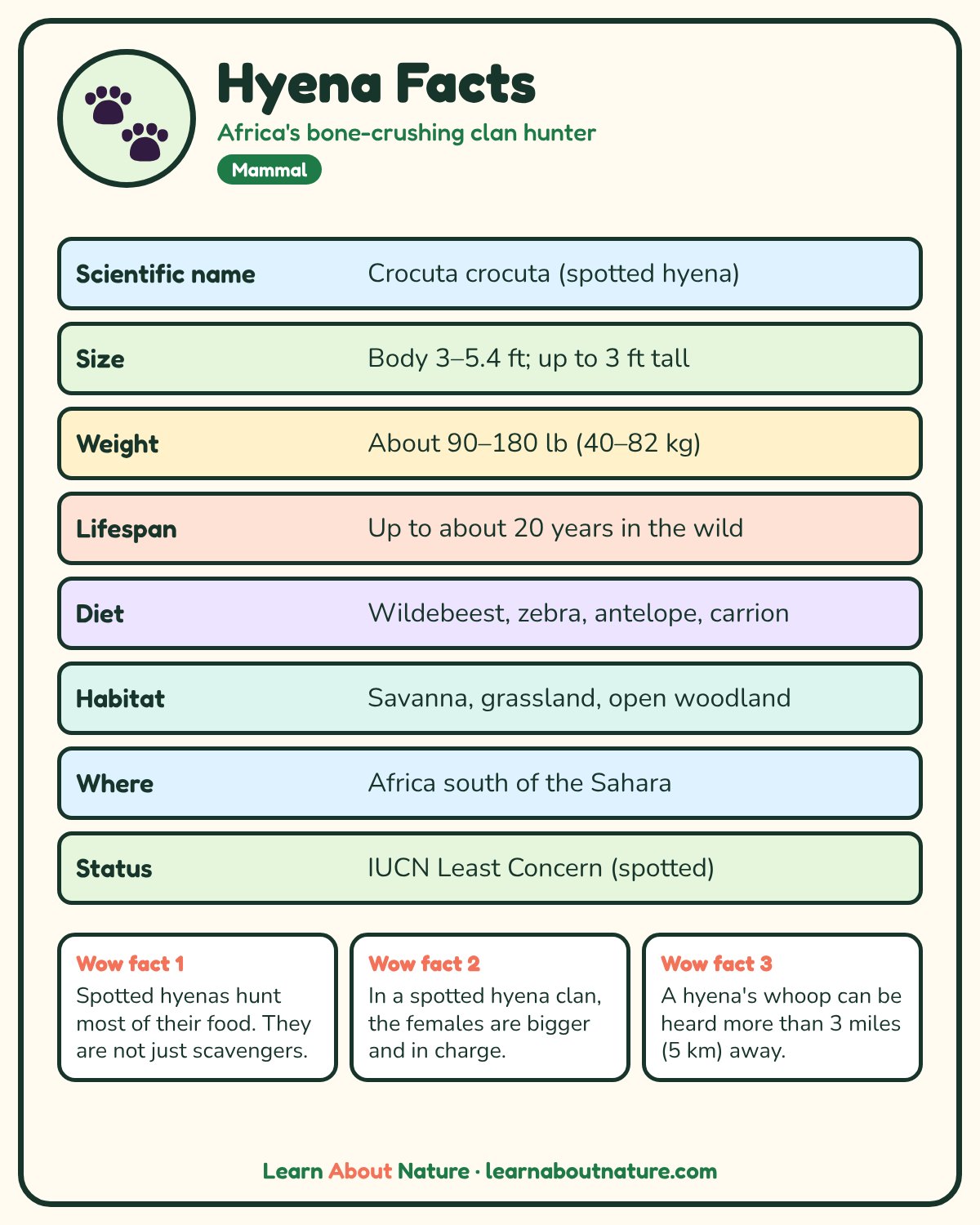
Hyena Quick Facts
| Class | Mammal |
| Family | Hyaenidae (4 species) |
| Scientific name | Crocuta crocuta (spotted hyena) |
| Size | Body 3–5.4 ft; 2.3–3 ft at the shoulder |
| Weight | About 90–180 lb (40–82 kg); females larger |
| Top speed | About 37 mph (60 km/h) |
| Group name | Clan |
| Baby name | Cub |
| Cubs per litter | Usually 2 |
| Conservation status | Least Concern (IUCN), spotted hyena |
What Is a Hyena?
Hyenas are carnivores in the family Hyaenidae. They look a bit like big dogs, with long front legs, a sloping back and large ears, but they are not dogs. Hyenas belong to the cat-like branch of carnivores, so they are more closely related to cats, mongooses and civets than to wolves or foxes.
There are four living species in the hyena family:
- Spotted hyena: the largest, with dark spots and round ears
- Striped hyena: smaller, with stripes and a shaggy mane; lives in Africa, the Middle East and parts of Asia including India
- Brown hyena: shaggy and dark brown; lives in southern Africa
- Aardwolf: a small, striped relative that eats mostly termites
Where Do Hyenas Live?
Spotted hyenas live across much of Africa south of the Sahara Desert. They are most common on open savannas and grasslands, but they also live in woodlands, semi-deserts and mountains. A clan defends a territory that can be smaller than 15 square miles (40 square km) where food is plentiful or bigger than 380 square miles (1,000 square km) in dry areas.
Clans often use a shared den, usually old burrows dug by other animals and then enlarged. The den is the center of family life, especially for young cubs.
What Do Hyenas Eat?
Spotted hyenas are both predators and scavengers. In many places they kill most of what they eat, from about half to more than 90 percent depending on the area. Common prey includes wildebeest, zebras, gazelles and other antelope. They also eat carrion (dead animals) and will chase lions or other predators off a kill if they have enough clan members.
Hyenas waste very little. Their huge cheek teeth and strong jaw muscles let them crack open bones to get at the marrow, and very strong stomach acid helps digest them. Because they eat so much bone, their droppings often turn white from calcium.
Striped and brown hyenas are mostly scavengers that also eat small animals, insects, eggs and fruit. The aardwolf eats termites, licking up many thousands in a single night.
Body, Senses and Speed
A spotted hyena’s body is about 3 to 5.4 feet (95 to 165 cm) long, and it stands about 2.3 to 3 feet (70 to 91 cm) tall at the shoulder. Most adults weigh about 90 to 150 pounds (40 to 70 kg), and the biggest reach about 180 pounds (82 kg). Unusually for mammals, females are bigger and heavier than males.
Hyenas have excellent hearing, night vision and sense of smell. They can follow a scent trail or hear the sounds of a kill from far away.
They are built for stamina. A spotted hyena can run at about 37 miles per hour (60 km/h) and can keep chasing prey over long distances until it tires out.
Hyena Cubs
Baby hyenas are called cubs. A spotted hyena mother is pregnant for about 110 days, or a little under four months. She usually has twins, though litters of one to four can happen.
Spotted hyena cubs are born with their eyes open and their front teeth already showing. Their fur is almost black at first, and their spots appear as they grow. Each cub weighs about 2 to 3.5 pounds (1 to 1.6 kg) at birth. After a few weeks, the mother moves her cubs to the clan’s shared den.
Hyena milk is very rich in fat and protein. Cubs start eating some meat at a few months old but keep nursing for about 12 to 16 months, which is unusually long for a carnivore. A daughter inherits her mother’s rank in the clan.
- Pregnancy: about 110 days
- Cubs per litter: usually 2
- Born: eyes open, fur nearly black
- Nursing: about 12–16 months
Clans and Communication
Spotted hyenas live in groups called clans, which can have from a few members to about 80. Clan members often split up to search for food alone or in small groups, then gather at the den or at a big kill.
A clan is led by females. Every adult female outranks every adult male, and daughters take a place just below their mothers. Females usually stay in the clan where they were born for life, while young males leave to join other clans.
Hyenas are noisy. Their long, rising whoop can carry more than 3 miles (5 km) and helps clan members find each other. Each hyena’s whoop is a little different, like a voice. The famous “laugh” or giggle is not a sign of fun. Hyenas make it when they are nervous, excited or being chased, often in fights over food.
Threats and Conservation Status
Lions are the spotted hyena’s main natural enemy, and the two often fight over food. People are a bigger threat. Hyenas are killed by farmers protecting livestock, caught in snares set for other animals, poisoned and losing habitat as farms and towns spread.
The IUCN Red List lists the spotted hyena as Least Concern. There are thought to be about 27,000 to 47,000 spotted hyenas, but their numbers are falling outside protected areas. The striped hyena and the brown hyena are both listed as Near Threatened, and the aardwolf is listed as Least Concern.
Spotted Hyenas vs Other Hyenas
The four members of the hyena family look and live in quite different ways. The spotted hyena is the biggest, the most social and the best hunter. Its clans can bring down animals as large as zebras and wildebeest.
The striped hyena is smaller and lighter, with a long, shaggy mane it can raise to look bigger. It mostly scavenges and lives alone or in small family groups. It is the only hyena found outside Africa, ranging into the Middle East, Central Asia and India.
The brown hyena of southern Africa is a shaggy scavenger that also walks beaches to eat dead seals and fish. The aardwolf is the odd one out. It has small, peg-like cheek teeth and a long, sticky tongue for licking up termites, and it hardly ever eats meat.
Fun Facts About Hyenas
A few more surprising hyena facts:
- The spotted hyena is also called the laughing hyena because of its giggle.
- Each spotted hyena has its own pattern of spots.
- Hyenas can eat a lot at once and then go a long time without food.
- Clan members greet each other with special sniffing rituals.
- Hyenas are more closely related to cats than to dogs.
Fast Facts for Young Readers
- Hyenas live mostly in Africa.
- Spotted hyenas hunt most of their own food.
- They live in big family groups called clans.
- Female hyenas are bigger than males and are the bosses.
- Baby hyenas are called cubs.
- Hyenas can crunch and eat bones.
- Hyenas are closer cousins of cats than of dogs.
Key words: clan – a family group of spotted hyenas that shares a territory; scavenger – an animal that eats dead animals it did not kill; predator – an animal that hunts and eats other animals; carrion – the body of a dead animal; territory – an area an animal or group lives in and defends.
Try this: Make a Venn diagram comparing hyenas and dogs: list how they look alike on one side, how they differ on the other, and add the surprising fact that hyenas are closer relatives of cats.
Related Guides
- Zebra facts for kids
- Gorilla facts for kids
- Tiger facts for kids
- Wolf facts for kids
- All animal facts for kids
Hyena FAQs
Are hyenas dogs or cats?
Neither, but they are closer to cats. Hyenas have their own family, Hyaenidae. They belong to the cat-like branch of carnivores, which also includes cats, mongooses and civets. Their dog-like look comes from living a similar life of running and chasing prey on open land.
Do hyenas really laugh?
Spotted hyenas make a high-pitched giggling sound, but it does not mean they are happy. They usually giggle when they are nervous, excited or being chased, such as during squabbles over food. Their most important call is a long whoop that can be heard more than 3 miles away.
Are hyenas just scavengers?
No. Spotted hyenas are strong hunters that kill most of their own food in many areas, including wildebeest, zebras and antelope. They also scavenge and will steal kills from other predators. Striped and brown hyenas scavenge more, and the aardwolf eats mostly termites.
Why are female hyenas in charge?
In spotted hyena clans, females are larger and more aggressive than males, and every adult female outranks every adult male. Daughters inherit a rank just below their mothers. Scientists think this helps mothers get enough food at crowded kills to feed their cubs during the long nursing period.
Are hyenas endangered?
The spotted hyena is listed as Least Concern on the IUCN Red List, though it is declining outside protected areas. The striped hyena and brown hyena are listed as Near Threatened. The main threats are conflict with farmers, snares, poisoning and loss of habitat.
Sources: Animal Diversity Web: Crocuta crocuta; Britannica: Hyena; Down To Earth: International Hyena Day 2025, Africa’s 4 hyaenids facing increasing threats; Wikipedia: Spotted hyena (IUCN 2015 assessment and population estimate)

Nato is a content writer and researcher with a background in psychology who’s eager to explore the wonders of nature. As a travel enthusiast and animal lover, she hopes to inspire others to discover and cherish the beauty and importance of the natural world. She also writes about the history of candy and snacks for Snack History and about food and healthy eating for The Fitchen.