
Food Chain and Food Web: Diagram, Examples and Trophic Levels
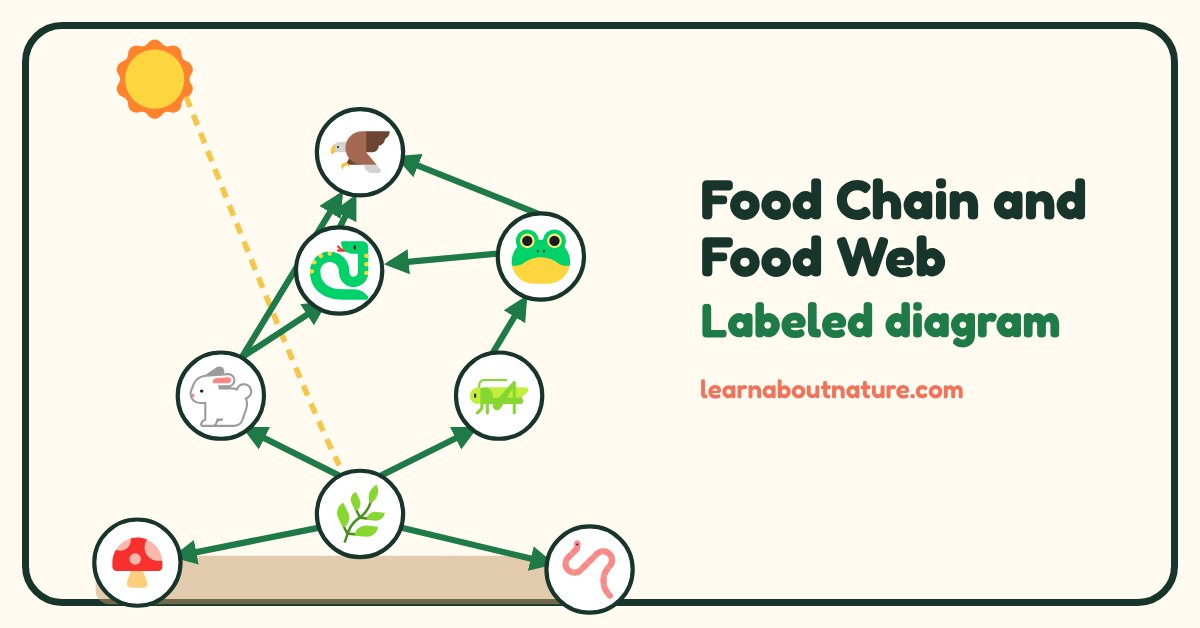
Quick answer: A food chain shows one path of energy, such as sun to grass to rabbit to hawk. A food web joins many food chains to show who eats whom in an ecosystem. Each feeding step is a trophic level: producers, primary consumers, secondary consumers and top predators, with decomposers recycling dead material at every level.
Every living thing needs energy, and almost all of it starts with the sun. Plants catch sunlight and store its energy as food. When an animal eats a plant, or eats another animal, that energy passes along. Tracing who eats whom shows how energy moves through nature.
A food chain follows one straight line of eating. A food web shows the whole tangle of connections, because most animals eat more than one thing and are eaten by more than one predator. This guide uses a grassland example to explain both, along with the roles, the trophic levels and why energy shrinks at every step.
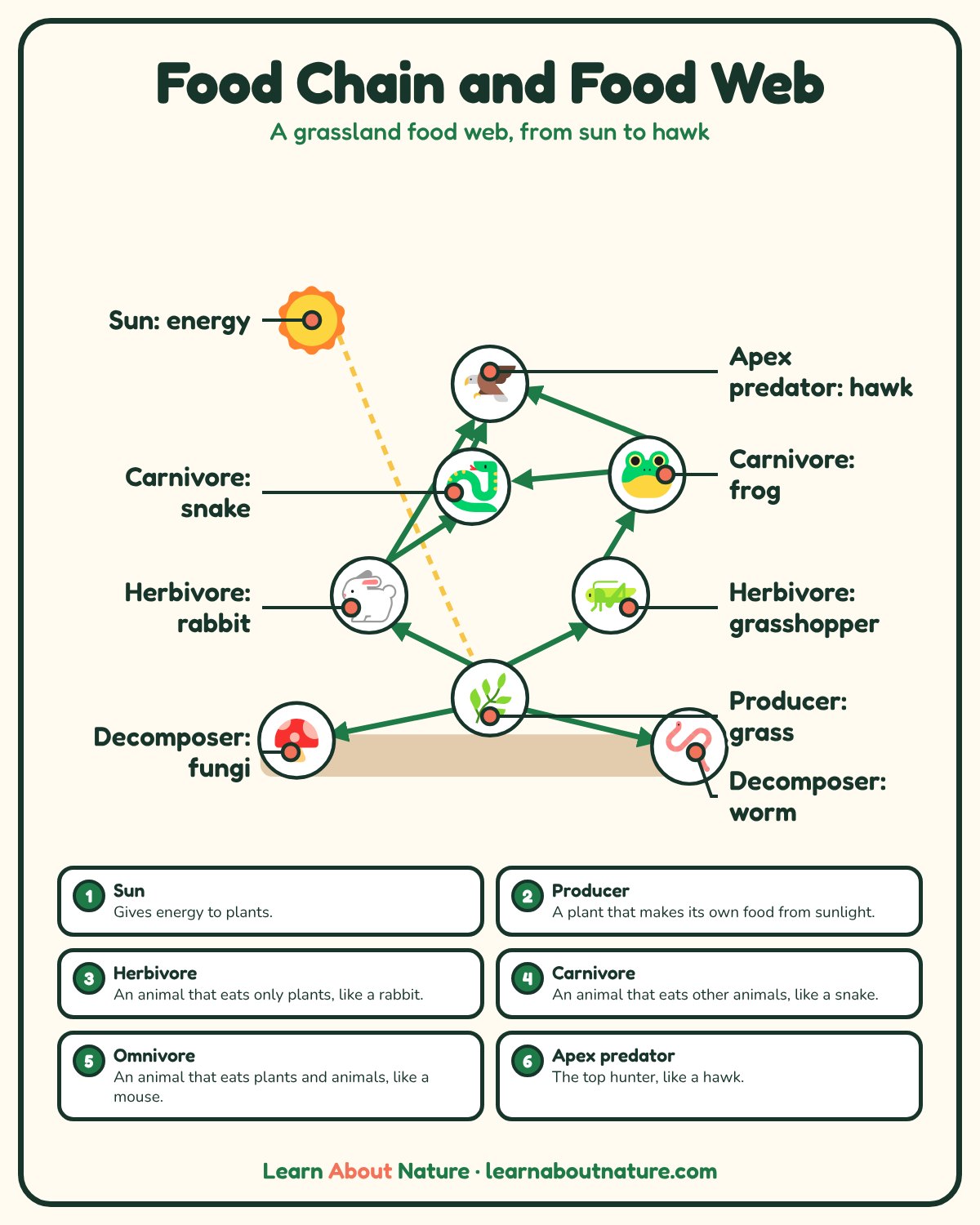
Teachers and students: you’re welcome to use this diagram in lessons and projects with credit to Learn About Nature.
Free printable: Download the Food Chain and Food Web labeling worksheet (PDF) – label the parts using the word bank. Answer key included.
Parts of a Food Web and What They Do
| Part | What it does |
|---|---|
| Sun | Supplies the energy that starts almost every food web |
| Producer | Makes its own food from sunlight (grass, trees, algae) |
| Primary consumer | Herbivore that eats producers (grasshopper, rabbit) |
| Secondary consumer | Eats primary consumers (frog, snake) |
| Tertiary consumer | Eats secondary consumers (snake that eats frogs) |
| Apex predator | Top predator with no natural predators as an adult (hawk) |
| Omnivore | Eats both plants and animals (mouse, bear, human) |
| Decomposer | Breaks down dead matter and recycles nutrients (fungi, bacteria) |
| Detritivore | Animal that eats dead material (earthworm, woodlouse) |
| Trophic level | A feeding step in a food chain |
| Energy pyramid | Diagram showing energy shrinking at each level |
What Is a Food Chain?
A food chain is a simple list showing how energy passes from one living thing to the next. Arrows point in the direction the energy flows, from the thing being eaten to the thing that eats it. The arrow means “is eaten by” or “gives energy to.”
Here is a grassland food chain: sun → grass → grasshopper → frog → snake → hawk. The grass captures the sun’s energy, the grasshopper eats the grass, the frog eats the grasshopper, the snake eats the frog and the hawk eats the snake. A shorter chain from the same grassland is sun → grass → rabbit → hawk.
What Is a Food Web?
Real animals rarely eat just one food. Hawks catch rabbits as well as snakes. Snakes eat frogs, mice and young rabbits. Mice eat seeds and insects. When you draw all these food chains together, the lines cross and link into a food web.
Food webs show how an ecosystem holds together. If one species disappears, the effects spread along many strands. For example, if disease wiped out the grasshoppers, frogs would lose a main food, snakes might eat more mice and rabbits instead, and grass might grow taller. A web with many links is usually more stable than a single chain, because animals can switch to other foods.
The Roles in a Food Web
- Sun: The source of energy for almost every food web on Earth. It is not a living thing, so it is not a trophic level, but it starts the flow.
- Producers: Living things that make their own food, mostly by photosynthesis. On land these are grasses, flowers, shrubs and trees; in the ocean they are mainly tiny algae called phytoplankton. Also called autotrophs.
- Primary consumers (herbivores): Animals that eat producers, such as grasshoppers, rabbits, deer and caterpillars.
- Secondary consumers: Animals that eat primary consumers, such as frogs that eat grasshoppers or snakes that eat rabbits.
- Tertiary consumers and apex predators: Animals that eat other meat-eaters. An apex predator, such as a hawk, eagle, wolf or lion, sits at the top of its food web and has no natural predators as a healthy adult.
- Omnivores: Animals that eat both plants and animals, such as mice, bears, raccoons and humans. They can feed at more than one level.
- Decomposers: Fungi and bacteria that break down dead plants, dead animals and droppings, returning nutrients to the soil for producers to use again. Earthworms, beetles and other small animals that eat dead material are often grouped with them; scientists call these detritivores.
Trophic Levels Explained
Each feeding step in a food chain is called a trophic level, from the Greek word for food or nourishment. Scientists number them like floors in a building.
- Level 1: producers, such as grass.
- Level 2: primary consumers, such as grasshoppers and rabbits.
- Level 3: secondary consumers, such as frogs.
- Level 4: tertiary consumers, such as snakes that eat frogs.
- Level 5: quaternary consumers or apex predators, such as hawks that eat snakes.
Why Energy Shrinks at Each Level: The 10 Percent Rule
When a rabbit eats grass, it does not turn all of that food into rabbit. Most of the energy is used to stay alive, to hop, breathe, keep warm and digest, and is lost as heat. Some is in parts that cannot be digested and passes out as droppings. Only a small share is stored in the rabbit’s body, ready for a hawk.
On average, only about 10 percent of the energy at one trophic level is passed on to the next. Scientists call this the 10 percent rule. It is an average, not an exact law, and the real figure varies from about 5 to 20 percent depending on the animals and the ecosystem.
Imagine the grass in a field holds 10,000 units of energy. Grasshoppers that eat it would store about 1,000 units, frogs about 100, snakes about 10 and hawks only about 1. This is why food chains rarely have more than four or five levels, and why there are far fewer hawks than grasshoppers. Drawn as a diagram, this shrinking energy makes a shape called an energy pyramid, wide at the bottom and narrow at the top.
Food Chains in Other Habitats
A few unusual food webs, such as those around deep-sea hot vents, do not start with sunlight. There, bacteria make food using energy from chemicals in the vent water, a process called chemosynthesis.
- Ocean: phytoplankton → zooplankton → small fish → tuna → shark.
- Pond: algae → tadpole → dragonfly nymph → fish → heron.
- Forest: oak leaves → caterpillar → songbird → owl.
- Arctic: phytoplankton → zooplankton → Arctic cod → ringed seal → polar bear.
Fun Facts About Food Webs
- Phytoplankton in the ocean carry out roughly half of all photosynthesis on Earth.
- When wolves returned to Yellowstone National Park in 1995, scientists studied how their effects spread through the park’s food web, from elk to streamside willows.
- Some plants are consumers too: the Venus flytrap makes food from sunlight but also catches insects for extra nutrients.
- Without decomposers, dead leaves and fallen logs would pile up, and the nutrients locked inside would never return to the soil.
Food Chain and Food Web for Kids
- Sun: gives energy to plants.
- Producer: a plant that makes its own food from sunlight.
- Herbivore: an animal that eats only plants, like a rabbit.
- Carnivore: an animal that eats other animals, like a snake.
- Omnivore: an animal that eats plants and animals, like a mouse.
- Apex predator: the top hunter, like a hawk.
- Decomposer: a cleaner, like a mushroom, that breaks down dead things.
Key words: food chain – one path showing how energy passes from one living thing to another; food web – many connected food chains in one ecosystem; producer – a living thing that makes its own food, usually from sunlight; consumer – a living thing that gets energy by eating other living things; trophic level – a feeding step in a food chain; decomposer – a living thing that breaks down dead material and returns nutrients to the soil.
Try this: Write the sun, grass, grasshopper, rabbit, mouse, frog, snake, hawk and mushroom on cards, have each person hold one, and pass a ball of yarn from food to eater to build a web; then let one card drop out and see how many strands go slack.
Related Guides
- What are amphibians?
- Parts of a Mushroom
- Plant Cell vs Animal Cell
- Parts of a Seed
- Plant life cycle
- Angiosperm life cycle
- All labeled anatomy diagrams
Food Chain and Food Web FAQs
What is the difference between a food chain and a food web?
A food chain shows one straight path of energy, such as grass to rabbit to hawk. A food web joins many food chains together to show all the feeding links in an ecosystem. Food webs are more realistic, because most animals eat several kinds of food and have several predators.
What are the 4 trophic levels?
The four levels usually taught are producers, such as plants; primary consumers, which eat plants; secondary consumers, which eat plant-eaters; and tertiary consumers, which eat other meat-eaters. Some food chains have a fifth level of apex predators, and decomposers recycle material from every level.
What is the 10 percent rule in a food chain?
The 10 percent rule says that, on average, only about one tenth of the energy at one trophic level is passed to the next. The rest is mostly used for living and lost as heat, or left in undigested waste. That is why food chains are short and top predators are few.
Where do decomposers go in a food web?
Decomposers, such as fungi and bacteria, are often drawn at the bottom or side of a food web, with arrows coming from every level. They break down dead plants, dead animals and droppings, returning nutrients to the soil so producers can use them again.
Why does a food chain start with the sun?
Almost all energy in living things begins as sunlight. Plants and algae capture it by photosynthesis and store it in food. Every animal that eats them, or eats something that ate them, is using energy that first came from the sun.
Sources: Energy Flow and the 10 Percent Rule | National Geographic Education; Food Web | National Geographic Education; Food Chain Efficiency | HHMI BioInteractive; How has the ocean made life on land possible? | NOAA Ocean Exploration

Nato is a content writer and researcher with a background in psychology who’s eager to explore the wonders of nature. As a travel enthusiast and animal lover, she hopes to inspire others to discover and cherish the beauty and importance of the natural world. She also writes about the history of candy and snacks for Snack History and about food and healthy eating for The Fitchen.


