
Tiger Life Cycle: Stages From Cub to Adult
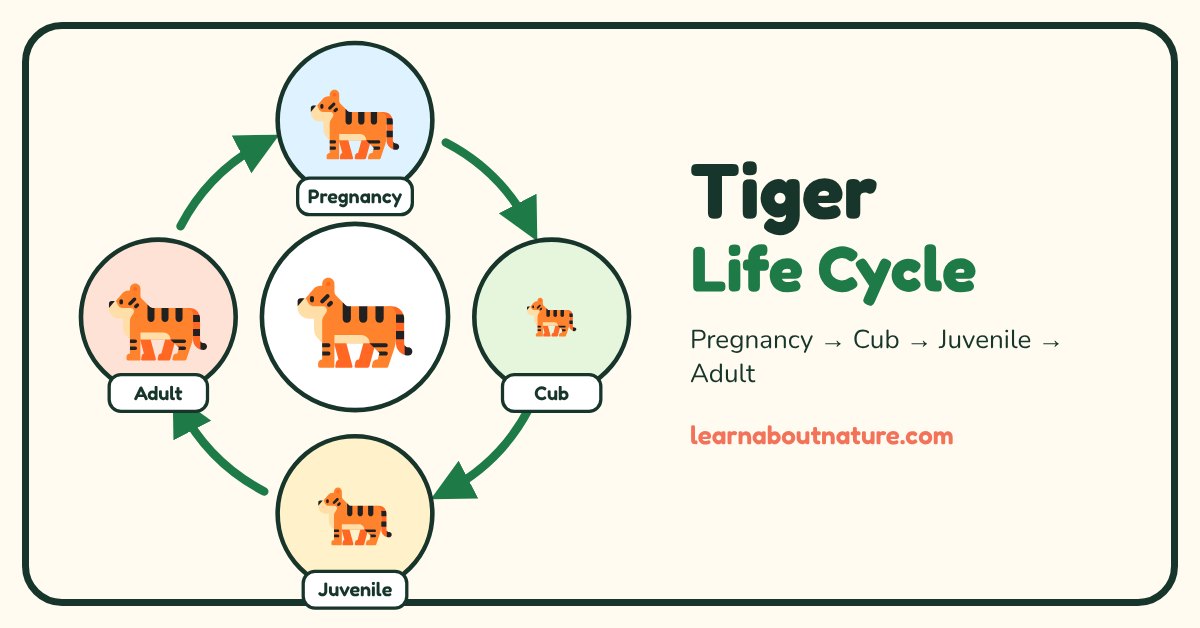
Quick answer: The tiger life cycle has four stages: pregnancy, cub, juvenile and adult. A tigress is pregnant for about 100 to 106 days and usually has two or three cubs. The cubs nurse for several months, hunt with their mother until about 18 to 24 months old, then live alone as adults.
Tigers are the largest cats in the world, yet every tiger starts life as a blind, helpless cub weighing just a few pounds. For about two years its mother does everything for it, from feeding and protecting it to teaching it how to hunt.
This page walks through the tiger life cycle from pregnancy to adulthood. Tigers live across parts of Asia, from the snowy forests of the Russian Far East to the mangroves of India and Bangladesh. Some numbers vary a little between subspecies, such as Bengal, Amur and Sumatran tigers, so we give ranges where sources differ.
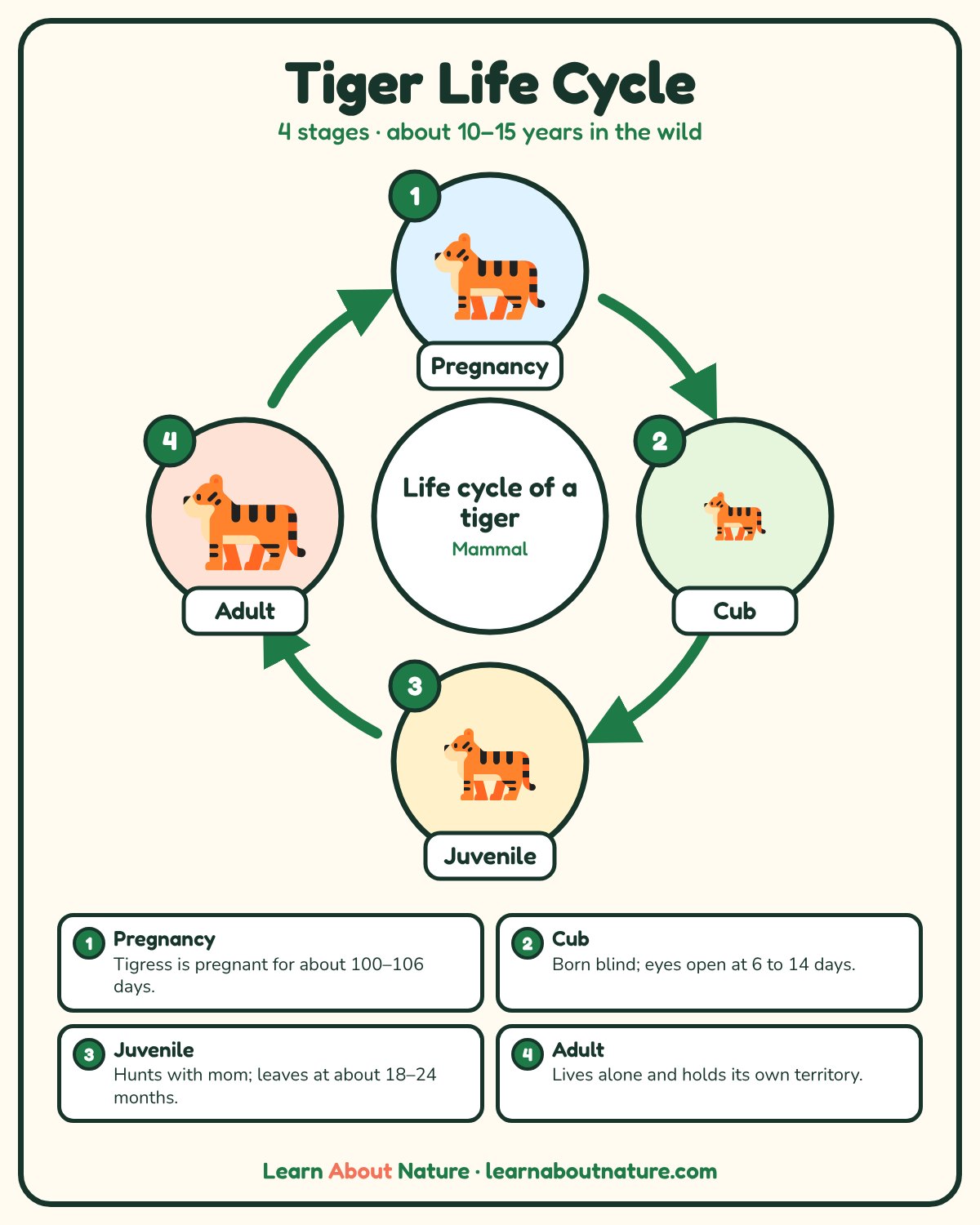
Teachers and students: you’re welcome to use this diagram in lessons and projects with credit to Learn About Nature.
Free printable: Download the Tiger life cycle worksheet (PDF) – label the diagram, cut and sequence the stages, and match key words. Answer key included.
Tiger Life Cycle Quick Facts
| Gestation | about 100–106 days (range about 97–110) |
| Cubs per litter | usually 2–3 (range 1–7) |
| Weight at birth | about 1.7–3.5 lb (780–1,600 g) |
| Eyes open | about 6–14 days |
| Weaned | about 3–6 months |
| Independence | about 18–24 months |
| Maturity | females 3–4 years; males 4–5 years |
| Lifespan in the wild | about 10–15 years |
| Status (IUCN) | Endangered |
Mating and Courtship
Adult tigers live alone. Each one has a home range that it marks with scent, scratches on trees and droppings. Those marks also tell other tigers when a female is ready to breed.
Tigers can mate at any time of year, though in many areas mating happens most often between November and April. A tigress comes into season about every three to nine weeks if she is not pregnant, and she is ready to mate for only about five days. During that short window, a male and female stay together and may mate many times.
Tigers are induced ovulators, which means the female releases eggs only after mating. Once courtship is over, the male leaves. Male tigers play no part in raising cubs.
Stage 1: Pregnancy
A tigress is pregnant for about 100 to 106 days on average, or a little over three months. Most pregnancies last between about 97 and 110 days.
Before giving birth, the mother finds a sheltered den, such as a cave, a rocky crevice, a hollow under fallen trees or a thick patch of tall grass. She gives birth there to a litter of usually two or three cubs. Litters can range from one to seven cubs, but very large litters are rare.
Stage 2: Cub
Newborn tiger cubs weigh about 1.7 to 3.5 pounds (780 to 1,600 g). They are born blind, and their eyes open at about 6 to 14 days old. Each cub already has its own pattern of stripes, which it keeps for life.
For the first weeks, the cubs stay hidden in the den and live entirely on milk. The mother has to leave them alone while she hunts, which is when they are most at risk from predators, floods, fires and other dangers. If the den is disturbed, she may carry the cubs one at a time to a new hiding place.
At about two months old, cubs begin following their mother outside the den and start eating meat from her kills. They are usually weaned from milk between three and six months old.
Cubs spend a lot of time playing. Chasing, pouncing and wrestling with their littermates builds the strength and timing they will need later. The mother also teaches through example, letting the cubs watch as she stalks and catches prey.
- Birth weight: about 1.7–3.5 lb (780–1,600 g)
- Eyes open: about 6–14 days
- Leave the den with mom: about 2 months
- Weaned: about 3–6 months
Stage 3: Juvenile
From about five or six months old, young tigers begin to take part in hunts. At first they mostly watch and get in the way. Over the following year they practice stalking, ambushing and pinning prey, often by play-fighting with their brothers and sisters.
Young tigers usually stay with their mother until they can hunt well on their own, at around 18 to 24 months. Young males often wander off for several days at a time by about 15 months. Full independence usually comes at two to three years old.
Once they leave, young tigers must find a home range of their own. Daughters often settle close to their mother’s range. Sons usually travel much farther, and many young males die while searching for space that is not already held by an older male.
Stage 4: Adult
Female tigers become sexually mature at about three to four years old, and males at about four to five. A tigress that raises her litter successfully usually has cubs about every two years. If she loses a litter, she can become pregnant again soon after.
Adult tigers spend most of their time alone, hunting large prey such as deer and wild pigs. A male’s range usually overlaps the ranges of several females. Tigers defend their space by scent-marking and calling, which mostly helps them avoid dangerous fights.
Tigers usually hunt around dusk, at night or near dawn, creeping close to prey before a short, powerful rush. Many hunts fail, so an adult tiger may go several days between meals and then eat a large amount at once.
Tiger and Lion Life Cycles Compared
Tigers and lions are close relatives, and their life cycles look similar on paper. Both are pregnant for a little over three months, both usually have two or three cubs, and in both species the cubs depend on adults for food until they are around one and a half to two years old.
The big difference is family life. Lion cubs grow up in a pride, where several lionesses may nurse and guard them. Tiger cubs have only their mother. She must hunt, guard the den and teach her cubs alone, which is a big reason why raising a tiger litter is so demanding.
Adult life differs too. Lionesses usually stay with their sisters and mothers for life, while every adult tiger, male or female, lives on its own except when mating or raising cubs.
Survival and How Long Tigers Live
Growing up is the hardest part of a tiger’s life. In the wild, about half of all cubs die before they are two years old. Even among those that survive to leave their mother, only about 40 percent go on to claim a territory and breed.
Wild tigers usually live about 10 to 15 years. A few reach 20, and tigers in zoos can also live to about 20 years.
Threats and Conservation
Tigers are listed as Endangered on the IUCN Red List. In 2022, the IUCN estimated that there are about 3,700 to 5,600 wild tigers. That figure is higher than earlier estimates, largely because counting methods have improved, not only because numbers have grown.
Tigers once lived across much of Asia, but they have lost most of their former range. The main threats are habitat loss as forests are cleared, poaching for skins and body parts used in traditional medicine, and the loss of wild prey. When prey runs short, tigers may kill livestock, which leads to conflict with people. Protected reserves, wildlife corridors that link forests, and anti-poaching patrols have helped tiger numbers recover in some countries, including India and Nepal.
Interesting Tiger Life Cycle Facts
These facts highlight how a tiger’s life differs from that of other big cats.
- Unlike lions, tigers live alone; only mothers and cubs stay together.
- Every tiger has a unique stripe pattern, a bit like a human fingerprint.
- Tiger cubs are born with their eyes closed and depend completely on their mother.
- A mother tiger raises her cubs with no help from the father.
- Young female tigers often set up home next door to their mothers.
Tiger Life Cycle for Kids
Here is the tiger life cycle in simple steps:
- Pregnancy: A mother tiger carries her babies inside her for a little over three months.
- Cub: Baby tigers are born with closed eyes and drink their mother’s milk.
- Juvenile: Young tigers follow their mom and learn how to hunt.
- Adult: Grown-up tigers live on their own and have cubs of their own.
Key words: cub – a baby tiger; tigress – a female tiger; den – a hidden, sheltered place where a mother gives birth; territory – the area an animal lives in and defends; solitary – living alone rather than in a group; weaning – when a young animal stops drinking its mother’s milk.
Try this: Make a tiger timeline on a long strip of paper, marking birth, eyes opening, leaving the den, first hunt and leaving mom, then compare it with a lion timeline.
Related Life Cycles and Guides
- How long do tigers live?
- Do tigers have predators?
- Pig life cycle
- Panda life cycle
- Kangaroo life cycle
- Rabbit life cycle
- Wolf life cycle
- All animal & plant life cycles
See also: Tiger Facts for Kids
Tiger Life Cycle FAQs
How long is a tiger pregnant?
A tigress is pregnant for about 100 to 106 days on average, which is a little over three months. Most tiger pregnancies last between about 97 and 110 days. She gives birth alone in a hidden den.
How many babies does a tiger have?
A tigress usually has two or three cubs in a litter. Litters can range from one to seven cubs, but large litters are rare. Mothers who raise their cubs successfully usually have a new litter about every two years.
How long do tiger cubs stay with their mother?
Tiger cubs usually stay with their mother until they are about 18 to 24 months old, when they can hunt well on their own. Some young tigers stay close to her range for longer and become fully independent at two to three years.
Do male tigers help raise cubs?
No. Male tigers leave after mating and play no part in raising cubs. The mother feeds, protects and teaches the cubs on her own until they are old enough to live independently.
How long do tigers live?
Tigers usually live about 10 to 15 years in the wild, and a few reach 20. In zoos, tigers can also live to around 20 years. About half of wild cubs do not survive their first two years.
Sources: Smithsonian’s National Zoo: Tiger; San Diego Zoo Wildlife Alliance Library: Tiger Fact Sheet, Reproduction; NPR: There are 40% more tigers in the world than previously estimated (IUCN 2022)

Nato is a content writer and researcher with a background in psychology who’s eager to explore the wonders of nature. As a travel enthusiast and animal lover, she hopes to inspire others to discover and cherish the beauty and importance of the natural world. She also writes about the history of candy and snacks for Snack History and about food and healthy eating for The Fitchen.

