Fish Anatomy: Parts of a Fish and What They Do
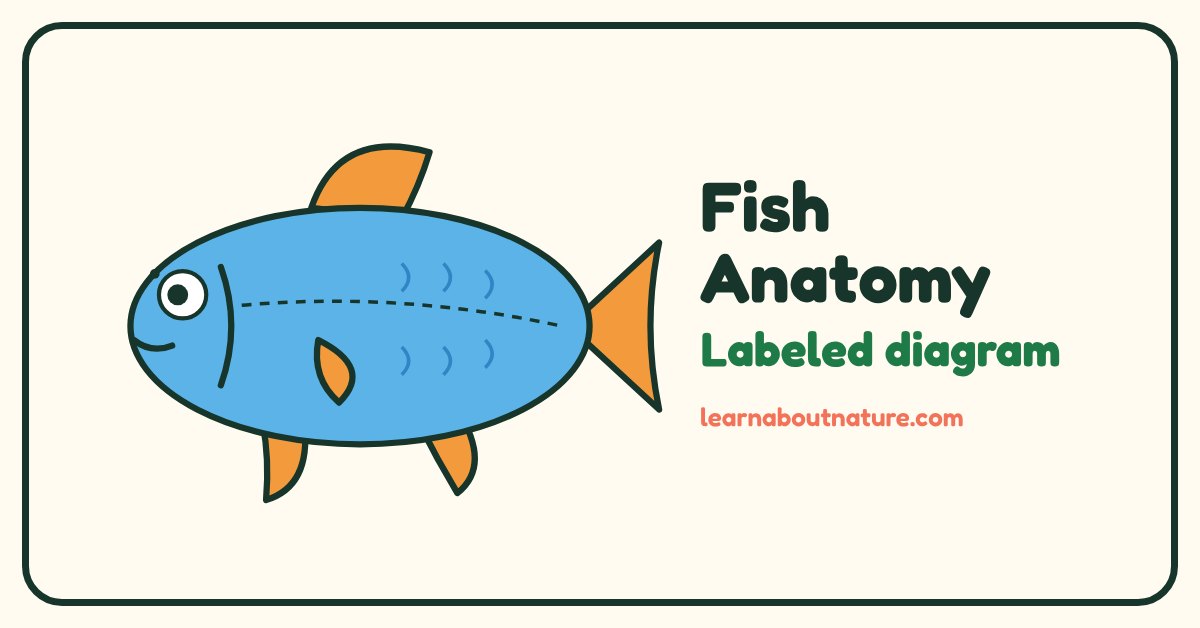
Quick answer: The main parts of a bony fish are the head (with mouth, nostrils, eyes and a gill cover), a body covered in scales, a lateral line along each side, and its fins: the dorsal fin on the back, paired pectoral and pelvic fins, the anal fin underneath and the caudal (tail) fin at the back.
A fish is built for life in water. Almost every part of its body, from the shape of its tail to the slime on its scales, helps it swim, breathe, find food or stay safe.
This guide covers the anatomy of a bony fish, such as a perch, trout or goldfish. Bony fish are by far the largest group of fish, with more than 30,000 known species. Sharks and rays are built a little differently, and we compare them near the end.
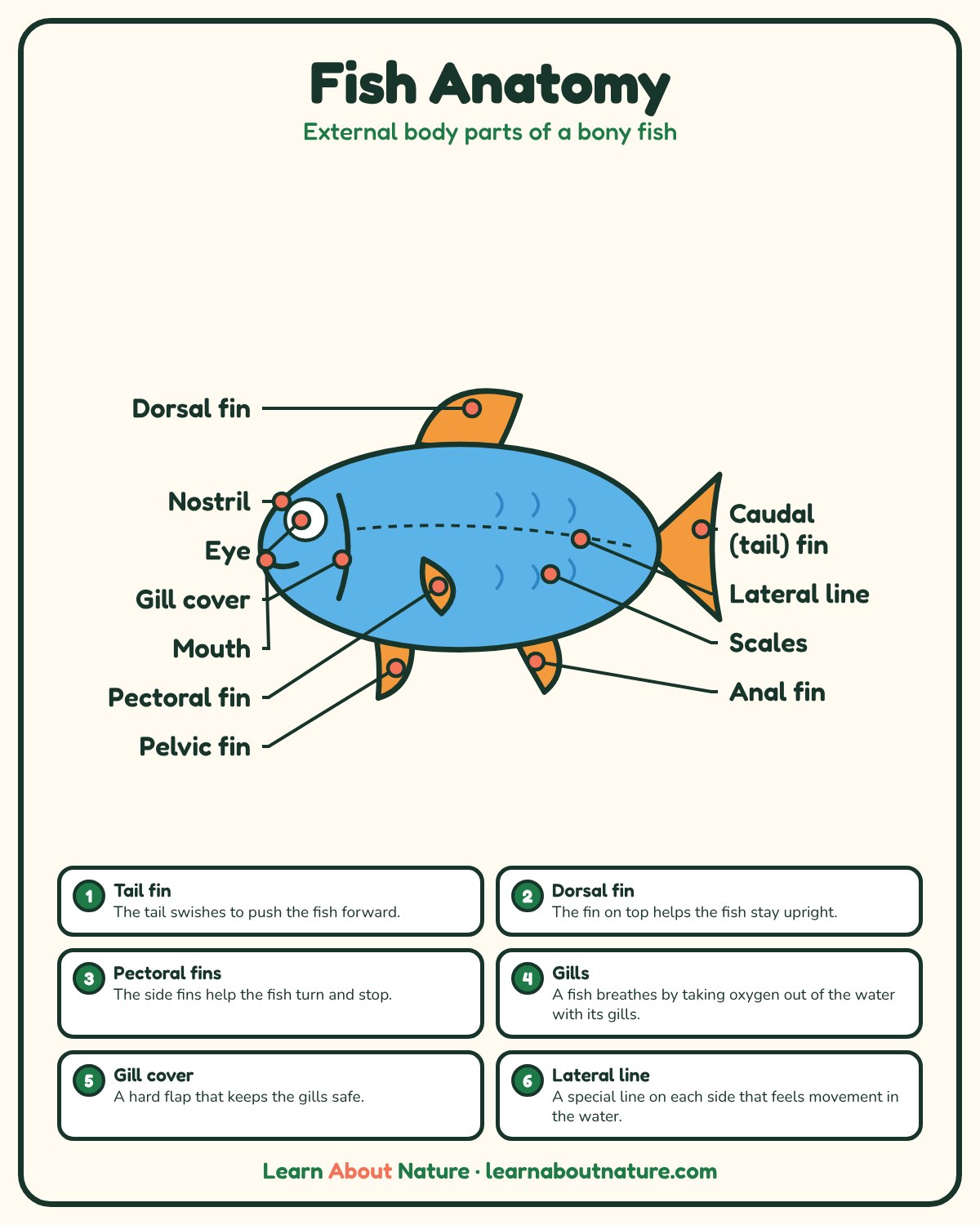
Teachers and students: you’re welcome to use this diagram in lessons and projects with credit to Learn About Nature.
Free printable: Download the Fish Anatomy labeling worksheet (PDF) – label the parts using the word bank. Answer key included.
Parts of a Fish and What They Do
| Part | What it does |
|---|---|
| Dorsal fin | Keeps the fish upright and stops it rolling; spines can protect it |
| Caudal fin (tail) | Pushes the fish forward through the water |
| Anal fin | Keeps the fish steady while swimming |
| Pectoral fins | Steer, brake, turn and hover |
| Pelvic fins | Help with balance and moving up and down |
| Gill cover (operculum) | Protects the gills and helps pump water over them |
| Lateral line | Senses vibrations and water movement |
| Scales and mucus | Protect the body from injury, germs and parasites |
| Eye | Sees prey, predators and surroundings |
| Mouth | Takes in food and water |
| Nostrils (nares) | Smell the water; not used for breathing |
| Gills | Take oxygen from the water |
| Swim bladder | Gas-filled sac that helps the fish float at the right depth |
The Fish Body Plan
Most fish have a streamlined body that is pointed at the front, widest in the middle and narrow toward the tail. This shape lets water slide past easily. Biologists split the body into three regions: the head, the trunk (the main body) and the tail.
Inside, a bony fish has a skeleton made of real bone, with a backbone running from the skull to the tail. Ribs and muscles wrap around the backbone. The muscles are arranged in zigzag blocks, which you can see in a cooked fish fillet as flakes.
The Fins
Fins are thin sheets of skin held up by stiff spines or bendy rays. Some fins come in pairs, one on each side, and others sit alone along the middle line of the body. Each has its own job.
- Dorsal fin: on the back. It keeps the fish upright and stops it rolling. Some fish have two dorsal fins, and the front one often has sharp spines for protection.
- Caudal fin: the tail fin. It pushes the fish forward. A deeply forked tail usually belongs to a fast, long-distance swimmer, while a rounded tail suits a fish that turns quickly in tight spaces.
- Anal fin: on the underside near the tail. It helps keep the fish steady as it swims.
- Pectoral fins: on the sides behind the head. They work like oars and brakes, helping the fish steer, turn, hover and stop.
- Pelvic fins: on the belly. They help with balance and with moving up and down.
- Adipose fin: a small, fleshy fin with no rays, found between the dorsal fin and tail in trout, salmon and catfish. Scientists are still studying what it does.
The Head: Mouth, Nostrils, Eyes and Gill Cover
The mouth tells you a lot about how a fish feeds. A mouth that points upward suits a fish that grabs food from above, a mouth at the front suits one that eats what is in front of it, and a downward mouth suits a bottom feeder.
Fish have nostrils, called nares, on the snout. Unlike our nostrils, they are not used for breathing at all. Water flows in and out of small pits that are lined with smell cells.
Behind the eye is the gill cover, or operculum. This bony flap protects the delicate gills underneath and opens and closes to help pump water over them.
Scales, Slime and the Lateral Line
Most bony fish are covered in thin, overlapping scales that work like a flexible suit of armor. Not every fish has them. Most catfish, for example, have bare skin. On top of the scales is a layer of mucus, or slime, that helps keep out germs and parasites and lets the fish slip through the water.
Along each side runs the lateral line, a row of tiny pores leading to sense organs just under the skin. It picks up vibrations and changes in water movement. This lets a fish feel a predator coming, find prey in murky water and keep its place in a school.
Internal Anatomy: Organs Inside a Fish
Under the gill cover are the gills, rows of feathery filaments packed with tiny blood vessels. Water goes in through the mouth, passes over the gills and leaves through the gill opening. Oxygen moves from the water into the blood, and carbon dioxide moves out.
Most bony fish have a swim bladder, a gas-filled sac in the body cavity. By changing how much gas it holds, the fish can float at a chosen depth without working hard to swim.
A fish’s heart is simpler than ours. It has two main chambers and pumps blood in a single loop: from the heart to the gills, then on to the rest of the body. Other organs include the stomach and intestine for digestion, a liver, and kidneys that help control the balance of water and salts.
Fish Senses
Fish use several senses at once. Their eyes have no eyelids, and many species see in color. Their sense of smell can be very sharp; salmon are thought to use smell to find the stream where they hatched. Many fish also have taste buds on their lips, and catfish have them on their whiskers (barbels) and skin.
Fish have inner ears inside the skull, with no openings on the outside. Together with the lateral line, these let a fish sense sound and movement all around it.
How a Fish Swims and Breathes
Most fish swim by bending their body from side to side in a wave that travels back toward the tail. The caudal fin gives the final push, while the other fins steer and keep the fish balanced.
To breathe, a fish opens its mouth to take in water, then closes it and squeezes the water back over the gills and out under the gill covers. Some fast swimmers, such as tuna, mostly let water rush over their gills as they swim.
Bony Fish vs Sharks
Sharks and rays are fish too, but they belong to a different group called cartilaginous fish. Their skeleton is made of cartilage, the bendy material in your ears, instead of bone.
Sharks have no gill cover. Instead, you can see five to seven gill slits on each side of the head. They also have no swim bladder and rely partly on a large, oily liver to help them stay afloat. Their skin is covered in tiny tooth-like scales called dermal denticles rather than the flat scales of a bony fish.
Fun Facts About Fish Bodies
- You can estimate the age of many fish by counting growth rings on their scales, a bit like tree rings.
- A flounder starts life with an eye on each side of its head. As it grows, one eye moves over so both end up on the same side.
- Seahorses are bony fish that swim upright and steer with small fins, so they are slow swimmers.
- Some fish, such as lungfish, can breathe air as well as water.
Fish Anatomy for Kids
- Tail fin: the tail swishes to push the fish forward.
- Dorsal fin: the fin on top helps the fish stay upright.
- Pectoral fins: the side fins help the fish turn and stop.
- Gills: a fish breathes by taking oxygen out of the water with its gills.
- Gill cover: a hard flap that keeps the gills safe.
- Lateral line: a special line on each side that feels movement in the water.
- Scales: little overlapping plates that protect the fish like armor.
Key words: operculum – the bony flap that covers and protects a fish’s gills; lateral line – a line of sense organs along a fish’s side that feels vibrations in the water; swim bladder – a gas-filled sac inside many bony fish that helps them float; caudal fin – the scientific name for a fish’s tail fin; nares – a fish’s nostrils, used for smelling, not breathing; gill filaments – thin, feathery parts of the gills where oxygen enters the blood.
Try this: Draw a large fish outline and have students label each fin, then act out its job: arms as pectoral fins for turning, hips swaying for the tail, and standing tall like the dorsal fin.
Related Guides
- Fish life cycle
- Octopus Anatomy
- Jellyfish Anatomy
- Crab Anatomy
- Shark life cycle
- All animal & plant anatomy diagrams
- Animal & plant life cycles
Fish Anatomy FAQs
What are the 7 fins of a fish?
Many bony fish have seven fins: one dorsal fin, two pectoral fins, two pelvic fins, one anal fin and one caudal (tail) fin. Some species add a second dorsal fin or a small adipose fin, and a few have lost certain fins, so the exact number varies.
Do fish breathe through their nose?
No. A fish’s nostrils are only for smelling. They lead to small pits lined with smell cells and do not connect to the gills. Fish breathe by passing water from the mouth over the gills, where oxygen moves into the blood.
What does the lateral line do in a fish?
The lateral line is a row of tiny pores along each side that leads to sense organs under the skin. It detects vibrations and water movement, helping a fish notice predators, find prey in dark or muddy water and swim close to other fish in a school without bumping into them.
Do all fish have scales?
No. Most bony fish have scales, but some, including most catfish, have smooth, scaleless skin. Sharks and rays have tiny tooth-like scales called dermal denticles, which feel rough like sandpaper.
What is a swim bladder?
A swim bladder is a gas-filled sac inside most bony fish. By adding or removing gas, the fish can hover at a certain depth without sinking or rising. Sharks do not have a swim bladder; they rely on an oily liver and swimming to stay up.
Sources: Fish Anatomy – South Carolina Department of Natural Resources; Form and Function Background – New York Sea Grant (I FISH NY); Shark Anatomy – Fisheries and Oceans Canada; Fish Anatomy – Western Australia Department of Primary Industries (Marine Waters)

Nato is a content writer and researcher with a background in psychology who’s eager to explore the wonders of nature. As a travel enthusiast and animal lover, she hopes to inspire others to discover and cherish the beauty and importance of the natural world. She also writes about the history of candy and snacks for Snack History and about food and healthy eating for The Fitchen.