Bean Plant Life Cycle: Stages From Seed to Pod (With Diagram)
Quick answer: The bean plant life cycle has five stages: seed, germination, seedling, flowering plant and pods with seeds. The seed’s root grows first, then the shoot lifts the cotyledons above the soil. The plant flowers, and each flower becomes a pod of new beans, all in one season.
The bean plant life cycle has five stages: seed, germination, seedling, flowering plant and pods with seeds. A dry bean soaks up water and sprouts, grows into a leafy plant, makes flowers, and each pollinated flower grows into a pod full of new beans. Most garden beans are annuals, so they do all of this in a single summer.
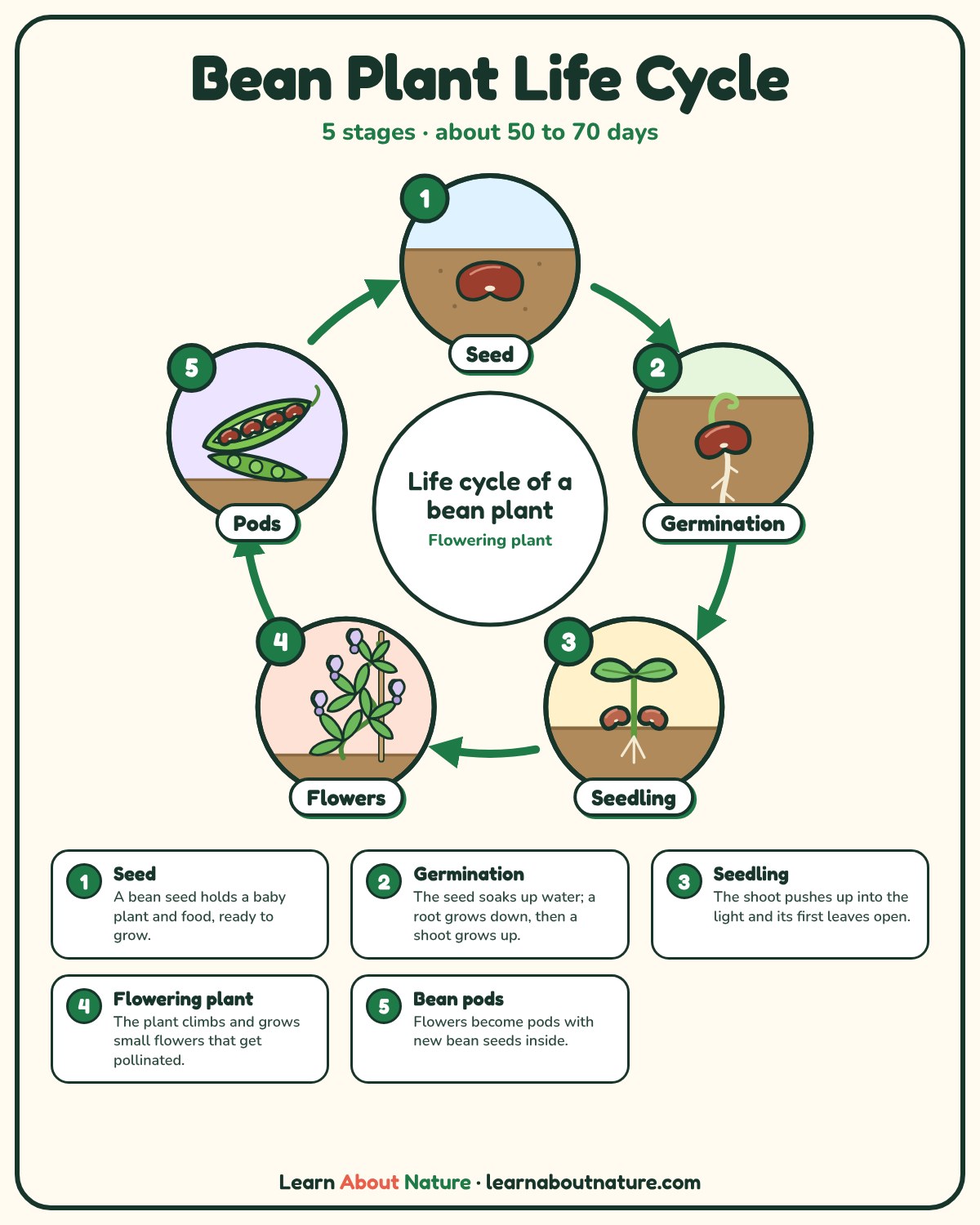
Bean plant Life Cycle Quick Facts
| Common name | Bean plant |
| Scientific name | Phaseolus vulgaris |
| Kingdom | Plantae |
| Phylum | Tracheophyta |
| Class | Magnoliopsida |
| Order | Fabales |
| Family | Fabaceae |
| Genus | Phaseolus |
| Conservation status | Least Concern |
| Life cycle stages | Seed, germination, seedling, flowering plant, pods with seeds |
| Type of development | Grows from seed |
| Time to sprout | About 1 to 2 weeks in warm soil |
| Time to green beans | About 50 to 60 days for bush beans |
| Lifespan | One growing season (annual) |
| Seeds per pod | Usually about 4 to 8 |
This page follows the common bean, the plant that gives us green beans, also called French beans, as well as kidney, pinto and black beans. Beans are one of the best plants for watching a life cycle up close, because they are big, fast and easy to grow in a classroom. You can also see all our animal and plant life cycles.
Stage 1: Seed
A bean is a seed. If you soak a dry bean in water overnight and gently peel it open, you can see its parts:
- Seed coat: the thin, tough outer skin that protects the seed.
- Hilum: the small scar on the side where the bean was attached to its pod.
- Cotyledons: the two thick halves of the bean. They are seed leaves packed with stored food.
- Embryo: the tiny baby plant tucked between the cotyledons, with a little root and a tiny pair of leaves.
A dry bean is alive but resting. It can stay this way for a long time if it is kept cool and dry, waiting for the right conditions to grow.
Stage 2: Germination
Germination is when the seed wakes up and starts to grow. A bean needs water, oxygen and warmth. Beans like warm soil, and they often rot instead of sprouting if the ground is cold and wet.
First, the bean soaks up water and swells, and the seed coat splits. The root always comes out first. It grows downward, even if the bean is lying upside down, and soon sprouts tiny side roots and root hairs to drink water. Next, the stem grows. In the common bean, the stem pushes up through the soil in a hook shape and pulls the two cotyledons above the ground with it. Then the hook straightens and the first leaves unfold.
In warm conditions, a root often appears in just a few days, and the shoot usually breaks through the soil in about 1 to 2 weeks.
Stage 3: Seedling
Once the seedling is above ground, its leaves turn green and it begins making its own food by photosynthesis. The cotyledons feed the young plant for a while, then shrivel and drop off once their food is used up.
The first true leaves are a pair of simple, heart-shaped leaves. After that, the plant grows leaves made of three leaflets each. The roots grow too, and on them small bumps called nodules appear. Inside the nodules live helpful bacteria that take nitrogen from the air in the soil and turn it into food for the plant. This is why farmers say beans help make the soil richer.
Seedlings face many dangers: slugs, birds, rabbits and insects such as the Mexican bean beetle all like to munch on young bean leaves. A late frost can kill them, too.
Stage 4: Flowering Plant
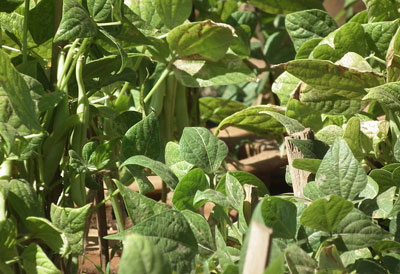
As the plant grows bigger, it takes one of two shapes. Bush beans stay short and compact, about 1 to 2 feet (30 to 60 cm) tall. Pole beans are climbers whose stems twist around a pole, string or fence and can grow taller than an adult.
Bush beans often start flowering about 6 to 8 weeks after planting. The small flowers can be white, pink or purple. Bean flowers usually pollinate themselves: pollen moves to the sticky center within the same flower, often before the flower has even fully opened. Bees sometimes visit too, but beans do not need them the way apple trees do.
Hot, dry weather can make bean plants drop their flowers, so gardeners keep the soil evenly moist while the plants are blooming.
Stage 5: Pods With Seeds
After pollination, the flower fades and a thin green pod starts to grow from its center. Inside the pod, a row of new seeds develops. A common bean pod usually holds about 4 to 8 seeds.
What happens next depends on what people want from the plant:
- Green beans are picked while the pods are young, tender and the seeds inside are still small. Picking often makes the plant produce more pods.
- Dry beans, like kidney or black beans, are left on the plant until the pods turn yellow, then brown and papery, and the seeds inside become hard.
When the pods dry out, the life cycle is complete. The dry seeds can be saved and planted next spring to start a new bean plant. The parent plant, being an annual, turns yellow and dies.
Try It: Grow a Bean in a Jar
The jar bean experiment lets you watch germination happen right in front of you:
- Soak a few dry beans (lima, kidney or pinto beans work well) in water overnight.
- Line the inside of a clear jar or plastic cup with a folded paper towel, and stuff more crumpled paper towel in the middle to hold it against the glass.
- Slide the beans between the glass and the paper towel, about halfway down, so you can see them from outside.
- Add a little water so the paper towel stays damp but the beans are not sitting in water.
- Keep the jar somewhere warm, check every day and keep the towel moist. Draw or photograph what you see.
Within a few days you should see the seed coat split and the root grow downward, followed by the stem and leaves reaching up. Try turning one bean upside down and watch how its root still bends to grow down. Once the plant has a couple of true leaves, you can move it to a pot of soil to watch the rest of the life cycle.
How Long Does a Bean Plant Live?
Most bean plants live for one growing season. Bush green beans are usually ready to pick about 50 to 60 days after planting, while pole beans take a little longer and keep producing for several weeks. Beans grown for dry seeds need more time, often around 3 months or more, for the pods to dry on the plant. Frost ends the life of any plants still growing in fall.

Bean Life Cycle vs Other Plant Life Cycles
Not all beans sprout the same way. Broad beans, also called fava beans, leave their cotyledons under the soil and send up only the shoot, while common beans lift their cotyledons into the air. Peas, including snow peas, sprout like broad beans, with their seed leaves staying underground.
Beans follow the same seed-to-seed pattern as every flowering plant in the angiosperm life cycle. Like the pumpkin life cycle, a bean’s whole life fits into one summer. Compare that with the much longer plant life cycle of perennials like trees, which take years before they make their first seeds.
Fun Facts About the Bean Plant Life Cycle
- Bean roots always grow down and stems always grow up, because plants can sense gravity.
- Thanks to the bacteria in their root nodules, beans can help feed the next crop planted in the same soil.
- People have been growing common beans in the Americas for thousands of years.
- A pod is actually the fruit of the bean plant, and the beans inside are its seeds.
- Ladybugs are a gardener’s friend because they eat aphids that suck juice from bean plants. Learn how ladybugs help gardeners.
More life cycles
- Sunflower Life CycleSeed → sprout → bud → flower → seeds
- Plant Life CycleSeed → seedling → adult plant → flower → seed
- Pumpkin Life CycleSeed → sprout → vine → flower → pumpkin
- Dandelion Life CycleSeed → rosette → flower → seed head
- Ladybug Life CycleEgg → larva → pupa → adult
Bean plant Life Cycle FAQs
What are the stages of a bean plant’s life cycle?
A bean plant grows from a seed, germinates, becomes a seedling, grows into a flowering plant and then makes pods with new seeds inside. The dry seeds can be planted to start the cycle again.
What comes out of a bean seed first?
The root always comes out first and grows downward. Then the stem pushes up through the soil, lifting the seed leaves (cotyledons) above the ground in common beans.
How long does it take a bean plant to grow?
Beans usually sprout in about 1 to 2 weeks in warm soil. Bush green beans are ready to pick in about 50 to 60 days, while dry beans need around 3 months or more.
How do you grow a bean in a jar?
Soak a dry bean overnight, then place it between a damp paper towel and the side of a clear jar. Keep the towel moist and the jar warm, and you should see the root appear within a few days.
Do bean plants need bees to make beans?
Usually not. Bean flowers mostly pollinate themselves, often before the flower fully opens, although bees sometimes visit them too.

Randi Jones is the owner and founder of the Nature Gift Store, an online retailer specializing in nature-themed gifts, educational science projects, live animal nature kits and real butterfly artwork. A biology graduate who fell in love with insects, she founded the company in 2001 to make active learning about nature fun, accessible and engaging for children and adults. Her store offers real butterfly frames, home and garden decor and educational live animal kits, including ant farms, worm farms, tadpoles, ladybugs and hermit crabs, and she runs a bug museum in Washington featuring live animals like Eddie the Iguana alongside other reptiles and insects.