Sunflower Life Cycle: Stages From Seed to Flower (With Diagram)

Quick answer: The sunflower life cycle has six stages: seed, germination, young plant, bud, flower and new seeds. Sunflowers are annuals, so they grow from seed to seed in one season of about 80 to 120 days. Each flower head is made of hundreds of tiny florets that become seeds.
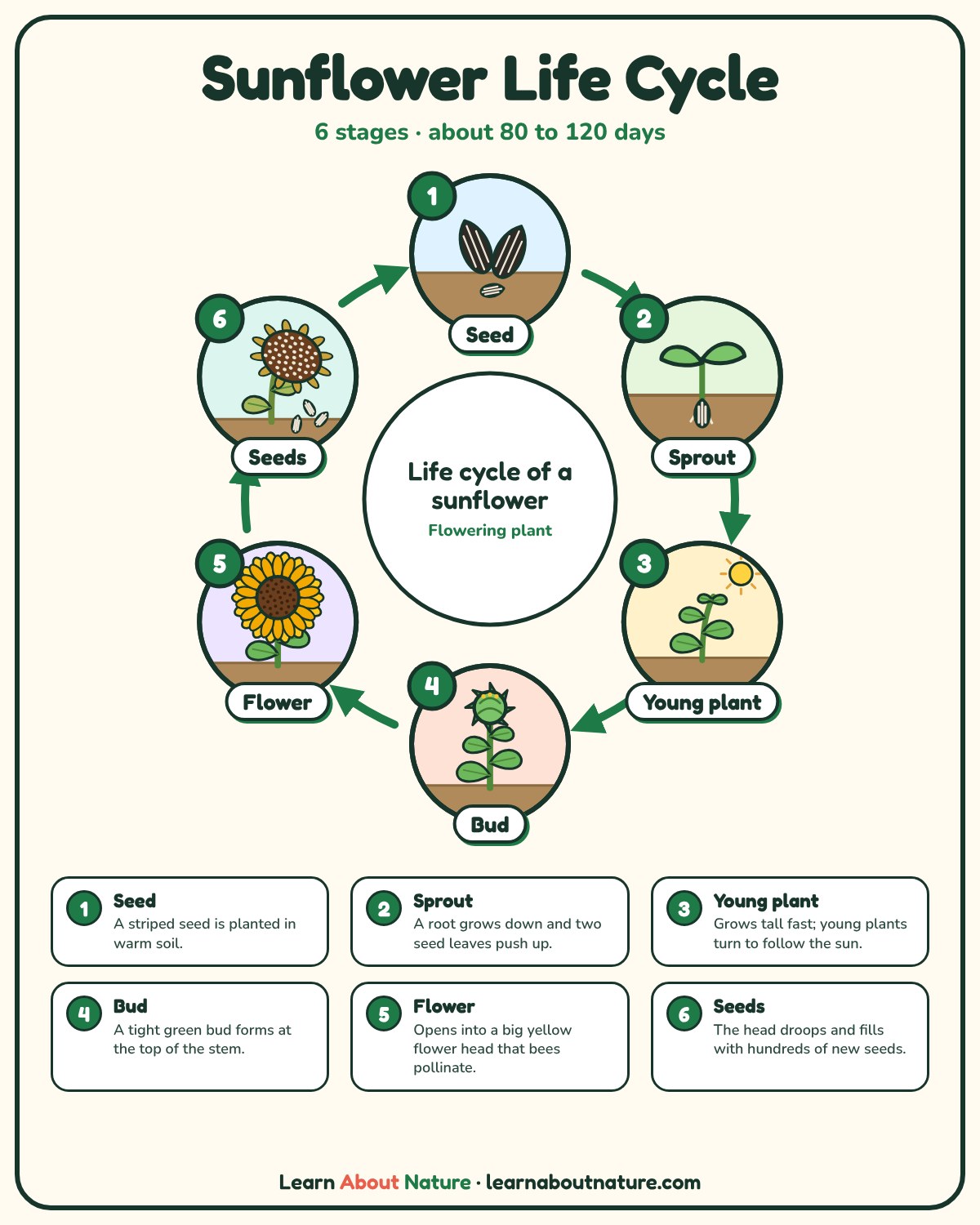
The sunflower life cycle has six stages: seed, germination (sprout), young plant, bud, flower and new seeds. The common sunflower is an annual plant, which means it goes through its whole life, from seed to new seeds, in a single growing season of about 80 to 120 days, and then it dies.
Sunflower Life Cycle Quick Facts
| Common name | Sunflower |
| Scientific name | Helianthus annuus |
| Kingdom | Plantae |
| Phylum | Tracheophyta |
| Class | Magnoliopsida |
| Order | Asterales |
| Family | Asteraceae |
| Genus | Helianthus |
| Conservation status | Least Concern |
| Life cycle stages | Seed, sprout, young plant, bud, flower, seeds |
| Type of development | Grows from seed |
| Time to flowering | About 2 to 3 months after planting |
| Lifespan | One growing season (annual), about 80 to 120 days |
| Seeds per head | Hundreds; large heads can hold more than 1,000 |
Sunflowers are native to North America, where people have grown them for their seeds for thousands of years. They are one of the easiest and most exciting plants to watch grow, because they shoot up so fast. To learn more about the plant itself, read our main guide to sunflowers, or see all our animal and plant life cycles.
Stage 1: Seed
A sunflower seed is not just a seed. The striped or black “seed” you buy is actually a tiny dry fruit with a hard shell, called a hull. Inside the hull is the real seed, the soft kernel. The kernel holds a baby plant (the embryo) and two thick seed leaves packed with oil and food.
In the wild, sunflower seeds fall to the ground in late summer and fall. Many are eaten by birds, squirrels and mice. The ones that survive rest through the winter and sprout in spring when the soil warms up. Gardeners usually plant seeds about 1 inch (2.5 cm) deep after the last frost, when the soil is warm.
Stage 2: Germination (Sprout)
Germination starts when the seed soaks up water and swells. The hull cracks open and a small root, called the radicle, pushes down into the soil first to anchor the plant and drink water. Then a curved stem pushes upward and pulls the seed leaves out into the light.
In warm, moist soil, sunflower sprouts usually appear in about 1 to 2 weeks. The first two leaves you see are the smooth, oval seed leaves (cotyledons). They often still wear the empty hull like a little hat for a day or two. Sprouts are a favorite food for slugs, snails and birds, so this is a risky time for a sunflower.
Stage 3: Young Plant
Soon the first true leaves appear above the seed leaves. They are rough, hairy and heart-shaped. Now the young plant can make plenty of its own food from sunlight through photosynthesis, and it starts to grow very fast. In warm summer weather, a tall variety can grow several inches in a single week.
Young sunflowers do something amazing called heliotropism, which means “turning toward the sun.” During the day, the growing tip and young leaves slowly bend to follow the sun from east to west. At night, they swing back to face east again, ready for sunrise. The plant does this by growing a little faster on one side of the stem than the other.
This sun tracking only happens while the plant is young and growing. As the stem stops growing, the movement stops too, and most mature sunflower heads end up facing east.

Stage 4: Bud
After several weeks, a small bud forms at the top of the stem. At first it looks like a tight green star made of pointed leaflike parts called bracts. Over the next couple of weeks, the bud swells and the stem below it keeps getting taller and thicker.
By now a tall sunflower may be taller than an adult. Many garden varieties reach about 5 to 10 feet (1.5 to 3 meters), while dwarf types stay under 3 feet (1 meter). Strong winds and heavy rain can knock tall plants over, so gardeners sometimes tie them to a stake.
Stage 5: Flower
When the bud opens, it looks like one giant flower. But a sunflower head is really made of hundreds or even thousands of tiny flowers, called florets, packed together. That is why sunflowers belong to the daisy family, along with daisies and dandelions.
There are two kinds of florets:
- Ray florets are the bright yellow “petals” around the edge. They help attract insects but do not make seeds.
- Disk florets fill the brown or dark center. Each one is a tiny flower that can make one seed.
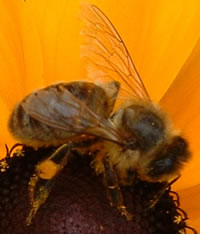
The disk florets open in rings, starting at the outer edge and moving toward the middle over several days. They make pollen and nectar, and bees, butterflies and other insects visit to feed. As they crawl across the head, they carry pollen from floret to floret and from plant to plant. Read more about these busy pollinators in our guide about honey bees. Scientists have found that east-facing heads warm up faster in the morning sun and get more visits from bees than heads facing west.
Stage 6: Seeds
After a floret is pollinated, its seed starts to grow. The bright ray florets wilt and fall off, the back of the head turns from green to yellow and then brown, and the heavy head droops down. Drooping helps protect the ripening seeds from rain and some birds.
The seeds are arranged in a beautiful spiral pattern that lets as many seeds as possible fit into the head. A large head can hold more than 1,000 seeds. When the seeds are ripe, they fall to the ground or are eaten by birds such as goldfinches and chickadees. The parent plant then dies, because it is an annual, but its seeds can start the life cycle again next spring.

How Long Does a Sunflower Live?
A common sunflower lives for only one growing season. From planting to ripe seeds usually takes about 80 to 120 days, or roughly three to four months, depending on the variety and the weather. Smaller types tend to finish faster than giant ones. The first frost of fall kills any plants that are still standing.
Some wild relatives of the common sunflower are perennials. They come back from their roots year after year, but the big, single-headed sunflower you see in gardens and farm fields is an annual.
Sunflower Life Cycle vs Other Flower Life Cycles
Sunflowers follow the same seed, sprout, flower and seed steps as every flowering plant in the angiosperm life cycle. Their closest match on our site is the dandelion life cycle: dandelions are in the same daisy family, and their yellow “flower” is also a head of many tiny florets. The big difference is that dandelions are perennials that come back each year and spread their seeds on fluffy parachutes, while sunflowers are annuals with heavy seeds that drop or are carried off by animals.
Like sunflowers, pumpkins are annuals that grow from seed to seed in one summer, which you can see in the pumpkin life cycle. For the bigger picture, see our overview of the plant life cycle.
Fun Facts About the Sunflower Life Cycle
- The tallest sunflower on record grew to more than 30 feet (9 meters).
- The spirals of seeds in a sunflower head often come in numbers like 34 and 55, which are part of a famous math pattern called the Fibonacci sequence.
- Only young sunflowers track the sun. Grown-up flower heads mostly stay facing east.
- Sunflower seeds are a favorite food of many birds, which is why people leave dried heads in the garden over winter.
- Other cheerful members of the same family include daisies and marigolds.
More life cycles
- Bean Plant Life CycleSeed → germination → seedling → flowers → pods
- Pumpkin Life CycleSeed → sprout → vine → flower → pumpkin
- Dandelion Life CycleSeed → rosette → flower → seed head
- Plant Life CycleSeed → seedling → adult plant → flower → seed
- Bee Life CycleEgg → larva → pupa → adult
Sunflower Life Cycle FAQs
What are the stages of a sunflower’s life cycle?
The sunflower life cycle has six stages: seed, germination (sprout), young plant, bud, flower and seeds. After the seeds ripen, the plant dies, and the seeds can start new plants the next spring.
How long does it take a sunflower to grow?
Most sunflowers take about 80 to 120 days to grow from seed to ripe seeds. Sprouts usually appear within 1 to 2 weeks of planting in warm soil.
Do sunflowers really follow the sun?
Only young, growing sunflowers do. Their tops turn from east to west during the day and back to the east at night. Once the plant is mature, the flower head stops moving and usually faces east.
Is a sunflower one flower or many?
A sunflower head is made of hundreds or thousands of tiny flowers called florets. The yellow ray florets around the edge attract insects, and the disk florets in the center each make one seed.
Do sunflowers come back every year?
The common sunflower is an annual, so it dies after one season. New plants only come back if seeds fall and sprout the next spring, though some wild sunflower species are perennials.

Randi Jones is the owner and founder of the Nature Gift Store, an online retailer specializing in nature-themed gifts, educational science projects, live animal nature kits and real butterfly artwork. A biology graduate who fell in love with insects, she founded the company in 2001 to make active learning about nature fun, accessible and engaging for children and adults. Her store offers real butterfly frames, home and garden decor and educational live animal kits, including ant farms, worm farms, tadpoles, ladybugs and hermit crabs, and she runs a bug museum in Washington featuring live animals like Eddie the Iguana alongside other reptiles and insects.