Sea Turtle Life Cycle: Stages from Egg to Adult (With Diagram)

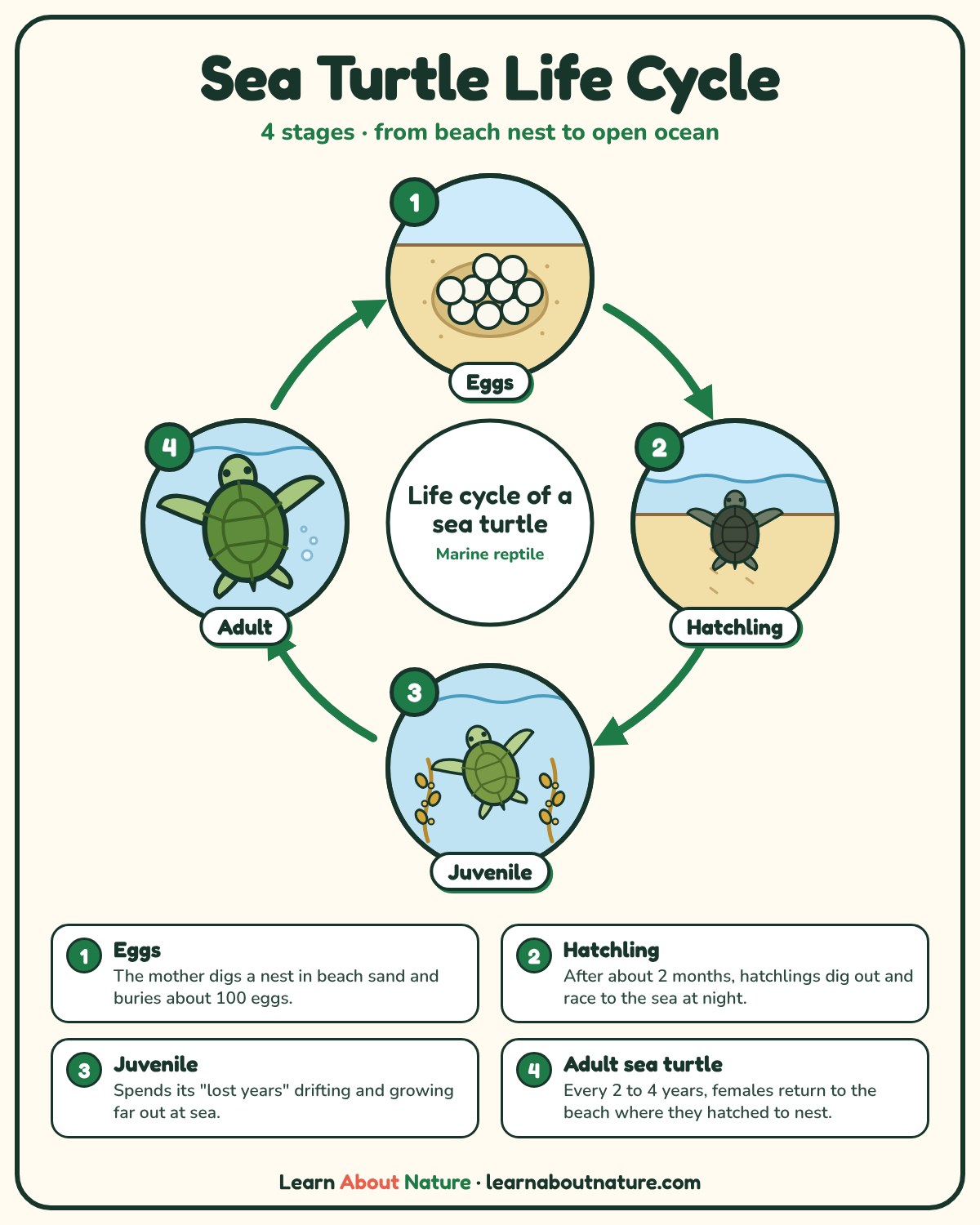
Quick answer: The sea turtle life cycle has four stages: egg, hatchling, juvenile and adult. Eggs hatch on sandy beaches after about two months, hatchlings race to the sea, juveniles grow for years in the ocean, and adult females return to the region where they hatched to lay eggs.
The sea turtle life cycle has four stages: egg, hatchling, juvenile and adult. It begins on a sandy beach, where a mother turtle buries her eggs, and then moves out into the open ocean, where the young turtles grow up slowly over many years before returning to the coast as adults.
Sea turtle Life Cycle Quick Facts
| Common name | Sea turtle |
| Scientific name | Chelonioidea |
| Life cycle stages | Egg, hatchling, juvenile, adult |
| Type of development | Hatches from eggs buried in sand |
| Incubation | About 45–70 days |
| Time to adulthood | About 10–50 years, depending on species |
| Lifespan | Often 50 years or more (estimated) |
| Number of eggs | Usually about 50–200 per nest, several nests a season |
There are seven kinds of sea turtles, from the small Kemp’s ridley to the giant leatherback. Their life cycles follow the same basic pattern, although the timing changes from species to species. Sea turtles spend almost their whole lives at sea. The only time most of them touch land is when they hatch, and, for females, when they come back to lay eggs of their own.
Stage 1: Egg
Sea turtles mate in the water near their nesting beaches. A few weeks later, the female crawls up the beach, usually at night. She uses her front flippers to clear a shallow pit and then carefully digs a deeper, flask-shaped egg chamber with her back flippers. Into this hole she drops a clutch of round, white eggs about the size of ping-pong balls.
A typical nest holds roughly 100 eggs, although the number can range from about 50 to 200 depending on the species. The eggs have soft, leathery shells, so they do not crack when they fall into the nest. The mother covers them with sand, smooths the area to hide it, and returns to the sea. She does not come back to look after them. Most females lay several clutches during one nesting season, about two weeks apart, and then usually skip one or more years before nesting again.
Temperature decides boy or girl
Sea turtles do not have their sex decided when the egg is laid. Instead, the temperature of the sand during the middle part of incubation decides it. This is called temperature-dependent sex determination. Warmer nests produce mostly females, and cooler nests produce mostly males. The tipping point is close to 84°F (29°C) for many species. Because of this, scientists are watching how warming beaches might affect the number of male and female turtles in the future.
The eggs take about 45 to 70 days to hatch, often around two months. Warmer sand makes them develop faster. Eggs face many dangers: crabs, raccoons, foxes, wild dogs and people may dig them up, and storms or very high tides can wash a nest away.
Stage 2: Hatchling
When the baby turtles are ready, they break out of their shells using a tiny, temporary egg tooth on the tip of the snout. The hatchlings in a nest work together, wriggling upward through the sand for several days. They usually burst out of the sand together at night, when it is cooler and darker and there are fewer predators about.
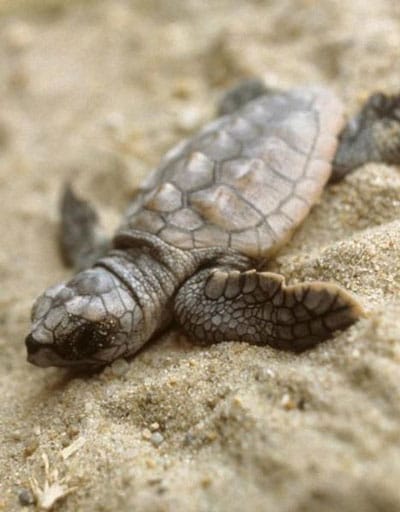
Most hatchlings are only about 2 inches (5 cm) long. They find the ocean by heading toward the brightest, lowest horizon, which on a natural beach is the moonlit or starlit sea. Bright lights from houses, hotels and streets can confuse them and lead them the wrong way, which is why many beach towns turn lights down during nesting season.
The dash to the sea is dangerous. Ghost crabs, gulls and other birds grab hatchlings on the sand, and fish wait for them in the shallow water. Once they reach the waves, the hatchlings swim almost nonstop for a day or more to get out to deeper water. This burst of energy is powered by leftover yolk stored in their bodies.
Stage 3: Juvenile
After leaving the beach, young sea turtles seem to disappear. Scientists used to call this time the “lost years” because it was so hard to follow the tiny turtles at sea. We now know that many young turtles drift with ocean currents for years, often hiding and feeding in floating mats of seaweed called sargassum. There they eat small animals and plants they find near the surface.
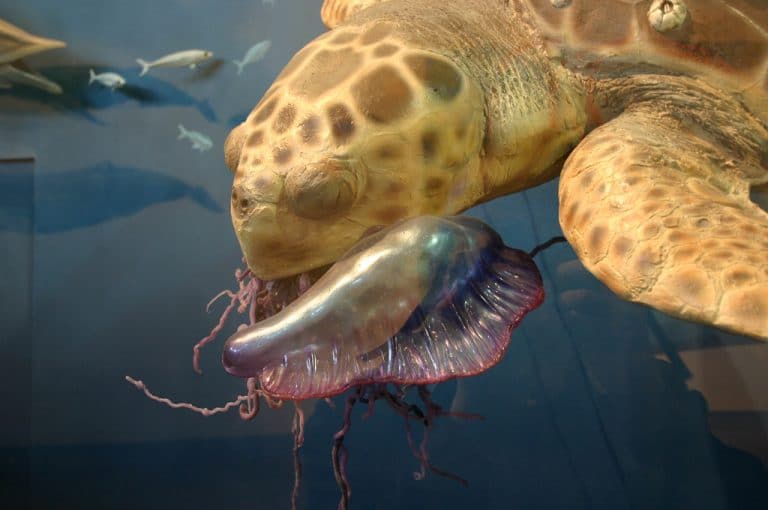
As juveniles grow bigger, many species move to coastal waters such as bays, lagoons, reefs and seagrass beds, where there is more food. Their diets also start to differ. Green turtles switch to eating mostly seagrass and algae, while loggerheads crunch crabs and shellfish and leatherbacks hunt jellyfish. You can read more in our guide to what sea turtles eat.
The juvenile stage is the longest part of the life cycle. Young turtles grow slowly, and they still face sharks, large fish and other predators. Human dangers are serious too, including getting caught in fishing nets, swallowing plastic bags that look like jellyfish, and being hit by boats.
Stage 4: Adult
Sea turtles grow up slowly. Depending on the species, they become adults at roughly 10 to 50 years old. Kemp’s ridleys are among the quickest to mature, while green turtles and loggerheads often take several decades.
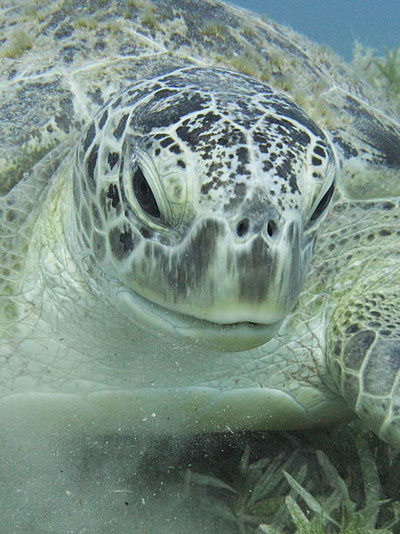
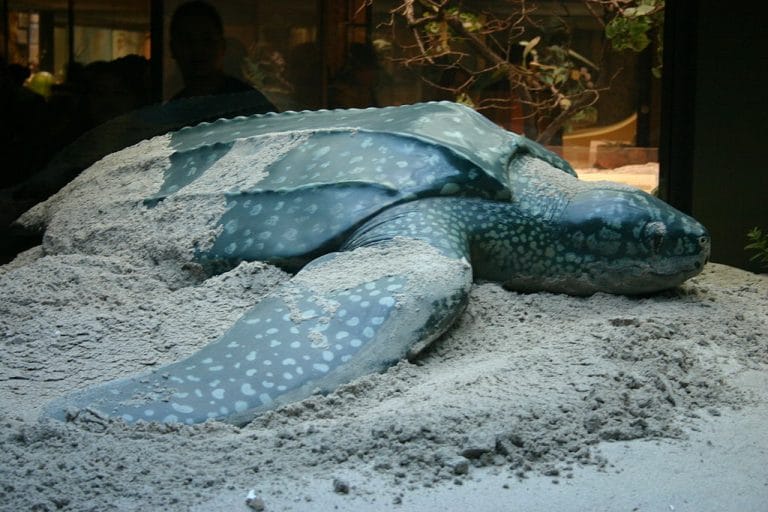
Adults vary a lot in size. The Kemp’s ridley sea turtle, the smallest kind, has a shell about 2 feet (60 cm) long. The leatherback turtle, the largest, can be about 6 feet (1.8 m) long and weigh well over 1,000 pounds (450 kg).
Returning home to nest
One of the most amazing parts of the sea turtle life cycle is how adult females return to nest in the same region, and often the same stretch of beach, where they hatched decades earlier. Scientists think the turtles use Earth’s magnetic field like a map to find their way back, perhaps together with smell and other clues near the coast. This homing is the reason protecting nesting beaches matters so much: if a beach is lost, the turtles that were born there have nowhere else they know to go.
Adult females may travel hundreds or even thousands of miles between their feeding grounds and their nesting beach. Males rarely come ashore at all after they leave as hatchlings. When the females lay their own eggs, the life cycle starts all over again.
How Many Sea Turtles Survive?
Very few baby sea turtles live long enough to become adults. A commonly cited rough estimate is that only about 1 in 1,000 hatchlings survives to adulthood. The real number is very hard to measure and probably differs between species and beaches, but everyone agrees that the odds are low. That is why sea turtles lay so many eggs and nest many times during their long lives.
Today most sea turtle species are listed as threatened or endangered. People help by protecting nesting beaches, keeping lights off near the shore, using turtle-safe fishing gear and picking up plastic trash.
How Long Does a Sea Turtle Live?
Nobody knows exactly how long sea turtles live in the wild, because their lives are so long and they spend them far out at sea. Scientists think many sea turtles live for 50 years or more, and some may live much longer. Because they take so long to grow up, an adult female may keep nesting for many years once she starts. For a wider look at turtle ages, see how long turtles live.
Sea Turtle vs Turtle Life Cycle
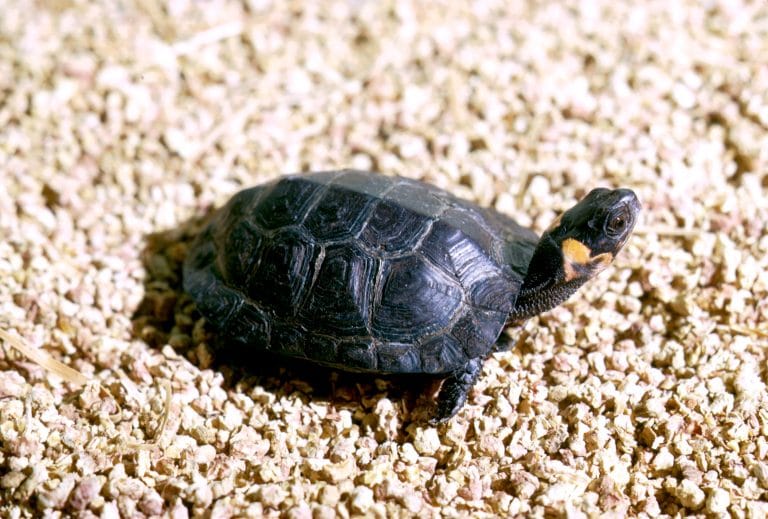
The turtle life cycle of pond and land turtles follows the same four stages, and many freshwater turtles also have temperature-dependent sex. There are some big differences, though:
- Home: Sea turtles live in the ocean and come ashore only to nest. Pond turtles and box turtles spend much more time on land or in fresh water.
- Body: Sea turtles have flippers instead of clawed feet, and they cannot pull their heads into their shells.
- Size and age: Sea turtles are much bigger and usually take much longer to become adults.
- Travel: Sea turtles may migrate across whole oceans, then return to the region where they hatched to lay eggs.
Want to compare more animals? See all our animal and plant life cycles, or learn about the difference between a turtle and a tortoise.
Fun Facts About the Sea Turtle Life Cycle
- Nesting sea turtles sometimes look like they are crying. The “tears” are actually salt being removed from their bodies by special glands near their eyes.
- Hatchlings from the same nest dig out together, which helps them escape the sand faster than one baby could alone.
- The leatherback is the biggest turtle in the world and can dive deeper than most other air-breathing animals.
- The hawksbill sea turtle often nests on beaches near coral reefs, where it feeds on sponges.
- The flatback sea turtle nests only in Australia.
- Loggerhead and green sea turtle hatchlings may spend years drifting among floating seaweed before moving closer to shore.
For more about these ocean reptiles, check out our sea turtle facts for kids or read about the loggerhead sea turtle.
More life cycles
- Turtle Life CycleEgg → hatchling → juvenile → adult
- Alligator Life CycleEggs → hatchling → juvenile → adult
- Frog Life CycleEgg → tadpole → froglet → frog
- Lizard Life CycleEgg → hatchling → adult
- Fish Life CycleEgg → larva → fry → juvenile → adult
Sea turtle Life Cycle FAQs
What are the stages of a sea turtle’s life cycle?
A sea turtle goes through four stages: egg, hatchling, juvenile and adult. The juvenile stage is the longest and can last many years.
How long does it take sea turtle eggs to hatch?
Sea turtle eggs usually hatch after about 45 to 70 days, often close to two months. Warmer sand makes them hatch sooner.
Do sea turtles return to the beach where they were born?
Yes. Adult females usually return to nest in the same region, and often the same beach, where they hatched. Scientists think they use Earth’s magnetic field to find their way.
How many baby sea turtles survive?
Only a small fraction survive. A commonly cited rough estimate is about 1 in 1,000 hatchlings reaching adulthood, though the true number is hard to measure and varies.
Does the mother sea turtle look after her babies?
No. After burying her eggs, the mother returns to the sea. The hatchlings must dig out and find the ocean on their own.

Randi Jones is the owner and founder of the Nature Gift Store, an online retailer specializing in nature-themed gifts, educational science projects, live animal nature kits and real butterfly artwork. A biology graduate who fell in love with insects, she founded the company in 2001 to make active learning about nature fun, accessible and engaging for children and adults. Her store offers real butterfly frames, home and garden decor and educational live animal kits, including ant farms, worm farms, tadpoles, ladybugs and hermit crabs, and she runs a bug museum in Washington featuring live animals like Eddie the Iguana alongside other reptiles and insects.