Freshwater Stingray: A Detailed Guide for Experienced Aquarists

If you’re an experienced aquarium hobbyist seeking something distinctive and unquestionably spectacular to add to your collection, the freshwater stingray is a species to take into consideration!
Freshwater stingray Quick Facts
| Common name | Freshwater stingray |
| Scientific name | Potamotrygon |
| Kingdom | Animalia |
| Phylum | Chordata |
| Class | Elasmobranchii |
| Order | Myliobatiformes |
| Family | Potamotrygonidae |
| Type | Cartilaginous freshwater ray |
| Diet | Carnivore: fish and crustaceans |
| Habitat | Sandy slow rivers and flooded forests |
| Native range | South America (Amazon tributaries, Rio de la Plata) |
| Lifespan | 5-10 years in aquariums |
| Special feature | Venomous tail barb; senses electric signals |
Due to their alluring beauty and amiable disposition, freshwater stingrays are unquestionably among the most popular aquarium pets. However, it will be surprising to observe just how intelligent this species is and how effortlessly it will figure out how to understand and connect with its human companions.
So, keep reading the following comprehensive guide to learn more about how to keep these stunning and mysterious freshwater fish in an ideal environment!

Origins & Natural Habitat
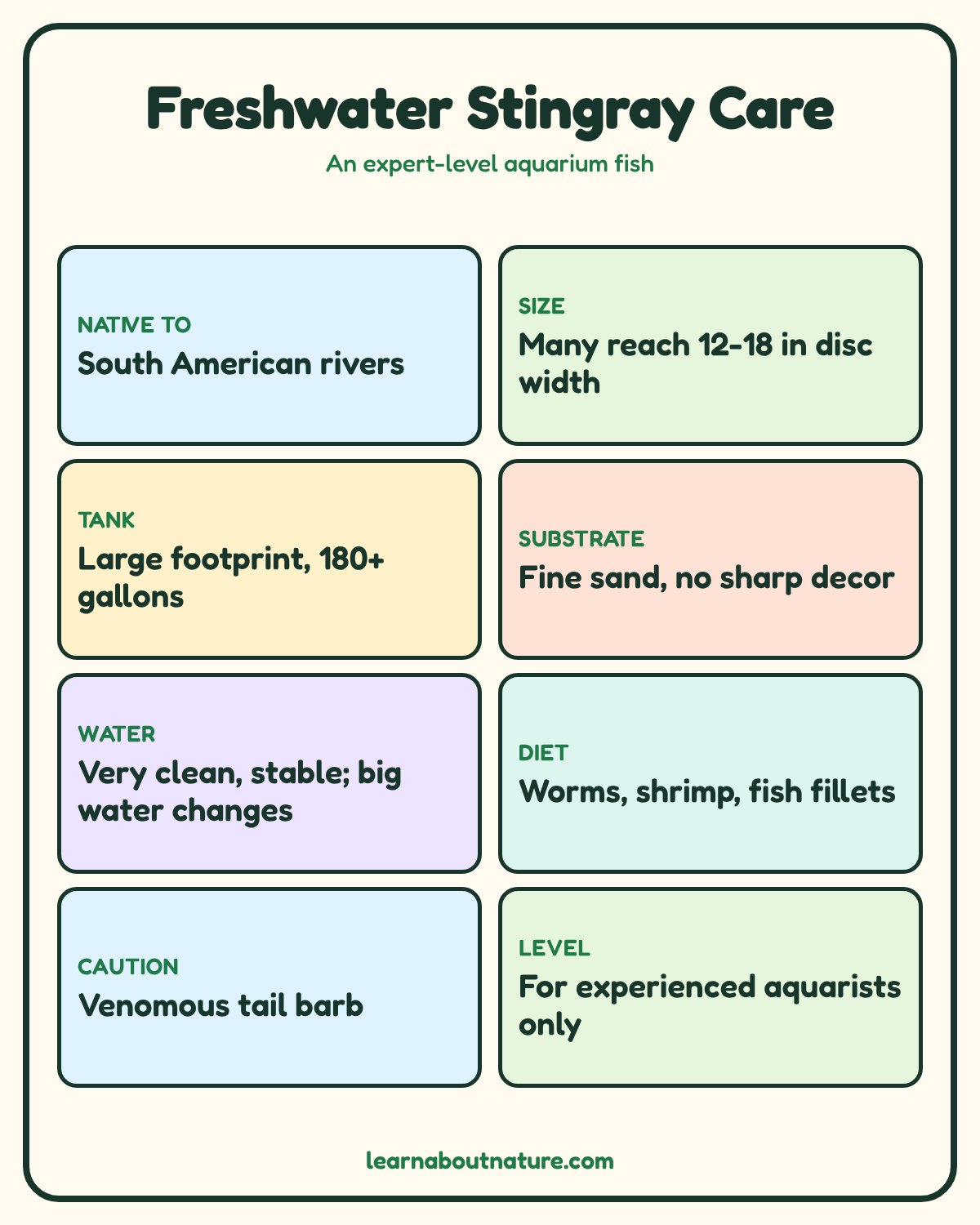
Considering they are related to sharks, sawfish, skates, and guitarfish, stingrays have cartilaginous skeletons rather than actual bones. Stingrays feature a venomous barb on their tails, which is a modified scale that they use as a defense mechanism, as their name suggests. Occasionally, the barbs fall off and are replaced by fresh ones, leaving behind spines that may be seen on the aquarium’s bottom. On their heads, rays contain structures called “ampullae of Lorenzini” that enable them to detect electrical impulses in the water.
Freshwater stingrays can be found in a range of settings, such as slowly flowing rivers with sand bottoms and flooded forests. Freshwater stingrays are extremely intelligent and friendly towards people. Even hand feeding can be taught to them. They require substantial aquariums, spotless water, and specific feeds, but for those prepared to put in the time and effort, they are genuinely distinctive fish that rapidly become cherished companions.
Historically, the majority of rays marketed for sale were taken from the wild, making them typically stressed and susceptible to parasites and other ailments. Fortunately, nowadays the situation has changed, and you can purchase a healthy freshwater stingray from an experienced breeder.
5 Most Popular Species of Freshwater Stingray
1. Tiger River Stingray

Tiger River Stingray is a freshwater stingray that is most vulnerable to water quality. The majority of these species cost above $750 and are caught in the wild. The nickname “tiger” is given to this freshwater stingray due to its vivid, striking colors. Tiger river stingrays feature beautiful gold-orange markings on their deep-black bodies.
2. Ocellate Freshwater Stingray

One of the freshwater stingray species most frequently encountered in aquariums at home is the Ocellate freshwater stingray. These rays can reach a diameter of 24 inches and are among the species that are easiest to maintain. Ocellate rays can cost up to $300.
Ocellate river stingrays are vividly colored and have polka-dot patterns. Their markings are a vivid yellowish-orange color, encircled by dark rings. Depending on the stingray’s habitat, the colors change. The majority of these stingrays weigh between 10 and 15 kg, making them of a modest size. However, the largest ocellate river stingray ever recorded weighed an astonishing 35 kg.
3. Xingu River Stingray

Among the stingrays found in aquariums, the Xingu River Stingray is one of the most beloved species. Their striking, overlapping colors make them incredibly alluring.
Their black bodies have white bands and dots that give them distinctive markings. These stingrays are easier to recognize in riverbeds due to their dark, speckled coloration. The white dots, according to researchers, are like the light reflecting off the river’s bottom. In captivity, they frequently live shorter lives. The lifespan of these stingrays is 7 to 15 years.
4. Black Devil Stingray
A Black Devil Stingray may grow to be 18 cm in diameter and can cost up to $1,500. These rays are among the most costly fish for hobbyists since they are rare in nature. Black Devil Stingrays are a unique and stunning species of fish that can only be found in the Xingu River, an Amazon tributary. The export of these fish is prohibited due to their rarity, but captive-bred specimens are still available since they are quite simple to breed.
5. Porcupine River Stingray

First-time freshwater stingray owners frequently choose the Porcupine River Stingray, which originates from the upper parts of the Rio de la Plata. Compared to other species, these rays are less sensitive and relatively inexpensive. Additionally, they are somewhat small, with diameters up to 16 cm. One of these stunning rays might cost you up to $250.
Behavior & Tank Mates
Stingrays are mostly found at the bottom of the water. They can stay buried in the sand while waiting for food, as their eyes and gill inlets are on the surface of their bodies. They may catch prey with their bodies by leaping out of the sand and using their keen eyesight.
Freshwater stingrays thrive particularly well in tanks with other rays, however, severums, Geophagus species, silver dollars, arowanas, and bichirs are also viable options. As long as there is enough room and filtration, a variety of species and sizes of stingrays can coexist.
Additionally, the fish should be peaceful enough to avoid biting the rays or stealing their food while being huge enough to avoid being devoured by them. To provide your rays with unrestricted access to the bottom, choose species that swim in the middle or upper levels of the water. Avoid plecostomus and other suckermouth catfish, which are known to harm rays by sucking on their delicate bodies.
How to Take Care of Freshwater Stingray Care
Housing Requirements
Larger aquariums are preferable when it comes to the ideal size for freshwater stingray. Although height is not essential, long-term housing should be at least 72 to 84 inches long and 24 to 36 inches wide. For keeping juvenile stingrays, a 75 or 90-gallon aquarium is suggested. However, for keeping adults for an extended period, no aquarium smaller than a 180-gallon aquarium should be taken into consideration.
You should be very certain that the water conditions in your aquarium are ideal before getting a freshwater stingray. As a result, before adding water to the tank, you need to first adjust its specifications. The temperature of the water should be similar to tropical waters, which are this fish’s natural environment. The ideal temperature range is between 75 and 82 degrees Fahrenheit.
Water Parameters
For a freshwater stingray, a pH of 6.8 to 7.6 is considered safe. This fish can thrive in an alkalinity range of 18 to 70 ppm. In addition to these criteria, the amounts of ammonia, nitrite, and nitrate should be zero and no greater than 10 ppm, respectively.
You have the option of using fine sand as the tank’s substrate when setting it up. Also, keep in mind that decorations should not have any sharp edges and should be smooth. Allow the rays to swim and burrow in the sand by leaving as much of the bottom as possible accessible. We also advise you to employ a 12-hour cycle of day and night for lighting.
What Do Stingrays Eat?
In the wild, freshwater stingrays are carnivores that mostly eat fish and crustaceans. To get new rays feeding as quickly as possible, many hobbyists give them live blackworms. However, once rays have adapted to their new environment, frozen bloodworms, mysis shrimp, raw shrimp, white fish, and live earthworms are preferable options.
Lifespan & General Health Conditions of Freshwater Stingray
It is unclear how long freshwater stingrays live in the wild. The length of time it can live in a tank, however, varies from 5 to 10 years, depending on the tank’s circumstances and the quality of care given to it.
The parasite that affects freshwater stingrays is a tiny crustacean known as fish lice. Fish lice can harm your freshwater stingray in one of two ways: if they spread bacterial diseases that compromise your fish’s immune system. Or if it causes breathing issues, particularly if the number increases and they all gather around the gills.
Thankfully, this fish doesn’t suffer from ich or white spots, however, freshwater stingrays can develop fungal infections when they are first introduced to the tank.
Is It Legal to Buy a Stingray?
Before buying any animal, it is usually advisable to check local and state laws. This is particularly true for freshwater stingrays, as private ownership of Potamotrygon species is now prohibited in the states, including:
- Arizona
- Arkansas
- California
- Georgia
- Hawaii
- Mississippi
- Nevada
- Oklahoma
- Texas
- Utah
When it comes to Colorado and Florida, you require a permit to keep a freshwater stingray in your aquarium.
As additional guidance, we advise you to check for any obvious injuries and to ensure that the disc’s edges are not curled upward (a condition known as the “death curl”). Avoid freshwater stingrays that don’t appear interested in food and ask to witness the fish eating.
Never purchase a freshwater stingray that has just arrived at the store; instead, give them a week or longer to acclimatize before taking them home. Always isolate fresh rays for at least 30 days before adding them to an established community of fish.
Conclusion
Now there is no doubt that freshwater stingrays are a captivating addition to home aquariums due to their unique beauty and graceful movement. However, as you have already acknowledged, they require a complex set of care requirements, including tank size, water quality, and feeding needs.
Whether you are an experienced aquarist or an enthusiast with a deep commitment to learning, you can find delight in successfully keeping these stunning creatures. So why not try this intriguing endeavor first-hand if you are ready and willing enough for it?
Freshwater stingray FAQs
What do freshwater stingrays eat?
In the wild they are carnivores that mostly eat fish and crustaceans. In aquariums they can be fed frozen bloodworms, mysis shrimp, raw shrimp, white fish and live earthworms.
Do freshwater stingrays sting?
Yes. They have a venomous barb on the tail, which is a modified scale used for defense. The barb sometimes falls off and a new one grows.
Where do freshwater stingrays live?
They live in slow rivers with sandy bottoms and in flooded forests in South America. Some species come from the Xingu River and others from the Rio de la Plata.
How long do freshwater stingrays live?
No one knows how long they live in the wild. In a tank they typically live 5 to 10 years, depending on how well they are cared for.
How big a tank does a freshwater stingray need?
A big one. Young rays can start in a 75 or 90 gallon tank, but adults need at least 180 gallons, with a soft sand bottom so they can bury themselves.

Nato is a content writer and researcher with a background in psychology who’s eager to explore the wonders of nature. As a travel enthusiast and animal lover, she hopes to inspire others to discover and cherish the beauty and importance of the natural world.