Leatherback Turtle

Scientific Classification & Quick Facts
| Common name | Leatherback sea turtle |
| Scientific name | Dermochelys coriacea |
| Kingdom | Animalia |
| Phylum | Chordata |
| Class | Testudines |
| Family | Dermochelyidae |
| Genus | Dermochelys |
| Conservation status | Vulnerable |
| Type | Reptile (largest sea turtle) |
| Diet | Jellyfish, tunicates and squid |
| Habitat | Open ocean, including cold waters |
| Native range | Tropical and temperate oceans worldwide |
| Size | Up to about 2 m (7 ft) long |
| Weight | Over 900 kg (2,000 lb) for the biggest |
| Special feature | Soft, rubbery shell; stays warm in cold water |
The leatherback sea turtle Dermochelys coriacea, is at times referred to as the lute turtle; it is the fourth largest modern reptile after the three crocodilian species before it, and it is also the largest live turtle. The female leatherback turtle revisits her natal home where she was born to reproduce her young ones. At night, the female leatherback turtle lifts herself from the sea to its nest.

Anatomy

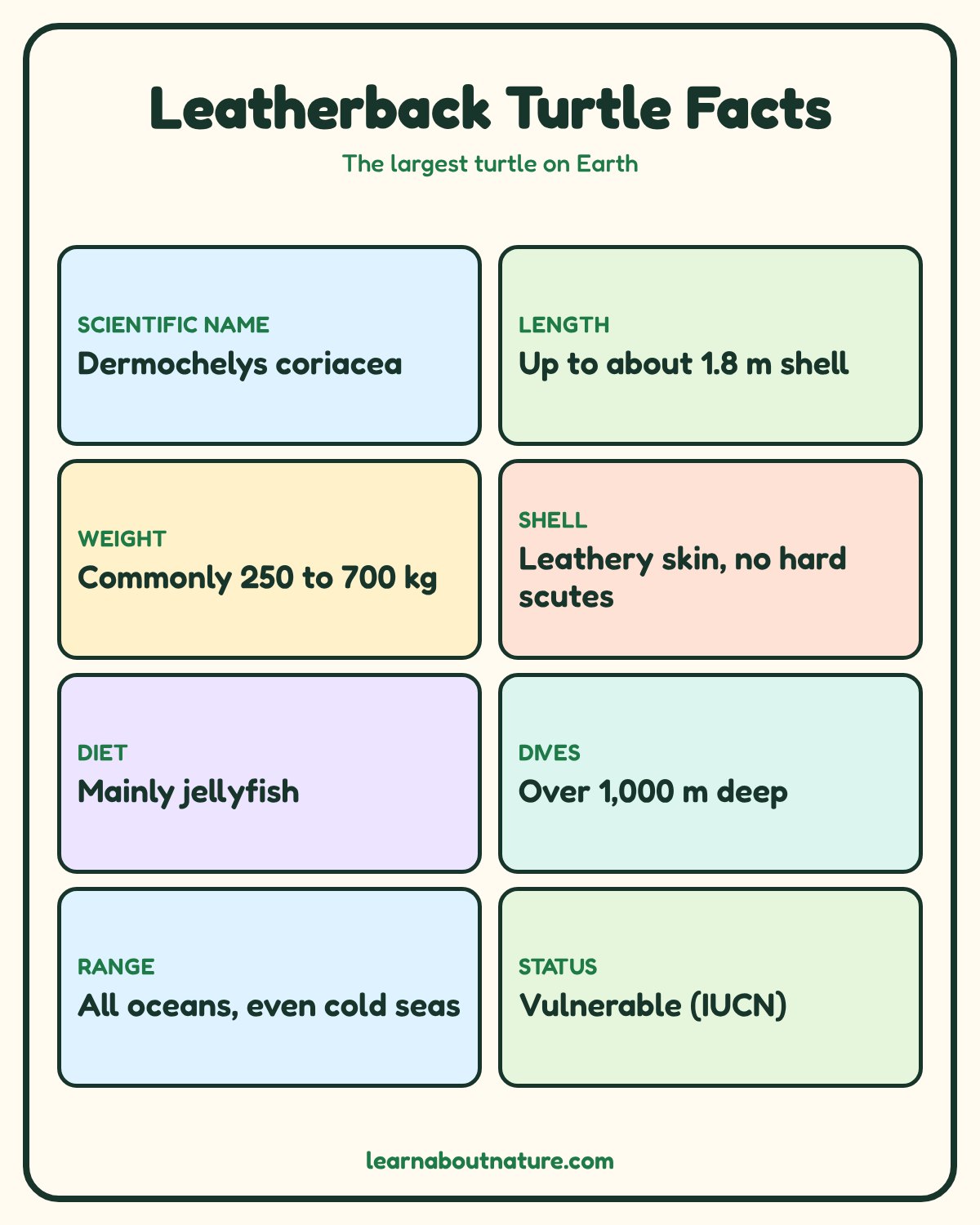
Leatherback turtles are the largest turtles that exist on the earth; they meet a length of up to 7 feet (2 meters) and the largest weigh as much as 2,000 lbs. (900 kg). These reptiles represent an ancestor of turtles whose history you can trace back to a 100 million years evolution. Once upon a time, every ocean excepting the Antarctic and the Arctic Oceans had them in abundance, but at present their numbers are systematically diminishing all over the world.
When compared to the bony and the hard shells of the other turtles the shells of the leatherback turtles are flexible and somewhat rubbery in texture and it has an inky-bluish carapace.
In the year 1988, a male leatherback washed ashore on the western coast of Wales, it was the largest size ever noticed, weighing 2,020 lbs (916 kg) and was as long as 8.5 ft (2.6 m).
Size: Normal leatherback turtles attain a weight of 500 kg and 180 cm in length.
Color: This species’ shell (carapace) is dark in color with white spots.
Life Cycle
The adult leatherback turtles are pelagic and dwell in the open oceans, even when the temperature falls below 10°C but, the juveniles remain in the warm waters where the temperature is more than 26°C, and adjacent to the coast till they grow to a curved shell length of more than 100 cm.
Habitat
The distribution of the leatherback turtles exceeds all varieties of reptiles and even vertebrates. We find them in the temperate and tropical waters of the Mediterranean, Atlantic, the Pacific and the Indian Oceans. The matured leatherback turtles travel to the south as far as New Zealand and South America and north as far as Canada and Norway. Different from their reptilian counterparts, these leatherback turtles possess a special condition in their body which enables them to sustain a warm body temperature under cold water conditions, and enables them to produce as well as keep up body heat. These adaptations arise from a thick layer of fat, the variations in swimming and flow of blood and the large size of their body.
Life Span
Their lifespan is still vague, since a great many of them die at an early age on account of human intervention. The experts estimate that only one of the thousand leatherback hatchlings survive up to adulthood once they are hatched. Humans take their eggs either for aphrodisiacs or as a means of living. A big number of them die on striking a boat or when they fall prey to the nets or fishing lines.
Migration and Breeding
Compared to other sea turtles, leatherbacks migrate the vast distances between feeding and breeding at an average distance of 3,700 miles (6,000 km) either way. Following mating at sea, the female leatherbacks return to the shore to nest during the breeding season. During the night, they dig a hole in the sand and lay around 80 eggs, fill the nests and disturb a vast expanse of sand so that the predators cannot find their eggs. In the end the females go back to the sea.
The sex of the hatchling depends on the degree of warmth inside the nest. A facile combination of male and female hatchlings takes place when the temperature is almost 85.1°F (29.5°C). However, at cool temperatures male offspring emerge and at higher temperatures females emerge. The juvenile male turtles enter the sea, while the females enter the sea and roam about in the oceans till they attain sexual maturity and revisit their nesting grounds to reproduce their offspring.
Every breeding season (seen once in every 2-3 years), the female leatherback turtles lay eggs 4 – 5 times, every time they lay 60 – 120 eggs. The incubation period of the leatherback turtles is almost 60 days
Marine Turtles- Their Important Role In The Marine Ecosystems

Leatherback turtles maintain the ecological control on the jellyfish, because leatherbacks are major consumers of jellyfish. The jellyfish consumes larvae of the fish, thereby reducing the number of fish in the ocean. If there are jellyfish in plenty in the oceans, then you will find the volumes of the commercially important fish radically diminishing.
Leatherback turtles are the largest of sea turtles and one among the largest living reptiles. You can easily identify them by their long front flippers as well as their leathery carapace that is not hard like that of the other turtles. Leatherback turtles are one among the variety of sea turtles that migrate the most and travel across both trans-Pacific and trans-Atlantic.
The uniqueness in the system of the leatherbacks blood supply to their cartilages and bones, maintains their body temperature to remain many degrees higher than the temperature of the water. This helps them to bear the cold water temperature like a mammal; they are capable of deep diving up to 1,200 meters more than the other marine turtles.
Latest DNA tests find the population in the Pacific and Atlantic as a clear genetic lineage of a particular species. You will find the nesting number of Pacific leatherbacks divided into two different genetic populations (western and eastern populations)
Diet
It is significant to note that these large-sized leatherbacks feed on low protein and low energy diet comprising of creatures having soft bodies like the tunicates (“jelly fish-like” marine invertebrates), squid and jellyfish.
Overharvesting and Illegal Trade
Illegal collection of nested Leatherback eggs from the beaches has become a serious problem with regard to these turtles’ population. Egg collection in Southeast Asia not illegal and therefore this contributes to the countless removal of eggs, thereby reducing the hatchlings in tens of thousands, and in fact, leading almost to extinction of these wonderful turtles in Malaysia. Indonesia has also witnessed a large-scale collection of leatherback turtle eggs and adult turtle killing for meat, resulting in their drastic population decline in the region. In South America, they have brought in legislation to prevent egg collection, but the trade still flourishes for commercial purposes or for sheer sustenance. Hunting of the leatherbacks and poaching for their eggs continues strongly in the Indian Ocean also.
Leatherback sea turtle FAQs
How big do leatherback sea turtles get?
Leatherbacks are the largest turtles in the world. They can be up to 7 feet (2 metres) long and weigh more than 2,000 pounds (900 kg).
Why is it called the leatherback?
It does not have a hard, bony shell like other turtles. Its shell is flexible and rubbery like leather.
What do leatherback sea turtles eat?
They eat soft-bodied animals, mostly jellyfish, tunicates and squid. By eating so many jellyfish, they help protect fish populations.
How can leatherbacks live in cold water?
They keep their body warm with a thick layer of fat, special blood flow and their large size. They can also dive up to about 1,200 metres deep.
How far do leatherback sea turtles travel?
They are some of the biggest ocean travellers, migrating an average of about 3,700 miles (6,000 km) each way between feeding and nesting places.

Randi Jones is the owner and founder of the Nature Gift Store, an online retailer specializing in nature-themed gifts, educational science projects, live animal nature kits and real butterfly artwork. A biology graduate who fell in love with insects, she founded the company in 2001 to make active learning about nature fun, accessible and engaging for children and adults. Her store offers real butterfly frames, home and garden decor and educational live animal kits, including ant farms, worm farms, tadpoles, ladybugs and hermit crabs, and she runs a bug museum in Washington featuring live animals like Eddie the Iguana alongside other reptiles and insects. Randi wrote most of the guides on this site. They first appeared on her long-running nature sites, including Monarch-Butterfly.com, Ladybug-Life-Cycle.com, Frog-Life-Cycle.com, Dragonfly-Site.com and Butterfly Pictures, which have now been brought together here at Learn About Nature.