Do Turtles Hibernate?
Turtles are very interesting creatures. They are reptiles that belong to the family of Testudines. Those slow-moving animals are developed mainly from the ribs.
Turtles are found on every continent in the world. The truth is that there are 360 living species, and each of them comes with unique and different characteristics. Since you came across this article, you may be wondering whether or not do turtles hibernate.
Biology Of Turtles
Let’s first learn more about their biology to find out whether or not turtles hibernate. The shell of the turtle is mainly made from bone. Underneath the body, it has a flat plastron, which is also known as a belly plate. If you take a close look at its outer surface, you will notice that it is covered in scales that are made from keratin. They are cold-blooded animals, and their internal temperature is dependent on the outer environment.
Turtles are omnivore animals, meaning they mainly eat plants and animals. Limited movements characterize those opportunistic hunters. They do not migrate long distances and prefer to migrate close to their living environments seasonally. The only species that migrate long distances are sea turtles. They go to warmer places to lay their eggs.
They have existed and been a part of myths and folktales for as long as we can remember. Many people have started to keep turtles as pets. For this purpose, mainly terrestrial and freshwater species are chosen. For centuries, they have been hunted for meat, and their shells were used in traditional medicine. And still, there is a question, do turtles hibernate?
Do Turtles Hibernate?
There is no one answer to the question of do turtles hibernate. However, some water turtles and land turtle species tend to do activities like hibernation during the winter. Additionally, pet turtles are also characterized by similar behavior to hibernation.
Do turtles hibernate? Well, not all the time. Some species of turtles do not really hibernate. Instead, they do sleep in the winter, and this behavior is called brumation. Unlike hibernation, during the brumation period, turtles are slightly active.
Hibernation and brumation are two different behaviors of animals that have some differences. Both happen when the temperature is very low and it is winter. Also, warm-blooded animals are going through brumation in order to survive without food.
Eventually, hibernation became a widely used term when talking about dormancy. When turtles are in the brumation phase, during the warm days, they will crawl out of the hidden spot to bask under the sun.
How Long Do Turtles Hibernate?
The brumation period for turtles starts when the weather gets chilly and the temperature drops. This happens in the autumn. The low temperature causes the metabolism to get slower and, therefore, the doof and oxygen are not required as much.
The hibernation period for turtles ranges from 2 to 4 months. However, the period and length mainly depend on the conditions. Most species hibernate from October to February. However, it changes, and, for example, turtle species that are close to the equator tend to hibernate for shorter periods of time in comparison to those that live further.
Where Do Turtles Hibernate?
Turtles prefer wetland locations for hibernation. Before the period starts, they look for a place that is safe and hidden from outer threats and predators. The choice of place also depends on the living conditions and environment. For example, water turtles choose the bottom of ponds or lakes to spend the summer.
On the other hand, land turtles have been observed burrowing their bodies beneath debris or digging deep into the mud to cover and hide. For example, box turtles are often seen hibernating under the soft ground, piles of leaves, piles of yard clippings, and tall weeds.
They choose to burrow in the substrate because, when the temperature is low and the ground is cool, it helps the body of a turtle to slow its metabolism rate. Also, the soil and ground that are hard on the turtle work as insulation and keep the reptile from freezing.
Pet turtles can hibernate indoors and outdoors too without a problem. These creatures, like other species and in different environments, try to hide and burrow their bodies in various substances.
How Do Turtles Hibernate?
When the temperature drops below approximately 50 degrees Fahrenheit, turtles start hibernation and their metabolism slows down. Those little reptiles can survive in extreme environments for long periods of time and can even live at near-freezing points.
Their metabolism slows down because the lungs need to be protected from the lactic acid buildup. Reduced metabolism helps in this process by slowing down lactic acid production.
How Do Turtles Hibernate In The Water?
Water turtle species hibernate underwater. They go to the bottom of the ponds, lakes, or streams and bury their bodies in the mud. In most cases, they leave their back visible while the rest of their body is hidden.
For sea turtles, the garden pond can be an ideal spot for hibernation in the winter. If you have a pet turtle, try to not put it in places where mice and cats can spot it. Because of their inactivity, they can be an easy target for predators.
Do All Species of Turtles Hibernate?
Snapping Turtle
Snapping turtles do hibernate, and they choose places underwater in lakes or ponds. They like it when the ice is formed on top of the water source. The snapping turtles in the hibernation process absorb the oxygen that is diffused in the water. When the water full of oxygen flows over the body parts, it gets absorbed by the blood vessels, skin, hinds, and cloaca.
Painted Turtle
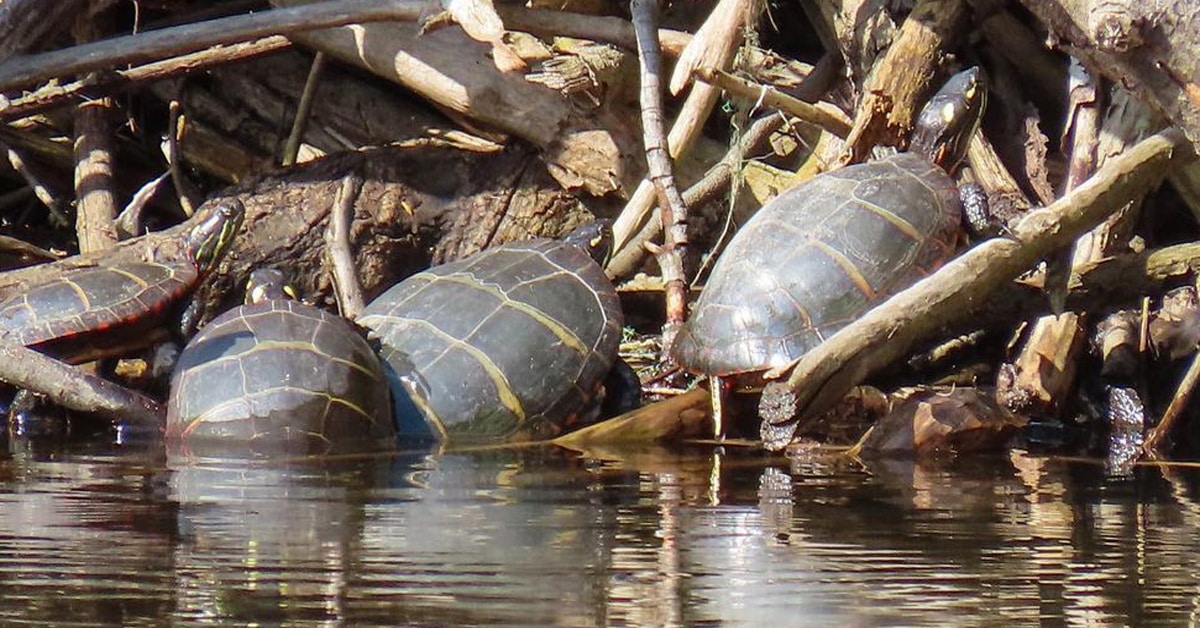
Painted turtles also hibernate, and they do it by burrowing themselves into the bottom of frozen lakes and water sources. Those ones are very unique and can live in very low oxygen or no oxygen environments. Their metabolism and overall body systems get adjusted, so oxygen is not required.
Terrapins
Terrapins hibernate in the winter when the water temperature drops. Before the start of the process, they lose their appetite and start to move around slower and slower. When the hibernation period starts, they stop moving and eating. Terrapins mainly hibernate, hidden in the mud.
Red-Eared Sliders
Red-eared sliders do not hibernate in the winter. They go into a brumation state instead. Their “sleeping” behavior is not like hibernation and is much shorter in time. Additionally, they still move slightly during this phase.
How To Prepare A Pet Turtle For Hibernation?
If you have ever wondered, do turtles hibernate indoors? Then you are about to find out. Indoor turtles hibernate too in the winter, and to help in the process, the hibernation box is often used.
Boxes are mostly made from durable materials like plywood. The box is insulated with special insulation foam, and inside, it is filled with the substrates that give the turtle an opportunity to cover itself.
For this purpose, different kinds of materials such as shredded paper, leaves, peat, coir, and moss are used. Boxes are placed in the fridge, so the temperature is kept cold, creating the illusion of an outside environment.
To prepare the pet turtle for hibernation, you can give it vitamin A in the summer. The best foods that provide needed vitamins are green vegetables and carrots. By the end of the summer, the turtles have to be provided with more fiber.
The fasting process has to start about a month before hibernation starts. This is essential because the undigested food may decay, and leftovers in the stomach can create a good environment for infections, bacteria, and pneumonia.
During the fasting process, it is also important to keep your turtle hydrated. To do so, you can soak them in water for half an hour a day. In the last phase, you will have to decrease the temperature slowly, and by this, you will cause the turtle to slow its metabolism and start the hibernation process.
Interesting Facts About Do Turtles Hibernate?
- When the temperature is warm, the turtle’s heart beats 40 times in a minute. In winter, during the brumation period, the heart only beats once every 10 minutes.
- Painted turtles can be buried up to 3 feet deep in water, several feet deep.
- Like other turtles, indoor turtles hibernate when it is cold. If the turtle is kept in a warm aquarium and the temperature does not change, it may not go through hibernation.
- Turtles get oxygen from the water. An interesting fact is that one part of their body can absorb oxygen much better than others, and this part is their butts.
- Hibernation can become especially dangerous if the cold temperature continues for too long and the ice doesn’t melt. If they wake up from hibernation, turtles can’t break the ice on top of the water, which may cause trouble.
Bottom Line- Do Turtles Hibernate?
Turtles are amazing creatures and, with their rounded shells, can withstand a high amount of pressure. The question of whether turtles hibernate is generally dependent on the specific species. However, in most cases, turtles do hibernate. They survive in cold weather conditions by lowering metabolism rates and body functions. Some species even stop breathing and can survive without oxygen.
Even though they are found worldwide, turtles are still victims of human activities. Their habitat is being destroyed, and because of that, many species today are close to extinction.

Nato is a content writer and researcher with a background in psychology who’s eager to explore the wonders of nature. As a travel enthusiast and animal lover, she hopes to inspire others to discover and cherish the beauty and importance of the natural world.