Adder Snake

The adder (Vipera berus), also called the common European adder or common viper, is Britain’s only native venomous snake. It is a shy, thick-bodied snake with a bold zigzag pattern down its back, and it uses its venom mainly to catch prey, biting people only if it is stepped on, grabbed or cornered.
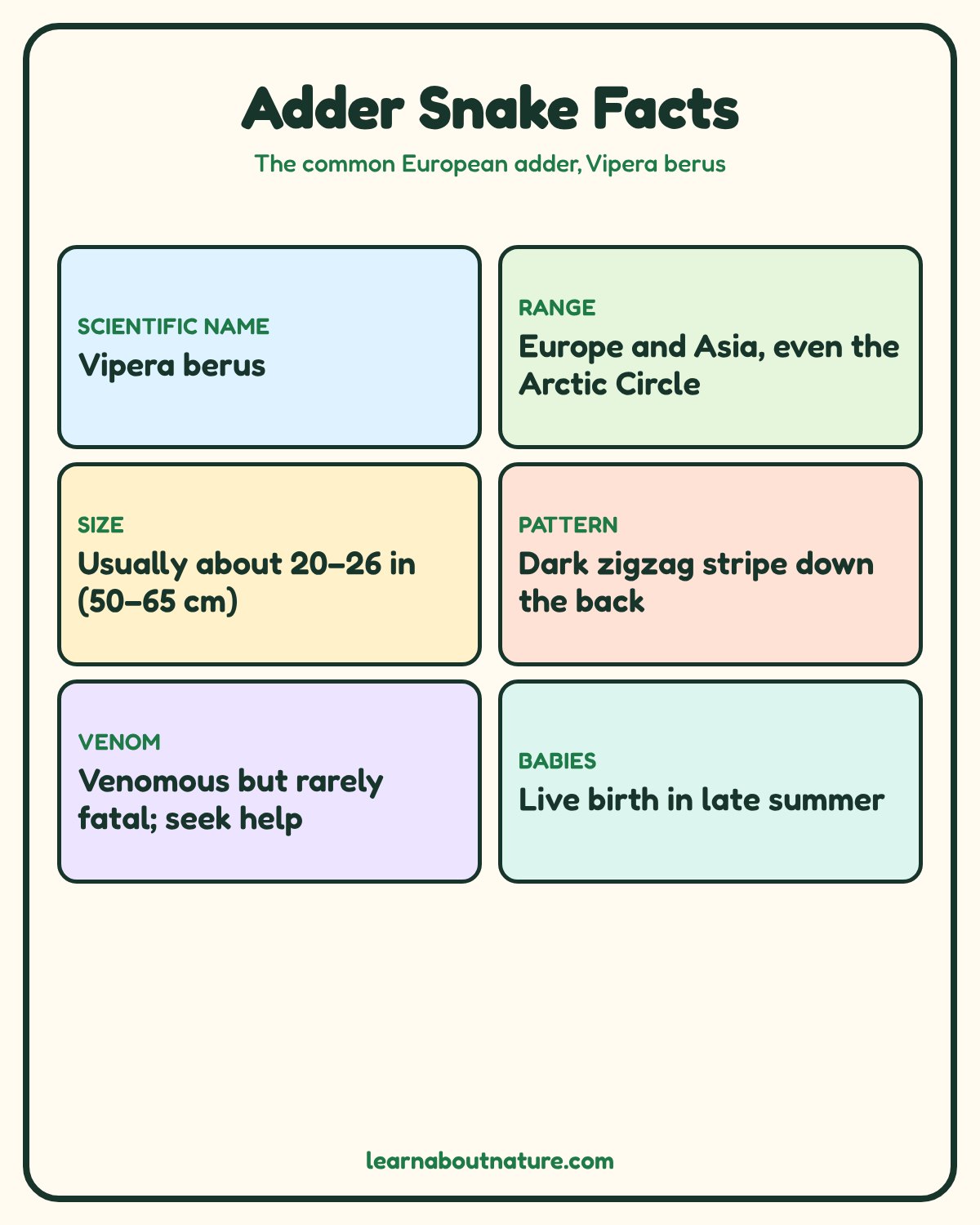
Scientific Classification & Quick Facts
| Common name | Common adder |
| Scientific name | Vipera berus |
| Kingdom | Animalia |
| Phylum | Chordata |
| Class | Squamata |
| Family | Viperidae |
| Genus | Vipera |
| Conservation status | Least Concern |
| Type | Reptile (venomous snake) |
| Diet | Voles, frogs, lizards, newts, baby birds |
| Habitat | Rough open country and woodland edges |
| Native range | Europe and northern Asia, up to Norway |
| Size | Up to 85 cm (33 in) long |
| Colours | Gray, brown or reddish with zigzag back band |
| Special feature | Shy; only bites if trapped or trodden on |

Where Adders Live
The adder has one of the largest ranges of any snake in the world. It is found across much of Europe and northern Asia, from Britain and France all the way east to the Pacific coast. It is a member of the viper family, Viperidae, and it is so well adapted to cold that it lives farther north than any other snake, even inside the Arctic Circle in Scandinavia.
In Britain, adders live mainly in open, wild places such as heathland, moorland, rough grassland, sand dunes and the sunny edges of woodland. They like a mix of open patches for basking and thick cover such as bracken, heather or brambles where they can hide quickly.
What Adders Look Like

Adders are fairly short, stocky snakes. In Britain, adults are usually about 2 feet (60 to 65 cm) long, and females are typically a little longer and heavier than males. The largest adders can approach 3 feet (about 90 cm), but that is rare.
Their most famous feature is the dark zigzag stripe running down the back, with a row of dark spots along each side. Many have a V or X shape on the back of the head. Males are usually pale gray or whitish with a black zigzag, while females are brown, reddish or copper with a dark brown zigzag. Some adders are almost completely black.
Adders have red or copper-colored eyes with vertical, slit-shaped pupils, like a cat’s. This is a handy clue, because Britain’s other common snakes, the grass snake and the smooth snake, have round pupils.
Like other snakes, an adder can swallow prey wider than its own head. Its jaw bones are joined by stretchy ligaments, and its lower jaw is not fused at the front, so the mouth can open very wide.
Behavior

Adders are calm, secretive snakes that would much rather slip away than fight. Many people walk right past one without noticing, because adders rely on their camouflage and stay still.
They hibernate underground through the winter, often in old burrows or among tree roots. On sunny days in early spring, usually from February or March, they come out to bask, which is the best time to spot them. Males emerge first and shed their skin in April, when their colors look especially bright.
In spring, rival males sometimes perform the famous “dance of the adders.” Two males rise up, twist their bodies together and try to push each other to the ground. They do not bite each other; the stronger snake wins and the loser leaves, giving the winner the chance to mate.
What Adders Eat
Adders mainly eat small mammals, especially voles, mice and shrews. They also take lizards, frogs, newts and sometimes chicks from ground-nesting birds.
When hunting, an adder strikes quickly, injects venom and then lets go. It waits for the venom to work, follows the scent trail to its prey and swallows it whole, usually head first. Adult adders may only need to eat a few times a year, and they often eat little or nothing during the breeding season.
Breeding and Baby Adders
Unlike most snakes, adders do not lay eggs. The eggs stay inside the mother’s body until the babies are ready to hatch, so she gives birth to live young. This helps the babies develop in colder climates, because the mother can keep them warm by basking.
Young adders are born in late summer, usually August or early September. A litter typically has around 3 to 20 babies, each only about 6 to 8 inches (15 to 20 cm) long. They look like tiny copies of the adults and already have working venom. Females usually breed only every second or third year because pregnancy uses up so much energy.

Are Adders Dangerous?
Adder venom is mainly meant for small prey like mice and voles. A bite is painful for people and can cause swelling, bruising, nausea and dizziness, but serious problems are uncommon, especially with medical care. Deaths are extremely rare: only around a dozen have been recorded in Britain in more than a century, and none for decades.
Even so, every bite should be treated as a medical emergency. If you or someone with you is bitten:
- Stay calm and keep as still as possible.
- Call emergency services or get to a hospital straight away.
- Remove rings, watches or tight clothing near the bite in case of swelling.
- Do not cut the bite, try to suck out the venom or use a tourniquet.
- If a dog is bitten, take it to a vet as quickly as possible.
Can You Keep an Adder as a Pet?
No. Adders are wild, venomous snakes and are not suitable pets. In Britain they are protected by law, which makes it illegal to kill, injure or sell them. Keeping venomous snakes also requires a special license, so they should only be handled by trained experts.
The best way to enjoy adders is to watch them in the wild from a safe distance. Stick to paths in adder country, keep dogs on a lead in spring and summer, and never try to pick one up.

Adders and Conservation
Adder numbers have fallen in many parts of Britain because of habitat loss, disturbance at their hibernation sites and populations becoming cut off from each other. Conservation groups ask people to report sightings to help track where adders still live. Protecting heathland and giving these shy snakes space helps make sure they stay part of the countryside.
Common adder FAQs
Are adders dangerous?
Adders are venomous and their bite hurts a lot, but it is rarely deadly. They are shy and only bite if trodden on or handled. No one in Britain has died from an adder bite for about 20 years.
What do adders eat?
Adders mostly eat small rodents such as voles, plus frogs, lizards, newts and baby birds from ground nests. They kill prey with venom and swallow it whole.
How big do adders get?
Adders reach up to 85 cm (33 inches). In Britain, males are about 60 cm and females about 75 cm long.
Do adders lay eggs?
No, adders give birth to live young in August or early September. The babies are about the size of an earthworm but look like tiny adults.
Where do adders live?
They live across Europe and Asia, even as far north as Norway near the Arctic Circle. They like rough open country and the edges of woods.

Randi Jones is the owner and founder of the Nature Gift Store, an online retailer specializing in nature-themed gifts, educational science projects, live animal nature kits and real butterfly artwork. A biology graduate who fell in love with insects, she founded the company in 2001 to make active learning about nature fun, accessible and engaging for children and adults. Her store offers real butterfly frames, home and garden decor and educational live animal kits, including ant farms, worm farms, tadpoles, ladybugs and hermit crabs, and she runs a bug museum in Washington featuring live animals like Eddie the Iguana alongside other reptiles and insects. Randi wrote most of the guides on this site. They first appeared on her long-running nature sites, including Monarch-Butterfly.com, Ladybug-Life-Cycle.com, Frog-Life-Cycle.com, Dragonfly-Site.com and Butterfly Pictures, which have now been brought together here at Learn About Nature.