Jewel Beetles

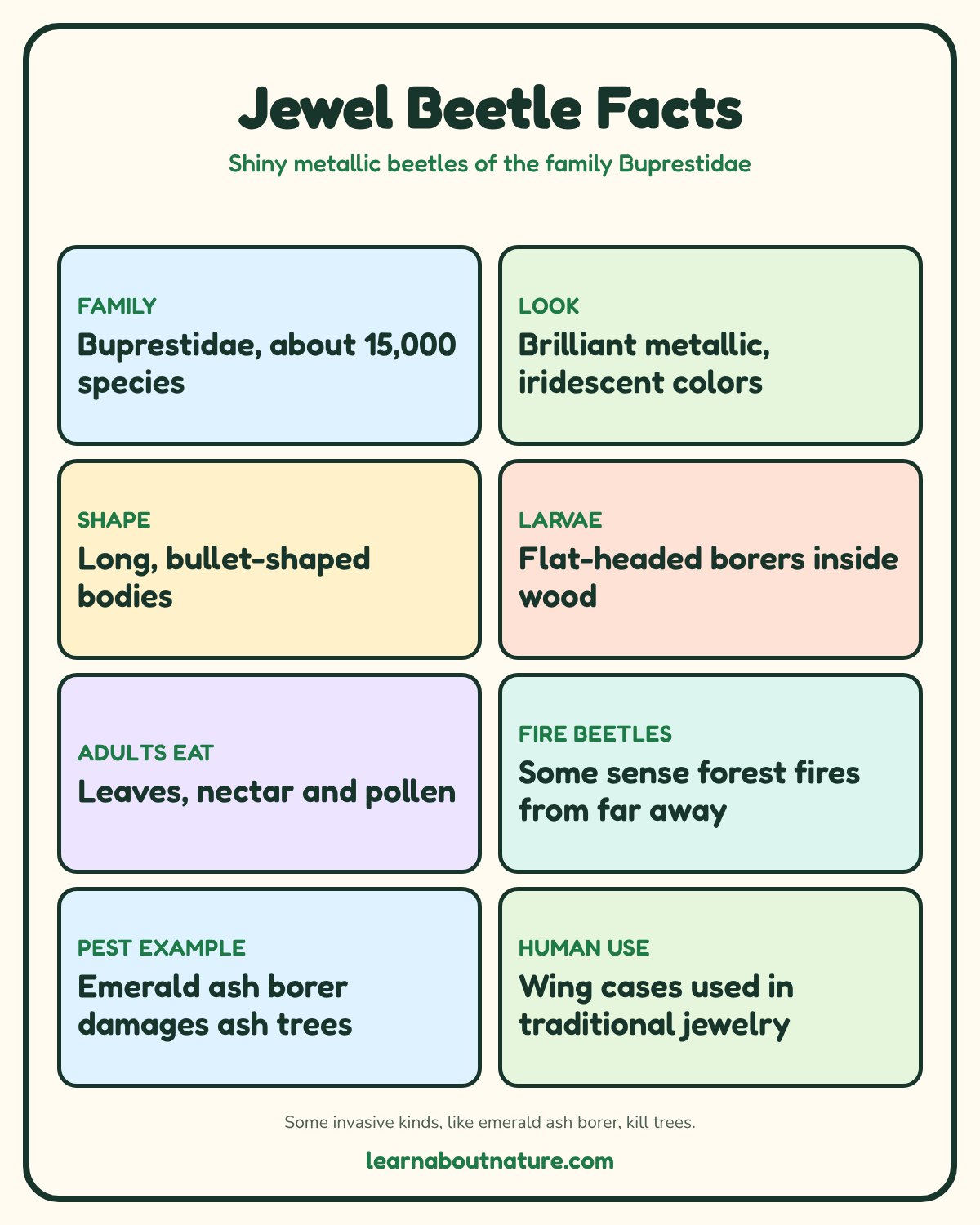
Jewel beetles are some of the most beautiful insects in the world, with shiny bodies that sparkle in green, blue, gold, copper and red. They belong to the family Buprestidae, and they are also called metallic wood-boring beetles because their larvae tunnel through wood. There are about 15,000 known species.
Jewel beetles Quick Facts
| Common name | Jewel beetles |
| Scientific name | Buprestidae |
| Kingdom | Animalia |
| Phylum | Arthropoda |
| Class | Insecta |
| Order | Coleoptera |
| Type | Insect (beetle family) |
| Diet | Adults: leaves, pollen and nectar; larvae: wood and plant tissue |
| Habitat | Forests, woodlands and scrub |
| Native range | Worldwide except Antarctica; most species in the tropics |
| Size | About 3 mm to 8 cm; most under 2 cm |
| Colours | Metallic green, blue, gold, copper, red and bronze |
| Special feature | Shiny structural colors that shimmer in the light |

A big, sparkly family
The jewel beetle family is one of the larger beetle families, with roughly 15,000 species in around 450 or more genera. Scientists have also described many fossil jewel beetles, showing that these insects have been around for a very long time.
Jewel beetles live on every continent except Antarctica, but the biggest and most colorful species live in the tropics. Many of the smaller species in cooler countries are dark bronze or coppery rather than rainbow-colored.
What do jewel beetles look like?
Most jewel beetles have a long, bullet-shaped or flattened body, with short antennae and large eyes. They range from about 3 mm to 8 cm (0.1 to 3.1 inches) long, but most are under 2 cm (0.8 inches). The largest include species of Euchroma, Chrysaspis, Catoxantha and Megaloxantha, mostly from tropical forests.
Their brilliant colors are not made by pigment, like paint. Instead they are structural colors. The beetle’s outer shell is built from many thin, microscopic layers. These layers bounce certain colors of light back toward your eye, so the beetle seems to shimmer and change color as it moves. It is the same effect that makes the back of a CD or a soap bubble shine with rainbow colors.
Jewel beetles and people
Because they keep their shine for a long time, jewel beetles have been used as decorations for centuries. In India, Thailand, Myanmar, Japan and other parts of Asia, their glittering wing covers have been sewn onto clothes and textiles and used in jewelry and artwork. A famous ancient Buddhist shrine in Japan, the Tamamushi Shrine, was once decorated with thousands of jewel beetle wings.
Large, brightly colored species are also popular with insect collectors, and some can sell for high prices.
Where do jewel beetles live?
Jewel beetles live wherever their food plants grow: forests, woodlands, scrub, grasslands and gardens. Adults love warmth and sunshine. On hot, sunny days you may see them resting on sunlit tree trunks and logs or visiting flowers, and they fly off quickly if disturbed.
What do jewel beetles eat?
Adult jewel beetles feed on plants. Many eat leaves, while others visit flowers to eat pollen and nectar.
The larvae are plant-eaters too, but they eat from the inside. Most bore through wood, just under the bark of trees and shrubs or deeper inside. Some tunnel in roots, some mine through leaves and stems, and a few even live in pine cones. Some species cause swellings called galls on plants such as roses, alder, hazel and ironwood.
Life cycle
Jewel beetles go through complete metamorphosis: egg, larva, pupa and adult.
- Eggs. The female lays her eggs in cracks in bark, on leaves or on the stems of the larva’s food plant.
- Larvae. Like other beetle larvae, the young look nothing like their parents. Jewel beetle larvae are pale and legless, with a very wide, flattened front end, which is why they are nicknamed flatheaded borers. They chew flat, winding tunnels packed with sawdust-like droppings. Larvae often take one to two years to grow, and in dry wood some take much longer.
- Pupae. The fully grown larva turns into a pupa inside its tunnel, close to the surface of the wood.
- Adults. The new adult chews its way out, leaving an oval or D-shaped exit hole, and flies off to find food and a mate, usually in spring or summer.
Adult jewel beetles have short lives compared with their larvae. Most live for only a few weeks, just long enough to feed, mate and lay eggs.
Fire beetles: insects that love wildfires
Some jewel beetles, called fire beetles (Melanophila), are attracted to forest fires. Freshly burned trees, such as pine trees, are perfect places for their larvae to grow, because the trees can no longer defend themselves. Fire beetles have special sense organs that detect infrared radiation, the heat given off by fires, and they can also smell smoke. This lets them find burning forests from many miles away, sometimes arriving while the ground is still smoking.
Jewel beetles as pests
Most wood-boring jewel beetles attack trees that are already weak, dying or dead, so they help break down old wood and return it to the soil. A few species, however, attack healthy trees and can be serious pests.
The best-known is the emerald ash borer (Agrilus planipennis), a small metallic green jewel beetle from Asia. It was discovered in North America in 2002 and has since killed many millions of ash trees. Its larvae tunnel under the bark and cut off the flow of water and food through the tree. To slow its spread, people are asked not to move firewood from one area to another.
Jewel beetles or jewel bugs?
Don’t mix up jewel beetles with “jewel bugs”. Jewel bugs are shiny shield bugs, which are true bugs with sucking mouthparts, not beetles at all. They belong to a completely different group of insects.
Jewel beetles FAQs
Why are jewel beetles so shiny?
Their colors come from tiny layers in their shells that reflect certain colors of light, called structural color. This makes them shimmer and seem to change color as they move, like a soap bubble.
Are jewel beetles harmful to humans?
No. Jewel beetles do not bite or sting people and are not poisonous. A few species, such as the emerald ash borer, can badly damage trees.
What do jewel beetles eat?
Adults eat leaves, pollen and nectar. Their larvae tunnel through wood, roots, stems or leaves, eating plant tissue as they go.
How long do jewel beetles live?
Most adults live for only a few weeks. Their larvae live much longer, often one to two years, hidden inside wood.
What is the largest jewel beetle?
The biggest jewel beetles reach about 8 cm (3 inches) long. They include giant tropical species such as Euchroma gigantea from Central and South America.

Randi Jones is the owner and founder of the Nature Gift Store, an online retailer specializing in nature-themed gifts, educational science projects, live animal nature kits and real butterfly artwork. A biology graduate who fell in love with insects, she founded the company in 2001 to make active learning about nature fun, accessible and engaging for children and adults. Her store offers real butterfly frames, home and garden decor and educational live animal kits, including ant farms, worm farms, tadpoles, ladybugs and hermit crabs, and she runs a bug museum in Washington featuring live animals like Eddie the Iguana alongside other reptiles and insects. Randi wrote most of the guides on this site. They first appeared on her long-running nature sites, including Monarch-Butterfly.com, Ladybug-Life-Cycle.com, Frog-Life-Cycle.com, Dragonfly-Site.com and Butterfly Pictures, which have now been brought together here at Learn About Nature.