Goliath Beetle

Goliath beetles are some of the biggest and heaviest insects on Earth. These giant flower beetles live in the forests of tropical Africa, and they are named after Goliath, the giant in the Bible story of David and Goliath. Their young, which are fat white grubs, can be even heavier than the adults.
Goliath beetle Quick Facts
| Common name | Goliath beetle |
| Scientific name | Goliathus |
| Kingdom | Animalia |
| Phylum | Arthropoda |
| Class | Insecta |
| Order | Coleoptera |
| Family | Scarabaeidae |
| Type | Insect (scarab beetle) |
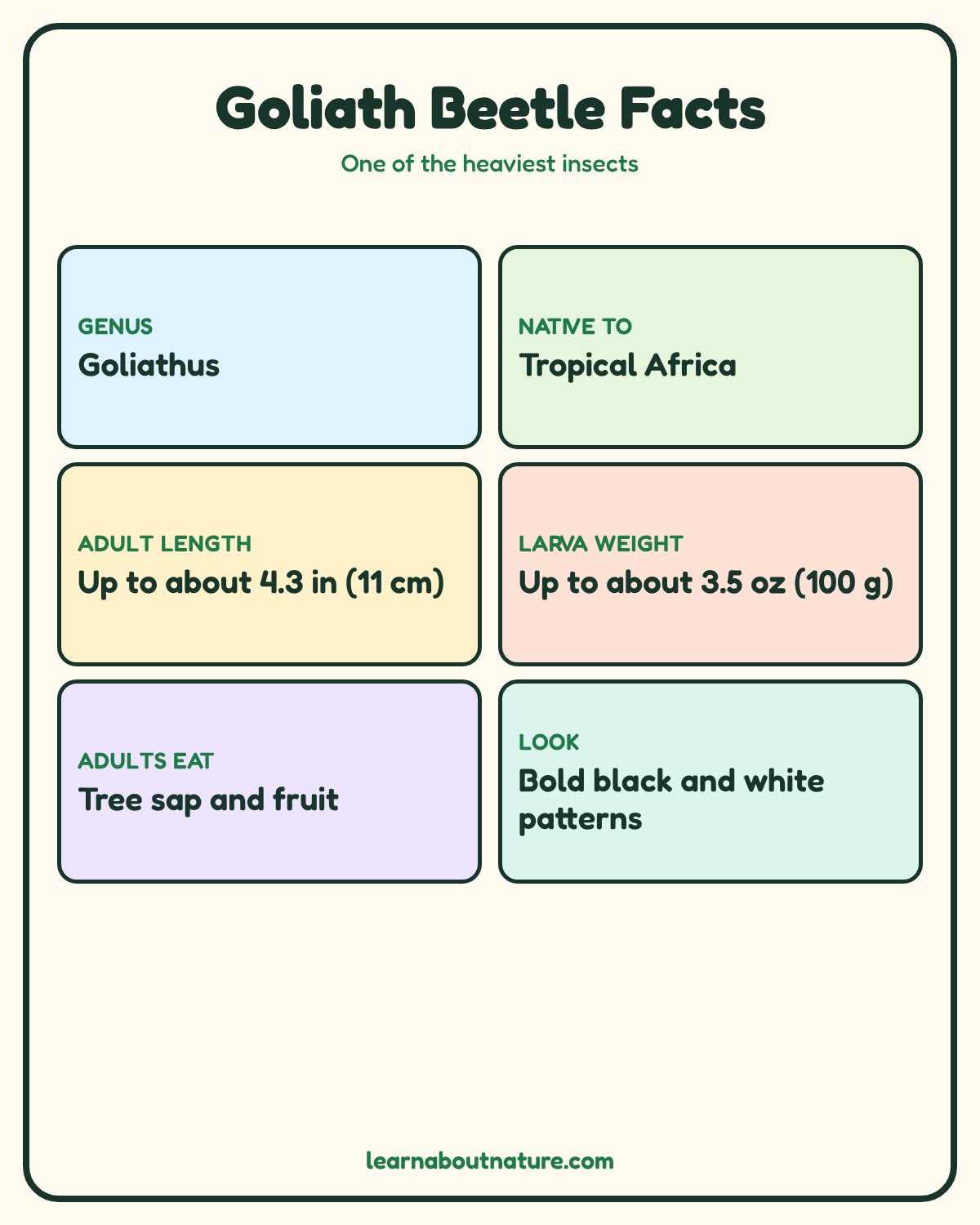
| Diet | Adults: tree sap and fruit; larvae: rotting plant matter |
| Habitat | Tropical forests and woodland |
| Native range | Central, western and eastern Africa |
| Size | Males 6-11 cm; females 5-8 cm |
| Weight | Larvae up to about 100 g |
| Special feature | One of the heaviest insects on Earth |

What are Goliath beetles?
Goliath beetles belong to the genus Goliathus, which has five species. They are part of the scarab family (Scarabaeidae) and the flower chafer group (Cetoniinae), so they are cousins of other scarab beetles such as dung beetles and June bugs.
How big are Goliath beetles?
Adult males are about 6 to 11 cm (2.4 to 4.3 inches) long, about as long as your palm. Females are smaller, about 5 to 8 cm (2 to 3.1 inches). Plenty of insects are longer, but very few are as bulky and heavy.
The real heavyweights are the larvae. A fully grown Goliath grub can weigh up to about 100 grams (3.5 ounces), roughly the weight of a small apple. That makes it one of the heaviest insect larvae known. The adults weigh less, because the grub uses up some of its stored body mass when it changes into a beetle.
What do they look like?
Goliath beetles have bold, eye-catching patterns. Depending on the species, the thorax is striped or patterned in black and white or brown and white, and the wing covers can be brown, black, white, cream or reddish. Females are usually plainer and browner than males.
Like other beetles, they have a pair of hard front wings called elytra that protect the body. Underneath are a pair of large, thin flying wings. Unlike many beetles, flower chafers can fly with their wing covers almost closed, sliding their flying wings out from the sides. Goliath beetles fly well and make a loud buzz.
Each of their six legs ends in sharp, hooked claws. These help them grip tree bark and branches tightly while climbing. If a Goliath beetle walks on your hand, you will feel those claws holding on.
Telling males from females
It is easy to tell a male from a female. Males have a Y-shaped horn on the head. They use it to push and wrestle other males when competing for food or mates. Females have no horn. Their heads are wedge-shaped, which is perfect for digging into soil to lay eggs.
Where do Goliath beetles live?
Goliath beetles live in the warm, humid tropical forests of Africa, especially in central and western Africa. One species, Goliathus orientalis, lives farther south and east, in drier woodland areas. Adults spend most of their time high in the trees, while the larvae live in the soil and rotting plant matter below.
What do Goliath beetles eat?
Adult Goliath beetles eat sugary foods: tree sap, ripe and rotting fruit, and sometimes nectar or pollen. They find their food with their antennae, which can smell fruit and sap from far away.
The larvae live in the soil and feed on rotting leaves and wood. To grow so large, they need a lot of protein. Breeders who raise them in captivity often add some dry cat or dog food to their soil, along with plenty of decaying leaves and wood.
Life cycle
Goliath beetles go through complete metamorphosis: egg, larva, pupa and adult.
- Eggs. After mating, the female digs into the moist soil and lays her eggs underground.
- Larvae. The grubs hatch and spend several months eating and burrowing. They can grow to about 13 cm (5 inches) long and up to 100 grams.
- Pupae. When fully grown, the grub builds a hard chamber of soil around itself and turns into a pupa. Inside, its body is rebuilt into an adult beetle.
- Adults. The new adult often stays in its chamber through the dry season, then digs its way out when the rains return.
Adults live for a few months. They spend their time feeding and looking for mates, and the cycle begins again.
Are Goliath beetles strong?
Like other big scarabs, Goliath beetles are very strong for their size and can push and pull objects many times heavier than themselves. You may have read that they can lift 850 times their own weight. That claim comes from tests on rhinoceros beetles and has not been shown for Goliath beetles, so it is best treated as a fun exaggeration.
Goliath beetles as pets
In some countries Goliath beetles are bred in captivity and kept by insect enthusiasts. They need a warm, humid tank, deep soil full of rotting leaves and wood for the larvae, and fruit or special beetle jelly for the adults. They are not cuddly pets: they should be handled gently and rarely, and never tied up or flown on a string, which can injure them.
Wild Goliath beetles are also collected and sold, so if you want one, a captive-bred beetle from a responsible breeder is the kindest choice. Always check your local rules first, as some countries do not allow foreign beetles to be kept.
Goliath beetle FAQs
How big is a Goliath beetle?
Adult males are about 6 to 11 cm (2.4 to 4.3 inches) long, and females are about 5 to 8 cm. Their larvae can weigh up to about 100 grams, making them among the heaviest insects.
Where do Goliath beetles live?
They live in tropical Africa, mostly in the warm, humid forests of central and western Africa. One species lives in drier woodlands farther south and east.
What do Goliath beetles eat?
Adults eat tree sap and ripe or rotting fruit. The larvae live in the soil and eat rotting leaves and wood, and they need a lot of protein to grow.
Are Goliath beetles dangerous?
No. They do not sting and are not poisonous. Their hooked leg claws can grip your skin tightly, but they are harmless to people.
Can you keep a Goliath beetle as a pet?
Some people breed them in captivity, but they need warm, humid conditions and special food. Check your local laws first, buy captive-bred beetles, and handle them gently and rarely.

Randi Jones is the owner and founder of the Nature Gift Store, an online retailer specializing in nature-themed gifts, educational science projects, live animal nature kits and real butterfly artwork. A biology graduate who fell in love with insects, she founded the company in 2001 to make active learning about nature fun, accessible and engaging for children and adults. Her store offers real butterfly frames, home and garden decor and educational live animal kits, including ant farms, worm farms, tadpoles, ladybugs and hermit crabs, and she runs a bug museum in Washington featuring live animals like Eddie the Iguana alongside other reptiles and insects. Randi wrote most of the guides on this site. They first appeared on her long-running nature sites, including Monarch-Butterfly.com, Ladybug-Life-Cycle.com, Frog-Life-Cycle.com, Dragonfly-Site.com and Butterfly Pictures, which have now been brought together here at Learn About Nature.