Lightning Bug (Firefly)
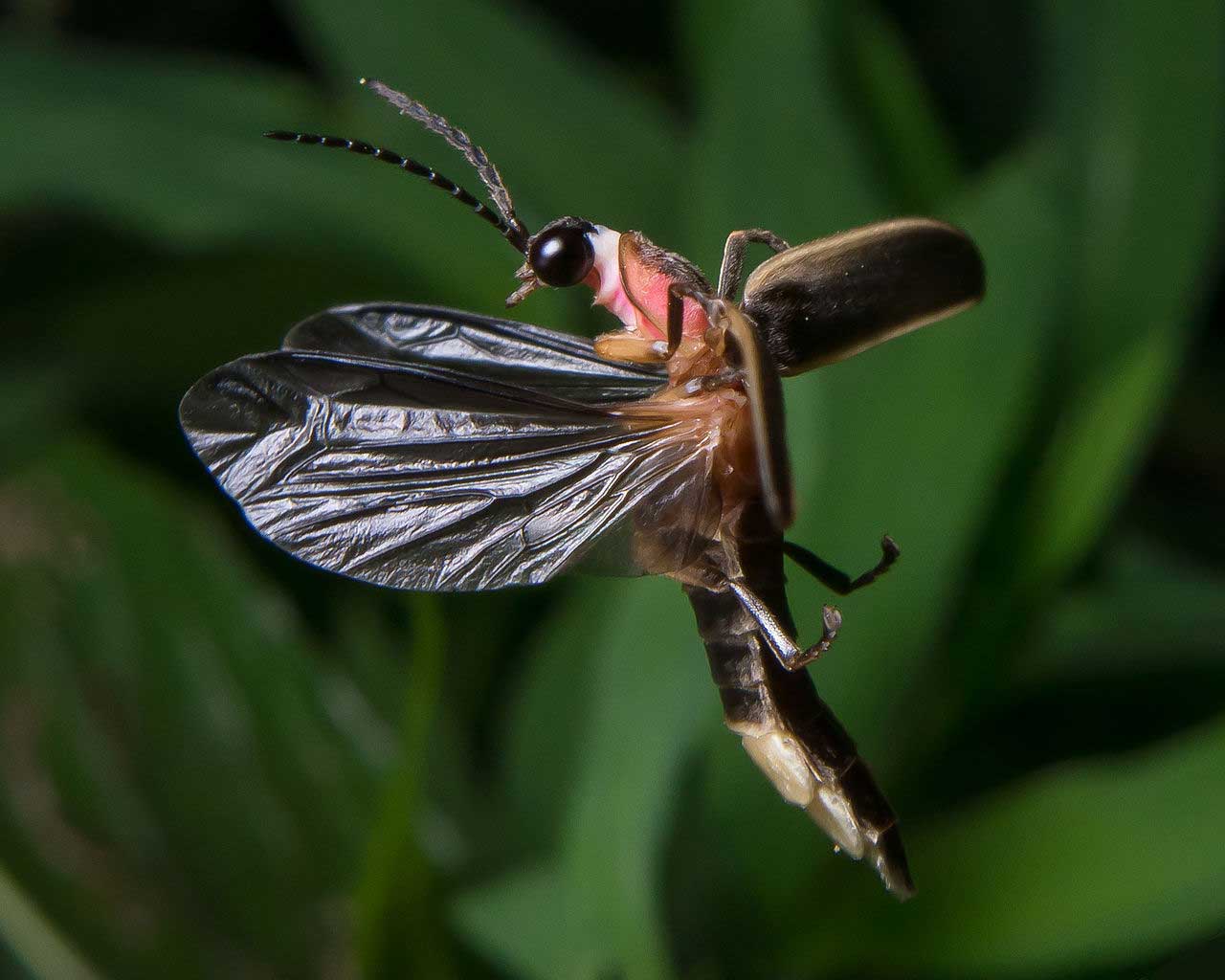
Fireflies, also called lightning bugs, are beetles that can make their own light. On warm summer evenings, they flash yellow-green signals across fields and forests to find a mate. One of the best-known groups in North America is the genus Photinus.
Firefly (lightning bug) Quick Facts
| Common name | Firefly (lightning bug) |
| Scientific name | Lampyridae |
| Kingdom | Animalia |
| Phylum | Arthropoda |
| Class | Insecta |
| Order | Coleoptera |
| Type | Insect (beetle) |
| Diet | Larvae eat snails, slugs and worms; most adults eat little or nothing |
| Habitat | Damp meadows, woods, marshes and gardens |
| Native range | Worldwide in warm and temperate regions; Photinus in the Americas |
| Size | Most about 1-2 cm long |
| Lifespan | Larvae a year or more; adults a few weeks |
| Special feature | Makes its own cold light by bioluminescence |

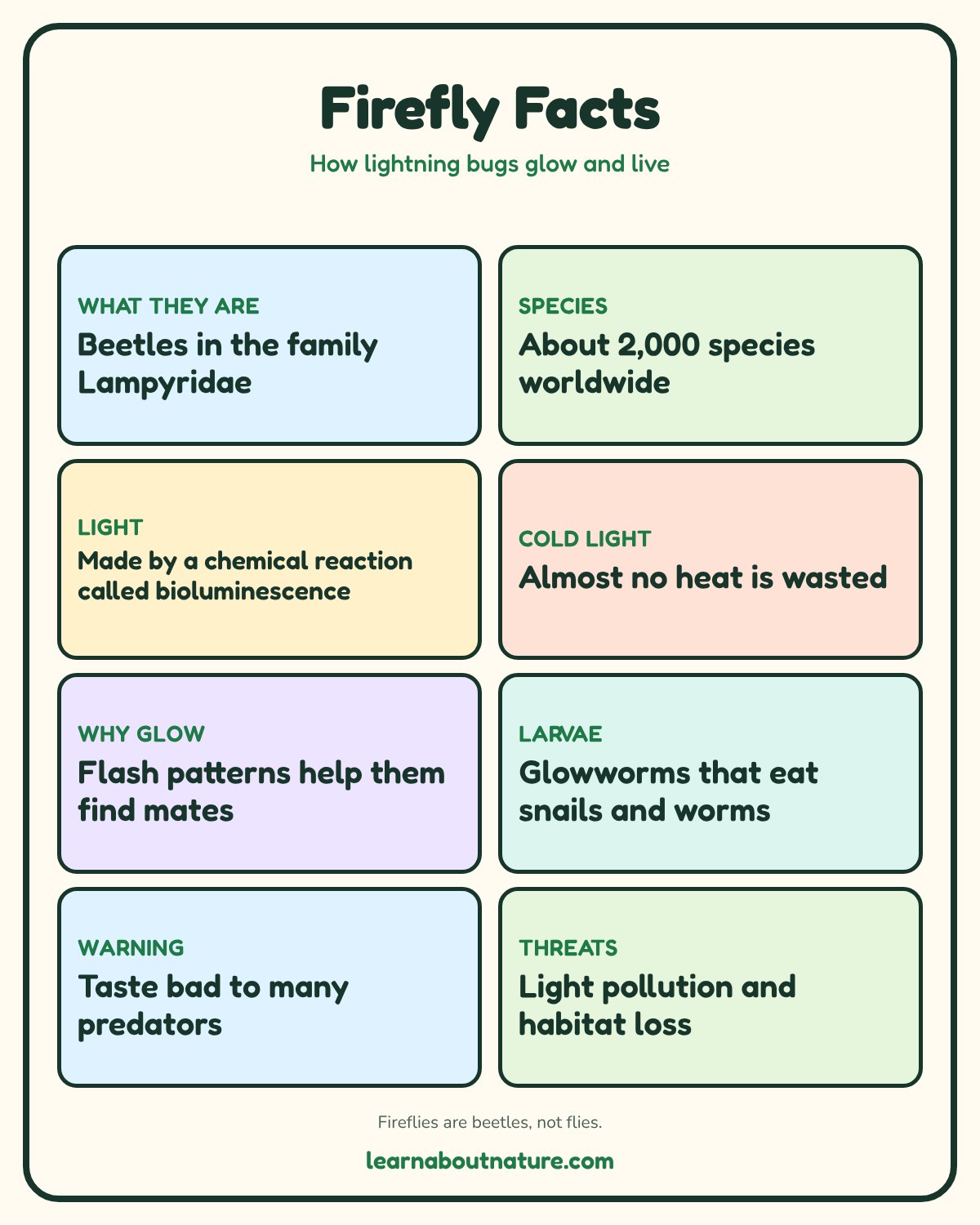
Not flies, not bugs, but beetles
Despite their names, fireflies are neither true flies nor true bugs. They are beetles in the family Lampyridae, which has around 2,000 species around the world. Like other beetles, they have hard front wings called elytra, which meet in a straight line down the back when they are resting.
When a firefly flies, it lifts its elytra out to the sides and flaps its thin back wings to move. Most fireflies are soft-bodied, brown or black beetles, often with red or yellow markings on the shield behind the head.
Meet the Photinus fireflies
Photinus fireflies are common across much of North America. In most species, the males fly around flashing while the females wait in the grass or on low plants and flash back. The light comes from special organs, called lanterns, on the underside of the abdomen. Some of the species in this genus include:
- Photinus carolinus (the synchronous firefly)
- Photinus pyralis (the common eastern firefly)
- Photinus australis
- Photinus floridanus
- Photinus pallens
- Photinus punctulatus
- Photinus tanytoxus
Photinus carolinus: the synchronous firefly

Photinus Carolinus Fireflies – Photo by: by Radim Schreiber; FireflyExperience.org
This firefly is famous for flashing in sync. Large groups of males blink together, filling the forest with waves of light followed by darkness. Every year, around late May and June, crowds of visitors come to see them near Elkmont in Great Smoky Mountains National Park, Tennessee.
Each male gives a burst of several quick flashes, then goes dark for several seconds before the next burst. The exact timing changes with temperature. During the dark pause, a female answers with a dimmer flash of her own. Synchronous flashing is rare in North America, but it is also seen in some fireflies in Southeast Asia, where many males gather on trees along rivers and blink together.
Photinus pyralis: the common eastern firefly

Photinus Pyralis Firefly – Photo by: by Terry Priest
Photinus pyralis, also called the big dipper firefly, is one of the most common fireflies in eastern North America. It often comes out at dusk, flying low over lawns and fields.
A male flies along and makes a single flash every few seconds while swooping upward, so his trail of light looks like the letter J. A female sitting in the grass answers with a flash about two seconds later. The male can tell she is the right species by the timing of her reply. In males, the lantern covers more of the underside of the abdomen than in females.
How do fireflies make light?
Firefly light comes from a chemical reaction called bioluminescence. Inside the lantern, a chemical called luciferin combines with oxygen with the help of an enzyme called luciferase. The reaction gives off light.
This kind of light is called cold light because almost none of the energy is wasted as heat. An old-fashioned light bulb, by comparison, turns most of its energy into heat, which is why it gets hot to touch. If fireflies made light the way those bulbs do, they would cook themselves!
Glowing at every age
All stages of a firefly’s life can glow. Even some eggs give off a faint light. The larvae are often called glowworms. Their glow seems to be a warning to predators that they taste bad.
Not all adult fireflies flash. Many species in western North America glow weakly or not at all as adults, and use scent signals to find each other instead. That is why people often think there are no fireflies west of the Rocky Mountains, even though there are.
What do fireflies eat?
Firefly larvae are hunters. They live in damp soil, leaf litter and rotting wood, where they eat earthworms, slugs and snails. They inject their prey with a substance that numbs and softens it. In parts of Asia, some firefly larvae even live underwater and hunt water snails.
Most adult fireflies eat very little or nothing at all. Some sip nectar or pollen. Adults live only a few weeks, just long enough to mate and lay eggs, while the larval stage often lasts a year or more.
Firefly tricks
Females of the genus Photuris are nicknamed “femme fatale” fireflies. They copy the answering flashes of Photinus females. When a Photinus male flies down expecting a mate, the Photuris female catches and eats him. She even gains some of his protective chemicals this way.
Amazing firefly facts
- Fireflies taste bad to many predators because their blood contains bitter defensive chemicals called lucibufagins. Their glow may help warn predators to stay away.
- Scientists use firefly luciferase in labs as a glowing marker to study cells, detect bacteria and test new medicines.
- Fireflies like damp, grassy places near woods, streams and ponds.
- Light pollution and habitat loss can make it hard for fireflies to find each other. Turning off outdoor lights on summer nights helps them.
Firefly (lightning bug) FAQs
Are fireflies really flies?
No. Fireflies, or lightning bugs, are beetles in the family Lampyridae. They have hard front wings called elytra, like all beetles.
Why do fireflies light up?
Fireflies flash mainly to find a mate. Each species has its own flash pattern, and females answer males of their species. The glow also warns predators that fireflies taste bad.
Do firefly lights get hot?
No. Firefly light is called cold light because the chemical reaction that makes it wastes almost no energy as heat.
What do fireflies eat?
Firefly larvae hunt snails, slugs and earthworms. Most adults eat very little, though some sip nectar or pollen. One group, Photuris, even eats other fireflies.
Where can you see synchronous fireflies?
The synchronous firefly Photinus carolinus is famous in Great Smoky Mountains National Park, especially near Elkmont, Tennessee, around late May and June.

Randi Jones is the owner and founder of the Nature Gift Store, an online retailer specializing in nature-themed gifts, educational science projects, live animal nature kits and real butterfly artwork. A biology graduate who fell in love with insects, she founded the company in 2001 to make active learning about nature fun, accessible and engaging for children and adults. Her store offers real butterfly frames, home and garden decor and educational live animal kits, including ant farms, worm farms, tadpoles, ladybugs and hermit crabs, and she runs a bug museum in Washington featuring live animals like Eddie the Iguana alongside other reptiles and insects. Randi wrote most of the guides on this site. They first appeared on her long-running nature sites, including Monarch-Butterfly.com, Ladybug-Life-Cycle.com, Frog-Life-Cycle.com, Dragonfly-Site.com and Butterfly Pictures, which have now been brought together here at Learn About Nature.