Willow

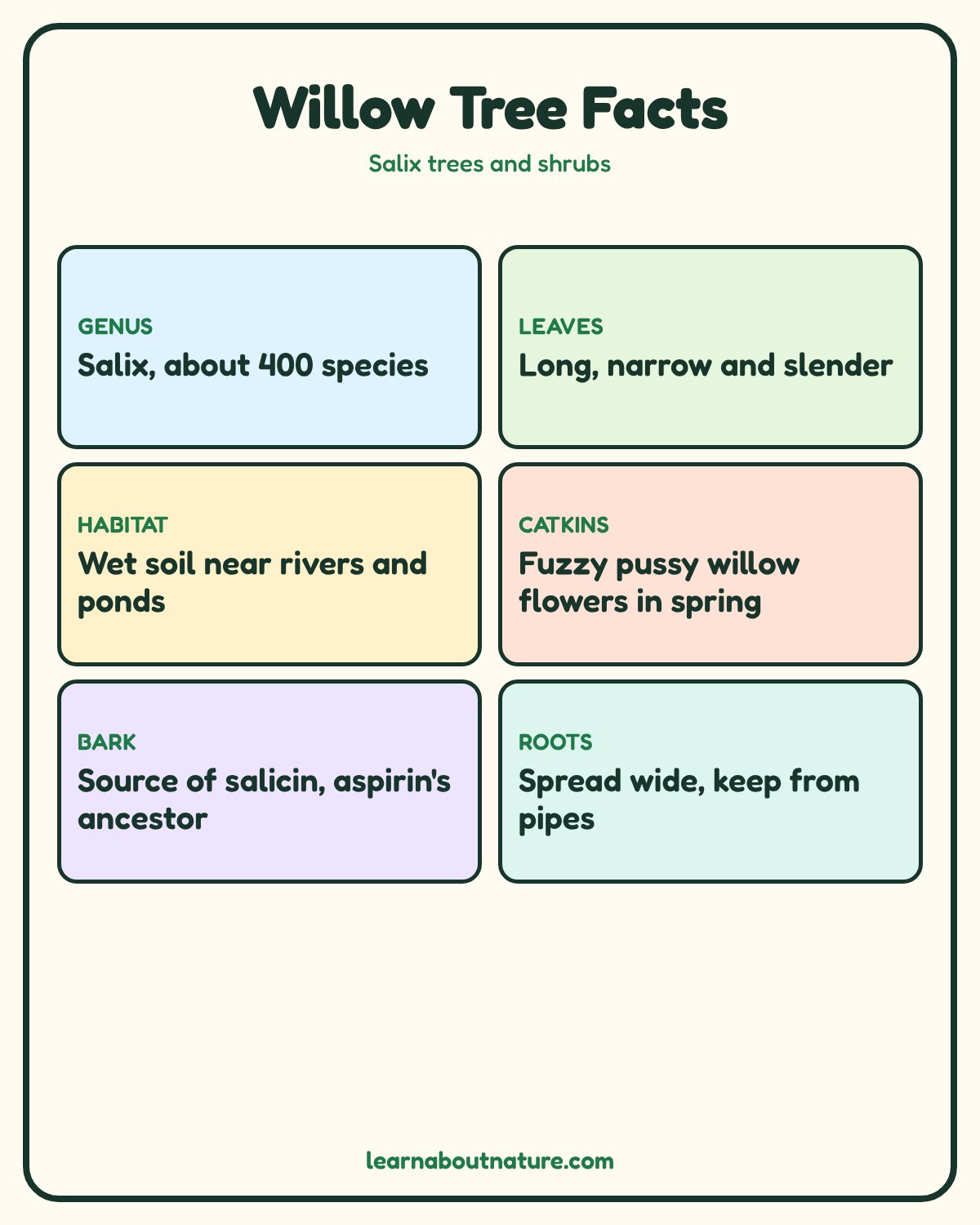
Willows are trees and shrubs in the genus Salix, famous for their long, slender leaves and love of water. There are around 400 species, found mostly in cool and temperate parts of the Northern Hemisphere, from tall weeping willows beside rivers to tiny Arctic willows only a few centimeters high.
Scientific Classification & Quick Facts
| Common name | Willow |
| Scientific name | Salix |
| Kingdom | Plantae |
| Phylum | Tracheophyta |
| Class | Magnoliopsida |
| Order | Malpighiales |
| Family | Salicaceae |
| Type | Deciduous trees and shrubs |
| Habitat | Very moist soils, riverbanks and ponds |
| Native range | Northern Hemisphere; weeping willow from China |
| Height | From 6 cm (dwarf) to about 50 feet |
| Special feature | About 400 species; narrow leaves in osiers |
Types of Willow
Most species are simply called willows, but some have special names:
- Osiers are shrubby willows with long, narrow leaves and flexible stems used for weaving baskets.
- Sallows are willows with broader, oval leaves, such as the goat willow (pussy willow).
- Dwarf willows grow in the Arctic and on high mountains. Some creep along the ground and stand only a few centimeters tall, making them some of the smallest trees in the world.
Willows belong to the family Salicaceae, which also includes poplars and aspens. Most willows have separate male and female plants. In early spring, they produce fuzzy flower spikes called catkins, which are an important early food for bees.
The Weeping Willow
The best-known willow is the weeping willow, with its long branches that sweep down to the ground. The original weeping willow, Salix babylonica, comes from northern China and was carried along trade routes to Europe and beyond. Many weeping willows planted in parks and gardens today are actually hybrids between this species and the white willow (Salix alba), which often have golden-yellow twigs.
Weeping willows are deciduous, which means they lose their leaves in fall. Their leaves are long and narrow, often around 8-15 cm (3-6 in) long and only 1-2 cm wide, with finely toothed edges and very short stalks. The tops of the leaves are green and the undersides are often paler or grayish.
These trees grow fast and usually reach about 9-15 meters (30-50 feet) tall, with a crown just as wide. Their branches are brittle and can snap in storms, and the trees drop lots of twigs and leaves, so they are best planted with plenty of space around them.
Habitat
Willows grow all across the Northern Hemisphere, and a few species are found south of the equator. They love damp places: riverbanks, lake shores, marshes, wet meadows, and the edges of ponds. Their dense roots help hold soil in place, so willows are often planted to stop riverbanks from washing away.
Weeping willows are not native to North America, but they are planted widely there, from Ontario down to Georgia, usually near water in parks and large gardens.
Growing a Willow
Soil
Willows can grow in many kinds of soil, including clay, loam, and sand, and in both slightly acidic and slightly alkaline conditions. What matters most is moisture. Clay and loam hold water well, which suits willows. Very dry, sandy, or shallow chalky soils are a poor choice unless the tree is near water.
Sunlight and Climate
Willows prefer full sun and do not grow well in deep shade. Many species are very hardy and cope well with cold winters – some even survive in the Arctic. Weeping willows grow best in regions with cool to warm summers and enough rainfall, especially near ponds, lakes, or streams.
Watering
Young willows need plenty of water. For the first few weeks after planting, water deeply several times a week, then cut back to about once a week once the tree settles in. During dry spells, keep watering. A layer of mulch over the soil helps it stay moist for longer.
Willow roots are strong and spread widely in search of water. They can damage drains, sewer pipes, septic systems, and building foundations, so plant willows well away from them – experts often suggest at least 15 meters (50 feet).
Pests and Diseases
Willows are a favorite food for many insects. Aphids gather on stems and leaves to suck the sap, and willow leaf beetles and caterpillars chew holes in the leaves. A healthy tree usually recovers, and these insects in turn feed many birds.
Fungi can also cause problems. Rust fungi make orange spots on the leaves, while diseases such as willow scab and black canker can make leaves and twigs turn black and die back. Good air flow, removing fallen infected leaves, and pruning out dead wood can help.
How People Use Willows

Photo by: André Karwath
Willows have been useful to people for thousands of years:
- Weaving: Flexible osier stems are woven into baskets, fences, and furniture.
- Cricket bats: A variety of white willow provides the light, tough wood used to make cricket bats.
- Medicine history: Willow bark contains a substance called salicin and was traditionally used to ease aches and fevers. In the 1800s, scientists studied it while developing aspirin.
- Living structures: Fresh willow stems root easily, so they can be planted to grow living tunnels, domes, and fences.
Willow as a Fuel Crop
Some willows grow so quickly that farmers raise them as an energy crop. In a method called short-rotation coppice, willows are planted closely together and cut down near the ground every two to four years. The stumps then sprout lots of new stems, and the harvested wood is chipped and burned to produce heat or electricity.
Large farms use special harvesting machines, but small growers in remote places, such as the Orkney Islands of Scotland, have found it hard to get affordable equipment. Trials there led to new small-scale harvesting machines designed to make willow fuel practical for smaller plots.
Willow FAQs
How many kinds of willow are there?
There are around 400 species of willow, found as trees and shrubs mostly in the Northern Hemisphere.
Where do willows grow?
Willows grow in very wet soils, especially on riverbanks and near ponds and lakes. They die quickly if the soil dries out.
How tall does a weeping willow grow?
A weeping willow can reach about 50 feet tall, and its slender, drooping branches have narrow leaves 7 to 12 cm long.
What is the difference between an osier and a sallow?
Willows with narrow leaves are called osiers, and willows with broad leaves are called sallows.
How much water does a willow need?
A lot. A newly planted willow needs about 10 gallons of water three times a week, then about once a week after the first month.

Randi Jones is the owner and founder of the Nature Gift Store, an online retailer specializing in nature-themed gifts, educational science projects, live animal nature kits and real butterfly artwork. A biology graduate who fell in love with insects, she founded the company in 2001 to make active learning about nature fun, accessible and engaging for children and adults. Her store offers real butterfly frames, home and garden decor and educational live animal kits, including ant farms, worm farms, tadpoles, ladybugs and hermit crabs, and she runs a bug museum in Washington featuring live animals like Eddie the Iguana alongside other reptiles and insects. Randi wrote most of the guides on this site. They first appeared on her long-running nature sites, including Monarch-Butterfly.com, Ladybug-Life-Cycle.com, Frog-Life-Cycle.com, Dragonfly-Site.com and Butterfly Pictures, which have now been brought together here at Learn About Nature.