Types of Trees

There are many types of trees, and scientists estimate there are more than 70,000 tree species on Earth. Most of them can be sorted in two simple ways: by whether they drop their leaves each year (deciduous) or keep them all year (evergreen), and by whether they are broadleaf trees with flowers and fruits or conifers with needles and cones.
What Are the Main Types of Trees?
The two main types of trees are broadleaf trees (angiosperms), which have flat leaves, flowers and seeds inside fruits, and conifers (gymnosperms), which have needles or scales and seeds in cones. Trees are also grouped as deciduous, losing all leaves seasonally, or evergreen, keeping leaves all year. Palms are another distinct group.
Why Trees Matter
Trees make oxygen, store carbon, hold soil in place, cool cities and provide homes and food for a huge number of animals, plants, fungi and microbes. A single large oak can support hundreds of different insect species.
People rely on trees too. We use them for:
- Wood for building, furniture and paper
- Fruits, nuts and syrups
- Medicines, including some important cancer drugs
- Shade, shelter from wind, privacy hedges and beautiful parks and streets
- Firewood and charcoal
- Recreation, from climbing to hiking through forests
Because trees are so useful, many forests have been cut down faster than they can grow back. Planting and protecting trees helps the whole planet.
Deciduous Trees

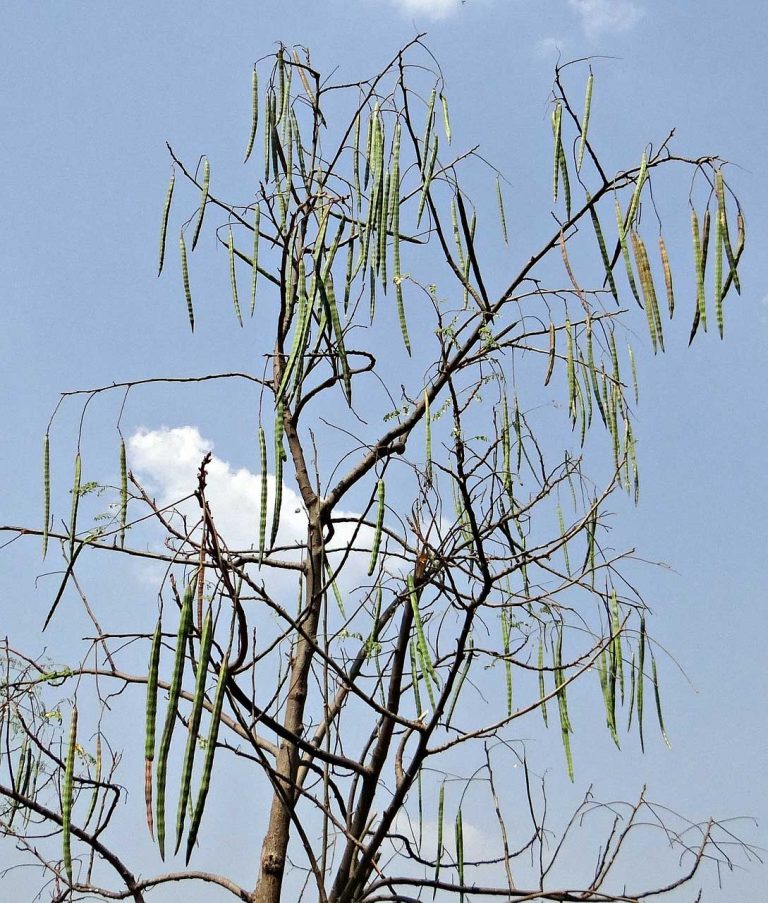
Photo by: Kundan Ramisetti
Deciduous trees shed all their leaves for part of the year. In cool temperate regions they drop them in autumn and rest through winter, which saves water and protects the tree from frost. In some tropical places, trees drop their leaves during the dry season instead. Many deciduous trees put on a dazzling show of red, orange and yellow before their leaves fall.
Most deciduous trees are broadleaf trees, such as oaks, maples, ashes, poplars, beeches and willows. You can buy them from nurseries as young trees grown in containers, with bare roots or with their roots wrapped in a ball of soil.
Broadleaf Trees
Broadleaf trees have wide, flat leaves rather than needles. The large leaves catch plenty of sunlight for photosynthesis, the process plants use to make food, but in cold climates they would be damaged by frost, which is one reason many broadleaf trees drop them in autumn. Broadleaf trees are flowering plants, and their seeds grow inside fruits, nuts or pods.
Their wood is called hardwood. Many hardwoods, such as oak, walnut and cherry, are prized for furniture and flooring. Not all broadleaf trees are deciduous, though: olive, holly, many magnolias and most tropical rainforest trees are evergreen.
Some Well-Known Broadleaf Trees
Flowering Trees
All broadleaf trees flower, but some are grown especially for their beautiful blossoms, such as cherries, crabapples, dogwoods and magnolias.
Oak Trees
Oaks are famous for their tough, heavy wood and their nuts, called acorns. There are about 500 species, growing across the Northern Hemisphere from lowlands to mountain slopes. In spring they produce dangling flower clusters called catkins, which release clouds of pollen onto the wind. Some oaks are deciduous, while others, like the holm oak and live oak, are evergreen.
Ash Trees
Ash trees are valued for their strong, springy timber, used for tool handles and sports equipment. Their seeds grow inside single winged fruits called samaras, or “keys,” which spin as they fall. Sadly, ash trees face serious threats: the emerald ash borer beetle has killed millions in North America, and a fungal disease called ash dieback is killing many ash trees across Europe.
Willow Trees
Willow trees love damp places such as riverbanks and lakesides. Their bendy twigs are woven into baskets, and their bark contains a chemical called salicin that people once used for pain relief. It inspired the invention of aspirin. Willows produce fuzzy catkins, with male and female flowers on separate trees and no petals.
Shade Trees
Shade trees have wide, spreading branches and dense leaves that block strong sunlight. Popular shade trees include oaks, maples, lindens and sweet gums, many of which grow 12 m (40 feet) tall or more.
Olive Trees
Olive trees are evergreen broadleaf trees from the Mediterranean region. They have small white flowers and fruit that starts green and turns purple-black as it ripens. Fresh olives are extremely bitter, so they are soaked or cured before eating. Olives are also pressed to make olive oil, and olive trees can live for many hundreds of years.
Japanese Maple
The Japanese maple (Acer palmatum) is a small deciduous maple tree native to Japan, Korea, China and southeastern Russia. It usually grows about 6 to 10 m (20 to 33 feet) tall. Its leaves are shaped like an open hand with five to nine pointed lobes and toothed edges, and they turn brilliant red, orange or gold in autumn.
Chinese Cedar
Despite its name, the Chinese cedar or Chinese mahogany (Toona sinensis) is not a true cedar at all. It is a deciduous broadleaf tree. In spring, popular garden varieties have new leaves that are bright pink, then fade to cream and finally turn green. In China, its young leaves are even eaten as a vegetable.
Dogwood Trees
Dogwoods belong to the genus Cornus, which includes both trees and shrubs. Most are deciduous. They are easy to recognize by their flowers, which are often surrounded by large white or pink petal-like leaves called bracts, their bright berries, and in some species their colorful red or yellow winter twigs.
European Beech
The European beech (Fagus sylvatica) is a tall deciduous tree that often reaches 30 m (100 feet) or more, with smooth, silvery-gray bark. It grows wild from southern Sweden and southern England down to Sicily, and from northern Spain east to northwestern Turkey. Its glossy leaves keep their copper-brown color long into winter on young trees and hedges.
Crape Myrtle
Crape myrtles (Lagerstroemia) love hot summers. They produce big clusters of crinkly flowers that look like crepe paper, in red, pink, purple, lavender or white. Their smooth bark peels away in patches, revealing colorful patterns underneath.
Golden Chain Tree
The golden chain tree (Laburnum) is a small deciduous tree, usually about 5 to 8 m (16 to 26 feet) tall. In late spring it is covered in long, hanging chains of bright yellow flowers. All parts of the tree, especially the seeds, are poisonous, so never eat any part of it.
Magnolia
Magnolias are ancient flowering trees and shrubs, and some are evergreen. Many deciduous magnolias flower in late winter or early spring, covering their bare branches in huge pink, purple or white blossoms before the leaves appear.
Coniferous Trees

Photo by: Gus Tonsay
Conifers are trees that carry their seeds in cones instead of fruits. There are around 600 species, including pines, firs, spruces, cedars, larches, hemlocks, cypresses and redwoods. Most have narrow, needle-shaped or scale-like leaves, and many grow in a cone or pyramid shape that helps snow slide off their branches.
Conifers include the oldest and tallest trees on Earth. Some Great Basin bristlecone pines in California’s White Mountains are more than 4,800 years old, and the coast redwood can grow taller than 115 m (380 feet). Their wood is called softwood, though some softwoods are actually quite hard. It is used for timber, paper and many other products, and the medicine paclitaxel, used to treat some cancers, was first discovered in the bark of the Pacific yew.
Are Conifers and Evergreens the Same?
Not quite. Most conifers are evergreen, keeping their needles all year and replacing them a few at a time. But a few conifers, such as larches and the bald cypress, are deciduous and drop all their needles in autumn. Meanwhile, many broadleaf trees, such as holly, olive and most rainforest trees, are evergreen. So “evergreen” describes how a tree keeps its leaves, while “conifer” describes how it makes its seeds.
Where Conifers Grow
Conifers grow all around the world, but they are most common in the Northern Hemisphere. Huge conifer forests, called boreal forest or taiga, stretch across Canada, Alaska, Scandinavia and Russia just south of the Arctic. Conifers also grow on mountains, in cool, wet coastal forests and even in some tropical regions. Many are very tough and can survive bitter cold, poor soil and drought.
Some Well-Known Conifers
Christmas Trees
Decorating evergreen trees at Christmas began in Germany around the 1500s. A popular legend says that Martin Luther, walking through a forest at night, was inspired by stars twinkling through the branches. The custom became fashionable in Britain in the 1840s, when pictures of Queen Victoria and Prince Albert’s family Christmas tree were printed in newspapers, and it then spread around the world. Fir, spruce and pine trees are the most popular choices.
Cedar Trees

Photo by: Smabs Sputzer
True cedars belong to the genus Cedrus. They come from the mountains of the Mediterranean region and the western Himalayas, growing at heights of about 1,000 to 3,200 m (3,300 to 10,500 feet). The best known are the cedar of Lebanon, the Atlas cedar and the deodar.
Cedars usually grow 30 to 40 m (100 to 130 feet) tall. Their wood is fragrant and resistant to rot. Their needles, about 1 to 6 cm long, grow in dense clusters on short side shoots, and their barrel-shaped cones sit upright on the branches.
Fir Trees
Firs (Abies) are a group of around 50 species of evergreen conifers in the pine family. They grow mainly in mountains across North and Central America, Europe, Asia and North Africa. Most grow 10 to 80 m (30 to 260 feet) tall.
You can recognize firs by their flat, soft needles, each attached to the twig by a tiny round base like a suction cup, and by their upright cones, which fall apart on the tree instead of dropping whole. The Douglas fir is not a true fir. It belongs to a different genus, Pseudotsuga.
Hemlock
Hemlocks (Tsuga) are evergreen conifers in the pine family from North America and eastern Asia. They got their name because their crushed needles smell a bit like the poison hemlock plant, but the trees themselves are not poisonous.
Hemlocks are medium to large trees, from about 10 to 60 m (33 to 200 feet) tall, with drooping top shoots and short, flat needles. The eastern hemlock grows in forests alongside sugar maple, yellow birch, beech and white pine, but it is threatened by a tiny sap-sucking insect called the hemlock woolly adelgid. The western hemlock grows in the damp coastal forests of the Pacific Northwest, from Alaska down to northern California.
Larch Trees
Larches (Larix) are unusual conifers that are deciduous. Their soft needles turn golden-yellow in autumn and then fall off, and new ones grow in spring. Larches grow about 20 to 45 m (65 to 150 feet) tall and are among the main trees of the vast boreal forests of Canada, Russia and Scandinavia, as well as high mountains farther south.
Pine Trees
Pines (Pinus) form the largest group of conifers, with more than 100 species. Their long needles grow in small bundles of two to five. Most pines grow 15 to 45 m (50 to 150 feet) tall. The tallest known pine is a ponderosa pine in southern Oregon, at about 82 m (268 feet), while the Siberian dwarf pine creeps along as a low shrub. Most pines have thick, scaly bark, which helps protect them from forest fires.
Redwood Trees
The redwood family group includes three amazing species: the coast redwood and the giant sequoia of California (with a few coast redwoods reaching southern Oregon), and the dawn redwood of China. The dawn redwood was known only from fossils until living trees were found in the 1940s, and, like a larch, it drops its needles in autumn.
Giant sequoias are the biggest trees on Earth by volume and can live for more than 3,000 years. All three species are now endangered because of past logging, changes to natural fire patterns and, more recently, severe wildfires and drought.
The Tallest Trees
The coast redwood tree (Sequoia sempervirens) is the tallest tree species in the world. In 1963, a team supported by the National Geographic Society measured a redwood beside Redwood Creek in northern California at about 112 m (368 feet), then the tallest tree known. In 2000, another redwood, nicknamed the Stratosphere Giant, took the title.
Then, in 2006, researchers exploring remote parts of Redwood National Park found three even taller trees. The tallest, named Hyperion, measures about 116 m (380 feet), taller than a 30-story building. Its exact location is kept secret to protect it.
Spruce Trees
Spruces (Picea) are a group of about 35 species of evergreen conifers that grow in the cold boreal forests and mountains of the Northern Hemisphere. Mature spruces usually reach 20 to 60 m (66 to 197 feet) and have a classic cone shape. Their stiff, sharp needles are four-sided, so they roll easily between your fingers, and each one sits on a tiny woody peg. Spruce cones hang downward, and each needle can stay on the tree for several years.
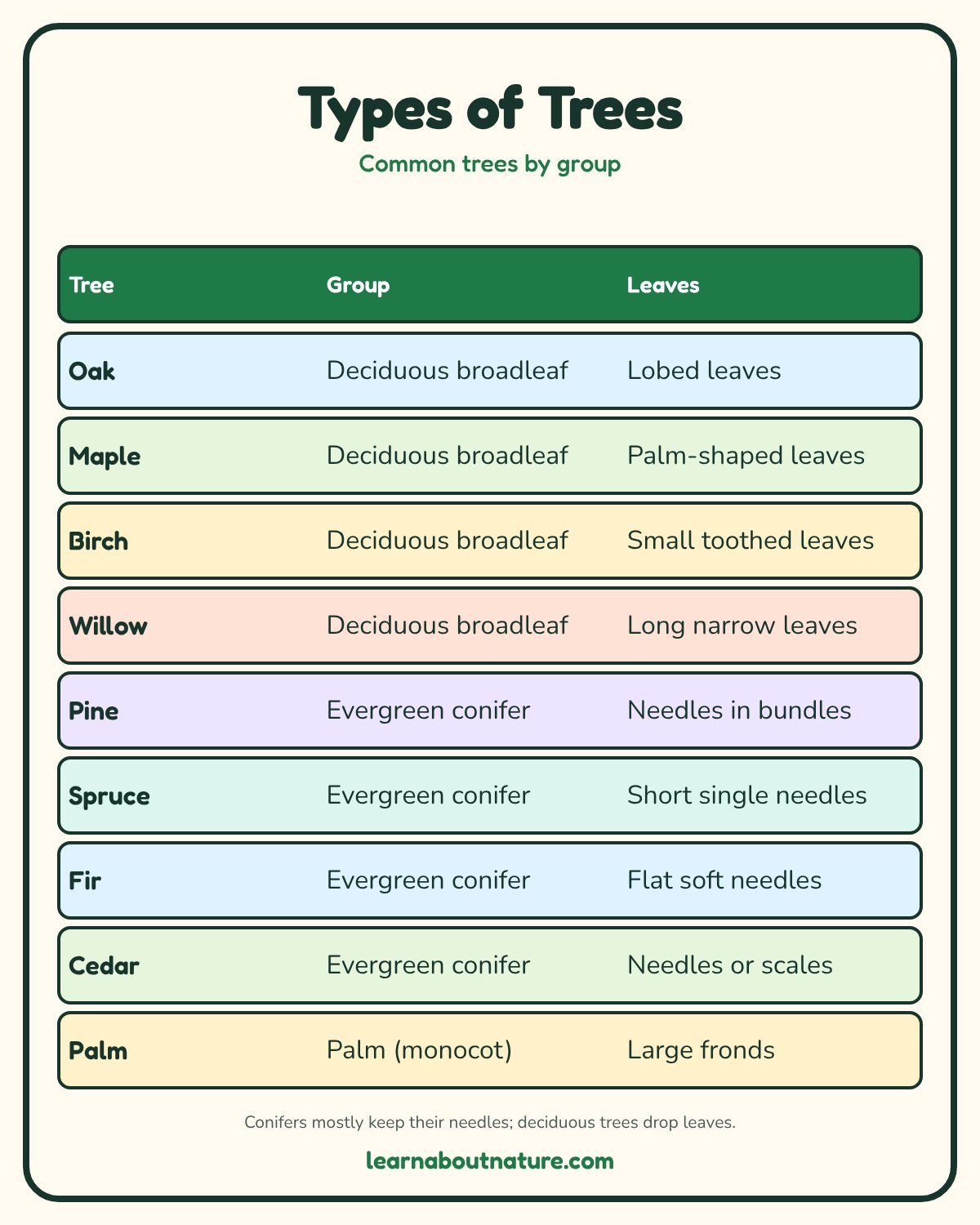
Common Tree Types Compared
| Tree | Group | Leaves | Typical height | Seeds |
|---|---|---|---|---|
| Oak | Broadleaf, mostly deciduous | Lobed or toothed | 15 to 30 m | Acorns |
| Maple | Broadleaf, deciduous | Hand-shaped | 10 to 30 m | Winged samaras |
| Birch | Broadleaf, deciduous | Small, toothed | 10 to 25 m | Tiny winged seeds in catkins |
| Willow | Broadleaf, deciduous | Long and narrow | 10 to 25 m | Fluffy seeds |
| Pine | Conifer, evergreen | Needles in bundles | 15 to 45 m | Woody cones |
| Spruce | Conifer, evergreen | Stiff square needles | 20 to 60 m | Hanging cones |
| Fir | Conifer, evergreen | Flat soft needles | 10 to 80 m | Upright cones |
| Larch | Conifer, deciduous | Soft needles in tufts | 20 to 45 m | Small cones |
| Palm | Monocot, evergreen | Large fans or feathers | Varies widely | Fruits such as coconuts and dates |
Heights vary a lot with species, soil and climate, so these are rough ranges for mature trees.
Palm Trees: A Different Kind of Tree
Palms are often left out of tree lists, but they are a large family of more than 2,500 species, mostly in the tropics and subtropics. They are flowering plants, but they belong to the monocots, the same broad group as grasses and lilies, rather than to the main group of broadleaf trees.
- Most palms have a single unbranched trunk topped by a crown of huge leaves, either fan-shaped or feather-shaped.
- Their trunks do not form annual growth rings and do not grow much thicker with age, unlike oaks or pines.
- They produce many important foods and materials, including coconuts, dates, palm oil and rattan.
- Some scientists do not class palms as true trees because they lack real wood, but in everyday language they are usually called palm trees.
How to Identify a Tree
You can usually work out what kind of tree you are looking at by checking a few features in order.
- Leaves or needles? Needles or scales usually mean a conifer. Flat, wide leaves mean a broadleaf tree.
- Leaf arrangement: are leaves opposite each other on the twig (as in maples and ashes) or alternate (as in oaks and birches)?
- Simple or compound: a single blade is simple; a leaf made of several leaflets, like ash or walnut, is compound.
- Leaf shape and edge: look for lobes, teeth or smooth edges.
- Bark: smooth and grey (beech), peeling white (birch), deeply furrowed (oak) or plated (many pines).
- Fruits, nuts and cones: acorns, keys, berries or cone shape often confirm the identification.
In winter, buds, twigs, bark and the overall shape of the tree become the most useful clues.

Randi Jones is the owner and founder of the Nature Gift Store, an online retailer specializing in nature-themed gifts, educational science projects, live animal nature kits and real butterfly artwork. A biology graduate who fell in love with insects, she founded the company in 2001 to make active learning about nature fun, accessible and engaging for children and adults. Her store offers real butterfly frames, home and garden decor and educational live animal kits, including ant farms, worm farms, tadpoles, ladybugs and hermit crabs, and she runs a bug museum in Washington featuring live animals like Eddie the Iguana alongside other reptiles and insects. Randi wrote most of the guides on this site. They first appeared on her long-running nature sites, including Monarch-Butterfly.com, Ladybug-Life-Cycle.com, Frog-Life-Cycle.com, Dragonfly-Site.com and Butterfly Pictures, which have now been brought together here at Learn About Nature.