Tree Trimming (Pruning)

Tree trimming, also called pruning, means carefully cutting off certain branches to keep a tree healthy, safe and good-looking. Done the right way and at the right time, pruning helps trees grow stronger and live longer.
Pruning is a job for adults, especially when ladders, saws or big branches are involved. But kids can learn a lot by helping plan the work, spotting dead branches and cleaning up afterward.
Reasons to Trim or Prune a Tree

There are three main reasons to prune a tree: health, safety and appearance.
- Health: Removing dead, diseased or damaged branches stops problems from spreading. Thinning a crowded crown lets air and sunlight move through, which helps prevent disease. Cutting off branches that rub against each other also prevents wounds.
- Safety: Dead or broken branches can fall without warning. Branches that block the view of drivers or walkers, or hang over roofs, may need to be trimmed. Never prune near power lines yourself; call your utility company.
- Appearance: Light pruning keeps a tree’s natural shape. Avoid forcing a tree into an unnatural shape, and never “top” a tree by chopping off its main trunk and big branches. Too much pruning weakens trees.
When to Prune

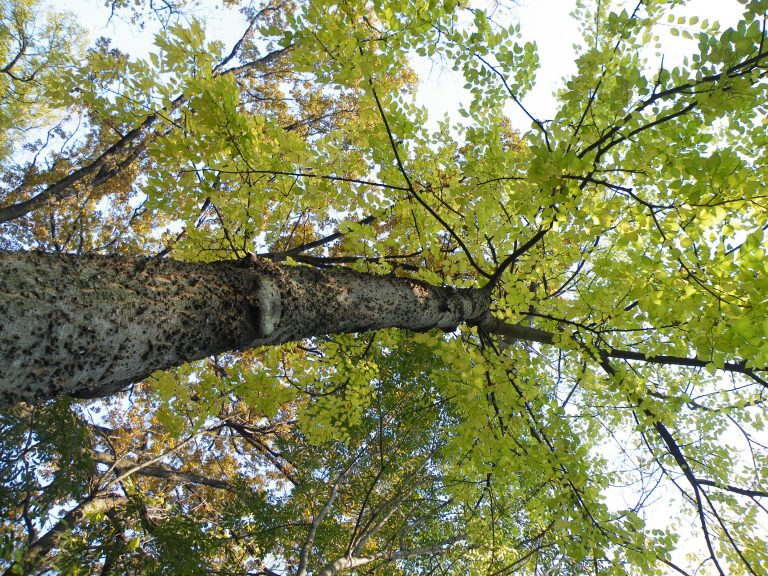
Photo by: Pauline Dana
For most trees, the best time to prune is late winter or very early spring, while the tree is dormant, or resting. Without leaves, it is easy to see the shape of the tree. Wounds also close quickly once spring growth begins, and many insects and diseases are less active in cold weather.
Some trees, such as maples, birches and walnuts, “bleed” sap when pruned in late winter. This looks alarming but does not usually harm the tree. If you prefer, prune these trees in early summer instead, after their leaves are fully open.
Pruning just after a tree’s spring growth is finished slows its growth, because it removes leaves that make food for the roots. Summer is also a good time to spot weak, dead or sagging branches.
Flowering trees need special timing:
- Trees and shrubs that bloom in spring, such as dogwoods and lilacs, should be pruned right after their flowers fade.
- Trees and shrubs that bloom in mid to late summer should be pruned in winter or early spring.
Dead, broken or dangerous branches can be removed at any time of year.
General Tree Trimming Tips
- Think about branch size. Branches less than about 2 inches (5 cm) across are usually fine to remove. Think carefully before removing branches 2 to 4 inches (5 to 10 cm) across. Only remove branches thicker than 4 inches (10 cm) if there is a very good reason.
- Look at the angle. Branches that join the trunk in a narrow V shape are weaker and more likely to split. Branches with a wide, U-shaped angle are stronger and are usually worth keeping.
- Pick the right side branch. When shortening a branch, cut back to a side branch that is at least one-third as thick as the branch you are removing.
- Keep plenty of leaves. Living branches should make up at least two-thirds of the tree’s height.
- Don’t overdo it. Avoid removing more than about a quarter of a tree’s leafy crown in one year. If more needs to come off, spread the work over several years.
- Start young. Pruning small branches on young trees is easier, leaves smaller wounds and shapes the tree for life.
Making a Good Cut
Where you cut matters a lot. Look for the branch collar, the slightly swollen ring where a branch joins the trunk. Also look for the branch bark ridge, the raised line of bark in the angle on top of the branch.
- Cut just outside the branch collar, angling slightly away from the trunk. Don’t cut into the collar, and don’t leave a long stub.
- Cut dead branches the same way as living ones.
- Wound paint or sealer is not needed. A clean cut in the right place lets the tree seal the wound itself.
For heavy branches, use the three-cut method so the bark doesn’t tear:
- First, about a foot out from the trunk, make a small cut on the underside of the branch.
- Second, a little farther out, cut down through the top of the branch. The branch will fall cleanly.
- Third, remove the leftover stub with a final cut just outside the branch collar.
Types of Tree Pruning
Crown Thinning
Thinning removes selected branches throughout the crown to let in light and air while keeping the tree’s natural shape.
- Keep side branches that are evenly spaced around the trunk.
- Remove branches that cross over or rub against others.
- Don’t remove more than about a quarter of the crown at once.
Crown Raising
Raising removes the lowest branches to make room for people, cars or buildings underneath. Keep living branches on at least two-thirds of the tree’s height. Removing too many lower branches can weaken the trunk.
Crown Reduction
Reduction makes a tree smaller by cutting branch tips back to strong side branches. It is a much better choice than topping, but it is best done by a professional on large trees.
Stay Safe
Tree work can be dangerous. Use sharp, clean hand pruners and saws, wear gloves and eye protection, and stay off ladders when using cutting tools. For large trees, high branches, chainsaw work or anything near power lines, hire a certified arborist.
How Much Does Tree Trimming Cost?

Pruning yourself costs little more than the price of good tools. Hiring a professional costs more, and the price depends on the size and number of trees, how hard they are to reach, how close they are to buildings or power lines, and where you live. It is wise to get quotes from more than one insured, certified arborist.
Whether you do it yourself or hire help, regular, careful pruning keeps trees healthy, safe and beautiful for many years.

Randi Jones is the owner and founder of the Nature Gift Store, an online retailer specializing in nature-themed gifts, educational science projects, live animal nature kits and real butterfly artwork. A biology graduate who fell in love with insects, she founded the company in 2001 to make active learning about nature fun, accessible and engaging for children and adults. Her store offers real butterfly frames, home and garden decor and educational live animal kits, including ant farms, worm farms, tadpoles, ladybugs and hermit crabs, and she runs a bug museum in Washington featuring live animals like Eddie the Iguana alongside other reptiles and insects.