California Red Sided Garter
Scientific Classification
| Kingdom: | Animalia |
| Phylum: | Chordata |
| Subphylum: | Vertebrata |
| Class: | Reptilia |
| Order: | Squamata |
| Suborder: | Serpentes |
| Family: | Colubridae |
| Subfamily: | Natricinae |
| Genus: | Thamnophis |
If you are looking for the most beautiful and strikingly colorful garter snakes, the California Red-Sided Garter Snake could be just the snake for you. These snakes belong to the subspecies Thamnophis Sirtalis Infernalis. This remarkable Red-sided Garter snake inhabits a narrow corridor on the Californian coast. You can see three species of Thamnophis sirtalis in California. They are;
- Thamnophis Sirtalis Tetrataenia (otherwise called San Fransisco (garter) snakes)
- Thamnophis Sirtalis Fitchi and
- Thamnophis Sirtalisi Infernalis.
These snakes possess a host of names. The California (red-Sided) Garter snake is also called, (blue striped), (Blue Stripe), (Chicago), (eastern), (maritime), (New Mexico), (Puget Sound) (red sided), (red-spotted), (San Francisco) (Texas) and (Valley) garter snake.
Anatomy
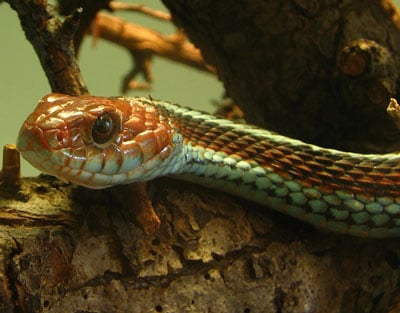
The females are larger than the males. The attain an overall length of 100 centimeters while the males are about 75 cms. The males are also more slender.
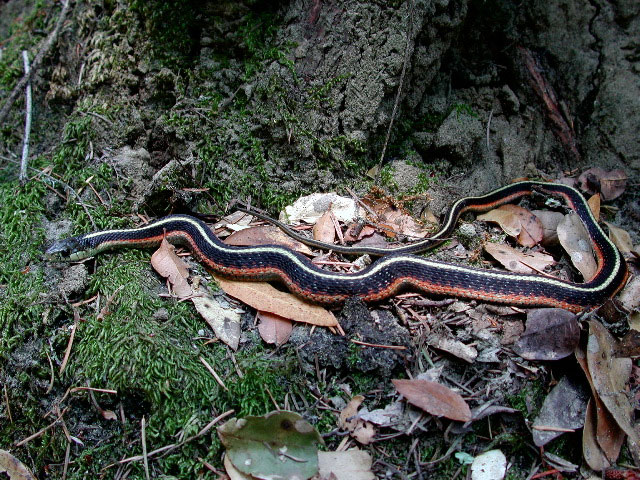
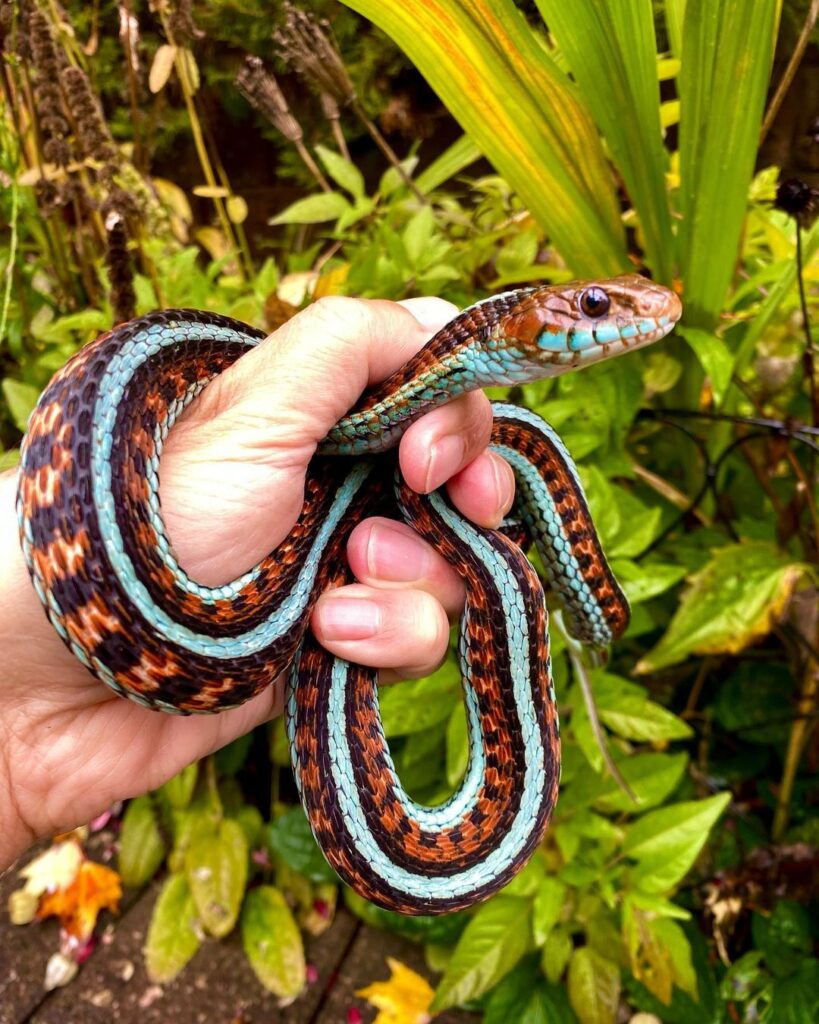
California (red-sided) garters possess blue or yellow stripes. They exhibit red color between the stripes with black spots in double rows. Some of the snakes have prominent red blotches coinciding with the lateral stripes. In other specimens, a red color reaches the stripes on the dorsal side. In others, black spots in the upper row appear to melt together, thereby forming a single black stripe that borders the stripe dorsally. You can easily distinguish between the California and San Franciscan Garter Snakes because In the case of San Franciscans, the blotches of red appear as a stripe without the red or the black blotches interrupting. In the case of Californian Garters, the blotches tend to interrupt the stripes all over. The top of the head is a striking red. They have a wider range, and exhibit much color and pattern diversity .
There is a great variance in the quantum of blue and red. The Californian and San Franciscan garters have the highest amounts of red.
Behavior
These garter snakes are active during the day. They are good swimmers and frequently escape into the water, when they feel threatened. Compared to other North American species, the Californian Garters are active at lower temperatures. When disturbed, this snake might coil up its body and strike. At the same time, they will hide their heads and flail their tails. They will also discharge a stinking, musky secretion. These are the techniques they use to escape from predators.
Habitat
The California red-sided garter Snake (Sirtalis Infernalis) is endemic (confined) to California. They range from Humboldt county, along the coast (most of San Francisco peninsula excluded), east of the bay of San Francisco to San Diego County, along the central and southern coasts. The snakes from Santa Clara might prove to be a new species. At present, however, they are grouped with S. Infernalis.
They inhabit a variety of habitats that include forests, grasslands, mixed woodlands, farmlands and chaparral. You can often find them near streams, ponds or marshes.
As a Pet
Breeding
The mating season of the species is in the spring and maybe, autumn. They give birth to baby snakes.
Housing
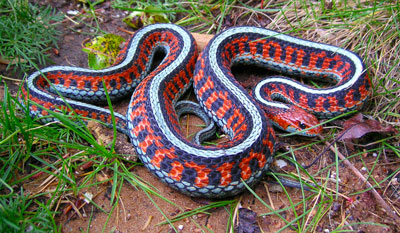
Thamnophis Sirtalis Fitchi – Photo by: Vincent Abbley
The snakes are diurnal. They bask under the sun lamp of the terrarium either on the ground or on a branch. The maximum temperature can be 35° C. Provide them with a dry terrarium and a bowl of water. You can feed them fish (dead), and give them Vitamin B1 as a supplement.
The juveniles also take worms. You can also get them accustomed to eat baby mice. Hibernation of two to four months can be permitted in moist substrates, at low temperatures ranging from 4 to 8° C. The snakes will benefit from the hibernation.
For or an adult snake pair, a terrarium of size 60 cms Length x 50 cms Width x 50 cms, .Height, will suit ideally.
Food
The California red-sided garter snake feeds on a wide range of prey. Larvae, amphibians, fish, eggs, fish, eggs, birds, reptiles, small mammals, leeches, earthworms and slugs, make up their diet. These snakes, even consume the highly poisonous Pacific newts without any ill effects. In captivity, they subsist on fish, tadpoles and small mice.
Handling
The initial handling of the snake can be a problem as they will strike and discharge malodorous, musky cloacal secretions.
Having discovered a fondness for insects while pursuing her degree in Biology, Randi Jones was quite bugged to know that people usually dismissed these little creatures as “creepy-crawlies”.