Butterfly Facts for Kids: Life Cycle, Diet and Fun Facts
Quick answer: A butterfly is a flying insect with large, colorful wings covered in tiny scales. Butterflies live on every continent except Antarctica, in meadows, gardens and forests. Adults sip nectar through a straw-like tongue, while caterpillars munch leaves. Butterflies change from egg to caterpillar to chrysalis to adult, and monarchs make one of the longest insect migrations.
A butterfly starts life as a tiny egg and a hungry caterpillar that looks nothing like its parents. Then, inside a chrysalis, its body is completely rebuilt. When it comes out, it has wings and can fly.
There are about 17,500 kinds of butterflies in the world. In this guide, our main example is the orange-and-black monarch butterfly, famous for its long migration. You will also learn how to tell a butterfly from a moth.
Teachers and students: you’re welcome to use this fact sheet in lessons and projects with credit to Learn About Nature.
Free printable: Download the Butterfly fact file worksheet (PDF) – draw the animal, fill in the facts and match key words. Answer key included.
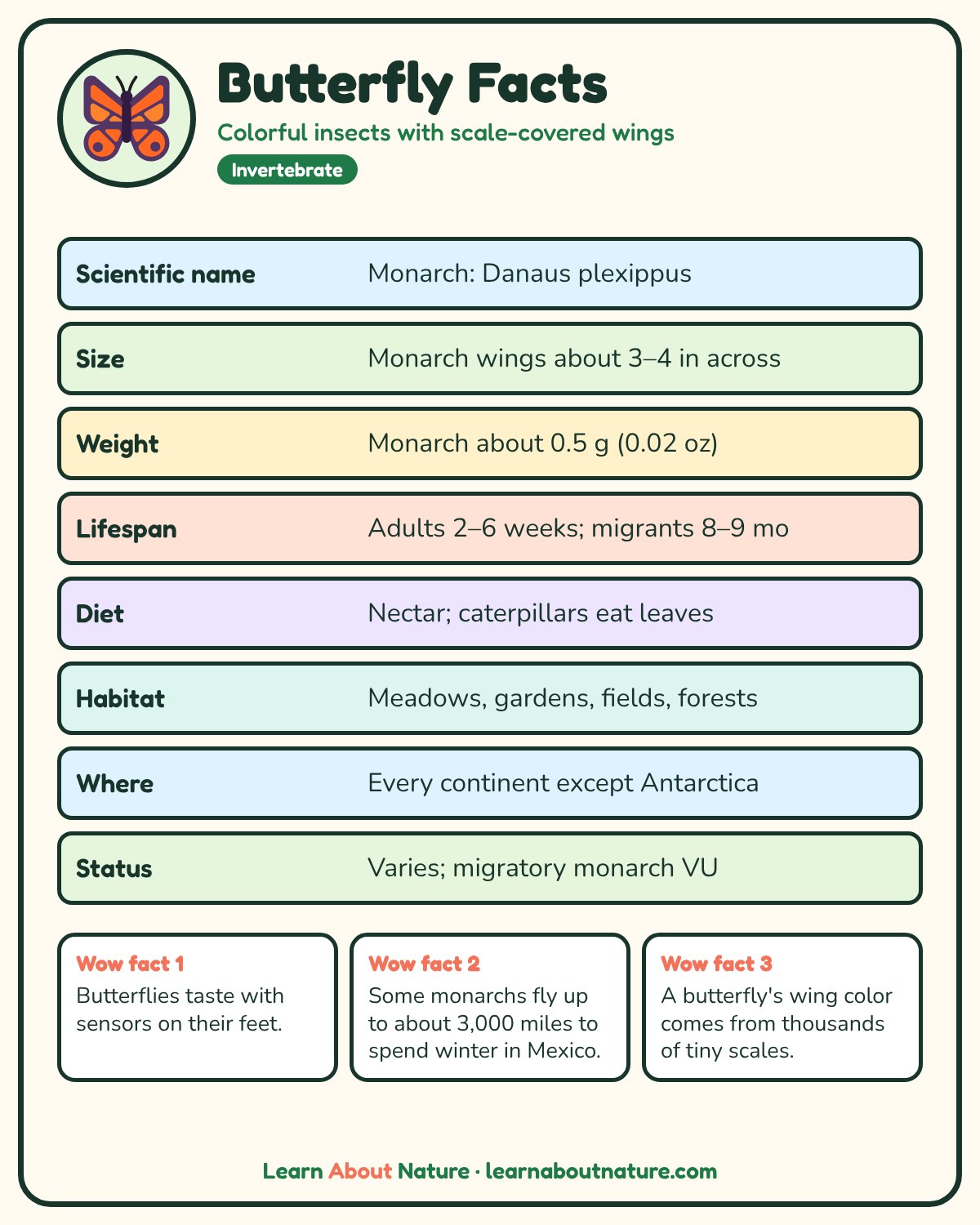
Butterfly Quick Facts
| Class | Insect |
| Order | Lepidoptera (butterflies and moths) |
| Number of species | About 17,500 butterflies |
| Example species | Monarch (Danaus plexippus) |
| Monarch wingspan | About 3–4 in (7–10 cm) |
| Largest butterfly | Queen Alexandra’s birdwing, about 10–11 in (25–28 cm) |
| Life stages | Egg, caterpillar, chrysalis, adult |
| Baby name | Caterpillar (larva) |
| Monarch migration | Up to about 3,000 miles (4,800 km) |
| Conservation | Varies; migratory monarch Vulnerable (IUCN, 2023) |
What Is a Butterfly?
A butterfly is an insect. It has six legs, three main body parts (head, thorax and abdomen), a pair of antennae and four wings. Butterflies belong to a group of insects called Lepidoptera, which also includes moths. Scientists know of about 165,000 kinds of butterflies and moths, and most of them are moths.
The monarch, Danaus plexippus, is one of the best-known butterflies in North America. Its wings are about 3 to 4 inches (7 to 10 cm) across, and an adult weighs only about half a gram, less than a paper clip.
The largest butterfly is the Queen Alexandra’s birdwing of Papua New Guinea. Females can have wings about 10 to 11 inches (25 to 28 cm) across.
Where Do Butterflies Live?
Butterflies and moths live on every continent except Antarctica. Butterflies are most common in warm, sunny places, and many kinds live in tropical rain forests. They also live in meadows, gardens, fields, deserts, forests and even high mountains.
Many butterflies need particular plants where they live. A female lays her eggs only on the kinds of plants her caterpillars can eat. Monarchs, for example, need milkweed. About 750 kinds of butterflies live in the United States.
What Do Butterflies Eat?
Adult butterflies cannot bite or chew. Instead, they sip liquids such as flower nectar, tree sap and juice from rotting fruit through a long, straw-like tongue called a proboscis. When the butterfly is not feeding, it keeps the proboscis coiled up like a garden hose.
Caterpillars are very different. They have strong jaws and spend most of their time eating leaves. Monarch caterpillars eat only milkweed leaves. Milkweed contains toxins, and the caterpillars store them in their bodies. This makes both the caterpillars and the adult butterflies taste bad to many predators.
Body and Senses
Butterfly wings are made of thin, clear layers of chitin, the same tough material that covers an insect’s body. They get their colors and patterns from thousands of tiny scales. These scales are the “dust” that can rub off a butterfly’s wings.
Butterflies have amazing senses. They taste mostly with sensors on their feet. When a female lands on a leaf, she can taste whether it is the right plant for her eggs. Their eyes contain about 6,000 tiny lenses, and they can see ultraviolet light, which people cannot see.
Butterflies are cold-blooded. On cool mornings, they often sit in the sun with their wings open to warm up before they fly.
Butterfly Life Cycle
Butterflies go through complete metamorphosis, with four stages. Here is how it works for a monarch:
- Egg: the female lays tiny eggs one at a time on milkweed. They hatch in about 3 to 5 days. A wild female may lay about 400 to 500 eggs in her life.
- Caterpillar (larva): the caterpillar eats and grows for about two weeks. It sheds its skin several times as it gets bigger, reaching about 2 inches (5 cm) long.
- Chrysalis (pupa): the caterpillar hangs upside down and forms a chrysalis. Inside, its body changes completely. This takes about 8 to 14 days.
- Adult butterfly: the butterfly comes out, pumps fluid into its wings to spread them and flies off. Most adult monarchs live about 2 to 6 weeks.
The Amazing Monarch Migration
Each fall, monarchs from the eastern United States and Canada fly south to spend the winter in fir forests high in the mountains of central Mexico. Some travel up to about 3,000 miles (4,800 km), a trip that can take more than two months. Monarchs from west of the Rocky Mountains travel shorter distances to groves of trees along the California coast.
In Mexico, eastern monarchs gather in oyamel fir forests about 8,000 to 12,000 feet (2,400 to 3,700 meters) up in the mountains. The cool air there slows their bodies down, which helps them save energy until spring. Western monarchs travel about 300 to 1,000 miles each year.
The monarchs that make this trip are special. Most monarchs live only a few weeks, but the late-summer generation that migrates can live 8 to 9 months. In spring, they head north and lay eggs. Their children and grandchildren keep moving north, and it takes several generations to reach Canada again.
Butterfly vs Moth: What’s the Difference?
Butterflies and moths are close relatives, so there are exceptions, but these clues usually work:
- Antennae: butterflies have thin antennae with rounded clubs at the tips. Many moths have feathery or thick antennae.
- Time of day: most butterflies fly during the day. Most moths fly at night.
- Resting wings: butterflies usually rest with their wings held upright and pressed together. Moths usually rest with their wings spread flat.
- Body: moths are often fuzzier and stouter than butterflies.
- Pupa: butterflies form a bare chrysalis. Many moths spin a silky cocoon around their pupa.
Threats and Conservation Status
Butterflies are harmed by habitat loss, pesticides and climate change. Many need wild plants, such as milkweed, that are disappearing as land is cleared or sprayed.
Conservation status varies by species. On the IUCN Red List, the monarch as a whole species is listed as Least Concern. But the migratory monarch of North America was listed as Endangered in 2022, then moved to Vulnerable in 2023 after new studies showed its decline had slowed. In the United States, the government has proposed listing the monarch as threatened. The Queen Alexandra’s birdwing is Endangered (assessed in 2018).
There is some good news. Counts of monarchs spending the winter in Mexico dropped sharply in the 1980s and 1990s, but they have been fairly steady for more than ten years.
Planting native flowers, and milkweed where monarchs live, gives butterflies food and places to lay their eggs.
Fun Facts About Butterflies
- Male monarchs have a small black dot on each hind wing, made of special scales. Females do not.
- Some butterflies that live in cold places survive winter by making a natural antifreeze in their bodies.
- Most butterflies live as adults for only about 2 weeks to 2 months.
- Butterfly wings are actually clear. The colors come from the scales on top.
- A monarch caterpillar grows from a tiny hatchling to about 2 inches long in roughly two weeks.
Fast Facts for Young Readers
- A butterfly is an insect with four wings.
- Butterflies sip nectar with a long, curly tongue.
- Butterflies taste with their feet.
- A baby butterfly is called a caterpillar.
- A caterpillar turns into a butterfly inside a chrysalis.
- Monarch caterpillars eat only milkweed.
- Most butterflies fly in the day, and most moths fly at night.
Key words: metamorphosis – a big change in body shape as an animal grows up; chrysalis – the hard case a butterfly caterpillar forms while it turns into an adult; proboscis – a long, straw-like tongue that butterflies use to sip liquids; migration – a long journey animals make at the same time each year; scales – tiny flat pieces that cover a butterfly’s wings and give them color; nectar – a sweet liquid made by flowers.
Try this: Fold a sheet of paper in half, paint a pattern on one side, then press the halves together to make a symmetrical butterfly. Label the head, thorax, abdomen, antennae and wings.
Related Guides
- Fun butterfly facts
- Monarch butterfly facts
- Butterfly Anatomy
- Ant facts for kids
- Bee facts for kids
- All animal facts for kids
Butterfly FAQs
What is the life cycle of a butterfly?
A butterfly has four stages. It starts as an egg, hatches into a caterpillar that eats and grows, then forms a chrysalis, where its body changes completely. Finally, an adult butterfly comes out. For a monarch, the whole journey from egg to adult takes about a month.
What is the difference between a butterfly and a moth?
Butterflies usually have thin antennae with rounded tips, fly during the day and rest with their wings held upright. Moths often have feathery antennae, fly at night and rest with their wings spread flat. Many moths spin a silky cocoon, while butterflies form a chrysalis.
How long do butterflies live?
Most adult butterflies live about 2 weeks to 2 months. Adult monarchs usually live about 2 to 6 weeks, but the generation that migrates to Mexico in late summer can live 8 to 9 months, long enough to spend the winter there and start the trip north in spring.
Why do monarch butterflies migrate?
Monarchs cannot survive cold northern winters. In fall, monarchs from eastern North America fly up to about 3,000 miles to cool mountain forests in central Mexico, where they rest until spring. Western monarchs spend the winter along the California coast. Over the next several generations, their offspring spread north again.
Are monarch butterflies endangered?
The migratory monarch of North America is listed as Vulnerable on the IUCN Red List. It was listed as Endangered in 2022, but in 2023 it was moved to Vulnerable after new studies showed its decline had slowed. The US government has also proposed listing monarchs as threatened.
Sources: Monarch (Danaus plexippus) – U.S. Fish & Wildlife Service; Monarch Butterfly FAQs – USDA Forest Service; Butterflies and Moths – San Diego Zoo Wildlife Alliance; Butterflies – Smithsonian BugInfo; Butterfly Moment: How Do They Taste? – Florida Museum; Monarch butterflies aren’t endangered, reversing recent decision – National Geographic

Nato is a content writer and researcher with a background in psychology who’s eager to explore the wonders of nature. As a travel enthusiast and animal lover, she hopes to inspire others to discover and cherish the beauty and importance of the natural world. She also writes about the history of candy and snacks for Snack History and about food and healthy eating for The Fitchen.