Jack Dempsey Cichlid
Scientific classification
| Kingdom: | Animalia |
| Phylum: | Chordata |
| Class: | Actinopterygii |
| Order: | Perciformes |
| Family: | Cichlidae |
| Subfamily: | Cichlasomatinae |
| Genus: | Rocio |
| Species: | R. Octofasciata |
| Binomial name: | Rocio Octofasciata |
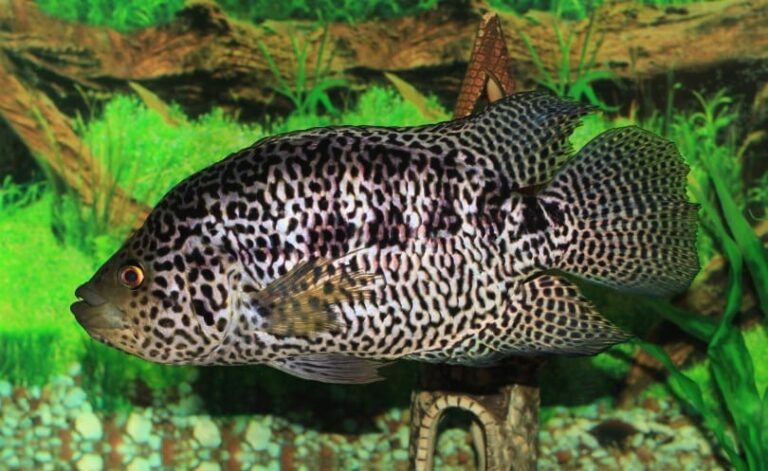
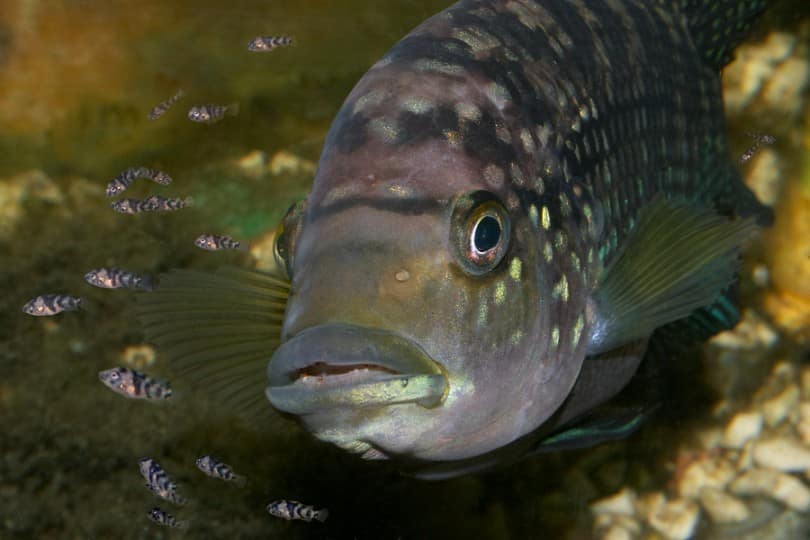
The Jack Dempsey belongs to the cichlid group, endemic to the Central and Northern regions of America, extending from south of Mexico to Honduras. Its scientific name is Rocio Octofasciata, The general name by which Jack Dempsey is called has references to its violent behavior and fierce facial expression, this relates to the well-known 1920s boxer, named Jack Dempsey!
Habitat and range
You can find this Cichlid in the Central and Northern regions of America; Guatemala, Southern Mexico, Honduras and Yucatan. They are natives of bogs and several other swampy and sluggishly moving warm water bodies; they live amidst areas where there weeds grow and in muddy and sandy bottoms. Their diet consists of crustaceans, feed worms, fish and insects.
Description
The Kack Dempsey has a sturdy structure; it is a fish with a compressed body and of oval shape, its dorsal and anal fins are sharp. This Jack Dempsey grows to a good length from 8 to 10 in, (20 to 25 cm). They survive for about 10 to 15 yrs.
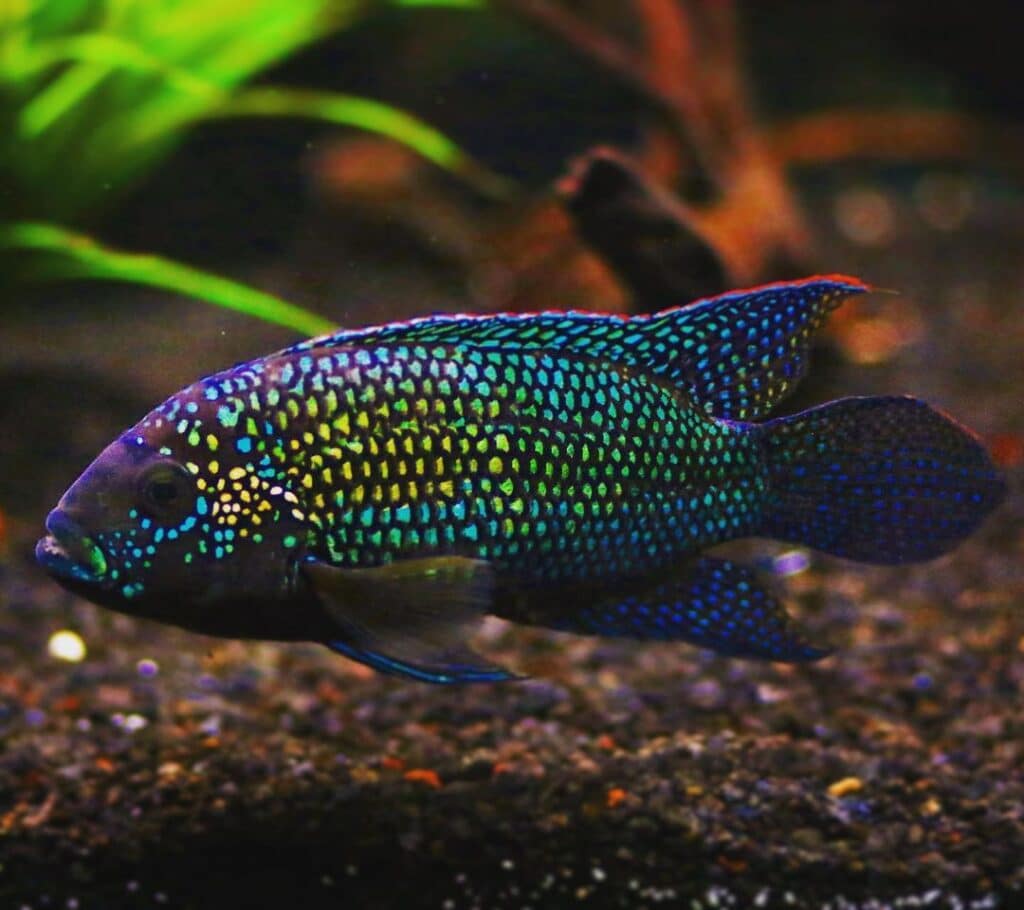
The color of the Jack Dempsey is eye-catching. It has a deep purplish gray background that contrasts with its dazzling, sparkling green, blue and golden flecks. The anal and dorsal fins of the male are lengthy and pointed with a red banded border, and perhaps at the end of the tail and the body center there is a circular black spot. The color flexibility of the female is less. The body of the female is totally oval and on the dorsal fin there is a deep spot and on the lower border of the gill cover. The brilliance of the juveniles is reduced. Their background color is tan or dull gray and the flex is a dull turquoise color.
Growing at Home
Breeding
The Jack Dempsey shows a typical way of spawning in the open. The temperature for spawning suggested is about 78o. Spawning at temperatures lower than this is impossible. In case the female is not ready to spawn, the male deals harshly on her and may not even hesitate to kill her. At the moment a couple is ready to spawn the remaining fish in the tank, is either destroyed or chased out. The Jack Dempsey is used to first cleanse the rock and then spawn over it. For this it needs a particular rock, without which it will not spawn. The size of the spawn is possibly 500 eggs, which get hatched within 3 days. Following hatching of the spawn, the couple shifts the fry to tiny holes that they dig in the gravel.
Water condition
Identifying the Jack Dempsey female from the male is confusing. The female is smaller in size compared to the male and they are dull colored. The water quality suggested is neutral with hardness, ranging from soft to medium; the temperature suggested is 78 to 82 F and pH value 7.0. Jack Dempsey breed in the open, they require water that is properly oxygenated.
Tank
The size of the tank suggested for a single fish is not less than 50 gallons, However a, bigger tank is required for many. This Jack Dempsey requires enough space for moving and a very good filtration process. Equip the tank with sufficient plants between the wood and the rocks for camouflaging. A few floating plants like Sagittaria will be cherished. Also provide fine gravel at the bottom of the tank. While arranging the plants, display them around the inner walls of the tank, leaving a central portion free for them to swim. In order to prevent the roots from uprooting, pot them or keep floating plants.
Jack Dempsey adjusts to most of the temperature conditions; even then, if the water is warm, the fish becomes aggressive. For reducing this inclination, most of the aquarists retain the temperature to a maximum of 78oF (26oC)
Nutrition
This carnivorous Jack Dempsey consumes all frozen and prepared foods, which includes Tubifex, frozen and dried blood worms and ocean plankton, also live fish.
Jack Dempsey Setup
The tank size recommended is minimum, 40 gallons, however, in case you intend having more fish, of different sizes, in a partially aggressive tank, have the tank larger in size. A good filtration process and pure water are required for them.
Having discovered a fondness for insects while pursuing her degree in Biology, Randi Jones was quite bugged to know that people usually dismissed these little creatures as “creepy-crawlies”.