Cherry Barb
Scientific classification
| Kingdom: | Animalia |
| Phylum: | Chordata |
| Class: | Actinopterygii |
| Order: | Cypriniformes |
| Family: | Cyprinidae |
| Genus: | Puntius |
| Species: | P. Titteya |
| Binomial name: | Puntius Titteya |
The cherry barb whose scientific name is Puntius Titteya, a fish from the tropical zone, is of the spotted barb variety and hails from the Cyprinidae family. The Cherry Barb is an inhabitant of Sri Lanka. , These were later introduced, in Columbia and Mexico. In the year 1929, Paul Edward Pieris Deraniyagala named the cherry barb Puntius Titteya. The synonyms of these are Capoeta Titteya and Barbus Titteya. In the aquarium business, the Cherry Barb has commercial significance. The threat is that this variety has been fished in excess, for this business. However, In the year 1996, as per records, it was of less importance.
Habitat and range:
The Cherry barb in the wild belongs to the Benthopelagic variety, in the tropical water habitat of Sri Lanka, extending from the Kelani River right up to the Nilwala basin. This species favors rivulets and streams, with good vegetation and proper shaded environments. We find these Cherry barbs particularly in the waters that flow gracefully and that are shallow, having a sufficient quantity of the debris of leaves and silt substrate.
As of now, it is known in also Mexico and Colombia..
Description
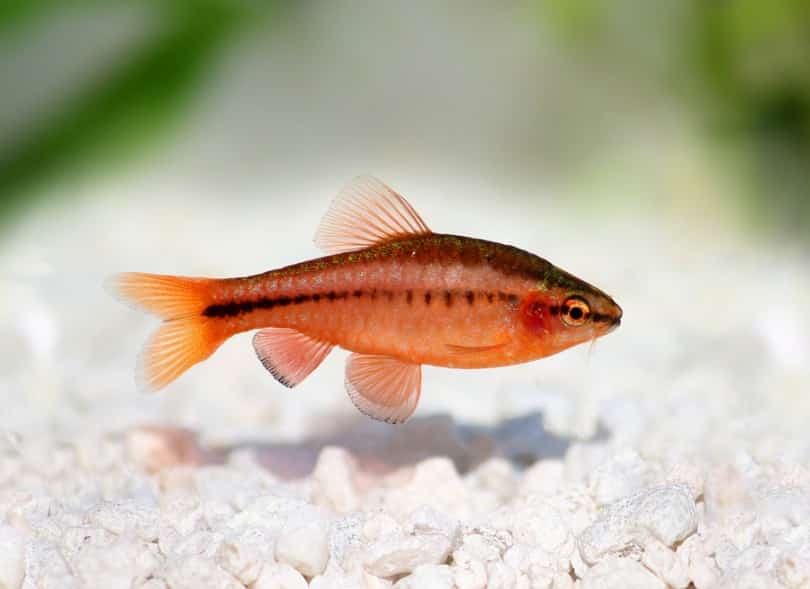
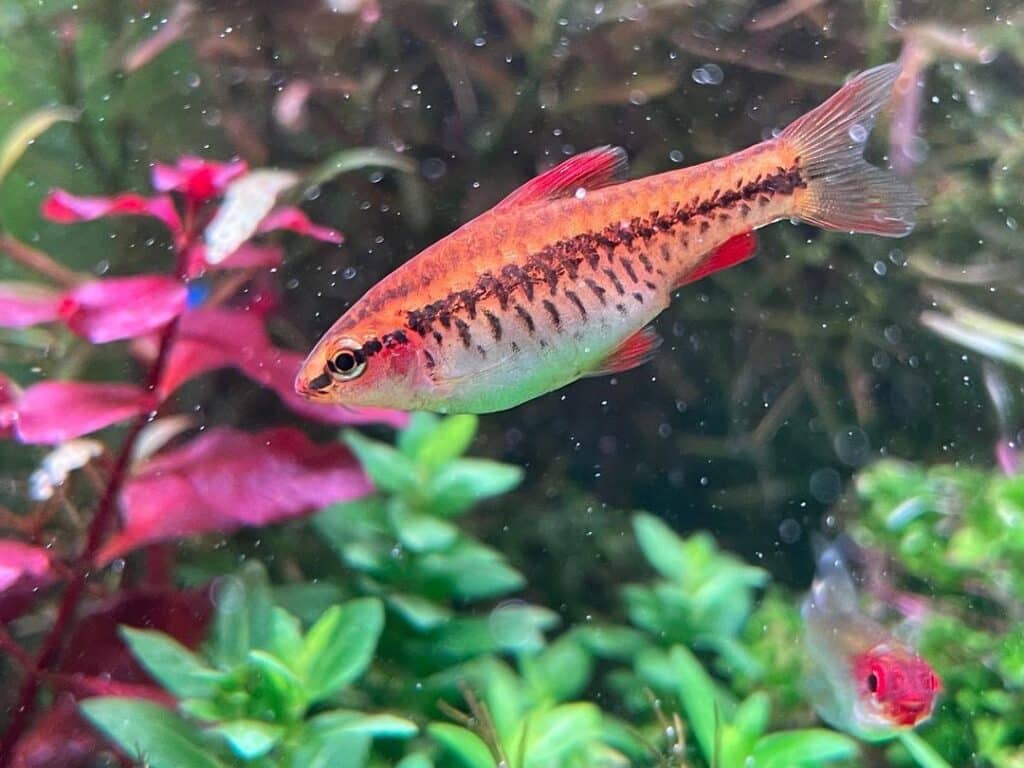
The Cherry Barb is a long fish that grows up to 5 cm. It has a compact body. Its color is fawn on the top and the sheen is a bit greenish. Its belly and sides are highlighted, lustrous silver color. From the tilt of the snout right through the eyes to the foot of the caudal fin, there is a longitudinal stripe running. The color of the stripe is blue-black to brown, having a metallic tinge to it. This color fades to blue or sea green when approaching the tail. The male Cherry barb is deeper red in color, compared to the female. While it breeds the color becomes deeper red. The color of the dominant male is bright red. The color of the female is faded, having the fins yellow.
How to Grow in an Aquarium
Breeding
During the period of breeding, the male swims, following the female, driving away the other males. The female spawns 200 – 300 eggs; this is spread over the substrate and on plants. These eggs hatch out in a day or two, following which the fry freely swims two days later. Five weeks hence, the hatchlings grow to almost 1 centimeter. At length, it has the full appearance of a Cherry Barb.
Tank
This peace loving Cherry Barb is a good acquisition for a public aquarium. For the purpose of prosperity, the ideal way is keeping them in groups, with a minimum of 6 to 8 varieties of their own, along with small community varieties. When the population increases, the Cherry Barb becomes quite lively, therefore it needs thick plantation and sufficient open area for swimming. The lighting facility required by them is a diffused one, with a temperature of 72 to 79 F and pH of 6 to 8
Water Condition
In the aquarium, the temperature rate preferred is from 23 to 27 C (73 to 80.5oF) and medium or soft water of dh from 4 to 15. The suggested pH is from 6.5 to 7.5, because the water appreciated by the Cherry Barb is moderate to acidic. In the wild, you find the Cherry barb where the dH increases from 5 to 19. And pH range is 6 to 8. An abrupt change in temperature or chemistry of the water is not good for your Cherry Barb. On the other hand, if these changes in the water temperature are gradually implemented, the aquarium fishes get adapted to it.
Nutrition
The Cherry barbs in the wild are omnivorous, their diet consists of a wide variety, comprising of green algae, detritus, diatoms, detritus and different animal matter. When in the aquarium, they tolerate almost any variety of food. They feed on flakes or several other manufactured food, intended for the tropical fish, however, in turns feeding them with vegetables, daphnia, brine shrimp, blood worms, plankton or some similar food is advisable/
Aquarium set up
The least size suggested for an aquarium is 75 Lt. (20 G.). All the time keep your Cherry barb in groups, with a minimum of 5 cherry barbs and more if possible, because this variety belongs to the schooling type. Keeping only one Cherry barb in an aquarium develops stress in it. While establishing your aquarium, simulate it to the wild by setting up enough plants and shady nooks. A good method is selecting plants that grow and shield the surface. Provide a free space for them in the aquarium.
Having discovered a fondness for insects while pursuing her degree in Biology, Randi Jones was quite bugged to know that people usually dismissed these little creatures as “creepy-crawlies”.